September 30, 2026
Why Tests Pass but Software Still Breaks: Closing the Assertion Gap in Automated Testing in 2026
A test suite where every test passes is not necessarily a trustworthy test suite. The most common failure mode in automated testing is not broken tests but tests whose assertions are too shallow to detect the defect: a test that checks HTTP 200 but not whether the response body contains valid data, or a test that verifies a UI element is present but not that it displays the correct value. This is the assertion gap — the distance between what tests execute and what they actually verify — and it explains why software that passes CI can still ship bugs that should have been caught before deployment.
This guide covers where the assertion gap comes from, the patterns that most reliably produce false confidence, and the practical changes QA engineers and SDETs can make to write assertions that fail when the software breaks. Teams looking for foundational context can review the complete software testing guide and Astaqc’s software testing services.
The assertion gap is the set of application behaviors that tests execute but do not assert on. Code coverage metrics measure the first part — which lines are executed — but not the second. A test that calls a function, checks the return code, and moves on has executed the function but may have asserted on nothing meaningful about its behavior. Coverage tools report this as covered code, not as an untested assertion.
The gap persists for several reasons. Writing a shallow assertion is faster than writing a deep one. Shallow assertions rarely fail during development, which creates the appearance that they are sufficient. Teams under velocity pressure add tests to hit coverage targets rather than to verify behavior. And once a test is green, it is rarely revisited to ask whether the assertion is actually meaningful.
The consequence is a test suite that detects complete failures — the endpoint is down, the page does not load — but misses the partial failures that are more common in practice. A function that returns the wrong value, an endpoint that returns the right structure with wrong field values, a UI that renders the wrong text — these are the defects that the assertion gap allows to reach production undetected.
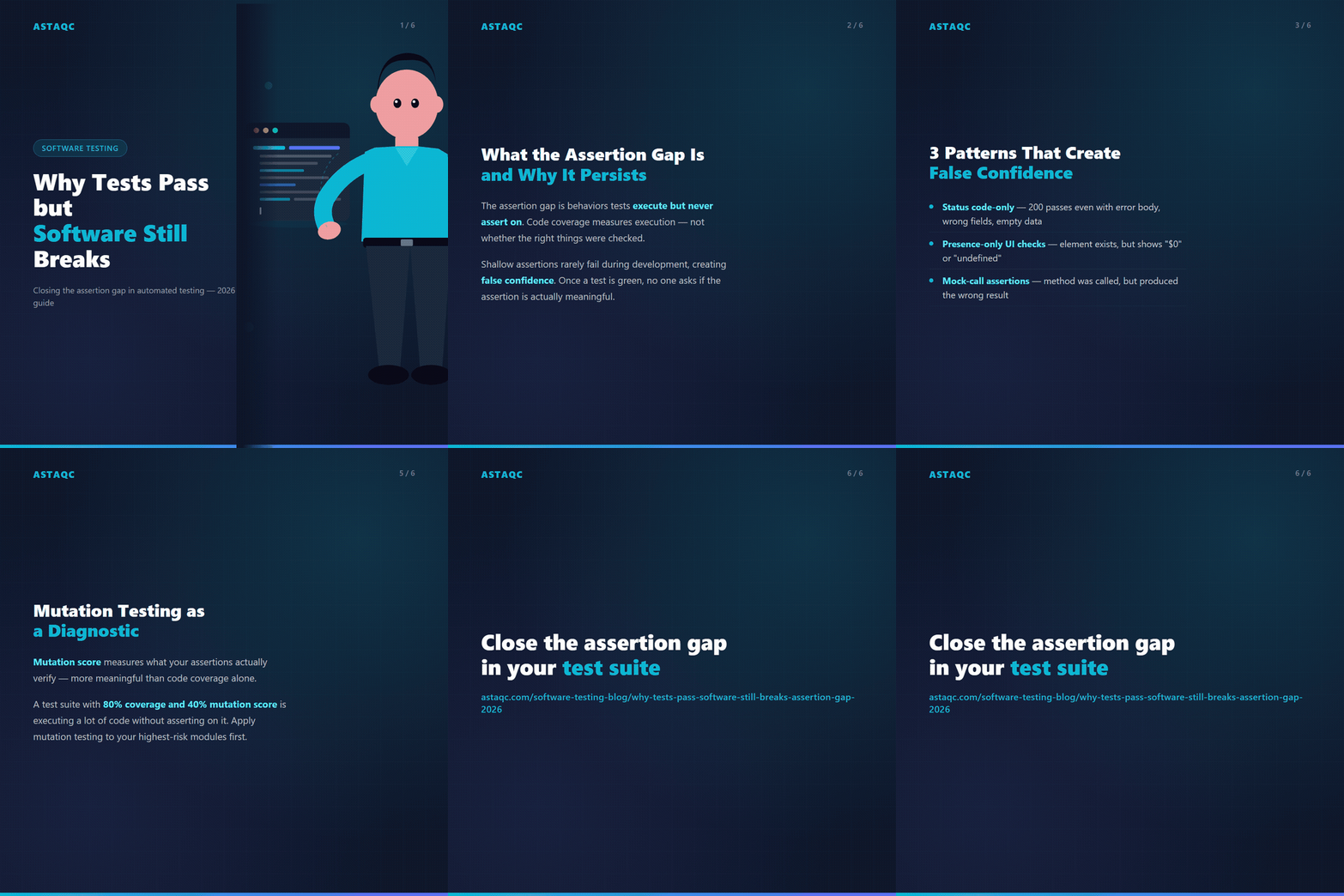
Most assertion gaps come from three specific patterns. The first is status code-only assertions on API calls: the test verifies that the server responded with 200 but does not check what the response body contains. This misses application-level errors that return 200 with an error payload, missing required fields, empty data arrays where data is expected, and incorrect field values.
The second pattern is presence-only assertions on UI elements: the test verifies that an element exists on the page but does not verify what it contains. A test that asserts a price element is visible passes whether the element shows “$99” or “$0” or “undefined”. Extending the assertion to check the element’s text value or that the value matches a specific pattern catches the defect; asserting on presence alone does not.
The third pattern is verifying setup rather than outcome: the test calls a function and then asserts on the function’s return value or on a property that the function is always expected to set, rather than asserting that the state change the function is supposed to produce actually occurred. For example, a test for a database write that only checks that the insert method was called — rather than querying the database to verify the record exists with the expected values — is asserting on the implementation, not the outcome. Teams can find additional coverage patterns in Astaqc’s test automation services and manual testing pages.
| Scenario | Shallow Assertion | Deep Assertion | What Shallow Misses |
|---|---|---|---|
| API login endpoint | Status code equals 200 | Response contains token field with non-empty string value | Token absent, empty, or wrong format |
| Product listing page | Price element exists | Price element text matches currency format, is non-zero | Shows $0, undefined, or blank |
| Database record create | Insert method was called | Record exists in database with expected field values | Insert called but silently failed or saved wrong data |
| Email notification | Send method called once | Send called with correct recipient, subject, and template data | Sent to wrong address or with wrong template |
The guiding principle for strong assertions is to assert on outcomes, not on implementation details. The outcome is the observable state change the code is supposed to produce: the record exists in the database with the correct values, the response contains a valid token, the UI displays the correct price. The implementation detail is the method that was called or the intermediate object that was constructed. Asserting on outcomes means the test will fail when the software stops producing the correct outcome, regardless of how the implementation changes.
For API tests, this means adding body assertions beyond status code. For every endpoint in the critical path, the test should assert on: the presence of required fields in the response, the type or format of the values in those fields (numeric, non-empty string, ISO date format), and the absence of error indicators in the response body. If the API uses an error field or an errors array in the response, asserting that it is absent or empty in the success path catches application-level errors that a status code assertion misses.
For UI tests, this means asserting on text content and computed state, not just element presence. If an element is supposed to display a value derived from server data, assert on the value, not just on the element’s visibility. For form submission flows, assert that the post-submission state is correct — the confirmation message contains the submitted data, the record appears in the list, the redirect destination is the expected page — rather than just that the submission button was clickable. Additional patterns are covered in Astaqc’s manual vs automated testing guide and software testing services.
For unit tests, this means asserting on return values and state mutations, not on method calls. Mock-based assertions that verify a method was called with certain arguments are fragile — they break when the implementation is refactored — and shallow — they pass even if the method was called correctly but produced the wrong result. Replacing mock-call assertions with outcome assertions (the state of the object after the method runs, the return value of the function, the contents of the database after the write) produces tests that are less brittle and more meaningful.
Mutation testing is the most direct way to measure whether your assertions are strong enough to catch real failures. A mutation testing tool modifies the source code in small ways — changing a comparison operator from greater-than to less-than, flipping a boolean, substituting a return value — and then runs the test suite to see whether the mutation is detected (the test fails) or survives (the test passes). A mutation that survives means the tests are not asserting on the behavior that the mutant changed.
Mutation scores are more meaningful than code coverage metrics for evaluating test quality. Code coverage tells you which lines were executed; mutation score tells you which behaviors were verified. A test suite with 80% code coverage and a 40% mutation score is executing a lot of code without asserting on it. A test suite with 70% code coverage and a 75% mutation score is smaller but more precise.
In practice, mutation testing is computationally expensive for large test suites. Teams running it for the first time typically apply it to the highest-risk modules — payment logic, authentication, data transformation functions — and address the surviving mutants before expanding coverage. The goal is not a 100% mutation kill rate but a meaningful improvement from wherever the baseline is. Astaqc’s test automation services include test strategy reviews that identify assertion gaps and recommend specific improvements. More context on AI-assisted approaches is available in the AI in software testing guide.
Teams without mutation testing tooling can apply the same logic manually by asking a specific question about each assertion: “If this assertion passed but the behavior it is testing were wrong, what would need to be true?” For a status code assertion on an API test, the answer is: the endpoint could return the expected status code with wrong data and the assertion would still pass. That question identifies candidates for additional body assertions without requiring any tooling changes.
Yes. Mutation testing was designed specifically to measure whether test assertions are strong enough to catch real defects. A mutation that survives — a code change that the tests do not detect — is a direct measurement of an assertion gap. Code coverage measures test execution; mutation score measures test assertion effectiveness. The two metrics are complementary, and neither alone is sufficient to characterize test quality.
Tools that generate assertions from observed behavior — such as snapshot tests and property-based testing frameworks — can add assertion coverage mechanically. Snapshot tests capture the output of a function or a UI component and fail if the output changes. This is better than no assertion, but snapshot tests can create false positives (failing on irrelevant output changes) and can be regenerated away rather than fixed. Property-based testing generates assertions about invariants, which tends to be more robust. Neither approach eliminates the need for engineers to think about what behavior matters and to assert on it explicitly.
The manifestation differs but the underlying problem is the same. In UI testing, shallow assertions tend to appear as presence checks rather than content checks. In API testing, shallow assertions tend to appear as status code checks without body validation. In unit testing, shallow assertions tend to appear as mock-call verification without outcome verification. Each layer needs its own targeted remediation, but the principle — assert on outcomes, not on execution — applies uniformly.
TDD, when practiced strictly, tends to produce strong assertions because the test is written to fail on a specific behavior before the implementation exists. The test asserts on the outcome because at writing time there is no implementation to call or mock. In practice, many teams write tests after implementation, which shifts the risk toward shallow assertions — the implementation is already passing, and the temptation is to write tests that confirm the existing behavior rather than tests that verify the correct behavior.
When a defect reaches production despite a passing test suite, the first step is to identify which test should have caught it and why it did not. In most cases, the test existed but its assertions were not specific enough to detect the failure mode. The fix is to add the assertion that would have failed on the defect, run it against the current codebase to confirm it passes, and then verify that the assertion would fail if the defect were reintroduced. This process turns each production defect into a permanent test improvement rather than just a one-time fix.
Astaqc’s software testing services include test suite audits that identify assertion gaps by module and priority. The test automation services page covers how Astaqc helps teams move from shallow to outcome-based assertions. For teams considering how AI affects this picture, the AI in testing guide covers both the opportunities and the limitations.
The most dangerous test suite is one where every test passes. When assertions are too shallow to detect the defect, green CI is a false signal, not a guarantee of correct software.
September 30, 2026


Sign up to receive and connect to our newsletter

We founded ASTAQC as a tight-knit group of professional Software Testers and software developers.
Subscribe to our Newsletter