September 29, 2026

How to Test Microservices in 2026: Integration Testing, Service Isolation, and Contract Validation Strategies
Microservices architectures replace a single deployable unit with dozens or hundreds of small services that communicate over the network. Each service can be tested in isolation, but the failure modes that matter most — wrong message formats, unexpected response codes, version drift between a producer and its consumers — only appear when services interact. Unit tests for individual services cannot catch these, and end-to-end tests that exercise the full system are slow and expensive to maintain.
This guide covers the testing approaches that work in practice for microservices in 2026: integration testing strategies that balance coverage with speed, service isolation techniques that make tests stable without eliminating integration coverage, and contract testing approaches that shift integration failures into the test suite where they are cheap to fix. Teams can review Astaqc’s software testing services and the complete software testing guide.
In a monolith, a function call is local — it either succeeds or throws an exception that the caller can catch. In a microservices system, the equivalent operation is a network call that can fail in many more ways: the service is down, the network is slow, the response has a different schema than the client expects, or the request succeeds from the caller’s perspective but fails silently on the provider side.
This means the test pyramid that applies to a monolith — mostly unit tests, some integration tests, few end-to-end tests — requires adjustment. The integration test layer needs to be substantially larger than it would be for a monolith, because that is where service interaction failures are caught. The unit test layer still covers business logic within individual services. The end-to-end layer covers only the critical user journeys that cannot be validated any other way.
The specific challenge is that running real integration tests requires the dependent services to be available, which creates a dependency management problem: if Service A’s tests require Service B, then Service B must be deployed and running in a test environment for Service A’s tests to pass. As the number of services grows, this dependency graph becomes complex and slow to set up. The isolation strategies covered below address this directly.
Integration tests for microservices run on a spectrum from completely local to fully deployed. The most common levels are unit-level tests that mock all external dependencies, local integration tests that run real service dependencies as containers, environment-level tests that run against a shared staging environment, and production-adjacent tests that run against a near-production environment with synthetic test data.
Local integration tests using Docker Compose or similar container orchestration give the highest value at the lowest cost. A developer can run the test suite locally against real containers for the services that the service under test directly depends on, without requiring a shared environment. The test finds real integration failures — wrong API contracts, unexpected response shapes, database migration issues — while running in seconds rather than the minutes required to deploy to a shared environment.
The tradeoff is fidelity: local containers may run different versions of dependent services than what is deployed in production. Teams using semantic versioning with strict compatibility constraints between services can mitigate this, but it remains a genuine limitation of the approach. Contract testing, covered below, addresses this limitation specifically by making the version contract explicit and machine-verifiable. Additional guidance is available in Astaqc’s performance testing guide and test automation services.
| Testing Level | Dependencies | Speed | Failure Fidelity |
|---|---|---|---|
| Unit (mocked) | None | Fastest | Lowest — misses contract drift |
| Local integration (containers) | Local containers | Fast | High for same-version failures |
| Test environment | Shared staging | Slow | High for multi-service failures |
| Production-adjacent | Near-prod environment | Slowest | Highest fidelity overall |
Test isolation for microservices means giving the service under test controlled substitutes for its dependencies, so tests can run without requiring all dependencies to be live. The three common approaches are mocking at the HTTP level, using service stubs, and using consumer-driven contracts that generate stubs from the actual contract definition.
HTTP-level mocking intercepts outgoing HTTP calls from the service under test and returns predefined responses. Tools like WireMock, Mountebank, and Hoverfly support this approach. The test engineer writes a mock definition that specifies which requests should match and what responses to return. This works well for simple request-response patterns but becomes maintenance-heavy as the API surface of the dependencies grows. More coverage on this is available in Astaqc’s manual testing guide and software testing services.
Service stubs are lightweight implementations of a dependency that run in the test environment and return realistic data. Unlike HTTP mocks, stubs can implement stateful behavior — a stub for an auth service can return different responses for valid and invalid credentials, can track how many times it was called, and can simulate error conditions on demand. Stubs are more realistic than HTTP mocks but require more maintenance work from the team owning the dependency.
Consumer-driven contracts address the core problem with both mocks and stubs: they are written by the consumer (the team whose tests use them), which means the provider (the team that owns the real service) has no visibility into what assumptions the consumer is making about the API. If the provider changes an API in a way that breaks the consumer’s assumptions, neither the mock nor the stub will detect the breakage. Consumer-driven contract testing tools like Pact address this by making the contract explicit and verifiable from both sides.
Pact is the most widely adopted consumer-driven contract testing tool for microservices. The workflow is: the consumer team writes tests that describe what requests they send and what response format they expect; Pact generates a contract file (the “pact”) from these tests; the contract file is shared with the provider team (via a Pact Broker); the provider team runs verifications against their service using the contract, confirming that their service produces the expected responses for the specified requests.
The key insight is that both sides verify against the same contract. If the provider changes an API in a way that breaks the consumer’s expectations, the provider’s verification step fails. This shifts the detection of integration breaking changes from production or a shared staging environment to the provider’s own CI/CD pipeline, typically within minutes of the change being made.
OpenAPI-based contract testing takes a different approach: the API specification is the contract, and tools validate that both the provider’s implementation and the consumer’s usage conform to the specification. Dredd and Schemathesis are common tools in this space. This approach works well when teams already maintain OpenAPI specifications, but requires discipline to keep the specification current with the implementation.
For most microservices systems in 2026, the practical testing mix is: unit tests for business logic within each service, contract tests for inter-service API boundaries, local container integration tests for database and message queue interactions, and a small suite of end-to-end tests covering the critical user journeys that span multiple services.
The distribution should weight toward contract and local integration tests and away from end-to-end tests. End-to-end tests that require the full system to be deployed are slow to run, expensive to maintain, and often unreliable due to environment flakiness. Contract tests catch the same class of failure — service API incompatibility — at a fraction of the cost. Teams can review Astaqc’s software testing services, the manual vs automated testing guide, and the outsourcing QA guide.
Yes, each service should have integration tests that cover its direct dependencies: the services it calls, the databases it writes to, and the message queues it publishes to. The scope of integration tests for a given service is its direct dependencies only — not the full dependency graph. Testing the full graph is the responsibility of the end-to-end test suite.
Each microservice should own its own database schema and run its own migrations as part of test setup. The test suite provisions a fresh database (or a schema within a shared database) and runs all migrations before the tests execute. This ensures that the migrations themselves are tested and that the test data is always consistent with the current schema.
The Pact Broker is a server that stores contract files and verification results and provides tooling for checking whether it is safe to deploy a service (the “can I deploy” query). Teams running Pact without a Broker can share contract files via their artifact storage or version control, but lose the deployment safety check. Teams with more than two or three services interacting via Pact should use a Broker — PactFlow (the commercial version) or the open-source Pact Broker.
Pact supports asynchronous message contracts in addition to HTTP contracts. The consumer defines what message format they expect to receive, and the provider verifies that their service publishes messages that match the consumer’s expectations. For teams not using Pact, an alternative is to run real message broker instances (Kafka, RabbitMQ) in Docker during tests and verify that messages published by the service match the expected schema.
Shared test data creates coupling between services and is a common source of test fragility. The preferred approach is for each service to own its own test data setup and teardown, and for integration tests to create the entities they need at the start of the test and clean them up at the end. References to entities owned by other services (such as user IDs or account IDs) should use synthetic IDs that are agreed to in advance via the contract.
Astaqc’s test automation services cover microservices test architecture design. The QA team hire page is available for teams that need embedded expertise. For teams considering outsourcing, the outsourcing QA guide and AI in testing guide provide context on how to structure the engagement.
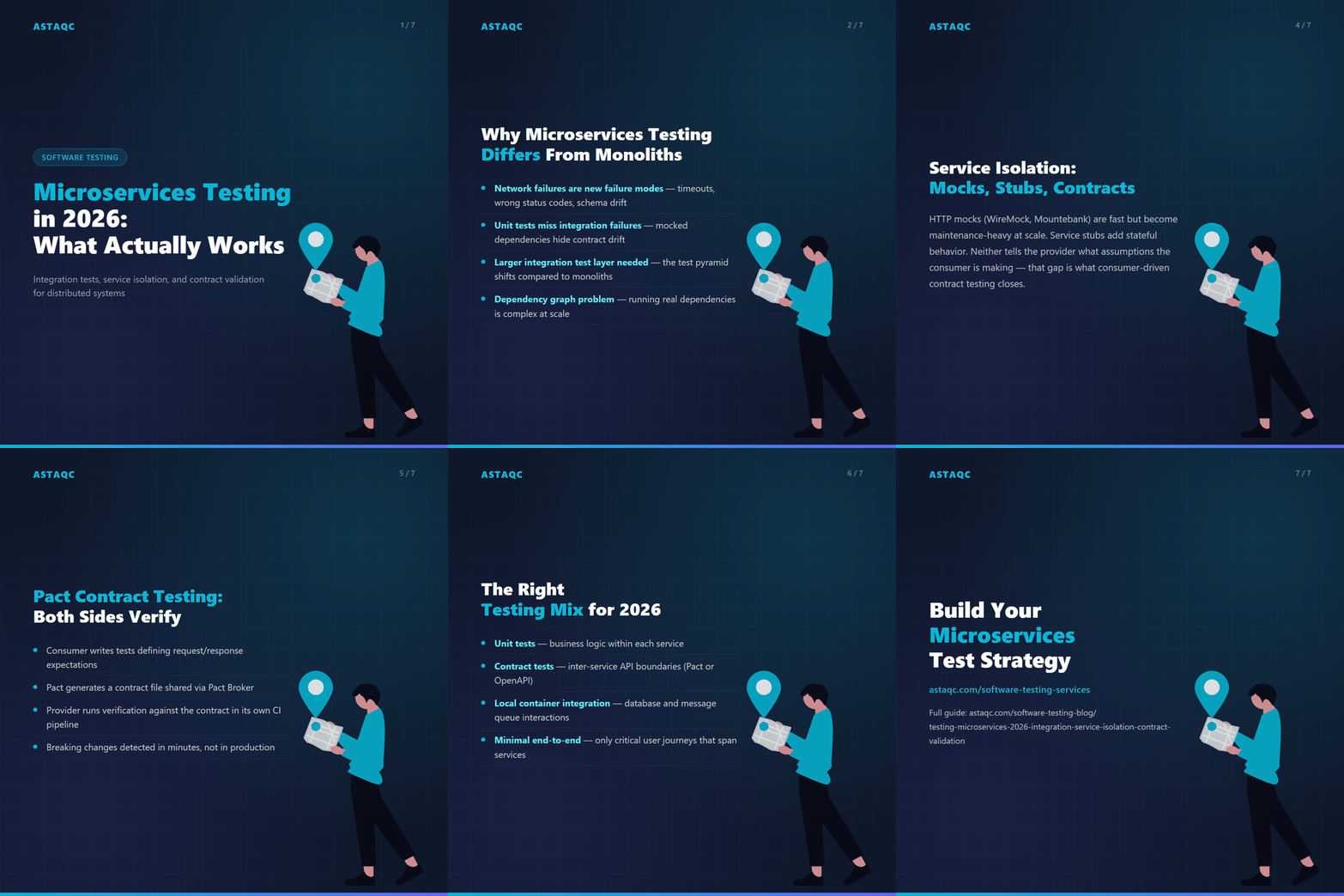
Unit tests for individual microservices cannot verify integration correctness. Consumer-driven contract testing shifts integration failures to the test suite, where they are cheaper and faster to fix than in production.
September 29, 2026


Sign up to receive and connect to our newsletter

We founded ASTAQC as a tight-knit group of professional Software Testers and software developers.
Subscribe to our Newsletter