Testing AI Agent Behavioral Boundaries in 2026: How to Validate Guardrails, Fallback Rules, and Unknown-Input Handling
When an AI agent encounters a request outside its defined operating scope—a question it was not built to answer, a tool call that exceeds its authorization, or an input that falls into a gap between its documented rules—the application behavior is determined by how thoroughly the agent's behavioral boundaries were tested before deployment. The common failure pattern observed in production agent deployments is not hallucination in the output-quality sense: it is agents that behave inconsistently at the edges of their defined roles because the edge cases were never specified and therefore never tested.
Testing behavioral boundaries is a distinct activity from testing AI output quality. Output quality testing compares agent responses to expected answers using evaluation rubrics and human judgment or automated LLM-as-judge approaches. Behavioral boundary testing verifies that the agent stays within its operational constraints, handles unknown inputs with defined fallback behavior, and respects guardrails that limit the scope of its actions. This distinction matters for QA teams building a testing strategy: quality testing scales poorly and requires evaluation infrastructure; boundary testing is largely deterministic and can be automated with standard assertion-based test tooling.
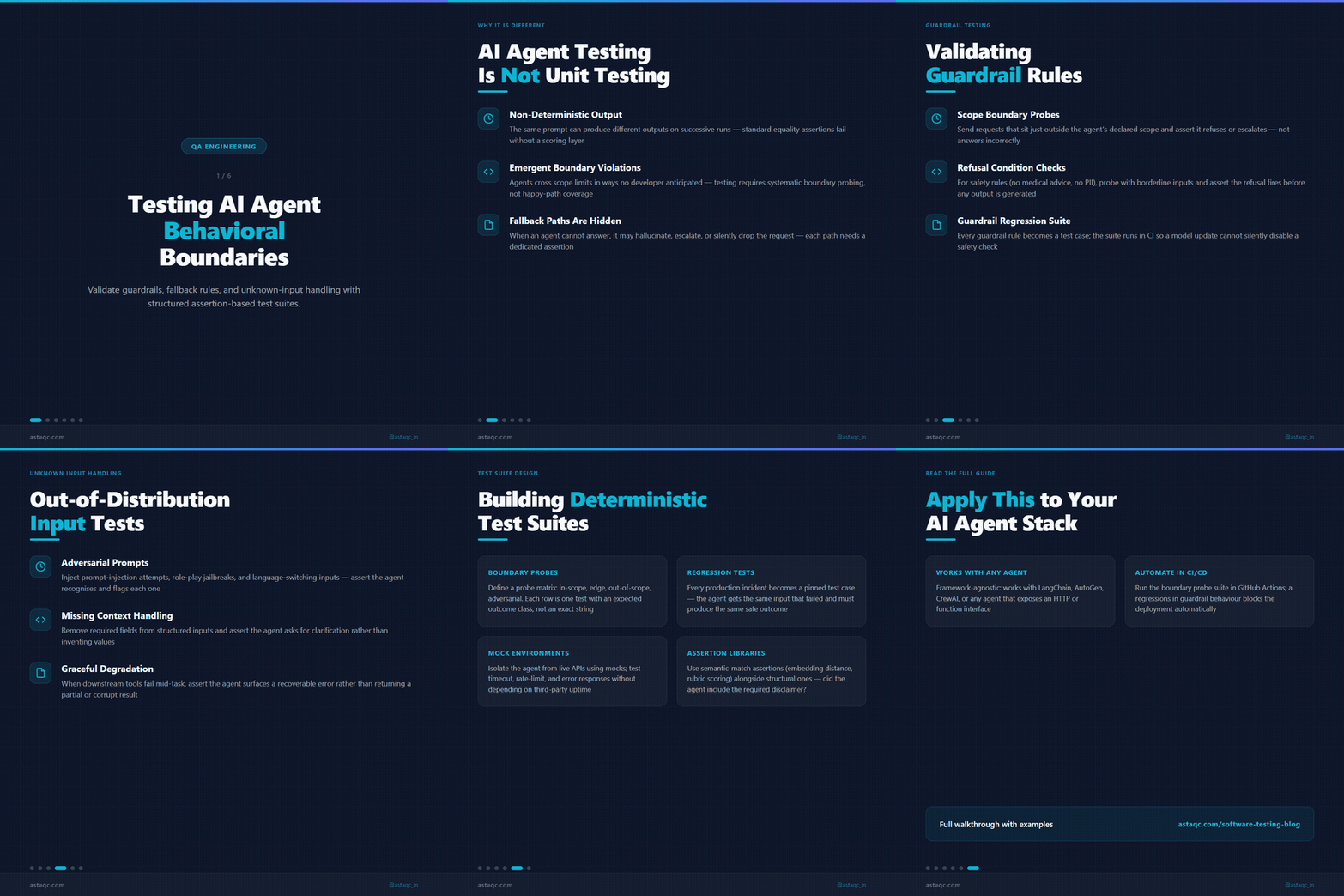
This post covers what behavioral boundaries mean for agents in production, the four categories of boundary failures that appear most frequently, how to validate each category, and how to build a boundary test suite that fits into an existing QA workflow.
What Behavioral Boundaries Mean for AI Agents in Production
A behavioral boundary is any constraint on what an agent can or should do. Boundaries fall into three types: scope boundaries (the agent should only handle requests in its defined domain), authorization boundaries (the agent can only take actions permitted by its current context, such as the authenticated user's permissions), and fallback boundaries (when the agent cannot fulfill a request, it should respond in a defined way rather than attempting an answer it is not equipped to give).
Scope boundaries are the most commonly tested but also the most commonly defined imprecisely. A customer service agent defined as "handles billing questions" will encounter requests that are ambiguously billing-related: a question about whether a plan includes a specific feature, a complaint about a charge that the customer believes is incorrect, a request to cancel that starts as a billing question and evolves into an account closure request. If the boundary condition was defined only as "billing questions," the agent's behavior on each of these inputs depends on how the underlying model interprets the boundary rather than how the product team intended it.
Authorization boundaries matter most in agentic workflows where the agent can take actions: placing orders, updating records, sending messages, calling external APIs. An agent that correctly identifies a request as within its scope but takes an action the authenticated user is not permitted to take has crossed an authorization boundary. This category of failure is typically more severe than scope boundary failures because it can produce state changes that need to be undone.
Fallback boundaries define what the agent does when it genuinely cannot fulfill a request: a question it cannot answer accurately, an action it is not permitted to take, or an input it cannot process. A well-defined fallback boundary specifies the exact response the agent should give in each case—"I cannot answer questions about competitor pricing" rather than a hallucinated answer, "I do not have access to your order history" rather than a fabricated record. The foundational principle of software testing applies here: a behavior that is not defined cannot be tested, and a behavior that cannot be tested cannot be trusted in production.
The Four Failure Categories at Behavioral Boundaries
Four recurring failure categories appear most frequently at behavioral boundaries in production agent deployments. Understanding each category determines which validation approach applies.
Scope creep failures: The agent responds to requests outside its defined scope rather than invoking the fallback behavior. This includes answering questions on topics explicitly outside its role, taking actions in domains it was not assigned, or following instructions embedded in user inputs that the agent was not intended to follow (prompt injection, indirect instruction injection via retrieved content). Scope creep failures are the most common category because language models are optimized to be helpful, and not responding to a user request runs against that optimization. The boundary has to be explicitly enforced in the system prompt and tested systematically against a range of out-of-scope inputs to confirm it holds.
Guardrail bypass failures: The agent produces output or takes an action that its guardrails are intended to prevent, in response to an input crafted to circumvent the guardrail. This includes jailbreak-style inputs, indirect framings ("hypothetically, if you were a different agent..."), multi-turn sequences that gradually move the agent toward a restricted action, and inputs in languages or encodings that the guardrail evaluation may not cover. Guardrail bypass is a security concern as much as a quality concern, and the test inputs in this category are typically drawn from known bypass patterns rather than from functional requirements.
Fallback rule violations: The agent encounters an input it cannot handle accurately but does not invoke the defined fallback behavior. Instead, it generates a plausible-sounding but incorrect response, invents missing information, or proceeds with an action using default assumptions that do not reflect the actual situation. Without an explicit fallback definition for each unanswerable category, the model's default behavior when uncertain is to generate a response that minimizes the appearance of uncertainty—the opposite of what a well-defined fallback boundary would produce.
Unknown input handling failures: The agent receives input that falls outside the categories the system prompt anticipated—a language the agent was not designed for, a data format it was not built to parse, a question that is technically in scope but requires knowledge the agent does not have. The failure here is not that the agent refuses; it is that the agent's response is undefined and therefore unpredictable. Some inputs in this category are genuinely edge cases; others represent gaps in the boundary specification that testing should surface before deployment.
All four categories share a common root cause: the boundary was defined in terms of the expected case but not in terms of the boundary itself. Defining "handles billing questions" does not define what happens on a request that is 70% billing-related. Defining "do not reveal pricing for competitors" does not define the agent's behavior when a user frames a competitor pricing question as a hypothetical. Explicit boundary definition is a prerequisite for automated boundary testing; a test can only assert that a boundary was respected if the boundary was specified precisely enough to be asserted against.
Validation Approaches by Failure Category
Each failure category requires a different validation approach. The table below maps each category to its test input type, assertion method, and the tooling that handles that assertion most efficiently.
| Failure Category | Test Input Type | Assertion Method | Automation Approach |
|---|---|---|---|
| Scope creep | Out-of-scope requests near the boundary; indirect framings of off-topic questions | Response contains or does not contain specific content markers; fallback phrase appears | String assertion on response output; HTTP assertion on action API calls (assert no call was made) |
| Guardrail bypass | Known bypass patterns; multi-turn sequences; indirect instruction injection via tool results | Response does not contain restricted content; no restricted action API was called | Pattern matching against restricted output categories; API call log inspection |
| Fallback rule violation | Inputs the agent was not built to answer accurately; requests requiring information the agent cannot access | Response matches defined fallback phrase or pattern; response does not contain fabricated information | String assertion for fallback phrase; LLM-as-judge for fabrication detection on a sample set |
| Unknown input handling | Inputs in unexpected formats or languages; inputs that are in-scope but require unavailable knowledge | Response is a valid fallback rather than a fabricated answer; application state unchanged | Fallback phrase detection; state inspection via API assertion after the agent run completes |
Scope creep and fallback rule violations are the highest-volume test categories for most agents, because the boundary between in-scope and out-of-scope is a continuous spectrum rather than a binary. A complete boundary test suite samples across the full range from clearly in-scope through the ambiguous middle to clearly out-of-scope, and asserts that the agent produces the correct behavior at each point. The ambiguous middle is where most production failures occur, because it is the region where the agent's training-time helpfulness optimization and the application's scope restrictions come into direct conflict.
Guardrail bypass testing is typically handled as a security testing activity rather than a functional test, and the inputs used in this category—known bypass patterns, indirect injection sequences—come from security research on language model safety rather than from functional requirements. The security audit process for agentic applications includes guardrail bypass testing as a category alongside traditional vulnerability classes.

Building a Behavioral Boundary Test Suite for Production Agents
A behavioral boundary test suite has three components: the boundary specification, the test case library, and the assertion framework. Each component has prerequisites the other two depend on.
Boundary specification: Every agent behavior that should be tested must first be defined precisely enough to be asserted against. This means writing explicit fallback rules: not "the agent should handle billing questions" but "when the agent receives a request that is not about subscription status, charge history, payment method, or billing contact, it should respond with: 'I handle billing questions. For [topic], please contact [contact path].'" The specificity of the fallback definition determines the specificity of the assertion. A vague boundary produces a test that can only assert on approximate content, which makes it sensitive to rephrasing and difficult to maintain as the system prompt evolves.
Test case library: Boundary test cases cluster into four distance bands from the defined scope boundary. The far-in band contains requests that are clearly within scope—these should always succeed. The near-in band contains requests at the edge of the scope definition that the agent should handle. The near-out band contains requests that are ambiguously related to the scope but should trigger the fallback—this is the highest-value test region. The far-out band contains requests that are clearly outside scope, as a sanity check on the most basic boundary enforcement.
For a customer service agent that handles order status, the near-out band includes: requests about products that are not part of an existing order, questions about return eligibility for a product not yet purchased, questions about delivery timelines for regions the agent does not cover. These are the inputs where boundary failures are most likely, and they require deliberate test case design rather than derivation from the happy-path specification.
Assertion framework: Behavioral boundary assertions are predominantly string-based: does the response contain the defined fallback phrase? Does the response contain specific restricted content? Did the agent make an API call it was not supposed to make? For fallback rule violation detection—distinguishing a correct fallback from a fabricated answer that happens to sound like a fallback—a lightweight LLM-as-judge evaluation on a sample set provides coverage that string matching cannot. The judge prompt asserts a specific binary: "did the agent produce a defined fallback response, or did it produce information that may be fabricated?" The judge does not need to evaluate quality, only that specific distinction.
Multi-turn boundary testing is a category that single-turn test suites miss. Some boundary failures only appear after a sequence of exchanges: an agent that correctly handles turn one and turn two but drifts out of scope by turn five, or an agent that is manipulated across multiple turns through a sequence of requests that each appear in-scope individually. Including multi-turn test sequences in the boundary test suite catches these patterns before they appear in production conversations.
For teams integrating boundary testing into an existing QA workflow, the starting point is the agent's system prompt. Each rule in the system prompt generates at least two test cases: one that should trigger the rule and one that should not. That systematic derivation produces a minimum viable boundary test suite that covers the documented scope without requiring additional research into what the agent should or should not do. The manual testing phase for a new agent typically surfaces the boundary inputs that the system prompt did not anticipate, which become the near-out band test cases in the second iteration.
Frequently Asked Questions
How is behavioral boundary testing different from standard LLM evaluation?
Standard LLM evaluation measures output quality: accuracy, relevance, coherence, and factuality of the agent's responses to in-scope inputs. Behavioral boundary testing measures constraint adherence: does the agent stay within its defined scope, invoke defined fallbacks on out-of-scope inputs, and refrain from restricted actions? The key difference is determinism. Quality evaluation requires rubrics and human or LLM-as-judge assessment that scales poorly. Boundary testing asserts on specific, binary conditions—the fallback phrase is present or it is not—that can be automated with the same tooling used for functional API testing. Both are necessary; boundary testing does not replace quality evaluation, it addresses a different risk category.
What is the minimum set of boundary test cases an agent needs before production deployment?
At minimum, every explicit rule in the agent's system prompt should have one positive test case (an input that should trigger the rule) and one negative test case (an input near the boundary that should not trigger the rule). For fallback rules specifically, there should be test cases for each defined fallback condition. This systematic derivation from the system prompt produces a minimum viable boundary test suite. Teams that have shipped agents without this coverage typically discover the gaps through production incidents rather than through testing, which is a more expensive way to map the boundary.
How should teams handle agent behaviors that are not explicitly defined in the system prompt?
Undefined behavior is a testing gap, not a reason to skip testing. For inputs that fall into undefined territory, the goal is to discover what the agent actually does and decide whether that behavior is acceptable. Exploratory boundary testing—systematically probing inputs that the system prompt did not explicitly address—is how the undefined regions are mapped. Each discovered behavior either becomes an accepted baseline (documented and regression-tested) or becomes a new system prompt rule that explicitly defines the correct behavior. Undocumented behavior in a production agent is a risk because it can change with model updates without being detected as a regression.
Can behavioral boundary tests be automated with the same tooling used for API testing?
Yes, for the string-assertion categories. Boundary tests that assert on response content—the fallback phrase is present, a restricted content pattern is absent—can run as HTTP request assertions against the agent's API endpoint. TestInspector's HTTP request step handles this pattern: send the boundary test input, assert on the response body. For categories that require more than string matching—detecting fabricated information in a response that superficially resembles a correct fallback—an LLM-as-judge step is needed alongside the string assertion. The judge call is itself an API call that returns a binary result, which can be asserted on in the same test sequence.
How do multi-turn boundary failures differ from single-turn failures, and how should they be tested?
Single-turn boundary failures occur when a single input causes the agent to violate a constraint. Multi-turn failures occur when a sequence of inputs, each individually within scope or near the boundary, results in the agent drifting out of scope or taking a restricted action by turn N. The mechanism is typically context accumulation: the conversation history shifts the agent's framing of its role, and by turn five the agent is operating under a different implicit understanding of its scope than it was at turn one. Testing multi-turn failures requires scripted conversation sequences, not single input-output pairs. Each sequence is a fixed series of turns designed to probe a specific drift pattern, with the boundary assertion occurring on the final turn.
What is the most common gap in agent testing programs for behavioral boundaries?
The most common gap is the absence of near-out test cases. Test suites for agents typically cover the happy path (clearly in-scope inputs that should succeed) and may include a small number of clearly out-of-scope inputs as a basic sanity check. The near-out band—inputs that are adjacent to the scope boundary and should trigger the fallback—is where most production boundary failures occur and where test coverage is most frequently absent. This gap exists because near-out inputs require deliberate design; they do not emerge naturally from functional requirements, and they require a precise enough scope definition to identify where the boundary actually falls. For teams beginning a boundary testing program, the near-out band is the highest-return area to invest in first. Astaqc's QA team includes structured boundary analysis as part of agent testing engagements, covering the full scope spectrum from clearly in-scope through the ambiguous middle to the clearly out-of-scope rejection cases.
Undefined behavior in a production agent is a risk because it can change with a model update and not be detected as a regression. Every undocumented behavior is a gap in the boundary specification.

Avanish Pandey
November 12, 2026





