
Testing AI Coworker and Multi-Agent Systems in 2026: How to Validate Agent Coordination, Tool Calls, and Shared State Across Autonomous Workflows
Testing AI coworker and multi-agent systems requires validating agent coordination, tool call correctness, and shared state integrity — areas that standard UI and API test tools are not designed to cover. The core challenge is that failures in multi-agent systems often appear not in individual agent responses but in how agents hand off work, resolve conflicts over shared resources, or handle unexpected inputs from upstream agents. The practical testing approach treats each agent boundary as an integration point and applies deterministic assertions — status codes, schema validation, field presence — to inter-agent communication rather than attempting to assert on natural language outputs directly.
What Distinguishes Multi-Agent Systems from Single-Agent Applications in Testing
A single-agent application has one decision-making component that receives a task, reasons about it, and returns a result. The only integration boundary is the input-output interface of that agent. A multi-agent system has several decision-making components that coordinate: an orchestrator delegates subtasks to specialist agents, each specialist may call tools or other agents, and the results are aggregated back through the chain. The number of integration boundaries grows with the number of agents, and each boundary is a potential failure point.
From a testing perspective, this matters because traditional end-to-end tests only verify the final output of the system. If the final output looks correct but was produced through the wrong agent path — skipping a mandatory validation step, using an outdated data source, or delegating to a fallback agent that produces lower-quality results — the test passes while the system behaves incorrectly. Effective multi-agent testing requires coverage at the boundary level, not just at the output level.
The other distinguishing factor is shared state. Multiple agents operating concurrently on the same session context, memory store, or task queue create race conditions that do not exist in sequential single-agent workflows. Testing shared state requires specific scenarios: two agents updating the same record simultaneously, an agent reading state that another agent has partially updated, or a session that is modified while a downstream agent is still executing against its previous value.
| Testing Dimension | Single-Agent System | Multi-Agent System |
|---|---|---|
| Failure location | Within one agent's response | At coordination boundary between agents |
| Test granularity | Single API endpoint or UI flow | Workflow spanning two or more agent calls |
| State management | Per-request context, isolated | Shared state updated by multiple agents |
| Non-determinism source | LLM output variation | LLM variation plus agent routing decisions |
| Regression signal | Individual response quality degradation | Workflow completion rate and hand-off correctness |
For teams building coverage across both traditional applications and AI-driven systems, the software testing services overview explains how structured QA practices apply to systems with non-deterministic components, including the coverage model and risk prioritisation approach that works across both domains.
Validating Agent Coordination: Tool Calls, Handoffs, and Task Delegation
Agent coordination in multi-agent systems happens through two main mechanisms: direct API calls between agents (where one agent invokes another's endpoint directly) and shared queue or event systems (where agents emit and consume messages). Both are testable through HTTP-level assertions, but the right assertions differ depending on how the system is designed.
For direct agent-to-agent API calls, the test mirrors the structure of an AI workflow test: submit a task to the orchestrator, extract the run ID from the response, and use it to verify downstream state changes in the sub-agent's output store. The assertion is on the final state — did the sub-agent's work product appear in the expected location with the expected structure — rather than on the natural language of the sub-agent's reasoning.
For event-driven coordination, the test submits a task, waits a defined interval, and then queries the queue or state store to verify that the expected events were emitted and consumed. Teams using automated test infrastructure can implement polling patterns as separate HTTP steps in a test sequence, with each step extracting the current status and conditionally proceeding. Tool call validation is a specific case that is straightforward to test when the agent API exposes an audit log or tool call history in the response body.
If the agent is supposed to call a search tool, a file read tool, or a code execution tool as part of completing its task, the test asserts that the tool_calls array in the response contains the expected tool name. If the system does not expose tool call history directly, the test can verify tool call evidence indirectly by checking for the state changes that the tool call was supposed to produce.
| Agent Action | What to Assert | Assertion Method |
|---|---|---|
| Search tool call | Tool called at least once in this run | $.tool_calls[0].name equals expected tool name |
| File write delegation | File exists in expected storage location | Downstream GET request returns 200 for the target file |
| Sub-agent handoff | Delegation event present in audit log | Webhook or status API shows sub-agent run created |
| Structured result return | Required fields present in final response | JSON schema validation on response body |
| Error fallback trigger | Fallback agent activated on primary failure | $.fallback_activated is true when primary agent returns 5xx |
Shared State Integrity: Detecting Conflicts and Context Corruption
Shared state in multi-agent systems includes session context (a conversation history or working memory that multiple agents read and write), task queues (a list of pending work items that agents consume), and persistent storage (a database or document store that agents update as part of task completion). Each of these is a potential source of data consistency failures that only surface under concurrent execution.
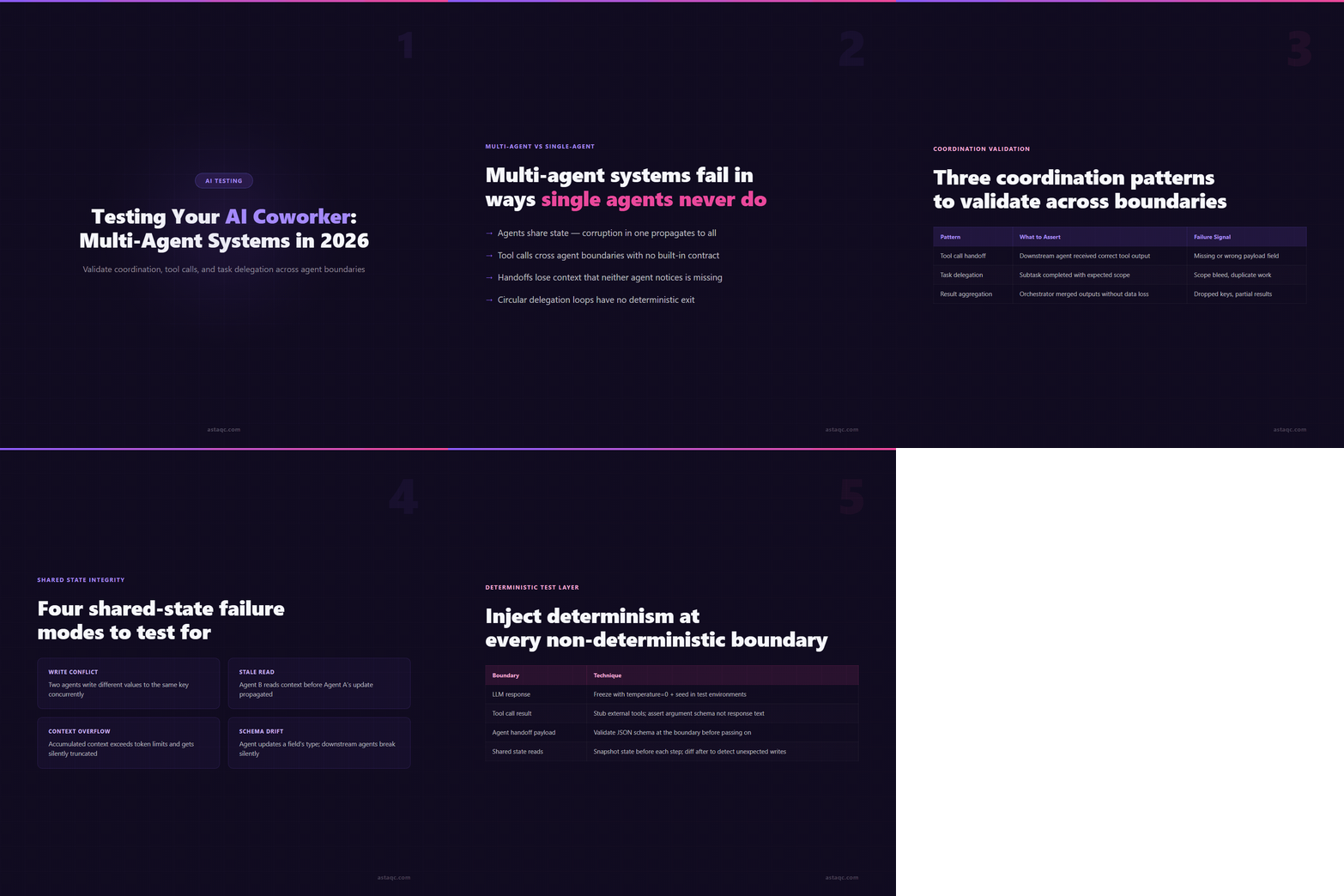
The key failure modes are write conflicts (two agents update the same record simultaneously and one overwrites the other's changes), partial read (an agent reads state that another agent has partially updated and is not yet in a consistent form), and context accumulation (an agent appends to a shared context store without bounds checking, eventually degrading response quality as the context grows beyond the model's effective window).
Testing for these conditions requires constructing specific concurrency scenarios: submit two tasks simultaneously to the same session and verify that both complete without data loss; submit a task that depends on a resource currently locked by another task and verify that the system correctly queues or rejects the conflicting request; submit a large volume of context updates and verify that the system handles context window overflow gracefully rather than silently truncating important history.
| Shared State Type | Concurrency Risk | What to Test |
|---|---|---|
| Session context | Simultaneous writes corrupt state | Concurrent updates; verify version increment and final state consistency |
| Task queue | Multiple agents claim same task | Concurrent dequeue; verify each task is processed exactly once |
| Memory store | Conflicting writes from parallel agents | Write conflict scenario; verify last-write-wins or merge policy behaves correctly |
| Tool credentials | Shared token expires mid-run | Expired token scenario; verify agent refreshes token and retries |
| Context accumulation | Context window overflow degrades quality | Long-session test; verify system summarises or prunes context before overflow |
For teams building production AI coworker systems where multiple agents run concurrently, shared state testing is not optional — it is the category of test most likely to catch failures that only appear under realistic load. The AI behavioral testing guide covers the broader test strategy for autonomous systems, including the coverage model for distributed agent architectures and the specific scenarios that QA teams prioritise.
Building a Deterministic Test Layer for Non-Deterministic Multi-Agent Behavior
Non-determinism in multi-agent systems has two sources: the LLM outputs at each agent, and the routing decisions that determine which agent handles each subtask. Neither can be fully controlled in a production system, but both can be tested against deterministic contracts: the structural and behavioral constraints that the system must satisfy regardless of how the LLM phrases its reasoning or which agent path was selected.
A deterministic test layer for a multi-agent system consists of three layers. The first is structural contract tests: HTTP assertions on the API interfaces between agents. The second is behavioral contract tests: scenario-based tests that verify the system handles specific inputs — a malformed upstream response, a missing required field, an empty task queue — with the correct downstream behavior. The third is regression baselines: a set of representative tasks where the system's output is captured and stored, with subsequent runs checked against the baseline using fuzzy comparison (field presence, response code, schema match) rather than exact text comparison.
Mocking upstream agents for unit-level testing is useful during development, but should not be the primary reliability mechanism in production test suites. Mock-based tests verify that one agent handles a hypothetical input from another agent correctly, but they do not verify that the other agent actually produces that input under real conditions. For integration-level coverage that provides meaningful regression detection, the tests need to run against real agent instances in a staging environment. The test automation services overview covers the environment design principles for staging multi-agent systems at scale.
| Test Layer | What It Tests | Deterministic | Run In |
|---|---|---|---|
| Structural contract | API schemas, field presence, status codes | Yes — schema is fixed | Every CI commit, staging |
| Behavioral contract | Error handling, fallback behavior, edge inputs | Yes — scenario inputs are fixed | Every CI commit, staging |
| Regression baseline | Output quality and workflow completion rate | Partial — schema is fixed, text varies | Pre-release, staging |
| Production smoke test | Live agent availability and response latency | Yes — status codes only | Scheduled, production |
Running the structural and behavioral contract tests on every CI commit, and reserving regression baseline evaluation for pre-release gates, gives teams fast feedback on structural regressions without the noise of LLM output variation triggering false failures on every build. For organisations building QA coverage for AI systems as part of a broader quality programme, Astaqc's software testing services provide structured assessment of multi-agent systems including test strategy design and coverage gap analysis.
Frequently Asked Questions About Testing AI Coworker and Multi-Agent Systems
What is an AI coworker system and how is it different from a standard chatbot?
An AI coworker system is an autonomous or semi-autonomous agent that takes on extended tasks — research, code generation, document drafting, workflow automation — by calling external tools, delegating to specialist agents, and operating across multiple steps without requiring human input at each step. It differs from a chatbot in scope: a chatbot handles conversational turns, while an AI coworker executes multi-step workflows that may span minutes or hours and affect external systems. This extended execution scope is what makes testing more complex, because the state changes produced by the agent persist beyond the conversation.
Can existing test frameworks be used for multi-agent systems?
Standard test frameworks — Playwright, Selenium, Pytest, Jest — work well for the UI and API layers of a multi-agent system but do not natively handle the specific challenges of agent coordination testing: variable-delay async results, non-deterministic output variation, and multi-step state chain verification. Teams typically extend these frameworks with custom polling helpers and schema validators, or use dedicated AI testing tools to cover the agent-specific layer while keeping existing UI and API tests in their current framework.
How do you test for hallucinations in a multi-agent workflow?
Direct hallucination detection in automated tests is impractical because it requires semantic understanding of whether a claim is factually correct. The practical alternative is to test for the structural conditions that make hallucinations harder to produce: verify that the agent called the required retrieval tools before generating its response, that the response cites verifiable fields from the retrieved data, and that the confidence or citation fields in the response are present and non-null. These structural checks verify that the system followed its own grounding protocol.
What metrics should QA teams track for multi-agent systems?
The four metrics that give the clearest signal for multi-agent system health are: workflow completion rate (what percentage of submitted tasks complete successfully end-to-end), agent error rate per boundary (which coordination points produce the most failures), mean time to completion (whether latency is stable or degrading over time), and schema compliance rate (what percentage of inter-agent responses match the expected structure). These are all measurable without asserting on natural language output, making them stable regression signals.
How often should multi-agent system tests run?
Structural contract tests and behavioral contract tests should run on every CI commit, because they are fast and deterministic. Regression baseline evaluation and full end-to-end workflow tests should run before each release candidate, because their results need human review before being used as a release gate. Production smoke tests — a minimal set of tasks that verify the live system is accepting and completing requests — should run on a scheduled interval, typically every 15 to 30 minutes, to give early warning of production incidents. The AI in software testing guide covers how to structure test schedules for systems with both deterministic and non-deterministic components.
Failures in multi-agent systems rarely appear in individual agent responses. They appear at coordination boundaries — where one agent hands off work to another and the assumption each agent made about the other's output turns out to be wrong. That boundary is the right place to test.

Avanish Pandey
November 13, 2026





