October 18, 2026

TestInspector and Selenide serve different segments of the testing market despite covering overlapping ground. Selenide is a Java wrapper around Selenium WebDriver that simplifies browser automation through a fluent assertion API and automatic waiting. TestInspector is a no-code AI-native platform that generates and runs tests without requiring test code in any language. The choice between them comes down to a fundamental decision: whether test creation and maintenance will be owned by developers writing Java, or by anyone on the team writing test steps in natural language. That decision determines not just which tool to use, but how many tests get written, how quickly coverage expands, and how much infrastructure the team needs to maintain.
Selenide is an open-source library built on top of Selenium WebDriver that reduces the verbosity and fragility of standard Selenium Java code. Where Selenium requires explicit waits, WebDriverWait configuration, and repetitive boilerplate for common assertions, Selenide provides a concise fluent API: $(By.id("submit")).shouldBe(Condition.visible).click() replaces several lines of Selenium setup code. Selenide handles automatic waiting for element visibility and interaction readiness, reducing one of the most common sources of test flakiness in standard Selenium suites.
Teams choose Selenide when they have Java-fluent developers maintaining a Selenium-based test codebase and want cleaner, more maintainable test code without migrating to a different framework. It integrates with standard Java testing toolchains — JUnit, TestNG, Maven, Gradle — and runs inside existing CI/CD pipelines that already manage Java builds. For teams already invested in the Selenium ecosystem with Java skills on the QA team, Selenide reduces the maintenance burden of Selenium without requiring a framework change.
Selenide supports all browsers that Selenium supports via WebDriver, runs tests in parallel through TestNG or JUnit 5 configuration, generates reports through existing Java test reporting tools (Allure, ExtentReports), and integrates with Page Object Model patterns. Its adoption is highest in enterprise Java shops and in markets — particularly Eastern Europe and Germany — where Selenium with Java has been the dominant QA automation stack for years. Astaqc’s test automation services page covers how frameworks like Selenide fit into a broader automation strategy.
The core limitation of Selenide is the same as any code-based test framework: creating and maintaining tests requires a developer with the language skills and framework knowledge to write and debug test code. A QA analyst who can describe a test case in detail but does not write Java cannot create a Selenide test. A product manager who notices a regression during a demo cannot add a test for it. A support engineer who knows exactly how a customer workflow fails cannot automate a check for it. The knowledge to create tests and the authority to decide what tests are needed frequently lives in people who do not write code, and Selenide does not bridge that gap.
Selenide also requires infrastructure investment. The team needs to manage Selenium Grid or a cloud browser provider for parallel execution, configure browser drivers and keep them synchronized with browser versions, set up the Java build toolchain, and maintain the Page Object Model or equivalent abstraction layer as the application UI changes. In teams without dedicated automation engineers, this infrastructure maintenance often causes test suites to degrade — tests that fail because of selector drift or driver version mismatches go unfixed for weeks because the developer who wrote them has moved to other priorities.
Selector maintenance is the highest-frequency maintenance task in any Selenium-based suite, including Selenide. When an application update changes the HTML structure — a class name change, an ID removal, a component refactor — every selector that referenced the changed element breaks. In Selenide, fixing broken selectors requires editing Java code, running the test, and verifying the fix. In applications with active frontend development, this cycle consumes QA engineering time continuously. Astaqc’s manual testing page covers the ongoing role of manual testing in teams where automation maintenance overhead limits automated coverage.
Project setup is non-trivial for teams new to Selenide. Setting up a Maven or Gradle project with the correct Selenide version, Selenium dependency management, browser driver binaries, and CI pipeline integration takes significant initial effort. Teams adopting Selenide from scratch need to build conventions for test organization, data management, and environment configuration that the framework does not provide out of the box.
TestInspector covers the same browser test scenarios that Selenide targets — login flows, form submissions, navigation, state-dependent assertions, multi-step user journeys — without requiring test code in any language. Tests are created through an AI chat interface (where the user describes a test in natural language and the platform generates structured steps), through a browser extension that records user actions and converts them to steps, or through direct step authoring in the platform’s step editor. The resulting test is a sequence of structured steps that can be reviewed, modified, and run without touching code.
Execution runs on Selenium against Chrome, Firefox, Edge, and Safari. The difference from Selenide is that the user does not write the Selenium code — TestInspector generates and manages it. Self-healing handles the most common form of selector drift: when a selector fails on retry, the platform suggests alternative selectors based on surrounding element context and previous successful runs. Visual regression uses SSIM screenshot comparison against approved baselines, with crop and exclusion selectors for dynamic content areas. Variable interpolation with {{VAR}}, {{TIMESTAMP}}, {{TOTP:secret}}, and {{ALPHANUMERIC}} handles dynamic test data in form fields and URL parameters.
HTTP request steps (GET/POST/PUT/PATCH/DELETE) with status code and response body assertions cover API testing without code. Accessibility assertions via axe-core check for WCAG violations with configurable severity levels. Scheduling via cron, interval, or one-time triggers enables test runs to be scheduled independently of CI pushes — useful for smoke testing in production or monitoring third-party integrations. For teams evaluating whether TestInspector fits their workflow, TestInspector’s product page covers the feature set in detail. Astaqc’s outsource QA guide covers when teams benefit from using managed testing tools rather than building in-house framework capability.
| Dimension | Selenide | TestInspector |
|---|---|---|
| Test authoring | Java code (fluent API) | AI chat, browser recording, step editor |
| Who can create tests | Java developers / SDETs | Anyone on the team |
| Browsers supported | All WebDriver-compatible | Chrome, Firefox, Edge, Safari |
| Selector maintenance | Manual (edit Java code) | Self-healing with AI suggestions |
| Visual regression | Via third-party integration | Built-in SSIM screenshot comparison |
| API testing | Via RestAssured or similar | Built-in HTTP request steps |
| Scheduling | Via CI/CD cron jobs | Built-in cron/interval/one-time scheduler |
| Infrastructure | Self-managed or cloud grid | Hosted, no infrastructure to manage |
| CI/CD integration | Native via Maven/Gradle | API trigger, MCP tokens |
| Learning curve | Moderate (Java + Selenium required) | Low (natural language authoring) |
Selenide is the better choice when the team has Java developers who are already writing code, when existing test infrastructure is Selenium-based and the goal is to improve code quality without a framework migration, when test scenarios require complex programmatic logic that benefits from a full programming language, or when integration with a Java-based test reporting and build pipeline is a priority. Selenide’s code-based approach gives experienced Java developers full control over test logic and enables patterns like parameterized test generation and custom assertion libraries that are difficult to replicate in no-code tools.
TestInspector is the better choice when the team includes QA analysts or product owners who need to create and maintain tests without writing code, when the team wants to reduce selector maintenance overhead, when cross-functional test creation is a goal, or when starting from scratch on test automation without the capacity to invest in framework infrastructure. TestInspector is also a strong fit for smoke testing production flows on a schedule and for teams using AI-assisted development workflows where MCP tokens enable test generation from within Claude Code or Cursor. Astaqc’s manual vs. automated testing guide covers how teams at different maturity levels decide when to automate and which tools match their context. For teams evaluating options, Astaqc’s hire a QA team page describes how coverage decisions map to team structures.
Yes. The most natural combination is using Selenide for complex integration and regression tests written by developers, and TestInspector for smoke tests, production monitoring, and coverage areas where non-developer team members are the best people to define and maintain tests. The two tools serve different parts of the team and different coverage needs, and there is no architectural conflict in running both. TestInspector’s export to Playwright TypeScript or Selenium IDE also means tests initially created in TestInspector can be migrated into a code-based suite if needs change.
Selenide is actively maintained as an open-source project with regular releases. Its development reflects the maturity of the Selenium ecosystem rather than abandonment. The project has a stable API and a large installed base, particularly in Java shops in Europe and at enterprise organizations with established Selenium infrastructure. Teams using Selenide for existing test suites are unlikely to encounter support or maintenance issues in 2026.
Selenide does not include self-healing. It provides automatic waiting (which reduces timing-related failures) and a more concise API (which reduces code maintenance effort), but when a selector fails because of an application change, a Selenide test fails and requires manual repair. TestInspector’s self-healing retries alternative selectors on failure and surfaces AI suggestions for replacement selectors based on element context, reducing failures that require manual intervention when UI changes break selectors.
Selenide’s fluent assertion API supports fine-grained conditions — element attribute values, text content matching with regular expressions, computed CSS properties, collection size checks — that are harder to express in a no-code step editor. TestInspector covers the common assertion types (element visibility, text content, URL, HTTP response status and body) that account for most functional test assertions. Teams with extensive assertion requirements for complex UI interactions may find Selenide’s code-based approach more expressive for those specific scenarios.
Selenide, running via a local Selenium Grid or CI runner, can parallelize across as many threads as the infrastructure supports. TestInspector runs tests on hosted infrastructure with parallelism determined by the account plan. For teams running tens to low hundreds of tests, the execution speed difference is not a decision factor. The more relevant speed comparison for most teams is test creation speed: TestInspector creates tests in minutes via AI chat; Selenide tests take hours to write, debug, and review.
There is no automated migration tool. The practical approach is to inventory the existing Selenide test suite, identify the highest-value tests, and recreate them in TestInspector using the browser extension recording or AI chat. Running both in parallel during a transition period — with TestInspector taking over new test coverage and Selenide maintaining existing coverage — is the lowest-risk approach. Astaqc’s test automation services include coverage migration and re-architecture for teams modernizing their automation stack.
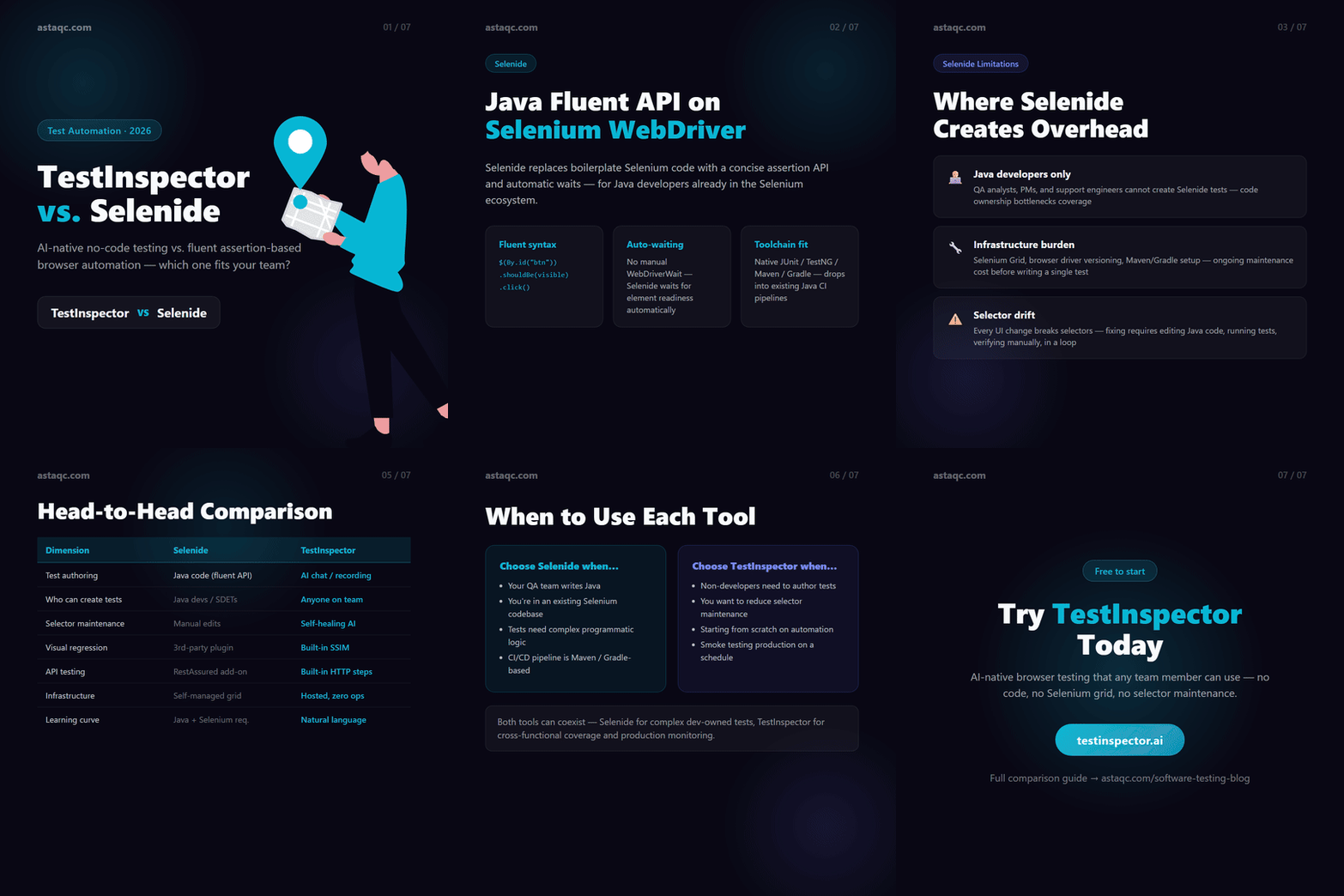
The most important difference between TestInspector and Selenide is not speed or coverage breadth — it is who can create and maintain tests. Selenide requires a Java developer; TestInspector requires someone who can describe a test in plain language.
October 18, 2026


Sign up to receive and connect to our newsletter

We founded ASTAQC as a tight-knit group of professional Software Testers and software developers.
Subscribe to our Newsletter