October 18, 2026
Retrieval-Augmented Generation (RAG) pipelines combine a document retrieval system with a large language model to answer questions using a knowledge base rather than relying solely on model weights. In 2026, RAG is the dominant architecture for enterprise AI systems that need to answer questions over private documents, internal knowledge bases, and frequently updated content. Unlike conventional software where outputs are deterministic, RAG pipeline outputs depend on retrieval quality, context window construction, and LLM response generation — each of which can fail independently or interact to produce incorrect results. Testing a RAG pipeline means verifying each stage separately and testing their combined effect on final answer quality. This post covers what to test, how to measure it, and which failure modes require the most attention.
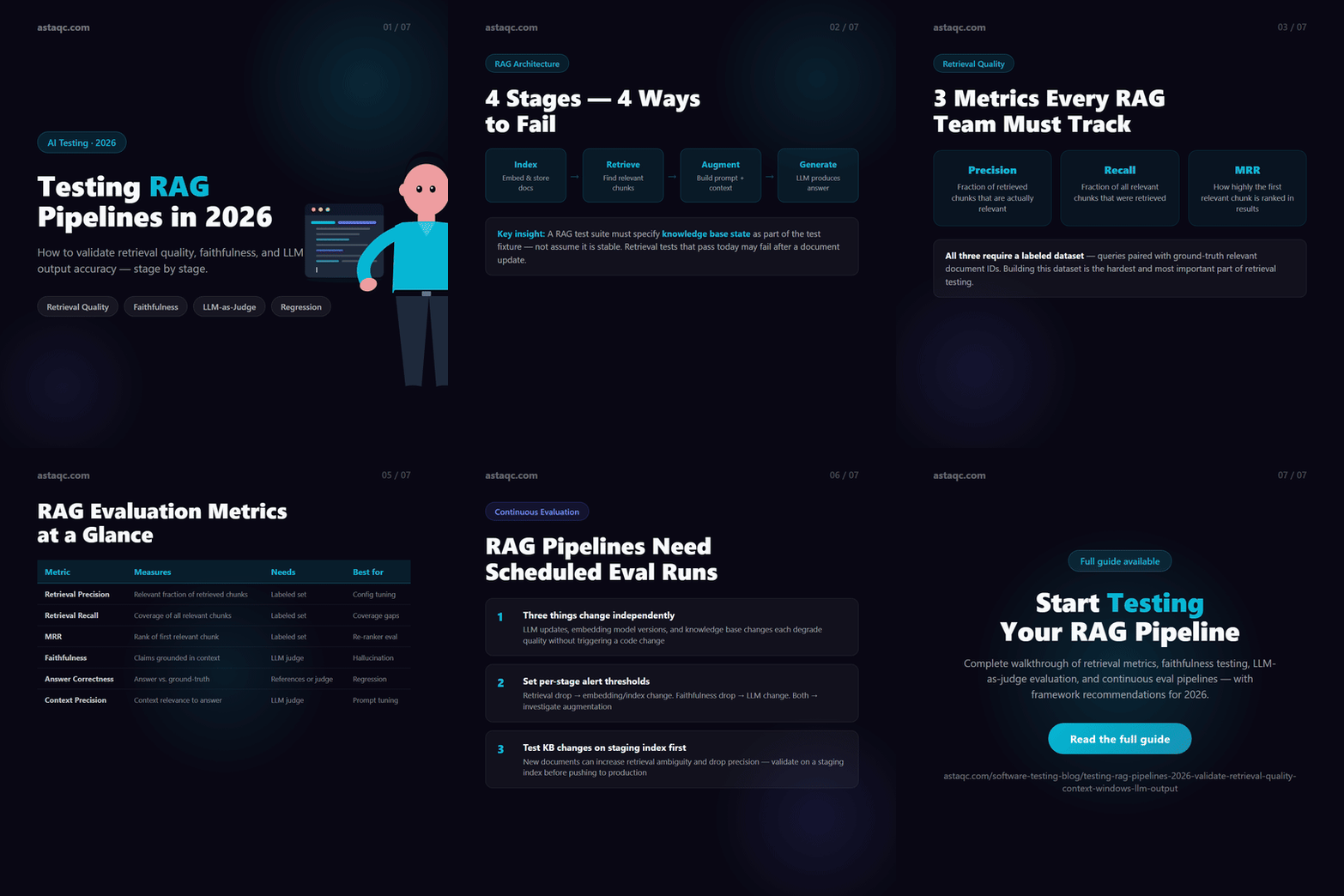
A typical RAG pipeline has four stages: indexing (embedding and storing documents), retrieval (finding relevant document chunks for a query), augmentation (constructing a prompt from the query plus retrieved chunks), and generation (calling the LLM to produce an answer). Failures can occur at any stage. Indexing failures produce malformed embeddings or truncated chunks that make retrieval unreliable. Retrieval failures surface the wrong documents or miss the relevant ones, even when they exist in the index. Augmentation failures build prompts that exceed context window limits or present contradictory chunks without signaling the contradiction. Generation failures produce hallucinations, partial answers, or refusals when the retrieved context is ambiguous. Testing requires instrumentation at each stage boundary so failures are attributable rather than observable only in final output degradation. Astaqc’s AI testing guide covers how AI system evaluation differs from deterministic software testing at a conceptual level.
The test surface for a RAG pipeline is larger than for a conventional API. A conventional API has inputs, outputs, and documented behavior — testing checks that outputs match behavior for a set of inputs. A RAG pipeline has inputs (queries), outputs (answers), and two additional dimensions: the knowledge base state (which documents are indexed) and retrieval behavior (which chunks are returned for which queries). Tests that pass when the knowledge base contains one set of documents may fail when documents are updated or added. This means test suites need to specify knowledge base state as part of the test fixture, not assume it is stable.
Retrieval quality is the most foundational metric in RAG testing. If the retrieval stage does not return relevant chunks for a query, the LLM cannot produce a correct answer regardless of its capability. The standard metrics for retrieval quality are precision, recall, and Mean Reciprocal Rank (MRR). Precision measures what fraction of retrieved chunks are relevant. Recall measures what fraction of relevant chunks were retrieved. MRR measures how highly the first relevant chunk is ranked. All three require a relevance judgment for each (query, chunk) pair, which in practice means a test dataset of queries paired with ground-truth relevant document IDs.
Building this dataset is the hardest part of retrieval testing. Options include: manually labeling relevant documents for a sample of representative queries, using the LLM to generate synthetic (query, answer, source) triples from documents and using source document IDs as ground truth, or using a domain expert to annotate a focused test set for high-stakes query types. Each approach has tradeoffs between cost, coverage, and annotation quality. For teams starting retrieval testing, synthetic generation via the LLM followed by spot-check validation is the most practical first approach. Astaqc’s testing services page covers evaluation approaches for AI systems where ground truth construction is part of the engagement scope.
Chunk size and overlap configuration affects retrieval quality significantly. Smaller chunks (256–512 tokens) improve retrieval precision by reducing the amount of irrelevant content in each retrieved unit, but reduce recall for questions that span multiple sections of a document. Larger chunks improve context continuity but increase the probability of retrieving chunks that contain the target answer alongside significant irrelevant content. Testing retrieval quality across chunk size configurations — not just at the default setting — helps identify the configuration that best fits the query distribution. Re-ranking models (which take the top-k retrieved chunks and re-order them before passing to the LLM) can substantially improve MRR and should be tested before and after re-ranking to isolate their contribution.
Context window construction is the stage between retrieval and generation where retrieved chunks are assembled into the prompt. Failures here include: exceeding the model’s context window limit (causing truncation of relevant content), ordering chunks in a way that places the most relevant content at the edges of the context (where attention degrades for many models), presenting contradictory information from multiple chunks without resolving the contradiction, and including too many chunks (increasing distraction) or too few (reducing coverage).
Testing context window construction means verifying that: the assembled prompt fits within the token limit for all query types in the test set, relevant content is not systematically placed at positions where attention is weakest (a phenomenon called “lost in the middle”), contradictory chunks are either filtered or flagged before reaching the LLM, and the number of chunks passed to the LLM is calibrated to retrieval quality rather than fixed at a constant. Automated checks on assembled prompts — token counts, chunk count, and embedding similarity between the query and included chunks — are fast to run and catch construction failures before evaluation. Astaqc’s test automation services page covers how automated checks fit into AI pipeline testing.
Faithfulness testing checks whether the LLM’s generated answer is grounded in the retrieved context rather than in model weights. A faithful answer makes claims that are directly supported by at least one retrieved chunk. An unfaithful answer makes claims that are not present in the retrieved context, even if those claims happen to be factually correct. Faithfulness is measured by an LLM judge: the judge is given the generated answer and the retrieved context and asked to classify each claim in the answer as supported or unsupported. The faithfulness score is the fraction of supported claims. This metric is distinct from factual correctness — a faithful answer might be factually wrong if the retrieved context is wrong, and an unfaithful answer might be factually correct if the model’s weights contain the relevant knowledge. For RAG systems, faithfulness is typically the more important metric because it tests whether the grounding mechanism is working, not whether the model’s weights are reliable. Astaqc’s performance testing page covers how evaluation latency affects AI pipeline testing cadence.
Answer quality is evaluated at the output stage and measures whether the generated answer correctly addresses the query. The core metrics are answer correctness (does the answer contain the right information), answer completeness (does the answer address all aspects of the query), and answer conciseness (does the answer avoid unnecessary content). All three are hard to evaluate with rule-based tests and require either ground-truth reference answers or an LLM judge.
Reference-based evaluation compares the generated answer to a ground-truth answer written by a human or generated by a high-quality model. The comparison can be done with embedding similarity (measuring semantic closeness), ROUGE or BLEU scores (measuring n-gram overlap), or an LLM judge scoring the generated answer against the reference. For factual question-answering tasks, reference-based evaluation is reliable when ground-truth answers are available. For tasks where multiple valid answers exist (synthesis, summarization, analysis), reference-based evaluation is less reliable because it penalizes semantically equivalent answers that differ in wording.
| Metric | What it measures | Requires | Best for |
|---|---|---|---|
| Retrieval Precision | Fraction of retrieved chunks that are relevant | Labeled relevance set | Retrieval config tuning |
| Retrieval Recall | Fraction of relevant chunks that are retrieved | Labeled relevance set | Coverage gaps |
| MRR | Rank of first relevant chunk | Labeled relevance set | Re-ranker evaluation |
| Faithfulness | Claims grounded in retrieved context | LLM judge | Hallucination detection |
| Answer Correctness | Answer matches ground-truth | Reference answers or LLM judge | Regression testing |
| Context Precision | Retrieved context relevance to answer | LLM judge | Context construction tuning |
A practical RAG test dataset has three components: a set of queries that represents the query distribution the system will encounter in production, a knowledge base snapshot that captures the state of the document store at test time, and expected outputs (reference answers and/or relevant document IDs) for each query. The queries should cover: simple factual lookups (questions answered by a single sentence in one document), multi-hop questions (questions requiring synthesis across multiple documents), out-of-scope questions (questions for which no relevant documents exist), and adversarial questions (questions designed to surface hallucination or retrieval failure). Astaqc’s outsource QA guide covers when building a test dataset is part of a QA engagement rather than an in-house task.
RAG pipelines require continuous evaluation because three things change independently: the LLM (model updates, provider changes), the embedding model (version updates that shift the embedding space), and the knowledge base (document additions, updates, and deletions). Any of these changes can degrade pipeline quality without triggering a code change that would prompt a test run. Regression testing for RAG means running the evaluation suite on a schedule — not just on code changes — and alerting when metrics drop below thresholds.
Setting regression thresholds requires baseline measurements. Run the evaluation suite before any changes, record the metric values, and set alert thresholds at a fixed percentage below baseline (5–10% is a common starting point). When a metric drops below the threshold, the alert should trigger investigation into which stage degraded: retrieval metrics point to embedding model or index changes, faithfulness metrics point to LLM generation changes, and answer correctness metrics can reflect either retrieval or generation degradation. Isolating the degraded stage reduces debugging time significantly compared to evaluating only end-to-end answer quality.
Knowledge base changes are the highest-frequency source of RAG pipeline degradation in production. When new documents are added to the knowledge base, retrieval precision can drop if the new documents contain content similar to existing documents (increasing retrieval ambiguity) or if the new documents introduce terminology not present in the embedding model’s training data. When documents are updated or deleted, queries that previously retrieved accurate content may retrieve stale content or fail to retrieve any content. Testing knowledge base changes before applying them to the production index — using a staging index — is the most effective way to catch degradation before it affects production users. Astaqc’s testing documentation page covers how evaluation frameworks fit into quality documentation for AI systems.
A minimum viable RAG test suite has three components: 20–50 representative queries with expected relevant document IDs (for retrieval evaluation), a faithfulness check run via LLM judge on 20–50 queries (to detect hallucination), and a set of out-of-scope queries that should return a “no relevant information found” response rather than a fabricated answer. This gives coverage of the three highest-impact failure modes — retrieval miss, hallucination, and out-of-scope handling — in under a day of setup time.
When ground-truth answers are unavailable, use an LLM to generate synthetic (query, answer) pairs from documents, use human review to validate a sample of the generated pairs, and use the validated pairs as the reference dataset. This approach produces a useful test set in hours rather than days. The limitation is that synthetic queries may not match the distribution of real user queries — adding real user queries from production logs as they become available improves coverage over time.
The most commonly used evaluation frameworks in 2026 are RAGAS (which provides implementations of faithfulness, answer relevance, context precision, and context recall metrics), DeepEval (which provides a broader set of LLM evaluation metrics including RAG-specific ones), and LangSmith (which provides evaluation, tracing, and dataset management integrated with LangChain). Teams not using LangChain typically use RAGAS or DeepEval as standalone libraries and build their own dataset management. The LLM judge pattern — using a separate LLM to evaluate outputs from the pipeline LLM — is the dominant evaluation approach for answer quality metrics where reference answers are unavailable.
Context window size changes affect how many chunks can be included in the prompt and therefore affect both faithfulness (more context means more material that could contradict the answer) and answer completeness (more context enables better synthesis across sources). When the LLM provider increases the context window limit, re-evaluate the optimal chunk count configuration rather than assuming more chunks is always better. Additional chunks increase context length and can reduce answer quality if the additional content is only marginally relevant.
RAG evaluation that depends on external LLM calls is slow (often 30–120 seconds per query) and expensive. Running a full evaluation suite in CI on every code commit is impractical. The recommended architecture is: lightweight deterministic tests (token count checks, schema validation, retrieval stage unit tests) in CI, and full evaluation suite runs as a scheduled job (nightly or weekly) and as a pre-merge gate for changes that touch retrieval configuration, embedding models, or prompt templates. Changes to the knowledge base trigger a targeted evaluation run against the affected query types rather than the full suite.
Testing RAG pipelines requires a different mindset than testing conventional software. The system can return an answer that looks correct in isolation but fails to ground its claims in the retrieved context — and neither a unit test nor a functional test will catch that without an explicit grounding check.
October 18, 2026


Sign up to receive and connect to our newsletter

We founded ASTAQC as a tight-knit group of professional Software Testers and software developers.
Subscribe to our Newsletter


