TestInspector vs. Gauge: When AI-Native No-Code Testing Replaces Specification-Based Test Execution
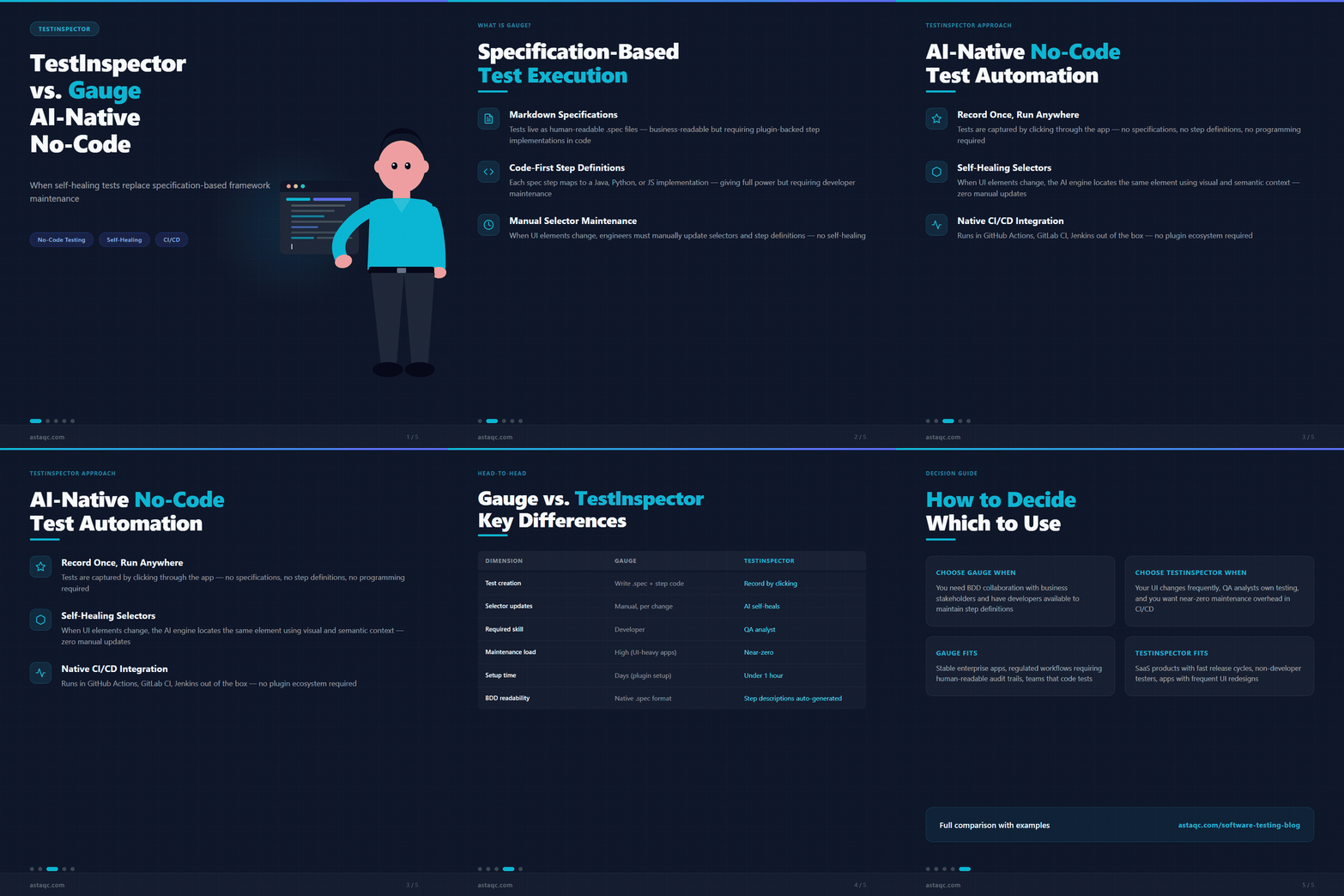
TestInspector and Gauge solve different versions of the same problem: running repeatable, maintainable tests against web applications and APIs. Gauge is a specification-based open-source framework where tests are written in Markdown-like specifications and executed through step implementations in Java, Python, Ruby, C#, or JavaScript. TestInspector is an AI-native platform where tests are generated through a chat interface and executed as structured steps in a cloud browser — no code required. If your team has experienced developers who prefer writing tests in a specification language and maintaining a plugin-dependent framework, Gauge is a viable option. If your goal is to give QA engineers and product teams the ability to build and run tests without writing or maintaining code, TestInspector removes the framework layer entirely.
What Gauge Does: Markdown Specifications, Plugin Architecture, and Execution Model
Gauge was created by Thoughtworks as an open-source test automation framework. Its defining characteristic is its use of Markdown-based specification files, where test scenarios are written in plain English and each step is implemented as executable code in a supported language. This creates a natural separation between the specification layer and the implementation layer — product managers can read and write specs, while developers implement the underlying step functions.
Gauge runs tests on the command line via its CLI, integrates with CI/CD pipelines through standard build tools, and supports parallel execution through its runner architecture. It has plugins for HTML reporting, XML output, and IDE integration with IntelliJ IDEA and VS Code. Browser automation is handled through Selenium or Playwright implementations that the team writes themselves.
The trade-off is framework ownership. Teams using Gauge are responsible for maintaining their step library as the application changes, managing driver updates when browser vendors release new versions, and debugging failures that originate in the framework rather than the application. The specification layer adds clarity for stakeholders, but the implementation layer still requires engineering effort to build and maintain.
Gauge is best suited to teams that already have engineers writing automation and want a clearer separation between test intent (the spec) and test implementation (the code). It does not reduce the technical overhead of test automation — it restructures it.
What TestInspector Offers: AI-Native No-Code Test Generation and Cloud Execution
TestInspector eliminates the implementation layer. Tests are created through a chat interface where an AI model generates structured test steps — click this element, fill this field, assert this response — without the tester writing any code. Those steps run in a cloud browser that TestInspector manages, against Chrome, Firefox, Edge, or Safari, with no local driver setup or maintenance.
Self-healing handles selector drift automatically. When an element's locator changes after a UI update, TestInspector's AI suggests updated selectors rather than breaking the test run and queuing a debugging session. Visual regression is built in through SSIM screenshot comparison with baseline approval, crop regions, and exclusion masks. Variable interpolation supports dynamic values including timestamps, random alphanumeric strings, and TOTP codes for 2FA flows.
For API testing, TestInspector supports HTTP request steps (GET, POST, PUT, PATCH, DELETE) with status code assertions and response body validation. This means teams can test API endpoints, webhooks, and service integrations alongside UI flows in the same test suite, without maintaining a separate Postman collection or REST client configuration.
Scheduling runs on cron, interval, or one-time triggers. CI/CD integration uses an API trigger that fits into GitHub Actions, GitLab CI, Jenkins, or any pipeline that can send an HTTP request. Live WebSocket streaming provides real-time run visibility during execution. Test runs are linked to TestInspector's organizational structure with owner, admin, and member roles, and variables can be scoped at the test, suite, or organization level with encrypted storage for sensitive values.
Gauge vs. TestInspector: Side-by-Side Comparison
| Dimension | Gauge | TestInspector |
|---|---|---|
| Test authoring | Markdown specifications + code implementations | AI chat interface generates structured steps |
| Execution environment | Local or CI runner; team manages browser drivers | Cloud-managed browsers; no driver maintenance |
| Selector drift handling | Step implementation breaks; manual fix required | Self-healing with AI selector suggestions |
| Visual regression | Requires separate plugin or integration | Built-in SSIM comparison with baseline approval |
| API testing | Requires separate HTTP library in implementation | Built-in HTTP request steps with assertions |
| Code requirement | Required for step implementations | None; AI generates steps from chat |
| Accessibility testing | Not built in; requires custom step implementation | Built-in axe-core assertions with severity levels |
| Pricing model | Free and open source | SaaS subscription |
Both tools work for teams that have already committed to automation. The divergence is in who does the work. Gauge distributes the automation burden across developers who maintain step implementations. TestInspector concentrates it in the platform itself, leaving QA engineers responsible only for test logic, not test infrastructure. For test automation teams evaluating both, the meaningful question is whether the team can sustain a framework indefinitely or whether automation coverage needs to survive team turnover and changing priorities.
Maintenance Cost: Framework Upkeep vs. Self-Healing Tests
The long-term cost difference between Gauge and TestInspector comes down to what breaks when the application changes.
With Gauge, a UI change that moves or renames an element breaks the step implementation that references it. Finding which steps broke, updating the locators or assertions, and verifying the fix requires a developer familiar with the step library. If the team that originally built the implementation has changed, undocumented step logic can slow debugging significantly. Gauge does not provide built-in retry behavior or self-healing — those behaviors must be coded into the implementation explicitly.
TestInspector's self-healing operates at the execution layer. When a test step fails because an element's locator has changed, the AI analyzes the current DOM state and suggests updated selectors. The test continues rather than halting the run. The QA engineer reviews the suggestion and approves the update. This reduces the maintenance cycle for routine selector drift from a debugging session to a review action.
That said, self-healing has limits. It addresses structural changes to locators and handles retries on intermittent failures, but it does not replace deliberate test design. If the application's behavior changes fundamentally — new flow logic, removed features, changed assertion targets — both tools require the test to be updated. The difference is in how the update happens: code change in Gauge, structured step edit in TestInspector.
For teams running manual testing alongside automation, TestInspector's maintenance model reduces the barrier for QA engineers who do not write code to keep tests current. With Gauge, those engineers depend on developers to handle updates. This can create a bottleneck when development velocity is high and the step library changes frequently. See also our guide on manual vs. automated testing for context on when each approach applies.
How to Decide: Team Profile, Test Types, and Migration Path
The right tool depends on what your team can sustain and what your tests need to do.
Gauge is a reasonable choice if your team already has developers writing automation in a supported language, you want a clear specification layer that non-technical stakeholders can read, and you are comfortable owning the browser driver and step library as a long-term engineering artifact.
TestInspector is the stronger choice if your goal is test coverage that QA engineers without coding backgrounds can build and maintain, you need self-healing to handle UI churn without developer intervention, or you want API testing, visual regression, accessibility assertions, and scheduled execution in one platform without adding plugins. For teams that already rely on software testing services, it integrates well into managed QA engagements.
Migration path: exporting from TestInspector to Playwright TypeScript, Selenium IDE (.side), or Gherkin is supported. Teams moving from Gauge to TestInspector typically start by rebuilding their most-maintained tests in TestInspector, and gradually reducing their Gauge step library as coverage shifts to the new platform.
What programming languages does Gauge support?
Gauge supports Java, Python, Ruby, C#, and JavaScript for step implementations. The choice of language determines what testing libraries the team uses for browser interaction — typically Selenium WebDriver or Playwright in the target language.
Can TestInspector replace Gauge for teams that need readable specifications?
TestInspector generates tests as structured steps rather than Markdown specifications. If stakeholder-readable specifications are a hard requirement, Gauge's specification format is more natural. If the goal is simply that non-engineers can review and understand what tests do, TestInspector's structured step format is comparable in readability.
Does Gauge support parallel execution?
Yes. Gauge supports parallel execution through its runner configuration with the --parallel flag. TestInspector also supports parallel test runs, managed entirely by the platform without infrastructure configuration on the team's side.
How does TestInspector handle test data compared to Gauge?
Gauge supports data-driven testing through CSV-based data tables. TestInspector uses variable interpolation with scoping at the test, suite, or organization level. Sensitive values are stored encrypted. Dynamic variables include timestamps, random alphanumeric strings, and TOTP codes.
Is Gauge still actively maintained?
Gauge is maintained by Thoughtworks and remains an active open-source project as of 2026. For teams evaluating automation tooling more broadly, our complete guide to software testing covers the decision framework in detail.
Can TestInspector export tests to Gauge format?
TestInspector exports to Playwright TypeScript, Selenium IDE (.side), and Gherkin. It does not export to Gauge specification format directly. For guidance on the transition, our QA team services page covers how managed teams handle tool migrations.
TestInspector removes the framework layer entirely — QA engineers build and maintain tests without writing step implementations, while self-healing handles selector drift automatically.

Avanish Pandey
November 6, 2026