gRPC API Testing in 2026: How to Validate Protocol Buffer Services, Streaming Calls, and Error Handling
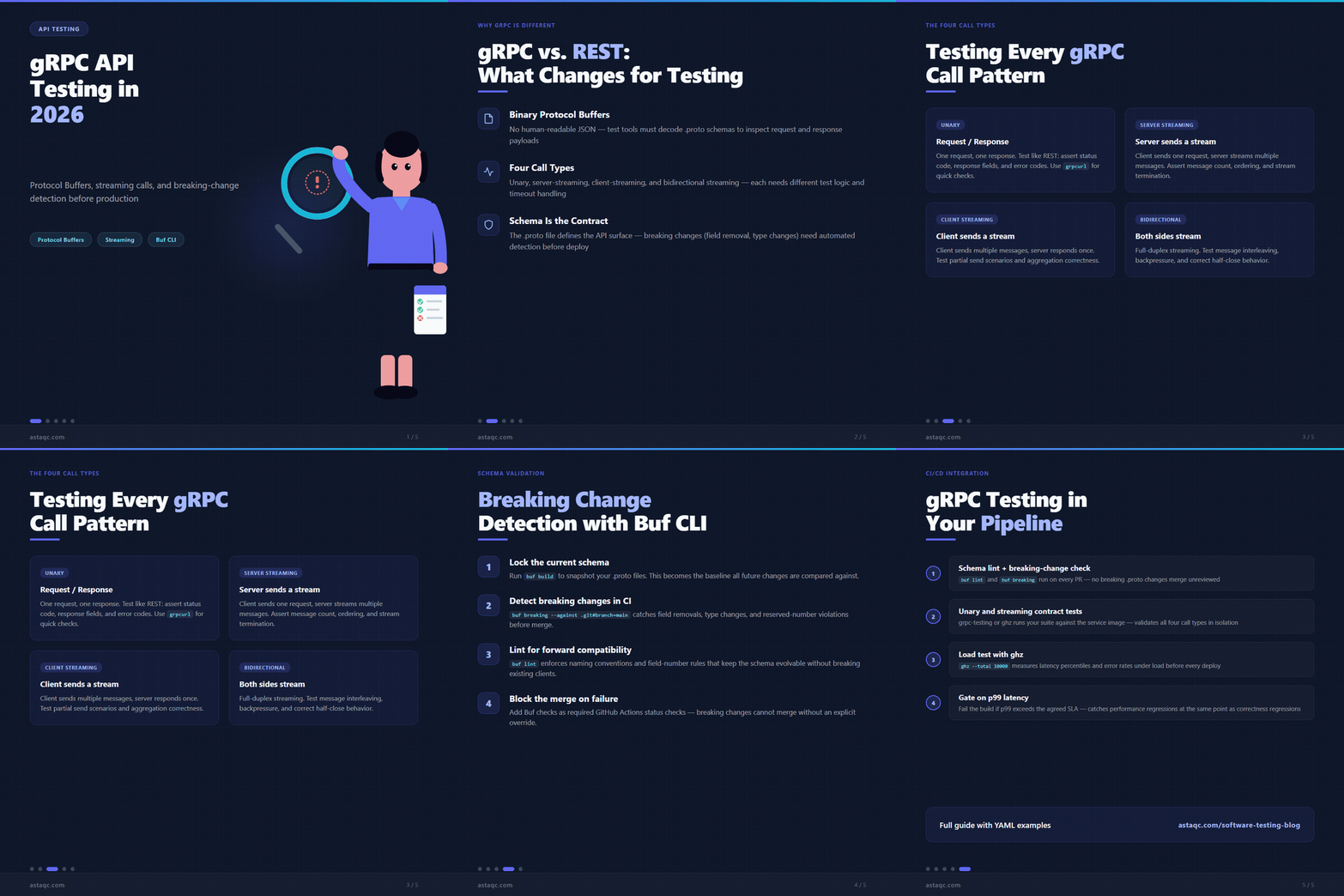
gRPC uses HTTP/2 for transport and Protocol Buffers for serialization, which means the testing patterns that work for REST APIs do not transfer directly. You cannot use a standard HTTP client to send raw requests without additional tooling, and the binary encoding of Protocol Buffers means you cannot inspect payloads with a plain network proxy the way you would with JSON. The right approach to gRPC API testing in 2026 combines a reflection-aware client for exploratory testing, a contract testing layer that validates your .proto schema against service behavior, and CI pipeline integration that catches breaking changes before they reach production.
Why gRPC Testing Requires Different Strategies Than REST
REST testing assumes HTTP/1.1 semantics and JSON payloads. Tools like curl, Postman (in HTTP mode), and most CI pipeline assertions are built around this assumption. gRPC breaks those assumptions at every layer.
First, gRPC runs on HTTP/2 by default, using multiplexed streams rather than individual request-response cycles. This means persistent connections with multiple in-flight streams, which changes how connection errors, timeouts, and retries behave. A gRPC call that times out may leave the stream open in a way that does not affect subsequent requests on the same connection — behavior you need to test explicitly.
Second, Protocol Buffers encode messages as binary. The shape of a message is defined in a .proto file, and the encoded bytes carry field numbers rather than field names. This means you cannot read a gRPC payload directly — you need the .proto schema to decode it, which makes proxy-based inspection (Charles Proxy, Fiddler, Wireshark) more complex than for JSON/REST.
Third, gRPC has four call types: unary (one request, one response), server-streaming (one request, multiple response messages), client-streaming (multiple request messages, one response), and bidirectional streaming (multiple messages in both directions). Each type requires different test assertions and timeout handling. A test framework built only for unary calls will miss behavior in streaming calls entirely.
These differences mean gRPC testing requires purpose-built tooling rather than adapted REST tools. For teams whose quality strategy spans multiple service types, our guide on software testing services covers how to structure test coverage across heterogeneous service architectures.
Tools for gRPC Testing: grpcurl, grpc-gateway, Postman, and Specialized Clients
The gRPC testing toolchain in 2026 has matured significantly. These are the primary tools teams use in practice.
| Tool | Primary Use | Key Capability | Limitation |
|---|---|---|---|
| grpcurl | CLI exploration and scripting | Uses server reflection; no .proto file needed | No assertion layer; output piped to jq or shell |
| Postman (gRPC) | Manual and scripted testing | GUI with Proto import; test scripts in JavaScript | Limited streaming support; CI integration via Newman |
| grpc-gateway | REST-to-gRPC translation layer | Exposes gRPC services as JSON/REST for existing tooling | Not all gRPC features map cleanly to REST |
| Go testing package + google.golang.org/grpc | Unit and integration tests in Go | In-process client; no network overhead; mock server support | Go-only; requires client code in the target language |
| Buf CLI | Schema linting and breaking change detection | Checks .proto changes against compatibility rules | Lint-only; does not execute tests against a running service |
For most teams, the practical toolchain combines grpcurl for exploration, language-native test clients for integration tests, and Buf CLI for schema validation in CI. For teams whose test strategy spans APIs and UI, our test automation services team regularly advises on how to structure coverage across both layers.
Testing Unary, Server-Streaming, Client-Streaming, and Bidirectional gRPC Calls
Each gRPC call type requires different test patterns. Using the same assertion model across all four types is a common source of incomplete coverage.
Unary calls (one request, one response) map most closely to REST. The test sends one request message, waits for one response, and asserts on the response fields and gRPC status code. The status codes to validate include OK, INVALID_ARGUMENT, NOT_FOUND, ALREADY_EXISTS, UNAUTHENTICATED, PERMISSION_DENIED, and RESOURCE_EXHAUSTED. Many teams test these thoroughly but fail to test the error status paths.
Server-streaming calls (one request, multiple response messages) require the test to consume all messages in the stream before asserting. Key behaviors to validate: the number of messages received, ordering of messages when order is a contract, what happens when the client closes the stream early, and what happens when the server closes the stream with an error mid-stream.
Client-streaming calls (multiple request messages, one response) require the test to send a sequence of messages and then signal the end of the stream before the server responds. Test concerns include: does the server return the correct aggregated response after receiving the full stream, what happens when individual messages in the stream contain invalid data, and does the server handle an unexpected early close from the client correctly.
Bidirectional streaming is the most complex to test. Both sides send messages at their own pace, and either side can close the stream. Testing this call type requires the test client to be stateful. Many teams defer bidirectional streaming tests to manual or exploratory sessions, which creates a gap that only appears in production under concurrent load. This is a scenario where our performance testing services can identify concurrency issues that unit-level tests miss.
Protocol Buffer Contract Testing: Schema Validation and Breaking Change Detection
Protocol Buffer contracts are defined in .proto files, and changes to those files can break clients silently if backward compatibility rules are not followed. Contract testing for gRPC means validating that changes to the .proto schema do not break existing consumers.
The backward compatibility rules for Protocol Buffers are specific. These changes are safe: adding a new field (existing clients ignore unknown fields), adding a new enum value, adding a new RPC method. These changes are breaking: removing a field or changing its field number, changing a field's type, changing a field's singular/repeated cardinality, removing an RPC method.
The Buf CLI enforces these rules as part of a CI workflow. Running buf breaking --against compares the current .proto state against a baseline and reports violations. Integrating this check into the merge request pipeline means breaking changes are caught before code reaches any environment. For teams managing testing documentation across multiple services, maintaining a contract registry alongside .proto schemas provides a clear record of which consumers depend on which fields.
| Change Type | Safe? | What breaks if not checked |
|---|---|---|
| Add new field (new field number) | Yes | Nothing — existing clients ignore unknown fields |
| Remove a field | No | Clients reading that field receive the zero value silently |
| Change field number | No | Old clients cannot decode the renamed field — silent data loss |
| Change field type | No | Deserialization error or corrupted data at client |
| Add new RPC method | Yes | Nothing — existing clients do not call the new method |
| Remove an RPC method | No | Clients calling the removed method receive UNIMPLEMENTED status |
Integrating gRPC Tests into CI/CD Pipelines
A gRPC test suite in CI typically runs at three distinct stages, each with different scope and speed constraints.
At the unit level, tests run against in-process mock servers that implement the gRPC interface. These are fast (milliseconds per test), require no network, and can run in parallel without port conflicts. These tests validate business logic and schema handling but do not test actual network behavior.
At the integration level, tests run against a real service (or a close replica) on a stable environment. grpcurl scripts wrapped in shell-based assertions, or language-native test clients calling a deployed service, cover the full protocol stack including TLS, metadata headers, and authentication interceptors.
At the contract level, Buf breaking change detection runs as a linter step on every .proto change. This is fast and runs before integration tests. If a breaking change is detected, the pipeline fails immediately without spinning up any services. For automated testing pipelines, this provides early feedback at the lowest cost.
For teams building a full testing strategy, our complete software testing guide covers the pipeline design decisions in more detail.
Can you test gRPC with Postman?
Yes. Postman added gRPC support in 2022 and has continued to improve it. You can import a .proto file or use server reflection to discover services. Postman supports unary and server-streaming calls, with test scripts written in JavaScript for assertions. For CI pipelines, language-native clients or grpcurl are more reliable.
How do you handle authentication in gRPC tests?
gRPC authentication is typically handled through metadata headers or interceptors. For token-based auth, the test client adds the token to the metadata of each call. For mTLS, the test client needs a valid certificate and key. The important thing is that at least one test stage runs against a service with authentication enabled, so auth interceptor behavior is tested end-to-end.
What is the difference between gRPC status codes and HTTP status codes?
gRPC defines its own set of status codes (0-16) that map to common failure modes. When gRPC runs over HTTP/2, the gRPC status code is carried in a response trailer (the grpc-status header), not in the HTTP status code. The HTTP status is almost always 200, even for application-level errors. Tests that assert on HTTP status codes miss most gRPC error handling.
How do you test gRPC with TLS in a local environment?
The simplest approach for local testing is to run the gRPC server without TLS and test only over secure channels in staging and CI. For teams that need to test TLS locally, mkcert can generate a locally-trusted certificate. grpcurl accepts a -insecure flag for local testing against servers with self-signed certificates. For guidance on integrating security validation, our AI in software testing guide covers how modern security checks fit into CI workflows.
How do you detect breaking changes in gRPC APIs before deployment?
The Buf CLI's buf breaking command compares the current .proto files against a baseline and reports violations of Protocol Buffer backward compatibility rules. The baseline can be a git reference, a Buf Schema Registry entry, or a local directory. Running this check as a required merge gate means breaking changes are caught before merge, not after deployment. This is part of the broader quality gate strategy covered in our QA outsourcing guide.
What do you test in gRPC error handling?
The status codes that most teams under-test are DEADLINE_EXCEEDED, RESOURCE_EXHAUSTED, and UNAVAILABLE. DEADLINE_EXCEEDED should be tested by setting a deadline on the client call that is shorter than the server's processing time. RESOURCE_EXHAUSTED (typically rate limiting) should be tested by sending enough requests to trigger the limit. UNAVAILABLE should be tested by calling a service that returns it and asserting that client retry logic behaves as expected.
gRPC testing requires purpose-built tooling rather than adapted REST clients — the binary encoding, HTTP/2 transport, and four distinct call types each demand different test patterns and assertions.

Avanish Pandey
November 6, 2026