Testing Voice Agents and Conversational AI in 2026: Validating LLM Tool Calls, Dialog State, and Non-Deterministic Outputs
Testing voice agents and conversational AI differs from testing traditional APIs in one fundamental way: the system under test is non-deterministic. The same input can produce different outputs on consecutive runs, tool calls may arrive in different orders, and the agent can reason its way to a correct outcome through multiple valid paths. Building a reliable test suite for a voice agent requires you to change what you assert.
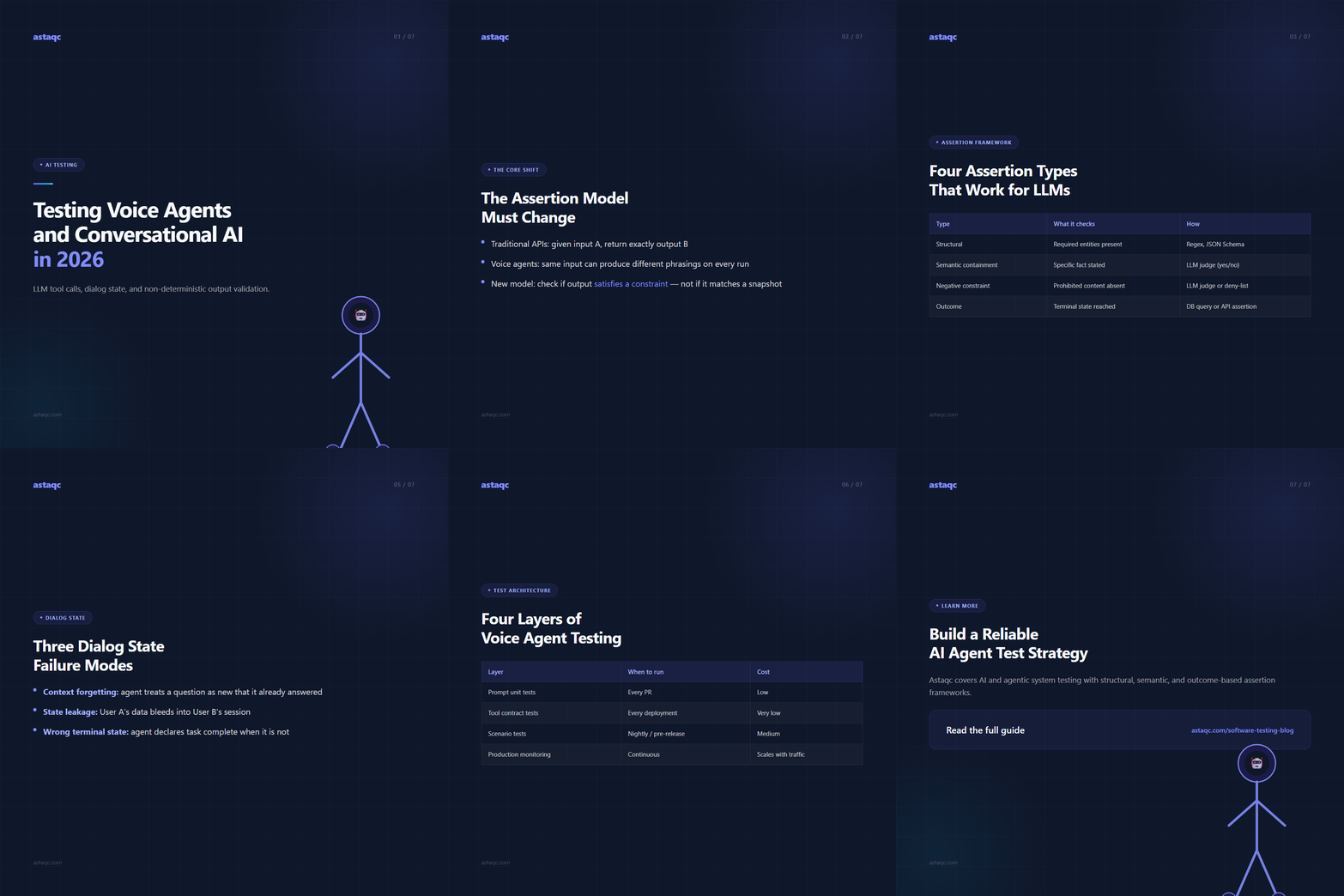
The core assertion model for voice agent testing is not the output equals X but the output satisfies constraint Y. That means checking whether the right tool was called with valid parameters, whether the conversation reached the correct terminal state, and whether the response stayed within defined guardrails — not whether the exact words matched a snapshot.
What Makes Voice Agent Testing Different From Traditional API Testing
Traditional API testing asserts deterministic behavior: given input A, the system returns exactly output B. Voice agent testing cannot do this because the LLM layer introduces probability distributions over possible outputs. Three specific differences shape how you design a test suite.
Non-deterministic text output. Two identical inputs to the same LLM can produce different phrasings, different levels of detail, and occasionally different conclusions. A snapshot-based test that asserts exact output strings will fail on irrelevant variation and give no signal on actual behavioral regressions.
Multi-step reasoning chains. A voice agent completing a task may call a retrieval tool, then a formatting tool, then a response generator — but the order and number of tool calls can vary depending on context. Testing requires coverage of outcomes, not step sequences.
Stateful conversation context. Unlike a stateless API, a voice agent accumulates context across turns. A test that checks only individual turns misses the class of bugs where the agent forgets an earlier constraint or repeats a question already answered.
| Dimension | Traditional API test | Voice agent test |
|---|---|---|
| Output assertion | Exact string or value match | Constraint satisfaction: contains key facts, avoids prohibited phrases, word count range |
| Tool call assertion | Not applicable | Tool was called, parameters were valid, return value was used correctly |
| Session assertion | Stateless; each request independent | Context retained across turns, correct terminal state reached after multi-turn dialog |
For background on AI testing at the application layer, see testing agentic AI systems in 2026 and the complete guide to software testing.
Defining Deterministic Assertions for Non-Deterministic LLM Outputs
The most reliable technique for asserting non-deterministic output is to separate the claims you care about from the phrasing used to express them. Four assertion types work reliably for LLM outputs.
Structural assertions. The response must contain specific entities: a phone number matching a known format, a date in ISO 8601 format, a URL pointing to a known domain. These can be asserted with regex or JSON Schema.
Semantic containment. The response must include a specific fact, stated in any form. Best evaluated by a secondary LLM judge: a simple prompt asking whether the response correctly answers the question, returning yes or no.
Negative constraints. The response must not contain prohibited content: competitor names, hallucinated pricing, statements about capabilities the agent does not have.
Outcome assertions. At the end of a multi-turn dialog, the conversation must have reached a defined terminal state: a booking was made, a ticket was created, an escalation was triggered.
| Assertion type | What it checks | Implementation |
|---|---|---|
| Structural | Required entities present in output | Regex, JSON Schema, or substring match |
| Semantic containment | Specific fact stated in any form | LLM judge (binary yes/no) |
| Negative constraint | Prohibited content absent | LLM judge or keyword deny-list |
| Outcome | Correct terminal state reached | Database query or API assertion on side effects |
Testing Tool Calls and Function Execution in Voice Agent Workflows
Tool call testing is the most reliable form of voice agent testing because tool calls have a deterministic interface: the function name, the parameter schema, and the return value are all defined ahead of time. Even when the agent's reasoning is non-deterministic, you can assert that the right tools were called with valid parameters.
Instrument the tool execution layer with a call recorder that logs every tool name and parameter set during a test run. At the end of the run, assert: the tool was called the expected number of times, the parameters matched the schema, the return value was used by the agent in the next turn, and no unexpected tools were called outside the agent's intended capability set.
Tool call testing also covers failure paths. When a tool returns an error, the agent should handle it gracefully: acknowledging the failure to the user, offering alternatives, or escalating. Test these paths explicitly by configuring the tool mock to return a 500 and asserting the agent's next-turn behavior.
See testing third-party integrations and webhooks and AI in software testing.
Dialog State and Session Management Validation
Dialog state testing validates that the agent correctly tracks and uses conversation context across multiple turns. This covers three common failure modes in production voice agents.
Context forgetting. After several turns, the agent treats a question as new that it already answered, or forgets a constraint the user set earlier. The test is a multi-turn scenario that checks the final-turn response for adherence to an earlier constraint.
State leakage between sessions. User A's session data bleeds into User B's session. Test this by running two concurrent sessions with different user profiles and asserting that each session's responses reference only that session's data.
Incorrect terminal state detection. The agent declares a task complete when it is not. Assert that the conversation ends in the correct terminal state and that the session is marked closed.
A minimal multi-turn test for a customer support agent: Turn 1 requests a delivery address change, Turn 2 provides the new address, Turn 3 confirms. Assert: address update tool was called with correct parameters; agent confirms the change and closes the task.
Run each scenario five to ten times and track the pass rate. A well-calibrated agent should complete this correctly 95% or more of the time. See testing LLM context windows and memory in 2026.
Building a Voice Agent Test Suite: Tools, Approaches, and CI Integration
A production-ready voice agent test suite has four layers: unit tests for prompt templates, integration tests for tool call contracts, scenario tests for multi-turn dialog behavior, and production monitoring for live traffic.
| Layer | What it tests | Run frequency | Cost |
|---|---|---|---|
| Prompt unit tests | System instruction correctness | Every PR | Low (small model) |
| Tool contract tests | Tool routing and validation | Every deployment | Very low (mocked LLM) |
| Scenario tests | Multi-turn dialog behavior | Nightly or pre-release | Medium (real LLM calls) |
| Production monitoring | Live traffic behavioral regression | Continuous | Scales with traffic |
Frequently Asked Questions
Can voice agent tests be fully automated?
The integration and unit layers can be fully automated. Scenario tests can be automated against fixed scripts and outcome assertions. Production monitoring is automated via sampling and classification. The only manual step is writing and reviewing the test scenarios and their expected outcomes.
How many times should I run a non-deterministic test before reporting a result?
Three to five runs per scenario is a practical minimum for local CI. For release gates, run each scenario ten times and require an 80% or higher pass rate.
What is an LLM judge and when should I use one?
An LLM judge is a separate model that evaluates the agent's output against a yes/no criterion. Use an LLM judge when the assertion cannot be expressed as a regex or a structural check, and when the volume is too high for manual review.
How do I test a voice agent that calls external APIs?
Use mocked tool implementations in integration tests and real tool implementations in scenario tests. In integration tests, the mock returns fixed responses that cover the happy path and all error cases.
Get Help with AI Agent Testing
If your team is building or scaling a voice agent and needs help designing a test strategy, Astaqc's software testing services cover AI and agentic system testing. See the AI in software testing guide and test automation services.
The core assertion model for voice agent testing is not the output equals X but the output satisfies constraint Y — check whether the right tool was called, whether the conversation reached the correct terminal state, and whether the response stayed within defined guardrails.
Astaqc Team
November 5, 2026