October 7, 2026
How TestInspector Tests Third-Party Integrations: Mocking External APIs, Simulating Webhooks, and Validating Integration Points Without Code
TestInspector tests third-party integrations through HTTP request steps — configurable GET, POST, PUT, PATCH, and DELETE requests with URL, headers, body, and multi-layer assertion fields, all configured in the UI without code. Teams use these steps to send a request to an external API, assert on the status code, parse the response body, extract values into variables, and chain them into subsequent steps that simulate the full integration flow. Webhook testing follows the same model in reverse: TestInspector sends a POST request to the application's webhook receiver endpoint, injects the payload the third-party service would send, and asserts on the application's response and downstream state. The result is a test that validates the integration contract between your system and external services without mocking infrastructure, without test utilities, and without writing code.
Third-party integration tests occupy a specific gap in most test suites: unit tests mock external services entirely, end-to-end UI tests are too slow and fragile to systematically cover API error paths, and dedicated API testing tools require code or YAML configuration that many QA teams cannot maintain. TestInspector closes this gap by making HTTP-level integration tests as accessible as browser-based UI tests — the same no-code interface, the same variable system, and the same scheduling and CI/CD trigger model apply equally to browser tests and HTTP tests.
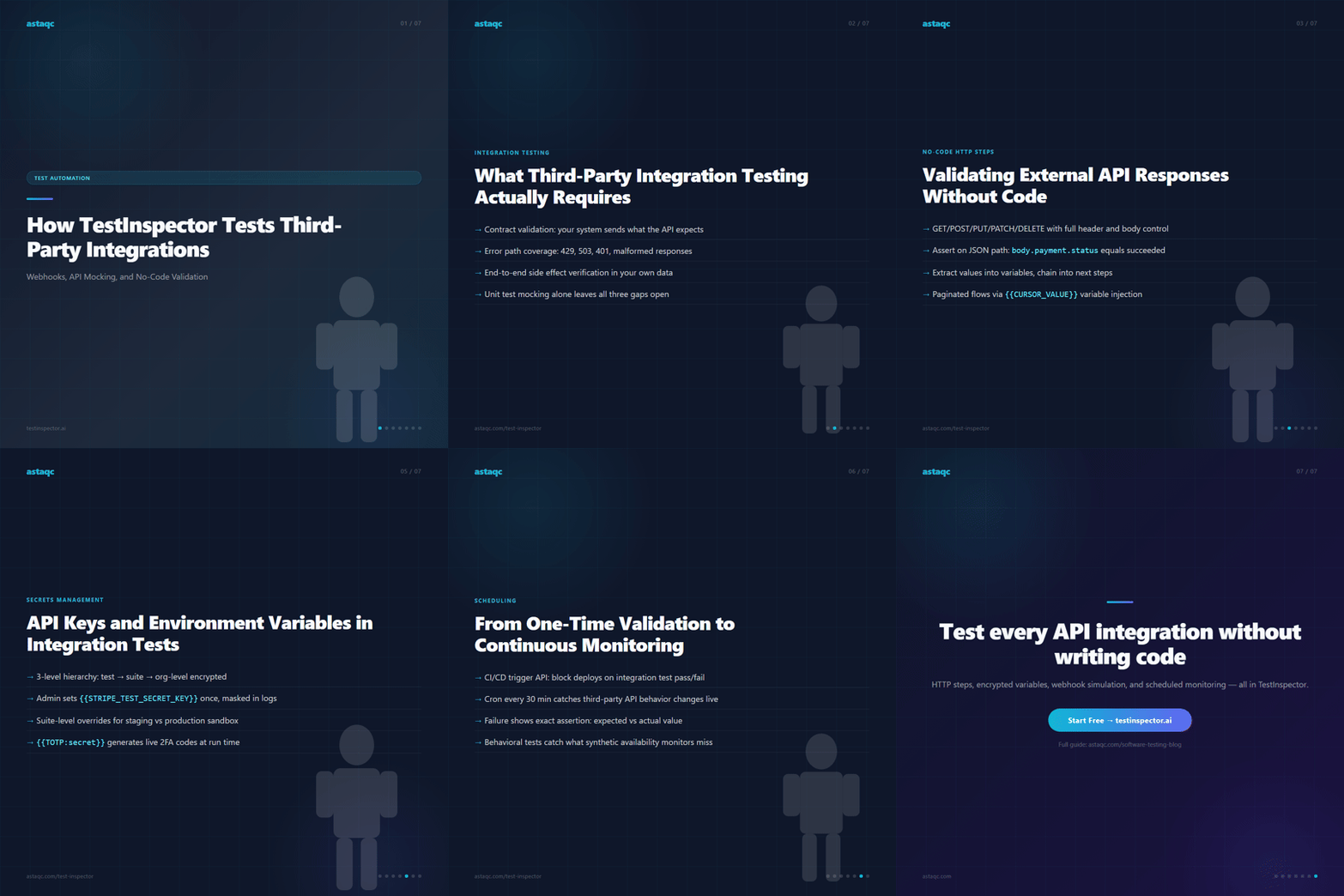
Third-party integration testing has three distinct requirements that unit tests and most UI tests do not address. The first is contract validation: verifying that your system sends requests in the format the external API expects and correctly handles the responses it sends back. The second is error path coverage: verifying that your system handles the failure modes the external API can produce — rate limit errors (429), service unavailable errors (503), authentication errors (401), and malformed response bodies — without cascading the failure into your own application's error state. The third is end-to-end side effect verification: verifying that the integration produces the correct downstream effect in your system, not just that the external API call completed.
Unit tests typically address only the contract part, with mocked responses. They cannot test real network connectivity, the actual response formats the API sends under different conditions, or the downstream side effects in your system's data. End-to-end UI tests can verify downstream effects but are slow, brittle, and cannot systematically exercise the error paths that real integrations fail on. The middle layer — HTTP-level integration tests that send real requests, assert on real responses, and verify real side effects — is where most testing gaps exist for third-party integrations.
Astaqc's software testing services include integration test design as part of test coverage audits. The complete software testing guide covers integration testing strategy including the boundary between unit test mocking and HTTP-level integration testing. The three-layer model — contract validation, error path coverage, and side effect verification — provides a checklist for evaluating whether an existing integration test suite is complete or has coverage gaps.
TestInspector's HTTP request step supports five HTTP methods (GET, POST, PUT, PATCH, DELETE) with full control over the request URL, query parameters, request headers, and request body (JSON, form data, or raw). Each step includes an assertions panel where test authors configure any number of assertions on the response: status code equals a target value, a body field at a specific JSON path equals an expected value, a response header contains a specific string, or a body value matches a regular expression.
The assertions panel supports deeply nested response structures through dot-notation JSON path syntax. A Stripe API response that includes payment_intent.status, payment_intent.charges.data[0].amount, and payment_intent.charges.data[0].payment_method_details.card.brand can each be asserted on separately in the panel. The test author does not need to write code to parse the response or traverse the structure — the assertion fields accept dot-notation paths that map directly to the response JSON. This means a QA engineer without JavaScript experience can write complete API contract tests for a payment integration on the first day of using TestInspector.
For external APIs that return paginated responses, TestInspector variable interpolation allows capturing a next_cursor or next_page_token from one step's response and injecting it into the next request URL or body. The variable {{CURSOR_VALUE}} is defined in the step's extract-to-variable configuration and used directly in the subsequent request. This pattern enables testing paginated flows, multi-step OAuth exchanges, and any integration where the second request depends on a value from the first response — without writing a loop or a callback function.
| Assertion Target | JSON Path Example | Assertion Type |
|---|---|---|
| Response status | (HTTP status field) | equals 200 |
| String field | body.customer.email | contains @domain.com |
| Numeric field | body.invoice.amount_due | equals 4999 |
| Nested boolean | body.subscription.active | equals true |
| Array element | body.items[0].sku | equals PROD-123 |
| Response header | Content-Type header | contains application/json |
Teams using TestInspector who store their Stripe, Twilio, or other third-party API keys as encrypted org-level variables can run complete integration tests against those APIs from the TestInspector UI without any local environment setup. Astaqc's test automation services help teams design assertion coverage for third-party integrations including the error path assertions most teams skip in their initial implementation — typically the 4xx paths that represent misconfiguration or expired credentials.
Webhook testing is the integration testing problem most teams defer because it appears to require infrastructure: a public endpoint for the webhook sender to call, a way to capture and inspect the received payload, and a mechanism to verify the downstream state change in the application. TestInspector solves this through the HTTP request step pointed at your own application's webhook receiver endpoint — instead of testing the integration by calling outbound, the test calls your webhook receiver directly with the payload the third-party service would send.
A Stripe webhook test in TestInspector works as follows. The test step sends a POST request to your application's /webhooks/stripe endpoint with a body matching the Stripe event object format: {"type": "payment_intent.succeeded", "data": {"object": {"id": "pi_XXXX", "amount": 4999, "currency": "usd", "status": "succeeded"}}}. The request headers include the Stripe-Signature header your webhook handler uses to verify authenticity — the value is either a test value the handler is configured to accept in test environments, or generated using the test webhook signing secret stored as an encrypted variable. The step asserts on the response: status 200, body.received equals true, or whatever your handler returns on success. A subsequent GET request to your application's order API asserts that the order status was updated — verifying that the webhook handler not only received the event but correctly processed it.
Covering error paths requires additional test steps with modified payloads: a payload with an invalid signature verifies your handler returns 401, a payload with an unsupported event type verifies your handler returns 200 without crashing (the common pattern is body.skipped equals true), and a payload with a missing required field verifies your handler returns 400 with an appropriate error. These error path tests are as important as the happy path test — webhook security vulnerabilities and silent failure modes are among the most commonly missed integration defects in production systems. Astaqc's testing documentation services include webhook test design templates covering Stripe, GitHub, Slack, and Shopify, with assertion patterns for each platform's signature verification scheme.
Third-party integration tests require API keys, client secrets, and auth tokens that cannot be hardcoded in test definitions. TestInspector's variable system addresses this through a three-level hierarchy: test-level variables (scoped to one test), suite-level variables (shared across a suite), and org-level variables (shared across the organization). Each level supports encrypted storage for sensitive values — the variable is stored encrypted and injected at run time without appearing in plaintext in the test definition or run logs. A test that uses {{STRIPE_TEST_SECRET_KEY}} in its Authorization header references an org-level variable that is set once by an admin and available to all tests without being visible to the test authors who use it.
For multi-environment testing — validating integrations against a staging version of a third-party service and against the production sandbox — the variable hierarchy allows environment-specific values to be set at the suite level without modifying individual test definitions. A suite configured for staging uses {{STRIPE_STAGING_KEY}} and {{STRIPE_STAGING_ENDPOINT}} as suite-level overrides; the same test suite run against the production sandbox uses different suite-level values. The test steps remain unchanged — only the suite-level variable values differ between environments. This separation means integration tests written once can validate multiple environments without any test definition changes.
| Variable Scope | Use Case | Security Model |
|---|---|---|
| Test-level | One-off values for a specific test step | Visible to test author |
| Suite-level | Shared values for a group of related tests | Visible to suite contributors |
| Org-level (encrypted) | API keys and secrets used across the organization | Admin-only, masked in logs |
| Built-in {{TIMESTAMP}} | Dynamic values generated at run time | All users |
| Built-in {{TOTP:secret}} | TOTP codes for 2FA-protected API endpoints | All users |
| Built-in {{ALPHANUMERIC}} | Random identifiers for test isolation | All users |
TestInspector's TOTP variable ({{TOTP:base32secret}}) generates a time-based one-time password at run time, which allows integration tests to authenticate against APIs that use 2FA without manual token entry. This is essential for testing admin API endpoints, customer portal integrations, and third-party services that require 2FA on their API access. Astaqc's hire QA team services include TestInspector variable hierarchy setup as part of integration test environment buildout, including encrypted org-level variable configuration for all connected third-party services.
Third-party integration tests serve two distinct purposes that require different execution models. The first is pre-deployment validation: running integration tests before deploying a change that touches third-party integration code, to verify the contract between your system and the external API has not broken. The second is continuous production monitoring: running a subset of integration tests on a schedule against the live integration, to detect third-party API behavior changes — rate limit policy changes, response format changes, new error codes — before they affect users.
TestInspector's scheduler supports both models. For pre-deployment validation, the CI/CD trigger API allows the build pipeline to trigger a TestInspector run as a build step and block deployment on the pass/fail result. The trigger API returns a run ID immediately; the pipeline polls the run status endpoint until the run completes and uses the result to gate the deployment. For continuous monitoring, the scheduler supports cron expressions, interval triggers, and one-time runs. A cron trigger configured for every 30 minutes runs the integration tests continuously — if an external API begins returning a new error format or changes a response field that the tests assert on, the next scheduled run catches the change and the failure appears in the run history with the exact assertion that failed and the actual versus expected values.
Astaqc's performance testing services extend this monitoring model to load-based assertions — verifying that the third-party integration performs acceptably under expected production request volume, not just that individual requests succeed under single-connection test conditions. The software testing cost guide covers how scheduled integration monitoring through TestInspector compares in cost to dedicated API monitoring platforms, and the AI in software testing guide covers how AI-assisted test generation can accelerate initial integration test coverage for new third-party services.
No. TestInspector's HTTP steps send real HTTP requests to real API endpoints. You can test against a third-party sandbox or test mode directly without any mocking infrastructure. If you want to test against mock responses without hitting a real endpoint, you would need a separate mock server — TestInspector does not include one, but it works with any mock server that exposes an HTTP endpoint.
Use the external service's sandbox or test mode for integration testing. Stripe, Braintree, PayPal, and most payment processors provide test API keys that accept test card numbers and simulate all response types including declines, 3DS challenges, and disputes without creating real transactions. Store the test API key as an encrypted org-level variable in TestInspector. For services without a sandbox, you can test the contract of outgoing requests and inbound webhook handling without executing real transactions, which covers the majority of integration failure modes.
TestInspector tests against HTTP endpoints, not databases directly. The verification pattern is to add a subsequent HTTP step that calls your own application's API to check the downstream state. A webhook test for a payment event would follow the webhook POST step with a GET to your order API that asserts the order status was updated correctly. If your application does not expose an API for checking webhook side effects, you can add a test-only endpoint that queries the database state and returns it as JSON — a common pattern for integration test verification that does not require exposing the database directly.
For tests that trigger rate limits, use TestInspector's scheduling and run sequencing to ensure integration tests run at intervals rather than all at once, and use the {{ALPHANUMERIC}} variable to generate unique identifiers per run so repeated runs do not conflict. For tests that verify your application handles a 429 response correctly, create a test step that sends a request designed to trigger a 429 against the external API sandbox, or use your application's own simulation endpoint if one exists. The error path test that verifies your application correctly handles rate limit responses is one of the most valuable integration tests to have in a production system.
Synthetic monitoring typically verifies availability and response time — that an endpoint returns a response within an acceptable time window. TestInspector's HTTP step tests are behavioral tests: they assert on what the response contains, not just that a response was received. The distinction matters because an integration can be available (returns 200) while being functionally broken (returns incorrect data or fails to process the payload). A scheduled TestInspector run that asserts on the full response structure catches functional regressions that a synthetic availability monitor would miss. Astaqc's test automation services help teams design the distinction between pure availability monitoring and behavioral integration testing for their specific third-party service portfolio.
The gap between a passing API test and a validated integration is the gap between asserting the server responded and asserting the server responded correctly. A status 200 with a null token field is a broken integration. HTTP request steps with multi-layer assertions are the mechanism for closing that gap without writing code.
October 7, 2026


Sign up to receive and connect to our newsletter

We founded ASTAQC as a tight-knit group of professional Software Testers and software developers.
Subscribe to our Newsletter