October 7, 2026
Test Infrastructure as Code in 2026: Managing Test Environments, Fixtures, and Configuration with Modern DevOps Tools
Test infrastructure as code means managing the environments, databases, seed data, and service dependencies that your tests require using the same declarative tools and source control practices that teams apply to production infrastructure. The practical result is reproducible test environments: a developer running tests locally, a CI pipeline running the same tests in parallel, and a staging validation run all use identically configured environments derived from the same code. The "works on my machine, fails in CI" failure class disappears when the test environment is not a manual configuration artifact but a versioned, executable specification that anyone on the team can reproduce from scratch in under ten minutes.
In 2026, the tooling for test infrastructure as code is mature and available across all cloud platforms, but adoption in QA teams lags behind adoption in platform engineering. The teams that have made the transition consistently report two improvements: a reduction in environment-related test failures (flaky tests that fail in CI but pass locally) and a reduction in the time required to onboard new team members to the test suite. Both improvements trace back to the same root cause — when the environment is code, it is auditable, reproducible, and reviewable in the same way the tests themselves are. Astaqc's software testing services include test environment architecture review as part of QA framework assessments. The complete software testing guide covers environment configuration as a foundational element of test suite reliability.
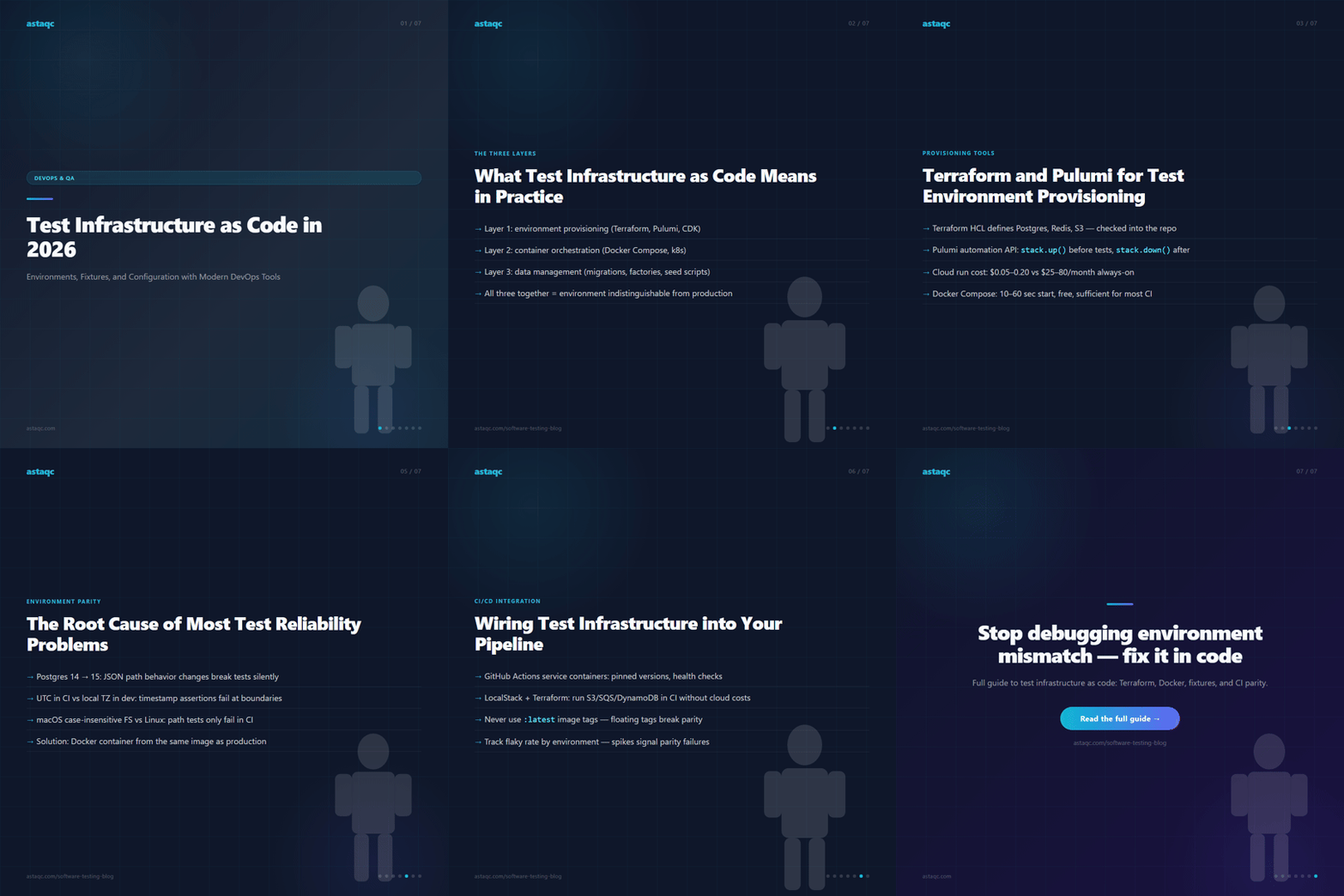
Test infrastructure as code is not a single tool — it is a principle applied through several complementary layers. The first layer is environment provisioning: using tools like Terraform, Pulumi, or AWS CDK to define the cloud resources (databases, caches, message queues, object storage) that tests need, and provisioning them reproducibly from a specification file checked into source control. The second layer is container orchestration: using Docker Compose or Kubernetes manifests to run service dependencies locally or in CI, with exact version pinning and configuration that matches the production service configuration. The third layer is data management: using migration tools, fixture generators, and seed scripts to populate test databases with the specific data state each test requires and reset that state between runs.
Teams that adopt all three layers have test environments that are indistinguishable from production in their configuration, differing only in data volume and compute scale. This matters for a specific class of defect: infrastructure-dependent bugs that appear in staging or production but not in development because the development environment uses a different database version, a different cache eviction policy, or a different network topology. Identifying these bugs requires reproducing the failure, which is only possible when the environment is code that can be compared across configurations. The manual versus automated testing guide discusses how manual exploratory testing in properly configured environments catches this defect class more reliably than automated tests in environments that differ from production. Astaqc's test automation services include environment parity audit as a standard deliverable in QA framework engagements.
Terraform and Pulumi are the two dominant infrastructure-as-code tools for test environment provisioning in 2026. Terraform uses HCL (HashiCorp Configuration Language), a declarative syntax that describes the desired end state of the infrastructure. Pulumi uses general-purpose programming languages — Python, TypeScript, Go — compiled to the same infrastructure definition. The choice between them matters less than the practice of defining test environments in code at all. Both tools maintain state files that track what has been provisioned, enabling the same environment to be updated, destroyed, and recreated reproducibly.
For test environments, the typical Terraform module defines a PostgreSQL database instance, a Redis cluster for session and cache dependencies, and an S3-compatible object store for file storage tests. The module takes environment-specific variables (environment name, instance size, region) and produces a consistent environment with the same schema and service versions across development, CI, and staging configurations. The module is checked into the same repository as the tests, so any configuration change that could affect test behavior is visible in the same pull request review as the test changes themselves.
The cost of cloud-based test environments is a real constraint that the provisioning approach must address. A PostgreSQL RDS instance running continuously in AWS costs $25–80 per month depending on instance size; running it only during CI test runs using Pulumi's automation API reduces this to the duration cost of the test run, typically $0.05–0.20 per run. For local development and most CI pipelines, Docker Compose is more practical than cloud provisioning — it is faster to start (10–60 seconds versus 2–8 minutes for cloud resources), free, and sufficient for the most common test environment requirements. Astaqc's software testing cost guide covers cost modeling for cloud-based test environments in detail.
| Tool | Language | Best For | Startup Time |
|---|---|---|---|
| Terraform | HCL | Cloud resource provisioning (AWS/GCP/Azure) | 2-8 min (new environment) |
| Pulumi | Python, TypeScript, Go | Programmatic provisioning and automation | 2-8 min (new environment) |
| Docker Compose | YAML | Local dev and CI service dependencies | 10-60 sec (container start) |
| AWS CDK | TypeScript, Python | AWS-only environments with CDK familiarity | 5-15 min (new environment) |
| LocalStack | Docker (AWS emulation) | Local/CI emulation of S3, SQS, DynamoDB | 15-45 sec |
The hardest problem in test infrastructure is not environment provisioning — it is test data state. An environment that starts with empty tables produces tests that must create their own data, which works for create-flow tests but fails for read-flow tests that need pre-existing records. An environment with a fixed seed dataset produces tests that depend on specific record IDs, which break when those records are modified by other tests. The solution is test-scoped data management: each test owns its required data, creates it as part of setup, and either deletes it or rolls it back after the test completes.
Database migration tools — Flyway, Liquibase, Alembic, or Rails migrations depending on the stack — handle the schema layer: every test environment runs the complete migration history and arrives at the same schema version as production. The migration run is a CI step that precedes the test run, not a manual setup step. This eliminates the entire class of test failures caused by schema differences between environments. Schema drift, where the development database has been manually patched and diverged from the migration history, is one of the most common causes of tests that pass locally and fail in CI.
For fixture management, factory libraries (FactoryBot in Ruby, factory_boy in Python, Faker combined with custom factories in TypeScript) generate test records programmatically with the exact field values each test requires. The factory approach is more maintainable than static seed files because factories adapt automatically to schema changes — when a new required column is added, the factory generates a valid value for it without requiring a seed file update. Transaction rollback is the most reliable isolation mechanism when the test and application code share a database connection: each test runs inside a transaction that is rolled back after the test, leaving the database in exactly the same state for the next test regardless of execution order. Astaqc's software testing services include fixture design and test data management architecture as a deliverable in QA framework engagements. The AI in software testing guide covers AI-assisted fixture generation for complex data models where hand-authoring factories is impractical.
For end-to-end tests where the test and application run as separate processes, transaction rollback is not available. The standard approach is database truncation and re-seeding between test groups: after each test group completes, the affected tables are truncated and the seed script runs again to restore the baseline state for the next group. This is slower than transaction rollback — a truncate-and-reseed cycle for a moderately complex schema takes 2–5 seconds — but it is reliable and works regardless of how the application accesses the database. Astaqc's test automation services include parallel test isolation design for teams scaling from sequential to parallel CI runs.
Environment parity — the degree to which test environments match production configuration — is the single largest driver of test reliability in 2026. Tests that pass in a development environment running PostgreSQL 14 on macOS may fail in a CI environment running PostgreSQL 15 on Ubuntu due to behavior differences in JSON operators, collation behavior, or lock timeout defaults. Tests that pass against a locally-run Redis instance may fail in CI against an ElastiCache cluster due to cluster mode configuration differences. These are not test bugs — they are environment parity failures, and they are invisible until the mismatch between environments surfaces a behavioral difference that a test happens to assert on.
The inventory of environment variables that affect test behavior is longer than most teams expect. Database minor version matters: PostgreSQL 14.8 and 14.10 have different behavior for specific edge cases in JSON path expressions and index scans. Character encoding configuration matters: a database configured with LC_COLLATE=en_US.UTF-8 and one with LC_COLLATE=C produce different sort orders for strings with non-ASCII characters — an internationalization test that passes in one fails in the other. Operating system timezone settings matter for any test involving timestamp storage or comparison, and they differ between macOS (which reads the user's local TZ) and Ubuntu CI runners (which typically default to UTC). Connection pool configuration matters: a development environment using a single connection and a CI environment using a pool of 10 can produce different locking behavior in concurrent tests.
| Parity Dimension | Common Mismatch | Test Failure Pattern |
|---|---|---|
| Database version | Dev: Postgres 14, CI: Postgres 15 | Edge case behavior differences, JSON path failures |
| Character encoding | UTF-8 vs Latin1 collation | Sort order failures, string comparison errors |
| Timezone | Local TZ on dev vs UTC on CI | Timestamp assertion failures, date boundary bugs |
| Connection pool | Single connection vs pooled 10 | Lock contention, race conditions in concurrent tests |
| Service version | Local Redis 6 vs ElastiCache Redis 7 | Command behavior changes, TTL handling differences |
| File system | macOS case-insensitive vs Linux case-sensitive | File path test failures that only appear in CI |
Containerization is the primary mechanism for achieving environment parity. When the test environment runs inside a Docker container built from the same image as the production service, the operating system, runtime versions, environment variables, and locale configuration are identical between development, CI, and production. Any configuration change to the Dockerfile that could affect test behavior must be reviewed as a code change — parity failures become visible in code review rather than discovered as unexplained CI failures. Astaqc's hire QA team services provide dedicated QA engineers who include environment audit and parity remediation in their initial engagement scope, and the outsource software testing guide covers how external QA teams handle environment management as part of a broader testing engagement.
The final layer of test infrastructure as code is integrating the environment lifecycle with the CI/CD pipeline. GitHub Actions, GitLab CI, and CircleCI all support service containers — database and cache dependencies defined in the pipeline YAML that start before the test run and are available at a predictable hostname. This is the entry-level implementation of test infrastructure as code and does not require Terraform or Pulumi: a services block with the correct database image, version, environment variables, and health check configuration is sufficient for many applications' test isolation requirements. The key requirement is that the service container image version is pinned (not latest) and matches the production service version — floating tags undermine parity and re-introduce the environment mismatch problem the approach is meant to solve.
For environments that require AWS services (S3, SQS, DynamoDB, SNS), LocalStack provides a containerized AWS emulation that can be run as a CI service container. Terraform modules can point at LocalStack endpoints when the AWS_ENDPOINT_URL environment variable is set, allowing the same infrastructure code that provisioned the production environment to provision the test environment locally and in CI without changes. This means integration tests that use S3 for file storage can run in CI without cloud costs or external network dependencies, using the same Terraform module and the same test code as the production integration. Astaqc's performance testing services extend the CI environment model to load testing — running realistic traffic volumes against the containerized environment to surface concurrency defects before staging deployment.
Observability for test infrastructure is often neglected. CI metrics on environment provisioning time, test run duration by environment configuration, and flaky test rate by environment surface the cost of infrastructure failures. A sudden increase in environment provisioning time in CI indicates a dependency change; an increase in the flaky test rate in CI that does not appear in local runs indicates an environment parity failure. Treating test infrastructure observability as a first-class concern — not just tracking test results but tracking the environments that produce them — is the difference between a test suite that reliably signals quality and one that produces unexplained failures the team learns to route around. Astaqc's outsource software testing guide covers how external QA teams can manage test infrastructure setup and maintenance as a service, reducing overhead on internal engineering teams that do not want to own environment management as a dedicated function.
No. Docker Compose is sufficient for most development and CI test environments. A docker-compose.test.yml file that defines pinned versions of PostgreSQL, Redis, and any other service dependencies your tests need is test infrastructure as code. Terraform and Pulumi add value when your tests need cloud resources that Docker Compose cannot emulate accurately, or when you need to provision isolated environments per PR for parallel testing workflows.
Three steps cover most of the benefit: pin all service dependency versions in your Docker Compose or CI service container configuration, add a database migration step to CI that runs before tests, and add a seed script that populates baseline test data from a version-controlled file. Together these three steps eliminate the most common environment-related test failures without requiring Terraform or a dedicated infrastructure engineer.
Transaction rollback handles this for integration tests where the test and application share a database connection — each test rolls back its transaction and the next test starts from a clean state. For end-to-end tests, use either separate database instances per parallel worker or a schema-per-worker approach where each worker operates in an isolated namespace. The database-per-worker approach is simpler to reason about and avoids cross-worker conflicts entirely; the schema-per-worker approach uses fewer resources but requires the application to support dynamic schema selection.
A QA environment is typically a long-lived shared environment used for manual testing and validation. Test infrastructure as code refers to ephemeral environments created on demand for automated test runs. The key distinctions are lifetime (ephemeral vs persistent), ownership (the test pipeline owns it vs a QA team owns it), and reproducibility (recreated from code vs maintained by manual updates). Both are typically present in mature engineering organizations — the QA environment handles exploratory testing and UAT, while the code-provisioned environments handle automated test isolation.
The two primary cost controls are using ephemeral environments (provision before tests, destroy after) and using LocalStack or Docker Compose to emulate cloud services locally rather than provisioning real cloud resources in CI. For teams that do need real cloud resources in CI, using smaller instance sizes for test environments and running tests only on pull requests that touch infrastructure-dependent code reduces the total environment runtime significantly. The software testing cost guide covers CI environment cost modeling with specific numbers for common configurations.
A test environment that exists only in a developer's memory, a shared wiki page, or a bash script no one has run in six months is not a test environment — it is a test liability. Infrastructure as code turns environment configuration into a reviewable, executable, version-controlled artifact that behaves the same way for every person and every CI run.
October 7, 2026


Sign up to receive and connect to our newsletter

We founded ASTAQC as a tight-knit group of professional Software Testers and software developers.
Subscribe to our Newsletter