Testing AI-Assisted Development Workflows in 2026: How to Validate Copilot-Generated Code, Inline Suggestions, and AI Refactoring Before It Ships
AI-assisted development tools — GitHub Copilot, cursor, Tabnine, and similar inline suggestion engines — have changed the rate at which code enters a codebase. They have not changed what that code needs to do before it ships: pass tests that verify its behavior against the specification. The testing gap that AI-assisted development creates is not in test volume but in test coverage orientation. Existing test suites were written to validate hand-authored code and reflect the patterns, structures, and edge cases that human developers typically produce. AI-generated code introduces new patterns and new edge-case behaviors that existing tests were not designed to catch.
This guide covers what that testing gap looks like in practice, the specific types of defects that appear most often in AI-generated code, and how to structure test coverage that catches these patterns before they reach production. The focus is on practical test design rather than on how AI tools work — the audience is QA engineers and developers who are already working with AI coding tools and need to know what their test suites are likely missing.
For teams managing QA coverage across AI-assisted development workflows, Astaqc's test automation services include specialist coverage for AI-generated code patterns. Teams looking to audit their existing test suites for AI-development coverage gaps can review Astaqc's software testing services for a structured approach to coverage analysis.
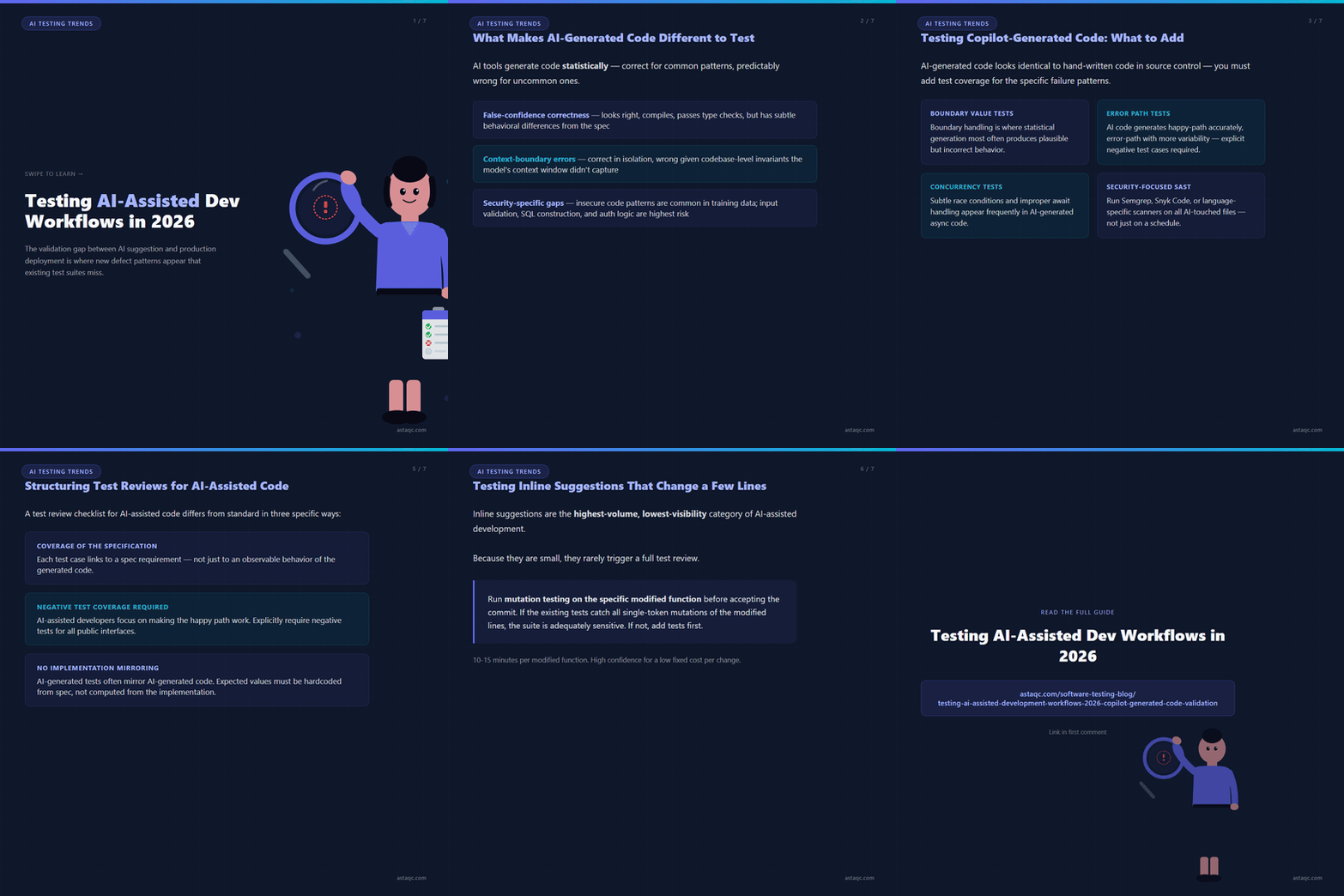
What Makes AI-Generated Code Different to Test
AI-generated code is statistically likely to be correct for common patterns and statistically likely to be wrong in specific, predictable ways for uncommon patterns. Understanding those failure modes is the foundation of effective test design for AI-assisted development workflows.
The first category is false-confidence correctness: the generated code looks right, compiles, passes type checking, and passes existing unit tests, but has subtle behavioral differences from what was intended. This occurs because the model generates code based on the statistical likelihood of the next token given the prompt and context, not based on a semantic understanding of the specification. For common patterns — a standard CRUD endpoint, a typical authentication check, a common data transformation — the statistical likelihood and the correct implementation overlap reliably. For uncommon patterns, they diverge.
The second category is context-boundary errors: the generated code is correct in isolation but incorrect given the specific constraints of the codebase it was inserted into. The model's context window captures the immediate file and perhaps adjacent files, but it does not reliably capture global invariants, cross-module assumptions, or non-obvious behavioral contracts that are only visible at the system level. Generated code that handles a null case by throwing is correct in many contexts but wrong in a codebase that has a convention of returning empty collections for null inputs.
The third category is security-specific gaps: AI tools are trained on a mixture of secure and insecure code, and they generate secure code most of the time for common patterns, but they generate insecure code more frequently than senior developers do for security-sensitive operations like input validation, SQL construction, deserialization handling, and authentication logic. This is not because the tools are bad — it is because secure implementation of these patterns is statistically less common in training data than the broader ecosystem of code they are trained on.
| Defect Category | Why It Appears | What Catches It |
|---|---|---|
| False-confidence correctness | Statistical generation, not semantic understanding | Specification-driven boundary and edge-case tests |
| Context-boundary errors | Context window does not capture global invariants | Integration tests that cross module boundaries |
| Security-specific gaps | Insecure patterns are common in training data | Targeted security tests + SAST on AI-touched files |
Testing Copilot-Generated Code: What to Add to Your Test Suite
When a developer accepts a Copilot suggestion for a function or block of code, the resulting code is indistinguishable in source control from hand-written code — there is no metadata indicating which lines were AI-generated. For test coverage purposes, this means you cannot rely on automated flagging of AI-generated sections. What you can do is add test coverage for the specific patterns where AI suggestions most commonly diverge from specification.
Boundary value testing becomes more important for AI-generated code than for hand-written code because boundary handling is where statistical generation most often produces plausible but incorrect behavior. A function that correctly handles typical inputs may handle the minimum-value input, the zero-value input, the maximum-value input, or the empty-collection input incorrectly if the boundary behavior was not explicit in the prompt. Add explicit test cases for all significant boundaries in any function that was substantially AI-assisted.
Error path testing is similarly important. AI-generated code tends to generate happy-path code accurately and error-path code with more variability. The error-path behavior depends heavily on the conventions of the codebase and surrounding context, which the model may not have fully captured. Explicit test cases for each error condition — not just that an error is thrown but that the correct error type is thrown with the correct message, and that any side effects that should not have occurred did not occur — provide the coverage that most AI-generated code is missing.
Concurrency and async handling is an area where AI tools generate code that looks correct but has subtle race conditions or improper await handling. Test coverage for async functions should include tests that verify behavior under concurrent access, that verify that async operations are properly awaited before accessing their results, and that verify that error handling in async code does not silently swallow exceptions. These defects are particularly common in AI-generated code and particularly hard to catch in code review.
For teams building coverage for AI-generated code at scale, Astaqc's QA team services provide specialist coverage for AI-assisted development workflows. The guide to test-driven development covers how TDD practices interact with AI coding tools, including how to write specifications before accepting suggestions to anchor the generated code to explicit requirements.
Validating AI Refactoring Before It Ships
AI refactoring — using an AI tool to restructure, rewrite, or simplify existing code — carries a specific testing risk that is different from AI code generation. When AI generates new code, the existing test suite provides a baseline. When AI refactors existing code, the test suite is supposed to verify that the refactoring preserved behavior, but only if the test suite was comprehensive enough to catch the specific behavioral changes that the refactoring introduced.
The most common refactoring defect in AI-assisted workflows is behavioral change that passes all existing tests. This happens when the refactoring changes behavior in a path that the existing tests do not exercise. AI refactoring tools optimize for the patterns they observe in the code being refactored, not for the full behavioral envelope of the function. If the original code had an undocumented special case for a specific input that is not tested, the refactoring may eliminate that special case while passing all tests.
The practical defense against this is mutation testing before accepting AI refactoring. Mutation testing verifies that the test suite is sensitive to the kinds of changes that AI refactoring commonly introduces: removed null checks, simplified conditional logic, extracted subexpressions, changed loop structures. Running mutation testing on the target code before refactoring establishes the test suite's current defect-detection capability. If the mutation score is below a threshold — say, 80% — add tests before accepting the refactoring.
Contract testing is a second technique that is particularly effective for AI refactoring validation. If the function being refactored has external callers that depend on specific behavioral contracts — return types, error types, specific null handling, specific edge-case behavior — explicit contract tests that document and enforce those contracts provide a safety net for the refactoring that general unit tests do not. AI refactoring is less likely to break a named, explicitly asserted contract than to break an implicit behavioral assumption.
Performance regression testing is an overlooked but important part of AI refactoring validation. AI tools may refactor code in ways that change its computational complexity or memory footprint without changing its functional correctness. A refactored O(n) sort that was previously O(n log n) is a functional correctness improvement, but a refactored O(n²) query that was previously O(n) is a performance regression that standard functional tests will not catch. Add performance assertions — or at minimum, compare execution time on a representative dataset — when accepting AI refactoring on performance-sensitive paths. See Astaqc's performance testing services for how performance testing integrates with refactoring validation workflows.

Structuring Test Reviews for AI-Assisted Development
Test review for AI-assisted development needs to cover not just the tests themselves but whether the tests are testing the right things given the specific risks of the AI-generated or AI-refactored code they cover. A test review checklist for AI-assisted code differs from a standard test review checklist in several specific ways.
Coverage of the specification, not just the implementation, is the first check. When a developer writes code and tests simultaneously, there is a natural tendency to test the implementation they wrote rather than the specification the implementation is supposed to satisfy. AI-generated code amplifies this risk: a developer who accepts a suggestion and writes tests for it is testing the AI's interpretation of the specification, not the specification itself. The test reviewer should verify that each test case corresponds to a requirement or specification item, not just to an observable behavior of the generated code.
Negative test coverage — tests that verify the system correctly rejects invalid inputs, handles error conditions, and enforces access controls — is a second check. AI-generated code is more likely than hand-written code to be missing negative test coverage because developers who write code with AI assistance tend to focus on making the happy path work. A test review checklist for AI-assisted code should explicitly require negative test coverage for all public interfaces and all security-sensitive operations.
Verification that tests do not duplicate the implementation is the third check. AI-generated tests (tests generated by an AI tool, as opposed to tests for AI-generated code) have a specific failure mode where the test mirrors the implementation logic rather than asserting against an expected outcome. A test that constructs the expected result using the same algorithm as the implementation under test is not a test — it is a duplication that will pass even when the implementation is wrong. Test reviews for AI-generated tests should verify that expected values are hardcoded from the specification, not computed from the implementation logic.
| Review Check | Why It Matters for AI Code | Pass Criterion |
|---|---|---|
| Coverage of specification | Tests may cover the AI's interpretation, not the spec | Each test case links to a spec requirement |
| Negative test coverage | AI-assisted code often skips error-path tests | Error paths and invalid inputs have dedicated tests |
| No implementation mirroring | AI-generated tests often mirror AI-generated code | Expected values are hardcoded from spec, not computed |
Frequently Asked Questions
How do you know if a CI failure is caused by AI-generated code?
You generally cannot distinguish AI-generated code failures from hand-written code failures in CI because there is no metadata in source control that flags AI-generated lines. The practical approach is to track which commits or PRs had significant AI assistance (a note in the PR description or a commit tag) and correlate CI failures with those PRs over time to identify whether AI-assisted PRs have higher defect rates in specific categories. If they do, that data supports adding specific test requirements to the AI-assisted development workflow — for example, requiring mutation testing on all AI-assisted functions above a size threshold, or requiring security-focused SAST on all AI-touched files.
Should we use AI tools to generate tests for AI-generated code?
Using AI to generate tests for AI-generated code amplifies both the value and the risk of AI-assisted development. The value is speed: AI tools can generate a broad test skeleton quickly, covering more scenarios than a developer might write manually. The risk is the implementation-mirroring failure mode: AI-generated tests for AI-generated code may pass despite the code being wrong because both the test and the implementation were generated from the same prompt with the same model. Mitigate this by requiring that AI-generated expected values be manually reviewed against the specification before accepting the tests. Never accept AI-generated tests without reviewing each expected value independently of the generated code.
What SAST tools are most effective for AI-generated code?
SAST tools that target security patterns are most effective for AI-generated code because security-specific gaps are the highest-risk category of AI generation defects. Tools like Semgrep with security rulesets, Snyk Code, and language-specific security scanners (Bandit for Python, Brakeman for Ruby, ESLint security plugins for JavaScript) provide targeted coverage for the input validation, injection, and authentication patterns where AI tools most commonly generate insecure code. Static analysis for general code quality (SonarQube, CodeClimate) is useful but less targeted for the specific AI generation risk profile. Run SAST on all files touched by commits with AI assistance as a minimum, and on all security-sensitive modules regardless of whether AI was used.
How does testing AI-assisted development workflows differ between languages?
The specific defect patterns differ between languages because AI tools are more accurate for languages with larger training corpora and clearer, more consistent idioms. Python and JavaScript have large, relatively consistent codebases in training data and tend to produce accurate suggestions for common patterns. Languages with smaller ecosystems or more varied idioms (Go, Rust, less common languages) show higher error rates for idiomatic code and more context-boundary errors. The testing approach is the same across languages — boundary testing, error path testing, security-focused SAST, mutation testing for refactoring — but the threshold for added test coverage should be higher for less-represented languages. For teams using AI tools across a polyglot codebase, Astaqc's software testing services provide specialist coverage for multi-language AI-assisted development workflows.
How do you test inline suggestions that change only a few lines of an existing function?
Inline suggestions that change a few lines are the highest-volume and lowest-visibility category of AI-assisted development. Because they are small changes, they rarely trigger a full test review. The effective defense is to run mutation testing on the specific function that was modified, not the whole file, before accepting the commit. If the existing test suite catches all single-token mutations of the modified lines — changed operators, flipped conditions, removed null checks — the test suite is adequately sensitive to the kind of change the inline suggestion made. If the mutation testing reveals gaps, add tests for the uncovered mutation patterns before accepting the change. This is a 10-15 minute process per modified function that provides high confidence that the inline suggestion is covered. See TestInspector for how UI-level test coverage complements unit-level mutation testing for AI-assisted changes in full-stack applications.
AI coding tools generate code fast, but generated code is not tested code — the validation gap between AI suggestion and production deployment is where new defect patterns appear that existing test suites were not written to catch.
Astaqc Team
November 21, 2026