October 6, 2026
How to Stop Green Tests from Lying: Assertion Gaps, Test Staleness, and CI Quality Gates That Actually Work
A green test means execution completed without throwing an exception — it does not mean the application behaved correctly. The gap between execution success and behavioral proof is the assertion gap: the difference between asserting that an endpoint returned HTTP 200 and asserting that it returned the correct data, in the correct format, with the correct side effects. Building CI/CD quality gates that actually stop bad deployments requires identifying where this gap exists in your pipeline, restructuring assertions to close it, and designing gate rules that block on behavioral evidence rather than execution evidence.
The assertion gap is not a theoretical concern. The testing community regularly surfaces concrete examples: pipelines that produce consistent green results while actual behavior is broken because the assertions verify that execution completed rather than that correct output was produced. Checkout flows that return HTTP 200 with error messages in the body. Authentication endpoints that return a token structure with null values. Data processing jobs that complete without errors but produce incorrect output. In each case, the test passes because execution succeeded; the defect hides behind the narrow scope of the assertion.
QA engineers and engineering managers who recognize this pattern often find it across large portions of their test suites — not because the tests were written poorly, but because the standard for a passing test was never explicitly defined to include behavioral proof. Astaqc's software testing services include assertion depth audits as a standard step in test suite reviews. The complete software testing guide covers assertion design as a foundational element of test quality strategy.
The assertion gap has three common structural causes. The first is assertion scope: the test asserts on a proxy measure rather than the intended outcome. A test that asserts an HTTP 200 status code is asserting on the proxy (the server responded) rather than the outcome (the server responded with correct data). A test that asserts an element is visible on a page is asserting on the proxy (the element rendered) rather than the outcome (the element shows the correct content). Proxy assertions catch a class of failure — server errors, rendering crashes — but miss all behavioral failures that occur within the range of a passing proxy.
The second cause is missing negative assertions: the test does not assert that error states are absent. A login test that asserts the dashboard URL appears after submission passes even when the dashboard URL appears alongside an error banner that the test does not check. A search test that asserts results are returned passes even when the results contain duplicates or incorrect ordering. Adding explicit assertions on the absence of error states — the error banner is not visible, the result count matches the expected count, the ordering is correct — transforms proxy assertions into behavioral assertions that catch the realistic failure modes in the feature.
The third cause is assertion timing: the test asserts at the moment of response rather than after the full side effect has completed. A test that asserts a record was created by checking the API response passes even when the creation is asynchronous and the record has not yet persisted at assertion time. An event-driven system where the API acknowledges receipt but processes asynchronously will produce green tests that do not wait for processing to complete. Assertions that rely on polling or eventual consistency checks close this timing gap. Astaqc's test automation services and the AI in software testing guide cover assertion timing patterns for asynchronous systems and event-driven architectures.
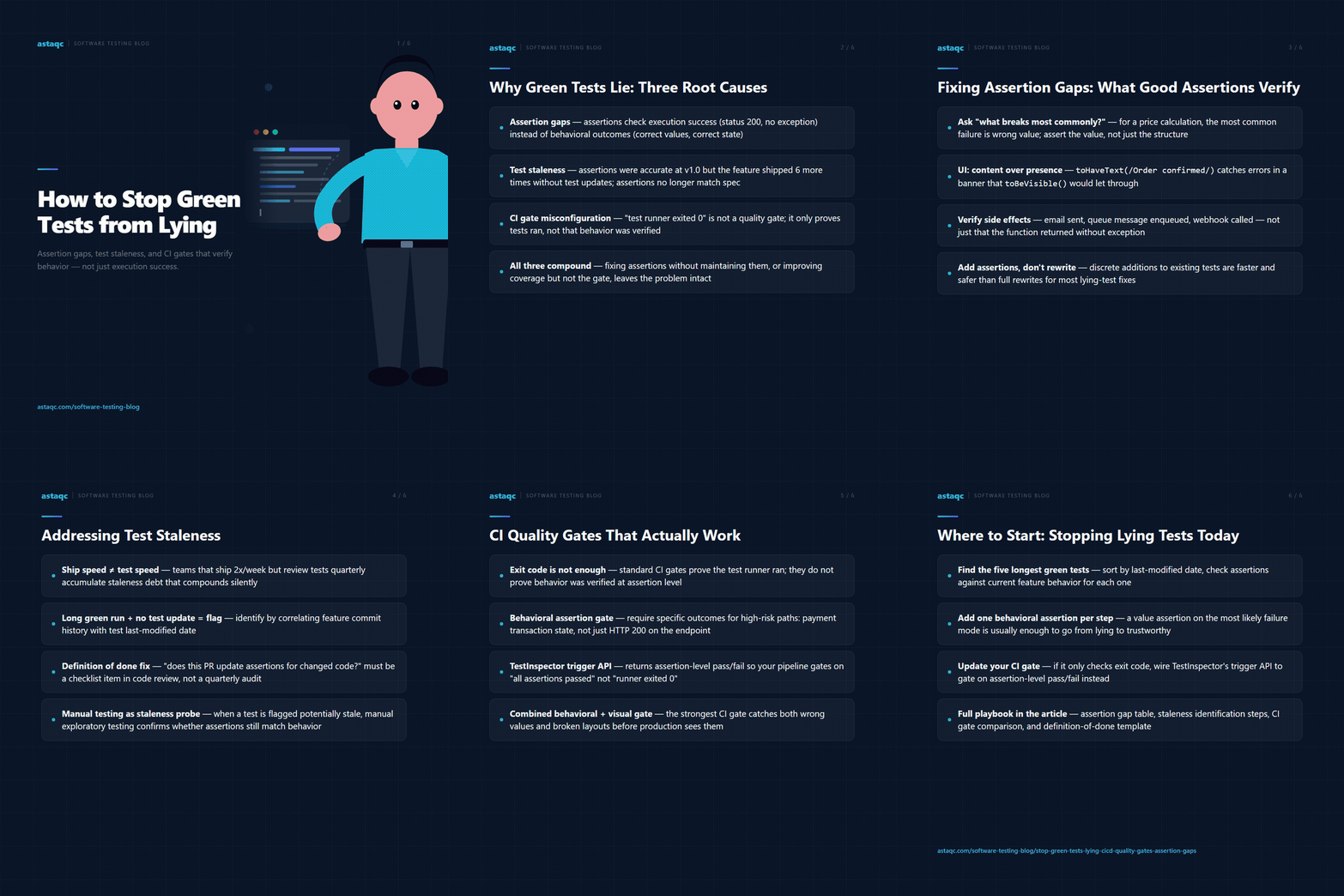
An assertion that stops green tests from lying must verify a behavioral outcome that would be wrong if the feature were broken. The test for a login endpoint should assert that the response body contains a valid token (not just that the status code is 200), that the token has the correct structure (not just that a token field exists), and that an invalid password produces the correct error response (not just that the server returns a 4xx). Each of these assertions corresponds to a specific way the login feature could be broken while still returning non-error HTTP responses.
The assertion review process starts with a question: if this assertion passed while the feature were broken in the most common way, would the test catch it? For a price calculation endpoint, the most common failure is a wrong value — the endpoint returns the correct structure with an incorrect number. An assertion that only checks the response structure (the body has a total field) would not catch this. An assertion that checks total === expected_price would. The difference between a test that lies and one that does not is often a single additional assertion on the value rather than the structure.
For UI tests, the assertion gap typically lives between element presence and element content. A test that asserts expect(successBanner).toBeVisible() without asserting on its text content will pass even if the success banner renders an error message. A test that asserts expect(successBanner).toHaveText(/Order confirmed/) verifies the behavioral outcome — the correct message was rendered, not just that a banner appeared. This pattern applies to every UI assertion: presence is a weak signal, content is a strong signal, and behavior (what happens after interaction) is the strongest signal of all.
| Test Level | Weak Assertion (Lies) | Strong Assertion (Catches Breakage) |
|---|---|---|
| API / HTTP | Status code is 200 | Status is 200 AND body.token is non-null AND body.error is absent |
| UI / DOM | Success banner is visible | Banner text matches /Order confirmed/ AND error banner is not visible |
| Database | Insert operation completed | Row exists with correct values for all non-default fields |
| Calculation | Function returned without exception | Return value equals expected result for each edge case input |
| Side effect | Function completed | Email was sent, queue message was enqueued, webhook was called |
Teams using TestInspector can add multi-layer assertions to HTTP steps through the assertions panel without writing code: each assertion target (status, body field path, header), operator (equals, contains, matches, is not null), and expected value is configured as a discrete step in the UI. The AI chat interface generates assertion sets for HTTP steps from a description of the expected response, which surfaces assertion gaps by showing what a complete assertion set looks like relative to what is currently configured. The AI in software testing guide covers how AI tools can be used to audit and improve assertion coverage systematically.
Test staleness accumulates when feature development and test maintenance run at different speeds. A team that ships two features per week but reviews its tests for staleness once per quarter will develop a gap between what the tests verify and what the features currently do. The gap is invisible in the test results — stale tests pass as reliably as current ones — and only becomes visible through a systematic review or a production incident that the tests failed to prevent.
The first step in addressing staleness is identification: which tests are most likely to have drifted from the current feature specification? The answer is tests that cover features that have been modified frequently without corresponding test updates. A login feature that has been shipped six times in three months while its test suite has not changed is a staleness signal. A price calculation feature that has had three business rule changes since its tests were last updated is a staleness signal. Identifying staleness requires correlating test modification history with feature modification history, which most test frameworks do not provide automatically.
TestInspector's run history view surfaces last-modified dates for each test alongside run results, making staleness identification possible without a manual audit of git history. Teams can scan for the pattern of long-stable pass rates combined with no test updates, identify the tests most likely to have drifted, and prioritize them for assertion review. Astaqc's manual testing services complement this process: when a test is flagged as potentially stale, manual exploratory testing of the covered feature can confirm whether the current behavior matches what the test asserts, at a lower cost than a full test suite rewrite.
Preventing future staleness requires a process change: test updates must be treated as part of the definition of done for every feature change, not as optional maintenance. Code review checklists that include a question about test assertion currency — “does this PR include updates to the assertions of any test that covers the changed code?” — surface the staleness risk at the right moment. Teams that defer this question to a quarterly audit are consistently surprised by the gap they find. Astaqc's test automation services include definition-of-done checklist design as a standard deliverable in QA framework audits, and the manual vs automated testing guide covers how the two approaches complement each other in a sustainable testing strategy.
A CI quality gate that prevents green tests from reaching production must check more than test runner exit codes. The most important change is separating execution success from behavioral verification: the pipeline should fail if any assertion type produces a failure, not just if the test runner crashes. Most CI configurations already do this for standard assertion failures — a failed expect() call in Jest or a failed assert in pytest produces a non-zero exit code that fails the build. The gap is not in the mechanics of assertion checking but in the completeness of what the assertions cover.
The structural improvement to CI quality gates is adding a coverage gate on top of the execution gate. A coverage gate that requires minimum line or branch coverage is common. What is less common, and more valuable, is a gate that requires assertions on specific behavioral outcomes for specific features. This is harder to implement generically but feasible for high-risk paths: for a payment processing flow, the CI gate should require not just that the test passes but that the test includes an assertion on the final transaction state — not just on the HTTP response. This kind of behavioral assertion gate requires agreement on what the critical behavioral outcomes are for each feature, which is a product and QA decision as much as a technical one.
TestInspector's CI/CD trigger API enables a different model: the pipeline triggers a TestInspector run and gates on the pass/fail result from the API, which includes the outcome of every individual assertion, visual regression check, and run history signal. This gives the CI pipeline visibility into behavioral verification at the assertion level, not just at the test level. A pipeline that gates on “all TestInspector assertions passed” is a stronger gate than one that gates on “test runner exited 0” because it requires specific behavioral outcomes to be verified, not just test execution to complete without crashing. Astaqc's performance testing services extend this model to load-based behavioral verification — ensuring that behavioral assertions pass under expected production throughput, not just under the low-concurrency conditions of a single test run.
| CI Gate Type | What It Catches | What It Misses |
|---|---|---|
| Exit code gate | Test runner crash, fatal assertion failure | Shallow assertions, stale assertions, missing coverage |
| Line coverage gate | Untested code paths | Assertion quality on covered paths |
| Behavioral assertion gate | Wrong values on specific outcomes | Visual regressions, performance regressions |
| Visual regression gate | Layout changes not caught by DOM assertions | Business logic failures with no visual impact |
| Combined behavioral + visual gate | Both behavioral and visual regressions | Staleness (requires separate staleness signal) |
A flaky test fails intermittently — it draws attention through inconsistency and eventually gets fixed or quarantined. A test that lies passes reliably while the feature it covers has behavioral failures the test cannot detect. The test that lies is more dangerous because it provides consistent false assurance. Teams learn to trust green runs; a test that lies exploits that trust to conceal defects until they reach production. Flakiness is a quality maintenance problem with a visible signal. False assurance is a quality assurance gap with no visible signal.
The highest-risk tests are those that have had the longest unbroken green run combined with the oldest assertion update date, covering features that have been modified frequently. Sorting your tests by last-modified date and cross-referencing with git blame on the features they cover surfaces the candidates quickly. For each candidate, the question is: if this feature broke in the most common way — wrong value returned, wrong state persisted, wrong UI rendered — would any of this test's current assertions catch it? If the answer is no, the test is lying. Run history in TestInspector shows last-modified dates for tests alongside pass rate history, making this triage straightforward without requiring a full git blame audit.
Add assertions first — rewriting is slower and introduces risk of inadvertently removing assertions that were accurate while fixing ones that were not. For each identified lying test, enumerate the behavioral outcomes that matter for the covered feature, check which ones the current assertions cover, and add discrete assertions for the ones that are missing. The goal is not a perfect test but a test that would fail if the feature broke in its most likely failure mode. A rewrite makes sense only when the test's structure is so misaligned with the current feature that adding assertions to it would be misleading.
HTTP response body assertions and UI content assertions add negligible overhead — they are in-memory comparisons of data already fetched. The only assertions with meaningful overhead are those that trigger additional I/O: database reads to verify persistence, API calls to check side effects, or file system reads to verify generated output. For most tests, adding three to five behavioral assertions per step adds under a millisecond of execution time. The slowdown is not in assertion evaluation; it is in test maintenance — more specific assertions require more updates when the feature changes intentionally. This is the right tradeoff: the alternative is a test suite that passes confidently while missing behavioral failures.
Test staleness is a process failure: the team's definition of done for feature changes does not include “update test assertions to reflect the new behavior.” Addressing staleness sustainably requires adding this to the definition of done and enforcing it in code review. A PR that modifies a feature without updating the assertions of its tests is incomplete. The code reviewer who approves it is accepting the staleness debt. Making this visible in the review process — a checklist item, a PR template question, or a test modification check that alerts when a feature file changes without a corresponding test file change — prevents accumulation. Astaqc's test automation services include PR template and definition-of-done design as part of QA framework setup.
TestInspector addresses all three root causes. For assertion gaps: its HTTP step assertions panel supports multi-layer assertions (status, body field values, headers) configured through the UI without code, and the AI chat interface generates complete assertion sets for any HTTP step. For staleness: run history shows last-modified dates for each test alongside pass rate trends, surfacing the long-stable, never-updated pattern that indicates staleness risk. For CI gates: the CI/CD trigger API returns assertion-level pass/fail results, giving the pipeline visibility into behavioral verification rather than just test runner execution. Teams that use TestInspector as the behavioral verification layer in their CI pipeline have a gate that distinguishes between execution success and behavioral correctness — which is the core requirement for a test suite that does not lie. Astaqc's software testing services help teams integrate TestInspector into their existing QA framework with assertion audits, CI gate configuration, and ongoing quality monitoring.
The test passes. The feature is broken. Somewhere between writing the assertion and shipping the change, the test became a ritual rather than a check. Stopping green tests from lying starts with understanding why they lie in the first place.
October 6, 2026


Sign up to receive and connect to our newsletter

We founded ASTAQC as a tight-knit group of professional Software Testers and software developers.
Subscribe to our Newsletter