September 22, 2026
TestInspector’s HTTP request steps let QA teams validate payment APIs, webhook callbacks, and status code contracts without writing code. A test that calls a payment initiation endpoint, asserts the response contains a transaction ID, and verifies the returned status is 201 can be built in TestInspector without Postman collections, custom scripts, or developer involvement. Payment integration testing has historically required either coding skills or expensive API testing platforms; TestInspector’s no-code HTTP step approach removes both requirements.
Payment API testing carries higher stakes than most other integration testing work. A bug in a checkout flow, a webhook handler, or a refund endpoint translates directly to revenue impact, customer trust loss, or compliance exposure. Teams that rely on manual QA for payment paths typically catch regressions late in the release cycle when they are expensive to fix. Teams that rely on end-to-end browser tests contend with external dependencies, test credit card management, and non-deterministic third-party sandbox environments. HTTP-level testing targets the interface between your application and the payment processor directly, without browser overhead or full session state.
This guide covers what payment integration testing involves, how TestInspector HTTP request steps work in practice, how to test Stripe webhooks and event callbacks, and how to build reliable assertions for status codes, response bodies, and error flows. For broader context on API testing strategy, see Astaqc’s test automation services and manual vs. automated testing guide. For information about the TestInspector platform itself, visit TestInspector.
Payment integration testing validates the interfaces between your application and payment processing systems: the API endpoints that initiate charges, refunds, and subscriptions; the webhook handlers that receive asynchronous event notifications; and the status code contracts that your application depends on to determine whether a transaction succeeded, failed, or is pending further action.
Unit tests with payment client mocks validate that internal code calls the mock correctly, not that the actual API responds as expected. When Stripe updates a response field, adds a required parameter, or changes error code semantics, mocked unit tests continue to pass while the production integration breaks. Browser-based end-to-end tests drive the full checkout UI, adding state management, authentication, and browser timing complexity that is unnecessary when the goal is validating the API contract. Manual testing is too slow and inconsistent for CI gating and cannot run on every deployment to catch regressions before they reach production.
HTTP request step testing targets the API layer directly. It sends the same requests your application sends, validates the same response fields your application reads, and asserts the same status codes your application branches on. It runs as part of a CI pipeline on every deployment, catching payment integration regressions before they reach staging or production. For teams using Astaqc’s software testing services, payment API test coverage is typically among the first automation priorities due to its direct impact on revenue integrity.
| Testing Approach | What It Validates | Catches API Contract Changes? | CI Compatible? |
|---|---|---|---|
| Unit tests (mocked) | Internal logic with fixed mock response | No | Yes |
| Browser E2E tests | Full checkout flow via UI | Partially (UI-visible failures only) | Slow and fragile |
| HTTP request steps | Status codes, response fields, error shapes | Yes, directly | Yes, fast |
| Manual testing | Exploratory flows, visual confirmation | Inconsistently | No |
TestInspector’s HTTP request step is a structured test action that specifies a method (GET, POST, PUT, PATCH, DELETE), a URL, optional request headers and body, and assertion rules against the response. A step can assert the status code, check that a specific key exists in the response body, compare a response field value against a literal or against a variable, or verify that the response body contains a specific string. All of these are configured through TestInspector’s interface without writing code.
For payment API testing, the most common pattern is a multi-step test sequence that chains HTTP steps together. The first step authenticates against the API to retrieve a bearer token, storing the token in a {{AUTH_TOKEN}} variable. The second step calls the payment initiation endpoint, passing the token as a request header and the payment data as a JSON body, and asserts that the response status is 201 and that the body contains a transaction_id field. The third step calls a status retrieval endpoint using the {{transaction_id}} variable captured from the previous step, and asserts that the status field is pending or succeeded. This sequence validates the create-and-confirm pattern that most payment APIs use, without writing a single line of code.
Variable interpolation is central to payment API testing in TestInspector. TestInspector supports {{VAR}} for environment variables, {{TIMESTAMP}} for unique identifiers (useful for generating unique order IDs in each test run), and {{ALPHANUMERIC}} for random string generation. Variables are organized in a three-tier hierarchy: test level, suite level, and organization level, with each tier inheriting from the one above. Payment credentials stored at the organization level—Stripe sandbox API keys, test card tokens, idempotency key prefixes—are available to all tests without being duplicated across test definitions. Sensitive values including API keys and webhook signing secrets are stored with encrypted storage and are never exposed in run logs.
TestInspector’s self-healing behavior applies to HTTP step tests: if the test fails because a response field changed (for example, a key was renamed in the API response), TestInspector’s AI provides selector suggestions for the new field name. The retry and auto-recovery logic also reduces transient failures caused by API rate limiting, temporary network errors, or sandbox environment instability during test runs. Run logs stream via WebSocket in real time, so QA engineers can see the request URL, status code, headers, and response body for each step as the test executes.
Webhook testing is the most commonly undercovered area of payment integration testing. Stripe and similar payment processors send asynchronous event notifications to your server when payment state changes: payment_intent.succeeded, payment_intent.payment_failed, charge.refunded, invoice.payment_failed. Your application’s webhook handler receives these events, validates the Stripe signature, and updates order status, sends confirmation emails, releases held inventory, or triggers fulfillment workflows. If the handler fails silently or processes events out of order, customer-visible state in your application becomes incorrect.
Testing webhook handlers directly with HTTP request steps requires simulating the POST request that Stripe would send to your webhook endpoint. The test constructs a JSON body that matches the Stripe event schema for the specific event type being tested, includes the Stripe-Signature header using a test webhook secret stored in a TestInspector organization variable, and sends the POST request to your webhook endpoint URL. The assertions check that your endpoint returns 200 (the expected acknowledgment), and subsequent steps can call your application’s order status API to verify that the application state updated correctly in response to the webhook event.
For teams using Stripe CLI for local webhook forwarding during development, TestInspector tests can target the forwarded URL in development environments and the live webhook endpoint in staging, controlled by environment-level variable overrides in the test suite. This approach tests the same handler code in both environments without modifying the test steps themselves. The webhook signing secret is stored as an encrypted organization variable, making it accessible in test header configuration without appearing in run logs or test definitions.
The most important webhook test cases to automate are: the happy path where a payment_intent.succeeded event triggers the expected order fulfillment; the failure path where payment_intent.payment_failed correctly marks the order as failed and does not fulfill; and the idempotency path where the same event ID sent twice produces the same outcome without duplicating the action. Idempotency testing for webhooks—verifying that duplicate deliveries do not produce duplicate effects—is frequently missed in manual testing and is a direct source of double-charge or double-fulfillment bugs in production. For teams building comprehensive payment test coverage, Astaqc’s manual testing services complement automated webhook tests by covering exploratory scenarios that structured test cases do not anticipate.
Payment APIs use status codes and structured error objects consistently across providers. HTTP 200 and 201 indicate success; 400 indicates a client-side validation error in the request; 401 indicates an authentication failure; 402 is used by some payment APIs specifically for payment-required errors; 422 indicates a processing error on a well-formed request; 429 indicates rate limiting; and 5xx indicates server-side errors. Your test suite should verify not only the happy path but also the most common error paths, because your application’s error handling behavior for payment failures is as critical as its success path behavior.
For each payment API endpoint, the minimum test cases are: a valid request that produces the expected success status and response fields; a request with an invalid API key that returns 401; a request with a malformed body that returns 400 with an error object containing a machine-readable error code; and a request with a test card number that triggers a specific decline reason. For Stripe, test card numbers like 4000000000000002 produce card_declined errors, 4000000000009995 produce insufficient_funds, and these are documented in the Stripe test mode reference. These decline-specific test cases verify that your application handles different failure reasons differently when the business logic requires it, such as showing a different error message for insufficient funds versus a stolen card flag.
Response body assertions in TestInspector check that specific JSON keys exist, that key values match expected literals or patterns, and that numeric fields fall within acceptable ranges. For payment responses, useful assertions include: verifying the status field equals a specific string; checking that the amount in the response matches the amount sent in the request; confirming that currency is in the expected ISO 4217 format; and verifying that the id field is present and non-empty. Capturing response fields as variables using TestInspector’s variable extraction allows chaining these assertions across multiple steps in the same test sequence.
Error path coverage should also include timeout behavior where possible. TestInspector’s HTTP steps support timeout configuration, which can be used to verify that your application handles slow responses without hanging indefinitely. For teams using Astaqc’s QA team services, payment API test coverage typically includes a test matrix mapping each error code to the expected application behavior, reviewed with product and engineering to confirm alignment between the test assertions and the intended user experience for each failure scenario. See also Astaqc’s complete software testing guide for context on integrating payment API tests into a broader quality strategy.
TestInspector runs tests against any URL you configure. For payment APIs, running against a live production environment means real charges could be made if the test sends valid payment data. The standard practice is to test against the payment processor’s sandbox environment, which accepts test card numbers and credentials that do not process real payments. For production monitoring scenarios—verifying that the payment endpoint is reachable and returning expected status codes without initiating a transaction—TestInspector’s HTTP steps can send a request that triggers a 401 (no auth) or performs a read-only lookup like retrieving an existing transaction, confirming connectivity without processing a payment.
Payment processor sandboxes typically have less restrictive rate limits than production, and most do not simulate 429 responses by default. Testing your application’s 429 handling typically requires either a sandbox environment that supports rate limit simulation, or a mock server that returns 429 responses for specific test cases. TestInspector tests can target a mock endpoint for rate limit response testing while targeting the real sandbox for all other payment test cases, with the mock URL stored as an environment variable that overrides the real URL in specific test suites.
TestInspector’s {{TIMESTAMP}} and {{ALPHANUMERIC}} variables generate unique values on each test run, making them useful for order reference numbers, idempotency keys, and customer email addresses that need to be unique to avoid conflicts between parallel CI runs. For fields that require specific formats—such as a merchant reference number with a specific prefix and numeric suffix—TestInspector supports variable concatenation patterns where a fixed prefix is combined with a dynamic suffix using these built-in variable types.
Webhook signature verification checks that the POST request originated from the payment processor, not from an unauthorized sender. For testing purposes, you have two options: compute a valid signature using the webhook signing secret and include it in the test request headers, or configure a test-specific endpoint that bypasses signature verification when a specific test header is present. The first approach is closer to production behavior and is generally preferred; TestInspector’s encrypted variable storage for the signing secret keeps the credential secure while making it accessible in test header configuration.
TestInspector’s HTTP request steps cover the same functional ground as Postman collections for synchronous API testing: defining requests, configuring headers and bodies, capturing response variables, and asserting against response fields. The key difference is the execution model. Postman collections are typically run manually or via Newman in CI as standalone test runs separate from the rest of the QA automation. TestInspector integrates payment API tests into the same test suite and scheduling infrastructure as browser UI tests, allowing a single CI trigger to run both UI and API tests with combined results in one place. For teams transitioning from manual testing, this consolidation reduces toolchain complexity and makes payment test coverage visible alongside the rest of the automated test suite.
The highest-priority payment test cases are those where a silent failure has the most severe business consequence: a successful charge that does not fulfill the order (webhook handler failure), a failed payment that the UI reports as successful (status code handling error), and a refund API call that returns 200 but does not actually process (response validation gap). These three failure modes have the highest revenue and trust impact and are the ones most likely to be missed by manual QA. Start with these, add decline handling and idempotency tests next, and add edge cases like currency formatting and amount rounding after the critical paths are covered. Astaqc’s testing documentation services can help teams build the test matrix and runbooks that define which error codes map to which application behaviors.
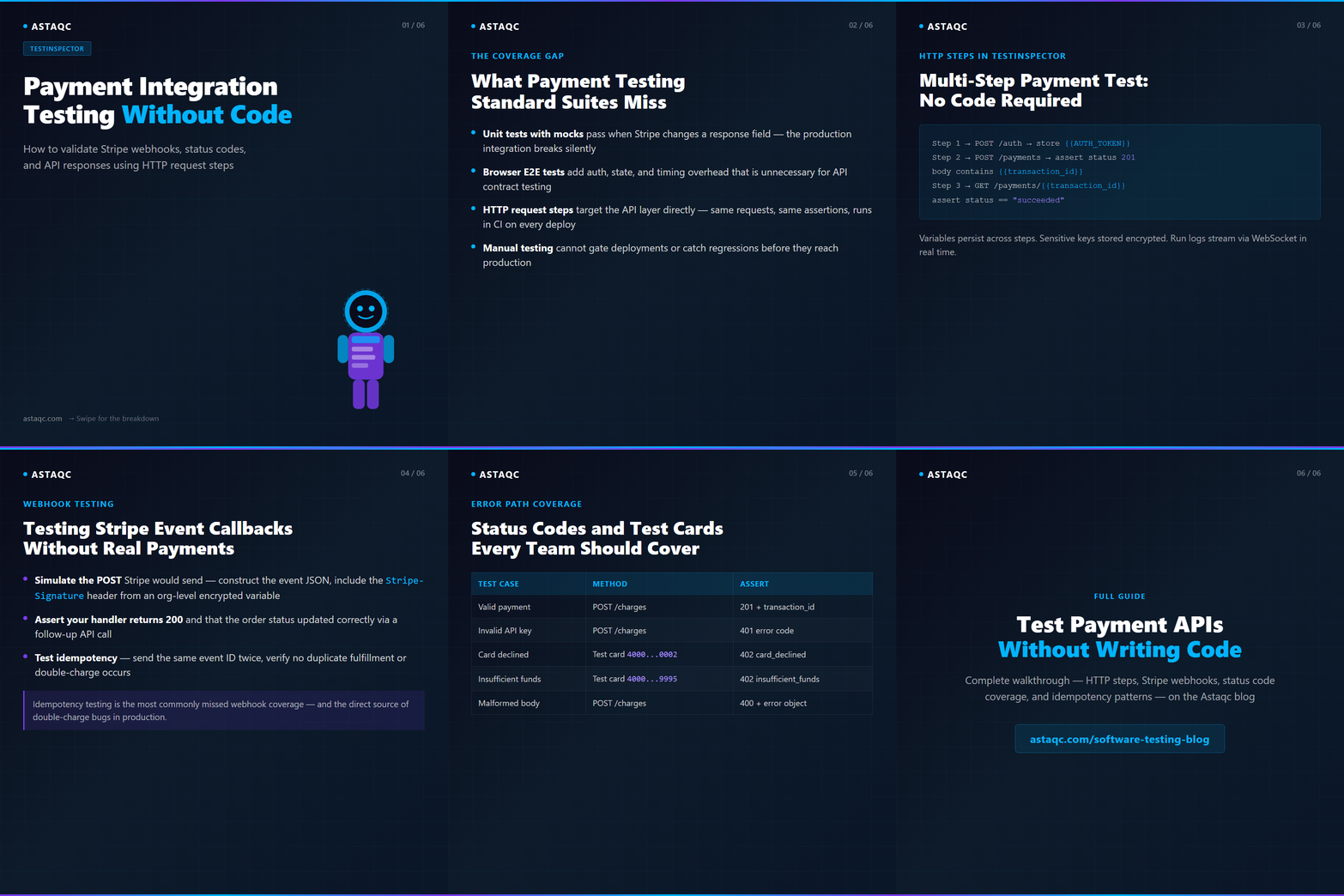
Payment integration tests built with HTTP request steps catch API contract regressions that mocked unit tests cannot see. When a payment processor changes a response field or error code, the HTTP step test fails immediately; the unit test continues to pass against the old mock. That gap is where most payment integration bugs reach production undetected.
September 22, 2026


Sign up to receive and connect to our newsletter

We founded ASTAQC as a tight-knit group of professional Software Testers and software developers.
Subscribe to our Newsletter