September 21, 2026
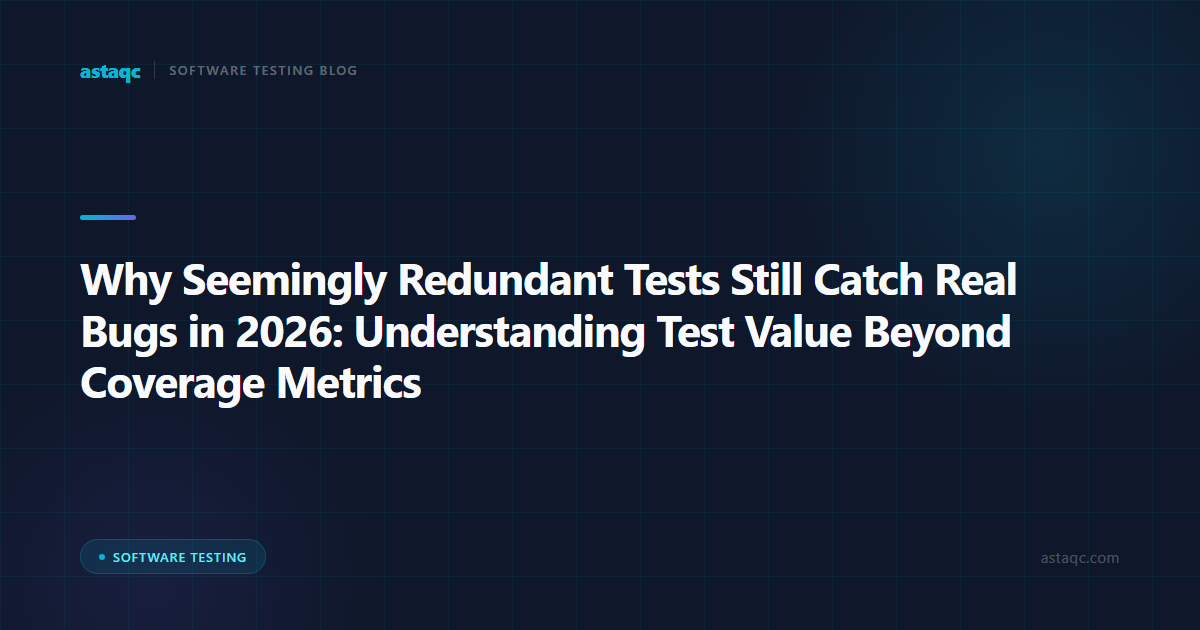
Test coverage reporting tells you which lines, branches, or functions your tests executed during a run. It does not tell you whether those tests verified that the code behaved correctly. A test can run through every line of a function and assert nothing about the output, producing 100% line coverage with zero validation value. The gap between execution coverage and validation coverage is the reason teams hit 80% coverage targets and still ship bugs introduced in code paths that are nominally covered.
This distinction matters because most coverage reporting tools report execution coverage by default. Istanbul, JaCoCo, Coverage.py, nyc—these tools instrument code and record which lines ran during the test suite. They do not analyze whether the tests contained meaningful assertions, whether the assertions checked the right conditions, or whether the test would have failed if the function returned incorrect output. A test suite that calls every function but asserts only that no exception is thrown passes 100% line coverage while validating almost nothing about the logic inside those functions.
This guide covers what different coverage metrics measure, how coverage inflation happens in practice, which metrics better reflect validation quality, how to read coverage reports without being misled by high numbers, and how to build a coverage strategy that serves the team's quality goals. For context on how coverage fits into a broader test automation strategy, see Astaqc's manual vs. automated testing guide and test automation services page.
Line coverage (also called statement coverage) records whether each executable line was reached by at least one test. It is the simplest and most commonly reported coverage metric, and also the least informative for quality assurance purposes. A line is covered if any test causes it to execute, regardless of whether the test asserts anything about the result of that line's execution. For most coverage tools, a line is covered or not covered—there is no distinction between a line that was thoroughly validated and a line that was incidentally executed as a side effect of testing something else.
Branch coverage records whether each decision point in the code—every if/else, every switch case, every ternary expression—was evaluated in both possible outcomes by at least one test. This is meaningfully better than line coverage because it requires both the true and false paths of a conditional to be exercised. A function with a single if statement can have 100% line coverage if tests only exercise the true path, but branch coverage reports 50% unless tests also exercise the false path. Branch coverage is typically the minimum useful metric for understanding whether a test suite exercises the decision logic in a codebase.
Mutation coverage (also called mutation score) is qualitatively different from line and branch metrics. Rather than recording which code ran, mutation testing introduces small artificial bugs—mutations—into the code (replacing + with -, changing a comparison operator, deleting a condition) and measures what percentage of mutations cause the test suite to fail. A mutation that passes the test suite undetected indicates an assertion gap: the code was executed but not validated precisely enough to catch a specific class of change. Mutation score is a direct measure of how well assertions validate behavior, not how thoroughly code is executed.
Path coverage records whether every unique path through a function was exercised. For a function with two independent binary conditions, there are four unique paths. Path coverage requires all four to be tested. Path coverage is rarely used in practice because the number of required paths grows exponentially with the number of conditions, making 100% path coverage impractical for real codebases. It represents the theoretical ideal that branch coverage approximates.
Coverage inflation—a high coverage number that does not reflect meaningful validation—happens through several consistent patterns. Understanding them is necessary to read coverage reports accurately and to design tests that add validation value rather than coverage points.
Assertion-free tests are the most direct form of coverage inflation. A test that instantiates an object and calls its methods without asserting anything about the results registers full line coverage for those methods. In practice, these tests typically exist as setup or smoke tests that verify the code does not throw an exception during execution. They are not entirely without value—verifying that a function does not throw is a form of validation—but they provide no coverage against logic errors, incorrect return values, or state mutations that produce wrong outputs without exceptions.
Mock-heavy tests inflate coverage of the code under test while validating only the mock behavior. When a function that calls a database, an external API, or a complex dependency is tested with those dependencies fully mocked, the lines of the function execute and contribute to coverage. But if the mock is configured to return a specific response regardless of input, the test validates only that the function handles that specific mock response, not that the function handles the real dependency's actual responses correctly. Coverage of the function is reported at 100%; validation of the function's behavior with real dependencies is zero.
Happy-path dominance inflates branch coverage for the positive case while leaving error paths, null inputs, boundary conditions, and failure modes untested. A payment processing function with 80% branch coverage might have comprehensive tests for successful transactions and no tests for cases where the payment service is unavailable, the user has insufficient funds, or the transaction ID is malformed. Line coverage for the error-handling branches is zero (those lines never ran), but branch coverage for the main flow appears high. The missing coverage is invisible in high-level coverage summary reports.
Incidental coverage from integration tests occurs when end-to-end or integration tests exercise large amounts of code as a side effect of testing a specific user flow. An integration test for user login may execute code in the authentication module, the session manager, the database abstraction layer, and the logging service. Coverage for all of those modules increases without any targeted assertions about their individual behavior. If a defect in the session manager produces a subtle bug that the login flow does not expose, the coverage report shows the session manager as covered while the defect goes undetected.
Coverage percentage is an output metric: it measures a property of the test suite after the tests run. Teams that optimize for coverage percentage as a primary target often end up with test suites that achieve the target number without proportionally increasing validation quality. Several metrics correlate more directly with whether a test suite will catch real bugs.
Mutation score is the most directly relevant metric for validation quality. Running a mutation testing tool (Stryker for JavaScript/TypeScript, PITest for Java, mutmut for Python) produces a concrete measurement of what percentage of injected faults the test suite detects. A mutation score of 40% means that 60% of the simple bugs that mutation testing introduces are not caught by any assertion in the suite. Mutation scores below 60% typically indicate significant assertion gaps even in codebases with high line and branch coverage. Mutation testing is computationally expensive for large codebases and is typically run on changed modules rather than the entire codebase on every CI run.
Assertion density is a simpler proxy for validation quality: the ratio of meaningful assertions to the number of test cases. A test suite with 200 tests and 50 assertions has an assertion density that suggests most tests are not asserting anything meaningful. Assertion density requires manual or static analysis to measure, and it conflates different assertion types—an assertion that checks a complex business rule is not equivalent to an assertion that checks a variable is not null. As a screening metric for identifying suites with obvious validation gaps, assertion density is useful without requiring mutation testing infrastructure.
| Metric | What It Measures | Catches Assertion Gaps? | Computational Cost |
|---|---|---|---|
| Line coverage | Which lines ran during the test suite | No | Very low |
| Branch coverage | Which decision paths were exercised | No | Low |
| Mutation score | Percentage of injected faults detected by assertions | Yes, directly | High (run on changed modules only) |
| Assertion density | Ratio of assertions to test cases | Partially (misses semantic assertion gaps) | Low |
| Defect escape rate | Percentage of production bugs in covered code paths | Yes, retrospectively | Zero (uses existing defect data) |
Defect escape rate—the percentage of production bugs that were introduced in code that had test coverage—is arguably the most useful retrospective metric for assessing whether the current coverage strategy is working. It requires tracking which code paths were covered at the time a production bug was introduced, which is available from historical CI run data and production incident records. A high defect escape rate in covered code is direct evidence that coverage is not correlating with validation quality.
Coverage reports become misleading when they are read as quality scores rather than execution maps. A report showing 85% branch coverage tells you that 85% of decision branches were reached by at least one test; it tells you nothing about whether those branches were asserted against meaningfully. Reading reports correctly requires looking beyond the top-level percentage at the specific gaps and the context of what is covered.
The first place to look in a coverage report is uncovered branches in business-critical code. An uncovered branch in a utility function that formats a date string is a much lower priority than an uncovered branch in payment processing, the authentication flow, or the data access layer. Coverage tools allow drilling into specific files and functions to see which branches are uncovered. Prioritizing coverage gaps by business criticality produces a more effective testing investment than targeting raw percentage improvement uniformly across the entire codebase.
The second place to look is files with 100% coverage that also have recently filed production bugs. If a module shows 100% coverage but has had multiple production incidents, the tests covering it are not validating the behaviors that fail in production. This is the clearest evidence of covered-but-not-validated code: full coverage, repeated failures. Investigation of the test suite for that module typically reveals assertion-free tests, tests that mock the entire external surface, or tests that only exercise the specific inputs that the developer knew would work during initial implementation.
The third indicator to check is whether coverage drops significantly after refactoring. When a codebase is refactored without changing external behavior, coverage numbers should be stable or slightly increase. If coverage drops significantly after a refactoring that did not change public APIs, the tests were coupled to implementation details of the old code rather than to the behavior the code is supposed to produce. Tests coupled to implementation details do not survive change and provide no durable quality assurance.
Coverage thresholds used as CI gates should be set per-module based on business criticality, not as a single global percentage. A threshold of 80% line coverage applied uniformly dilutes the signal when it covers generated code, configuration files, and framework boilerplate alongside critical business logic. Per-module thresholds allow enforcement proportional to risk: 90% branch coverage for payment processing code, 60% for internal admin tooling, no threshold for generated serialization code. For teams using test automation services, coverage threshold configuration is typically part of the initial CI setup. See the AI in software testing guide for how AI tools are affecting coverage strategy decisions, and performance testing for context on quality metrics beyond coverage in production.
There is no universal target percentage that applies to all codebases. The common industry references—70%, 80%, 90%—are rules of thumb that reflect what teams have found achievable without writing tests purely to hit a threshold. A more defensible approach is to set different targets by module criticality: high for payment, authentication, and data integrity code; lower for internal tooling and utility functions; and none for generated or framework code. The target should be driven by the risk of uncovered failures in that module, not by a single number applied uniformly across the codebase.
100% line coverage is achievable and appropriate for small, critical modules where every line represents a behavior that must be validated. For an authentication token validation function with 30 lines, 100% line coverage combined with meaningful assertions is a reasonable and maintainable target. For large application codebases, attempting 100% line coverage typically produces diminishing returns after approximately 85–90%: the remaining uncovered lines are often error handlers for conditions difficult to reproduce in tests, defensive null checks, or code paths that only execute under hardware or network failure conditions. Forcing 100% coverage on those paths typically produces fragile tests that are expensive to maintain and provide minimal validation value.
Mutation testing on a full codebase can take hours and is typically not run on every CI commit. The practical approach is to run mutation testing on changed modules as part of a pre-merge check, so that new code added in a pull request is tested for assertion completeness before it is merged. This limits the mutation testing scope to the code being changed and keeps the CI time impact manageable. Full-codebase mutation test runs are appropriate as periodic health checks—monthly or quarterly—or before major releases where confidence in the overall test suite is important.
Higher coverage can reduce the scope of manual testing needed for regression, but it does not reduce the need for manual testing for exploratory, usability, and edge-case scenarios that automated tests do not capture. Automated tests with good coverage validate that known behaviors produce expected outputs. Manual exploratory testing finds behaviors that no automated test anticipated: unexpected interactions between features, edge cases in user workflows, and UX issues that do not surface as assertion failures. Coverage and manual testing address different risk classes, and optimizing coverage to reduce manual testing budget typically results in less regression risk but does not address the exploratory risk that manual testing covers.
Error handlers and infrastructure code are legitimate candidates for lower coverage thresholds or explicit coverage exclusions. The alternative—writing tests that force error conditions through mock injection or environment manipulation—is often more expensive than the risk the tests mitigate. The more defensible approach is to be explicit about which code is excluded from coverage thresholds and why: documented exclusions are easier to audit than uncovered lines buried in a report. For teams building on frameworks that generate significant amounts of infrastructure code, excluding generated code from coverage reporting is standard practice and avoids inflating the difficulty of meaningful coverage targets.
Both tracking cadences serve different purposes. Per-commit coverage tracking in CI prevents coverage from declining incrementally—it flags each commit that reduces coverage and routes the alert to the developer who made the change, when the context is still fresh. Per-release tracking provides a summary view of how coverage has changed across a development cycle, useful for reporting quality trends to stakeholders. The per-commit enforcement is the more operationally valuable of the two: preventing coverage regression in each small change is more effective than noticing a large regression at release time when many changes have accumulated. See Astaqc's software testing guide and QA team service for how continuous coverage tracking is implemented in embedded QA engagements.
A test can run through every line of a function and assert nothing about the output, producing 100% line coverage with zero validation value. Coverage percentage reports execution; it does not report correctness. The gap between those two is where most post-release bugs in covered code originate.
September 21, 2026


Sign up to receive and connect to our newsletter

We founded ASTAQC as a tight-knit group of professional Software Testers and software developers.
Subscribe to our Newsletter