September 22, 2026
Background jobs, message queues, and event-driven workflows are now standard architecture in production systems, but most QA strategies still treat them as second-class citizens. A user action triggers an asynchronous process—a job is enqueued, a worker picks it up, events propagate across services, downstream state changes. Each of those transitions is a failure point, and none of them are visible to a browser-based end-to-end test watching the UI. When a background job fails silently, the user sees nothing wrong in the moment; the failure surfaces minutes or hours later as missing data, stale state, or a downstream service that never received the event it was waiting for.
Testing async workflows is fundamentally different from testing synchronous request-response flows. You cannot assert on a response that comes back in 200ms. The system under test involves timing: jobs that run on schedules, queues that batch or delay messages, workers that process in parallel, event buses that fan out to multiple subscribers. Deterministic assertions require either controlling time, polling until a condition is met with a timeout, or testing each layer of the async pipeline in isolation with synchronous contracts at the boundaries.
This guide covers the core strategies for testing background jobs, message queues, event-driven systems, and long-running processes in 2026. It addresses what to test at each layer, how to structure assertions for async outcomes, and how to integrate async test coverage into a CI pipeline without introducing flakiness. For context on where async testing fits in a broader quality strategy, see Astaqc’s test automation services and complete software testing guide. For teams building or scaling async test coverage, Astaqc’s software testing services provide specialist support.
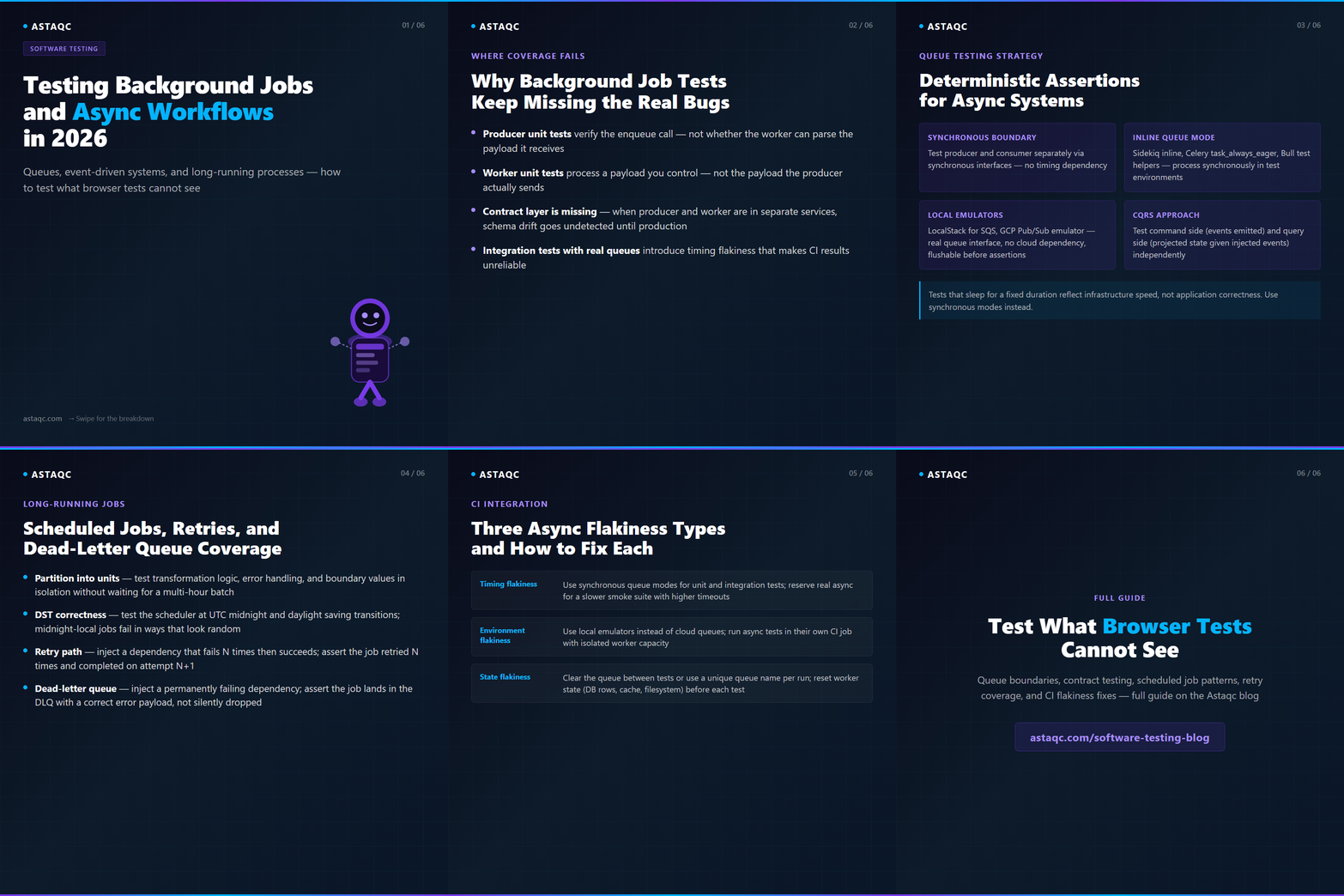
The most common failure in background job testing is testing the wrong thing. Unit tests that mock the queue client verify that the application calls the queue with the right arguments—they do not verify that the message format the worker expects matches what the producer sends. Integration tests that assert on the immediate response from an API endpoint that enqueues a job verify that the enqueue call succeeded—they do not verify that the job was picked up, processed, and produced the expected side effect. End-to-end tests that poll the UI for a result verify the visible outcome—they do not verify what happened between the queue and the UI update, making failures hard to diagnose.
Comprehensive background job testing covers three layers. First, the producer layer: that the correct job type is enqueued with the correct payload when the triggering action occurs, and that failures in the enqueue step are handled correctly (not silently dropped). Second, the worker layer: that the worker processes the job payload correctly, produces the expected side effects, handles malformed payloads without crashing, and correctly marks jobs as failed when processing encounters an error. Third, the contract layer: that the payload schema the producer sends matches the payload schema the worker expects, verified without relying on end-to-end execution of both.
The contract layer is the most frequently missed. Producer and worker are often in separate services, developed by separate teams, deployed independently. When the producer changes a field name or type without updating the worker, both sides can have passing unit tests while the integration is broken. Schema-based contract testing—where both sides register against a shared schema definition and tests verify each side independently against that schema—catches this class of bug before deployment. For teams using Astaqc’s QA team services, establishing contract tests for queue message schemas is a standard early-milestone deliverable when onboarding to a new async-heavy codebase.
| Layer | What It Tests | Common Failure Missed |
|---|---|---|
| Producer (unit) | Enqueue call made with correct args | Worker expects different payload format |
| Worker (unit) | Job processing logic given a payload | Payload never arrives in expected format |
| Contract | Producer and worker agree on schema | Drift between producer and consumer versions |
| Integration | End-to-end flow through real queue | Timing assumptions baked into assertions |
The central problem with testing event-driven systems is time. Events propagate asynchronously; you cannot assert at a fixed point in time that an event has been processed, because the time between event emission and downstream effect depends on queue depth, worker availability, and infrastructure latency. Tests that sleep for a fixed duration to wait for effects are fragile: they fail when the environment is slow and pass when it is fast, producing a result that reflects infrastructure state rather than application correctness. Tests that poll with a timeout are more robust but still require careful timeout selection and retry logic to avoid false negatives in slow environments and false positives that mask real failures.
The most reliable strategy for testing message queue behavior is to test each side of the queue boundary with synchronous interfaces. Instead of testing that emitting an event causes a downstream state change, test that emitting the event causes the correct message to appear in the queue (synchronous: the message is either there or it is not), and separately test that the consumer processes a message of the expected format and produces the expected downstream state change (synchronous: inject the message directly into the consumer’s handler without going through the queue). This separates the test of the producer’s emission logic from the test of the consumer’s processing logic, making each test deterministic and fast.
For integration tests that need to exercise the full async path, the standard approach in 2026 is to use an in-process or local queue implementation that processes synchronously in test environments, combined with a test harness that blocks until all enqueued jobs have been processed before asserting. Most major queue libraries support synchronous inline processing modes for testing: Sidekiq’s inline mode in Ruby, Celery’s task_always_eager in Python, Bull’s test helpers in Node.js. For cloud-managed queues like SQS or Pub/Sub, local emulators (LocalStack, the GCP Pub/Sub emulator) provide a real queue interface that runs in CI without cloud dependency and can be flushed synchronously before assertions.
Event sourcing and CQRS architectures require a specific approach: testing the command side and the query side separately against the event store. Commands produce events; tests verify the events emitted. Query projections consume events; tests verify the projected state given a sequence of injected events. End-to-end tests verify the full cycle but should be limited to happy-path smoke tests rather than exhaustive coverage, since the combinatorics of event sequences make full integration coverage impractical. For teams working in Astaqc’s manual testing practice, exploratory testing complements these structured approaches by surfacing timing-dependent failure modes that deterministic tests cannot anticipate.
Long-running background processes—batch jobs that process thousands of records, scheduled tasks that run overnight, multi-step workflows that execute over minutes or hours—require a different testing approach from short-lived job workers. You cannot run a full-duration test of a job that takes four hours in a CI pipeline. You cannot assert on intermediate state without instrumenting the job to expose checkpoints. You cannot test retry and failure handling without simulating failures at specific points in the execution, which requires either dependency injection or controllable failure modes.
The standard strategy for long-running job testing has two components. First, partition the job into testable units: functions or methods that can be tested in isolation with small inputs, verifying that each unit produces the expected output for the expected input. A batch processing job that reads records, applies a transformation, and writes results can be tested by verifying the transformation logic independently of the read and write operations. This is not different from standard unit testing, but long-running jobs are often written as monolithic scripts where this partitioning is absent and must be introduced as part of the testing effort. Second, use representative fixture data that exercises edge cases without requiring the full production data volume: records that are empty, records that have missing fields, records that trigger error handling, records that are at boundary values for numeric operations.
Scheduled job testing should verify that the job runs at the expected time and that idempotent jobs produce the same output when run multiple times on the same data. Time-zone correctness is a frequent source of scheduled job bugs: a job configured to run at midnight local time may run at unexpected UTC times when the server is in a different time zone, or may run twice or not at all on daylight saving transitions. Tests that explicitly set the system clock to DST transition times and verify that the scheduler fires correctly catch this class of bug before it reaches production. Most scheduling frameworks support clock injection or test helpers that simulate time advancement without waiting.
Retry and dead-letter queue handling are among the most important failure paths to test for background jobs. A job that fails and retries correctly under transient errors but fails silently without retrying under permanent errors requires tests for both cases. Tests that inject a failing dependency (a database that returns an error, an external API that times out) and verify that the job retries the expected number of times before marking itself as failed, and that a permanently failed job lands in the dead-letter queue with the correct error payload, verify the behavior that determines whether operations staff can recover from failures in production. For teams building these tests with Astaqc’s test automation services, retry and dead-letter queue coverage is part of the standard async testing checklist that Astaqc applies to new engagements.
Async tests that use real queues and real workers in CI are the most common source of flaky tests in codebases with significant background job usage. Flakiness in async CI tests falls into three categories: timing flakiness (the test asserts before the async effect is complete), environment flakiness (the queue or worker is slow under CI load, causing timeouts), and state flakiness (tests share queue state and a previous test’s messages interfere with the current test’s assertions). Each requires a different mitigation strategy.
Timing flakiness is mitigated by using synchronous queue modes in unit and integration tests, reserving real async execution for a separate smoke-test suite that runs less frequently and with higher timeouts. When real async execution is required, the test should poll for the expected outcome with a deterministic retry loop rather than sleeping, and the retry timeout should be set to a value that is high enough to succeed in slow CI environments but low enough that a genuine failure (the job never ran) is detected within the test run time budget. Logging the actual elapsed time when a timeout fires—rather than just reporting the timeout—makes these failures diagnose-able without requiring a re-run.
Environment flakiness is mitigated by using local queue emulators rather than cloud queue services in CI, isolating worker processes so that test runs do not compete with each other for worker capacity, and running async tests in their own CI job with dedicated compute rather than sharing resources with unit tests. For teams on containerized CI (GitHub Actions, GitLab CI), running the queue emulator and the worker as separate container services that start before the test suite and are torn down after provides a consistent environment that is not affected by other CI activity.
State flakiness is mitigated by clearing the queue between tests (or using a unique queue name per test run that is discarded after), ensuring that worker state (database rows, cache entries, file system state) is reset before each test, and avoiding shared worker instances that carry state across test boundaries. These patterns are consistent with general test isolation principles but require explicit implementation in async test setups where it is easy to assume—incorrectly—that an empty queue at test start means no state exists from previous tests. Astaqc’s testing documentation services include async test setup and teardown patterns as part of the test infrastructure documentation that Astaqc produces for new and existing test suites. See also Astaqc’s manual vs. automated testing guide for context on when manual investigation is more appropriate than automated async test coverage for a given failure mode.
Most queue libraries provide a test mode that records enqueued jobs without executing them. In this mode, after triggering the action that should enqueue the job, you inspect the recorded queue state to verify that the expected job type was enqueued with the expected payload. This approach tests the producer side in isolation: you verify that the application correctly delegates work to the queue when the triggering condition occurs, without coupling the test to the worker’s processing logic or requiring an active worker process during the test run.
Idempotency testing runs the same job handler twice with the same input and asserts that the second run produces the same output as the first without duplicating any side effects. The specific assertions depend on what the job does: for a job that creates a database record, the idempotency test verifies that the record exists exactly once after two runs, not twice. For a job that sends an email, it verifies that the email is sent once regardless of how many times the job executes. This requires the job’s side effects to be observable—database state, outbox records, mock call counts—so that the test can assert on the absence of duplication rather than just the presence of the expected effect.
Testing multi-service event-driven workflows uses a combination of contract tests and integration tests. Contract tests verify that each service’s published event schema matches the schema its consumers expect, using a shared schema registry or consumer-driven contract testing tool. Integration tests for the full workflow either use a local event bus that processes events synchronously, or use a real event bus with a test harness that subscribes to all event types, collects them, and exposes them for assertion after the workflow completes. The second approach requires careful teardown to avoid event leakage between tests, but it provides the highest confidence that the full flow works end-to-end.
Retry logic tests inject a dependency that fails on the first N calls and succeeds on the (N+1)th call, then run the job handler and assert that the job completed successfully, that the dependency was called N+1 times, and that no permanent failure state was recorded. Most dependency injection or mocking frameworks support call-count-conditional return values for this purpose. For testing the permanent failure path, inject a dependency that always fails and verify that after the maximum retry count is reached, the job is marked as permanently failed and moved to the dead-letter queue with an error payload that accurately describes the failure.
Testing scheduled job logic separates the scheduling mechanism from the job logic itself. The job’s core logic is tested by calling it directly with controlled inputs—date ranges, batch sizes, any time-dependent parameters—rather than waiting for the scheduler to fire it. The scheduling mechanism itself is tested with a clock injection tool that advances the system clock to the next scheduled run time, verifies that the scheduler fires the job, and verifies that the job receives the correct time-derived parameters. Combining these two test types gives full coverage of both the job logic and the scheduling behavior without waiting for real time to pass.
Start with the jobs that have the most severe silent failure consequences: jobs that process payments, fulfill orders, send legal or compliance notifications, or update records that downstream services depend on. For each of these, add a test that verifies the job processes the happy path correctly, and a test that verifies permanent failures land in the dead-letter queue rather than silently dropping. Add contract tests for queue message schemas if the producer and consumer are in different services or teams. Add idempotency tests for any job that has observable side effects. That set—happy path, failure handling, schema contracts, idempotency—covers the failure modes that matter most before investing in broader coverage. Astaqc’s QA team services include async coverage audits as part of onboarding, producing a prioritized list of job test gaps based on business impact rather than code coverage metrics.
Most background job test failures are failures of scope, not of execution. Unit tests that mock the queue catch code errors; they do not catch the contract mismatch between what the producer sends and what the consumer expects. That gap is where async bugs reach production undetected, because each side has passing tests while the integration is broken.
September 22, 2026


Sign up to receive and connect to our newsletter

We founded ASTAQC as a tight-knit group of professional Software Testers and software developers.
Subscribe to our Newsletter