October 13, 2026
TestInspector enables continuous testing in agile sprints by generating structured test steps from a natural language AI chat interface and executing them on any CI trigger, scheduled job, or on-demand run — without requiring a test framework, test runner configuration, or integration code. A QA engineer describes the behavior to test; TestInspector generates executable test steps, which run via Selenium on Chrome, Firefox, Edge, or Safari immediately after creation. The result is that teams can convert a backlog item into automated regression coverage within a single sprint, because there is no framework setup cost that pushes testing beyond the sprint boundary.
Traditional automation tools impose a setup cost that defers continuous testing in practice. A Selenium or Playwright project requires a directory structure, a test runner, a CI configuration file, and at least one team member who understands the toolchain well enough to maintain it across framework updates. TestInspector removes these prerequisites: the test is defined through a conversation, not code, and it runs through Selenium infrastructure the platform manages. The complete software testing guide covers how continuous testing fits in the broader quality model and what teams need to sustain it across sprints.
Continuous testing is the practice of running automated tests at every stage of development — against feature branches, on pull request creation, on deployment to staging, and on a nightly schedule against production. The goal is to catch regressions at the point in the pipeline where they are cheapest to fix. In practice, three conditions must be met: tests must be fast enough to run in the pipeline without blocking delivery, tests must be maintainable enough to stay current as the application changes, and tests must be easy enough to create that coverage keeps pace with development velocity.
Most teams satisfy the first condition — CI infrastructure is fast enough — but fail on the second and third. Test maintenance cost rises linearly with application change rate, and test creation requires engineering time that competes with feature development. Teams that attempt continuous testing with script-based frameworks report that maintenance eventually consumes more time than writing new tests, which causes coverage to drift behind the application. TestInspector’s self-healing selector recovery — where the AI suggests updated selectors when a DOM change breaks a step — addresses maintenance cost. The AI chat creation interface addresses creation cost.
The practical definition of continuous testing is not “tests run in CI.” It is “tests stay current with the application and run at every meaningful pipeline stage.” A suite of 200 tests that have not been updated in three months is not providing continuous coverage of the current application; it is providing coverage of what the application looked like three months ago. For test automation services teams that need to build sustainable continuous testing practices, the maintenance dimension is usually the binding constraint.
TestInspector integrates into a continuous testing workflow at four points: test creation during the sprint, execution on CI triggers, scheduling for regression runs, and maintenance during iterative development.
During the sprint, tests are created through the AI chat interface. A QA engineer or developer opens TestInspector, describes the user journey or feature behavior to test, and receives a structured test as a series of steps: navigate to URL, fill field, click button, assert text. No code is written. The test is immediately runnable against any environment the team has access to. TestInspector’s browser extension supports recording existing flows as an alternative to chat-based generation, which is useful for establishing coverage of existing functionality at the start of a sprint.
Execution is triggered through the TestInspector API. A CI pipeline — GitHub Actions, GitLab CI, Jenkins, or any system capable of making HTTP requests — calls the trigger endpoint with the suite identifier and target URL. TestInspector queues the run, executes it via Selenium, and streams results over WebSocket in real time. Pass/fail status is available immediately after execution, without waiting for a reporting step. The CI integration requires adding one API call to the pipeline configuration; it does not require installing a test runner, configuring a browser environment, or managing Selenium infrastructure.
Scheduling handles regression runs outside the sprint pipeline: a nightly run against staging at 2:00 AM, a post-deployment smoke test triggered on a deploy webhook, or a weekly run against production to verify critical user paths. TestInspector supports cron, interval, and one-time scheduling with configurable environment targets. Variable interpolation — including {{TIMESTAMP}}, {{ALPHANUMERIC}}, and {{TOTP:secret}} for authentication flows — allows the same tests to run against multiple environments without modification. Astaqc’s hire a QA team service includes engineers experienced in setting up this kind of structured coverage from zero. The TestInspector product page covers the full feature set available for integration.
The comparison below is between TestInspector and a script-based framework (Playwright or Selenium with a test runner) for continuous testing in a typical two-week sprint cycle. The comparison is not about raw feature coverage but about the operational cost of maintaining continuous testing at pace with development.
| Dimension | TestInspector | Framework (Playwright/Selenium) |
|---|---|---|
| Test creation | AI chat interface or browser recording; no code required | TypeScript or Python; requires developer involvement |
| CI integration | Single API call; no runner installation | Install runner, configure browser, add test command to CI config |
| Browser management | Managed by TestInspector (Chrome, Firefox, Edge, Safari) | Team manages browser binaries, versions, and cloud infrastructure |
| Selector maintenance | AI selector suggestions on failure; self-healing retry | Manual selector updates; no automated suggestions |
| Visual regression | SSIM screenshot comparison with baseline approval, crop and exclusion selectors | Requires additional library (Percy, Chromatic, Applitools) |
| Framework version updates | None; platform handles runtime | Regular updates required; breaking changes in major versions |
| Export for migration | Exports to Playwright TypeScript, Selenium IDE, Gherkin | Native format; no export needed |
The framework approach provides more control and expressiveness for complex test scenarios — custom page objects, complex async handling, programmatic test generation. The TestInspector approach provides faster creation and lower maintenance overhead for the majority of UI and API test scenarios that do not require custom code. In a sprint context where testing must keep pace with feature development, the creation and maintenance dimensions usually matter more than raw expressiveness. Teams with existing framework investments can export TestInspector tests to Playwright or Selenium IDE when a scenario requires code-level customization.
One of the operational challenges in continuous testing is coverage growth: as the application expands, the test suite must expand proportionally, but each new test adds maintenance surface. Framework-based suites address this through page object patterns, shared utilities, and helper libraries — abstractions that reduce maintenance per test but require engineering time to build and understand. TestInspector addresses this through test suite hierarchy, variable scoping, and the AI generation layer.
Suite hierarchy in TestInspector organizes tests at three levels: organization, suite, and test. Variables defined at the org level are available to all suites and tests; variables defined at the suite level are available to the tests within that suite; test-level variables override both. Encrypted variable storage handles secrets — API keys, authentication credentials, TOTP seeds — without exposing them in test definitions. This hierarchy mirrors how a framework would use environment variables and shared configuration, but without requiring code to consume it.
Coverage growth is tracked through run history and coverage baselines. TestInspector records pass/fail state across every run and surfaces tests that have not been run within a configured window (dead tests), tests that always pass but never assert anything meaningful (weak tests), and tests that fail intermittently (flaky tests). This visibility into coverage health addresses a common problem in continuous testing suites: tests are added faster than failing ones are removed, and the suite accumulates noise that degrades signal quality over time.
For teams scaling from an initial suite to production-grade continuous coverage, the practical sequence is: use browser extension recording to establish coverage of existing flows, use AI chat to generate tests for new features as they are built, and use scheduling to run the full suite nightly against staging and a smoke subset against production on every deployment. Astaqc’s software testing services include structured coverage audits to identify gaps before expanding a TestInspector implementation. The outsource testing guide covers when external QA support accelerates coverage growth. Teams managing multi-tenant applications can use TestInspector’s org-level access control — owner, admin, and member roles — to partition test ownership across teams without losing visibility into the full coverage picture.
No. Continuous testing in TestInspector can be achieved through scheduling alone: a cron or interval trigger runs the test suite against any reachable environment on a defined schedule. CI integration via the trigger API adds the ability to run tests synchronously with pipeline events — pull request creation, branch push, or deployment completion — which provides faster feedback but is not required to start continuous testing. Teams typically begin with scheduled runs and add CI triggers as their process matures.
Yes. TestInspector’s AI chat interface and browser extension are designed for use by QA engineers and product managers who understand the application behavior but do not write code. Test steps are structured (navigate, click, assert) rather than code, and the AI explains what each step does. Selector maintenance via AI suggestions reduces the expertise required to fix a broken test. The practical limit is complex scenarios that involve intricate JavaScript interactions or dynamic content not easily described in steps — those may require export to Playwright for code-level handling.
TestInspector stores authentication credentials as encrypted variables with test, suite, or org-level scope. TOTP-based two-factor authentication is handled through the {{TOTP:secret}} variable, which generates a valid OTP at runtime using the stored seed. Session tokens and cookies persist within a test run via browser context, so a login step at the start of a test maintains the authenticated session for subsequent steps. For OAuth and SSO flows, HTTP request steps can capture and store tokens from API responses as variables for use in subsequent steps.
When a test fails, TestInspector records the step that failed, the selector or assertion that did not match, and a screenshot of the page at the point of failure. Results stream over WebSocket in real time, so the CI trigger can report failure immediately. If the failure is a selector drift — the element moved or changed — the AI selector suggestion feature proposes updated selectors based on the current page structure. If the failure is a timing issue, the self-healing auto-retry re-attempts the step with progressively longer waits before reporting a final failure.
Yes. TestInspector runs independently of the application’s test framework. A CI pipeline can run both a Playwright suite (via npm test) and a TestInspector suite (via API trigger) in parallel stages, with results reported separately. Teams that are migrating from a framework to TestInspector can run both in parallel during the transition period. TestInspector’s export feature — to Playwright TypeScript, Selenium IDE, and Gherkin — allows tests created in TestInspector to be converted to framework format for scenarios that require code-level customization.
TestInspector supports three scheduling modes: cron (a standard cron expression for recurring runs), interval (run every N minutes or hours), and one-time (a specific future timestamp). For deployment pipeline integration, the CI trigger API is the more flexible option: the deploy step in the pipeline calls the TestInspector API with the target environment URL, and the pipeline waits for pass/fail before proceeding to the next stage. Scheduling is better suited for nightly regression runs, production monitoring, and scheduled smoke tests that run independently of deployment events.
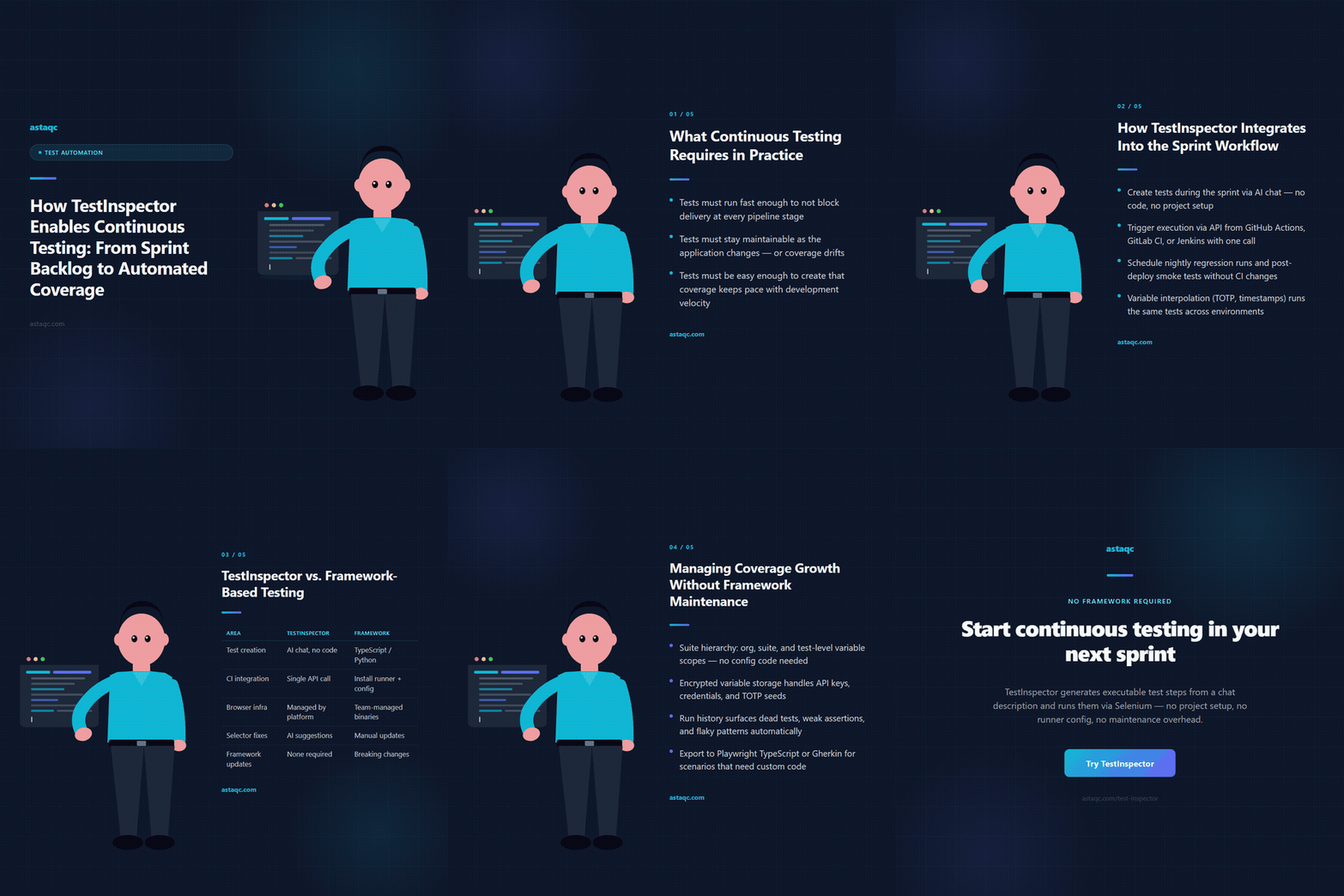
Continuous testing is not a CI configuration — it is a practice where tests keep pace with feature development. TestInspector removes the framework setup cost that pushes testing beyond the sprint boundary by generating executable steps from a natural language description and running them immediately on any pipeline trigger.
October 13, 2026


Sign up to receive and connect to our newsletter

We founded ASTAQC as a tight-knit group of professional Software Testers and software developers.
Subscribe to our Newsletter