October 13, 2026

Test parallelism in CI pipelines delivers faster feedback by running multiple tests simultaneously across workers, containers, or cloud machines. In 2026, most CI platforms — GitHub Actions, GitLab CI, CircleCI, Jenkins — support test splitting and parallel job execution as a first-class feature. The performance benefit is real: a 400-test suite that runs in 12 minutes sequentially can complete in 3 minutes across four parallel workers. The tradeoff is that parallelism introduces failure modes that do not exist in sequential execution: race conditions on shared resources, state pollution between tests, and data conflicts in shared databases.
These failures are expensive to diagnose. A race condition that surfaces one in five runs in CI but never reproduces locally appears to be an infrastructure problem rather than a test problem. A shared database row updated by two tests simultaneously produces intermittent assertion failures that point to the wrong test. A global variable set by one test and read by another passes when run in isolation but fails when both run concurrently. The pattern is the same: tests that were written for sequential execution contain hidden assumptions about ordering and isolation that parallelism violates. The complete software testing guide covers the broader testing model, including how isolation requirements differ across test types and what teams need to sustain reliable coverage in parallel environments.
A race condition in a test suite occurs when two tests access a shared resource in an order-dependent way and the execution order is not guaranteed. In parallel execution, the scheduler assigns tests to workers without respecting test ordering unless explicit barriers are set. The most common race condition patterns in 2026 CI environments are:
File system races: Two tests write to the same file path. The first test writes a fixture file to a known path, reads it back, and asserts the content. The second test writes a different fixture to the same path concurrently. The first test reads the second test’s content and fails. Solution: use per-test temporary directories generated with a UUID or process ID suffix, never shared fixture paths.
Port binding conflicts: Two tests start a local server on port 8080. The first server binds successfully; the second fails with EADDRINUSE. The test fails with a connection refused error rather than an assertion error, making the cause unclear. Solution: use port 0 (OS assigns an available port) and read the assigned port from the server instance after binding.
Environment variable mutation: A test sets process.env.DATABASE_URL to point at a test database, runs its suite, and clears the variable in teardown. A parallel test reads DATABASE_URL between the set and the clear and connects to the wrong database. Solution: use test-scoped configuration injection rather than mutating process.env; pass config through constructor parameters or dependency injection.
Race conditions often appear as flaky tests — they fail on some runs but not others depending on scheduling timing. Flakiness is a strong signal of a shared-resource problem rather than a logic error. For test automation services teams that have accumulated flaky test backlogs, the first diagnostic step is to identify whether failures correlate with parallelism level — if the failure rate drops when parallelism is reduced to one worker, the test has a shared resource dependency.
Shared state failures occur when tests depend on or modify global state — singletons, module-level caches, static variables, or process-level configuration. In sequential execution, tests run in a defined order and each test starts with a known state from the previous test’s teardown. In parallel execution, tests run on separate workers that may share a process (in the case of in-process parallelism like Jest workers) or may run in isolated processes (in the case of container-level parallelism). The type of parallelism determines what state is shared.
In-process parallelism (Jest, Vitest, RSpec parallel): Workers run in separate threads or processes but may share module caches. A singleton database connection pool initialized at module load time is shared across all tests in the same process. If one test closes the connection pool and another test attempts to use it concurrently, the second test fails with a connection error. Solution: initialize per-test resources in beforeEach and destroy them in afterEach; avoid singleton patterns in test infrastructure.
Container-level parallelism (GitHub Actions matrix, CircleCI parallelism): Each worker runs in an isolated container with its own process memory, so in-memory state is not shared. However, external resources — the database, the message queue, the cache — are shared unless deliberately isolated. Two containers running different tests against the same database table will produce conflicts if both tests insert rows with the same primary key or if one test truncates the table while the other is in the middle of a read. Solution: use per-worker database schemas or databases, created before the test run and destroyed after.
The practical approach for teams moving from sequential to parallel CI is to audit the test suite for shared state before enabling parallelism. The audit focuses on four areas: database access patterns (do tests share tables without transaction rollback?), external service mocking (are mocks applied globally or per-test?), file system usage (are paths generated dynamically or hardcoded?), and environment variable usage (are variables set at the process level or injected per-test?). Astaqc’s hire a QA team service includes engineers who perform parallel readiness audits as part of CI optimization engagements. The TestInspector product page covers how UI test execution handles session isolation in parallel browser contexts.
Database-level conflicts are the most common source of parallel test failures in backend and API test suites. The strategies available for data isolation differ in setup complexity, performance cost, and the degree of isolation they provide.
| Strategy | How it works | Isolation level | Performance cost | When to use |
|---|---|---|---|---|
| Transaction rollback | Wrap each test in a transaction; rollback in teardown | Full for single-connection tests | Low | Single-connection, no nested transactions |
| Per-worker schema | Create a separate database schema per worker (schema_1, schema_2...) | Full | Medium (schema creation at setup) | Multi-connection tests, tests that spawn background jobs |
| Per-worker database | Create a separate database per worker; pass DATABASE_URL as env var | Full | High (database creation at setup) | Tests that test DDL operations or require full isolation |
| Shared database with unique IDs | Insert rows with UUID primary keys; tests filter by their own IDs | Partial (no protection against full-table reads) | Low | Read-heavy tests that do not truncate tables |
| Database containers per test | Spin up a Docker container per test; destroy after | Full | Very high | Heavy integration tests that run few in number |
The per-worker schema strategy is the practical default for most teams. Most CI platforms expose a worker index (CIRCLE_NODE_INDEX, TEST_WORKER_INDEX in Jest) that can be used to construct a schema name: schema_${WORKER_INDEX}. The test setup script creates the schema if it does not exist, runs migrations against it, and the test teardown truncates or drops it. The CI job destroys the database entirely after all workers complete. This approach provides full isolation at moderate setup cost and works for multi-connection tests and tests that spawn background workers or queues.
When a test suite begins producing intermittent failures after enabling parallelism, the diagnostic approach differs from sequential failure diagnosis. Sequential failures point to a specific line in a specific test. Parallel failures point to an interaction between tests, which requires identifying which tests interact and what resource they share.
The first diagnostic step is to reproduce the failure deterministically. Run the failing test in isolation: if it passes alone, the failure is a parallel interaction, not a logic error in the test itself. Run the failing test alongside the test that ran concurrently at the time of failure: if both fail, the shared resource is between those two tests. Tools like GitHub Actions’ rerun-failed-jobs and CircleCI’s test insights surface which tests ran concurrently in the failing run, which narrows the search from the entire suite to two or three candidates.
The second step is to identify the shared resource. The failure message usually points to the symptom rather than the cause: “assertion failed: expected 5, got 6” does not indicate a database conflict, but “unexpected row count” in a table that both tests write to does. Add logging to the setup and teardown of both tests to capture what state they read and write. If the failure is intermittent rather than consistent, add a brief sleep between the two concurrent tests and observe whether the failure rate changes — a timing-dependent failure confirms a race condition.
The third step is to apply the appropriate isolation fix. For database conflicts, apply per-worker schema isolation. For file system conflicts, switch to per-test temporary directories. For environment variable conflicts, refactor to per-test configuration injection. For port conflicts, switch to port 0 binding. For global state conflicts, move initialization from module scope to beforeEach. Each fix is targeted to the specific shared resource rather than a general “make tests more isolated” refactor, which keeps the change minimal and testable.
For teams that need systematic help reducing parallel test failure rates, Astaqc’s software testing services include CI optimization audits that identify shared resource patterns across the test suite before they produce flaky runs. The outsource testing guide covers how external QA engineers integrate with an existing CI setup to triage and resolve parallel test failures without disrupting the development workflow. Teams using TestInspector for UI test execution benefit from the platform’s built-in session isolation — each parallel browser run gets its own session context, which eliminates the browser-level shared state problems that arise when running Selenium or Playwright tests in parallel without explicit context management.
The key indicator is whether the failure reproduces in isolation. Run the test alone with no other tests running concurrently: if it passes consistently, the failure is a parallel interaction, not a logic error. A second indicator is correlation with parallelism level: reduce the number of parallel workers and observe whether the failure rate drops. If a test that fails one in five runs with four workers passes consistently with one worker, the failure is parallelism-driven. A third indicator is the failure message: assertion failures that reference row counts, file contents, or port availability rather than application logic usually point to a shared resource conflict.
Yes, for practical reasons beyond parallelism. Tests that share state are order-dependent, which means the suite fails if tests run in a different order (as test runners often do between runs). Isolation makes tests individually understandable and independently runnable, which speeds up debugging. The cost of isolation — setting up and tearing down resources per test — is usually small compared to the cost of diagnosing state-dependent failures. The exception is very slow setup operations (starting a database, compiling a binary) that benefit from being shared across tests in a suite, where the ordering constraint is explicit and managed.
Test isolation means a test does not share mutable state with other tests — it reads from and writes to resources that no other test touches during the same run. Test independence means a test’s result does not depend on whether other tests have run before it — it produces the same result whether it runs first, last, or in isolation. A test can be isolated but not independent (if it depends on seeded data that another test creates), and in principle it can be independent but not isolated (if it modifies shared state in a way that happens not to affect other tests). In parallel execution, both properties are required: isolation prevents conflicts, and independence prevents ordering dependencies that become visible when the scheduler assigns tests to workers non-deterministically.
Most ORM-based test frameworks (RSpec with DatabaseCleaner, Django with TestCase) use transaction rollback as the default isolation strategy: each test wraps its database access in a transaction that is rolled back in teardown, leaving the database in a clean state. This works in sequential execution and in parallel execution when each worker has its own database connection. It fails when a test uses multiple connections (background jobs, WebSocket handlers, async middleware) because the background connection cannot see the uncommitted transaction from the test’s main connection and operates on a different database state. The fix is to switch from transaction rollback to per-test database truncation or per-worker schema isolation for tests that involve multiple connections.
Yes, with the right isolation configuration. Playwright supports parallel execution natively through test workers, each with its own BrowserContext, which provides session isolation (cookies, localStorage, and session storage are not shared between contexts). Selenium requires explicit session management: each parallel test must create its own WebDriver instance and tear it down after the test, never sharing a driver across tests. Both tools require that the application under test supports concurrent sessions — if the application has a single-user architecture or uses server-side session storage keyed by a single session ID, concurrent logins from parallel tests will conflict. Cloud testing platforms (BrowserStack, Sauce Labs) handle the browser infrastructure, but application-level session isolation remains the test suite’s responsibility.
The most reliable configuration combines per-worker database isolation, dynamic port allocation, per-test temporary directories, and test splitting by file rather than by test count. Splitting by file keeps tests that share fixtures in the same worker, which reduces the number of cross-worker interactions. Dynamic port allocation eliminates port binding races. Per-test temporary directories eliminate file system races. Per-worker database schemas eliminate data conflicts. The remaining failure sources after applying these fixes are usually application-level global state — singletons initialized at process startup, module-level caches, or configuration loaded from environment variables at import time — which requires targeted refactoring to move initialization to the test scope.
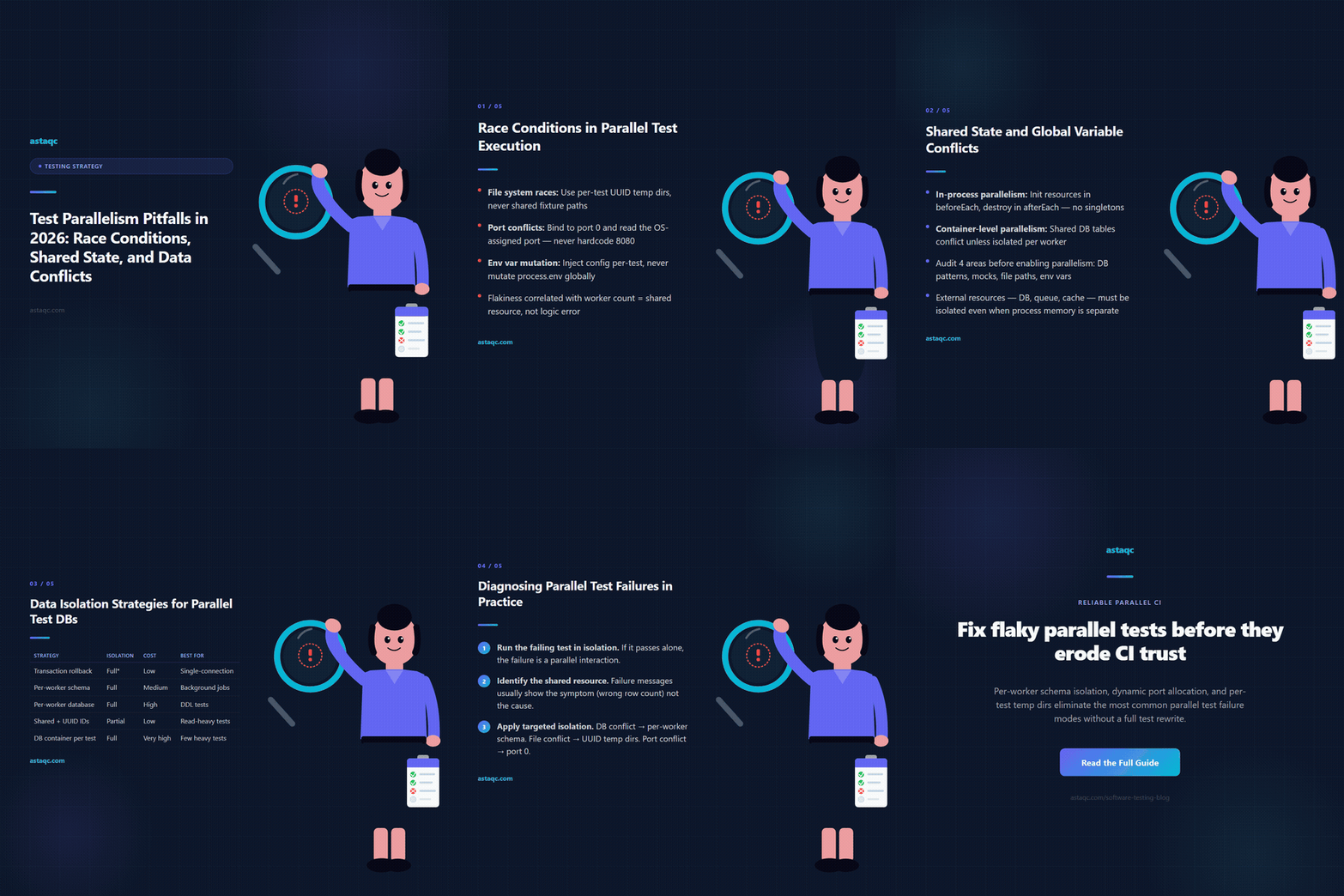
Running tests in parallel cuts feedback time but multiplies the ways tests can interfere with each other. Race conditions, shared database rows, and global state mutations that pass sequentially can fail unpredictably in parallel. Understanding the failure modes before scaling parallelism prevents the regressions that cause teams to distrust their CI results.
October 13, 2026


Sign up to receive and connect to our newsletter

We founded ASTAQC as a tight-knit group of professional Software Testers and software developers.
Subscribe to our Newsletter