Testing LLM-Powered SaaS Features in 2026: How to Validate AI Output, Latency SLAs, and Hallucination Guards Before They Break Production
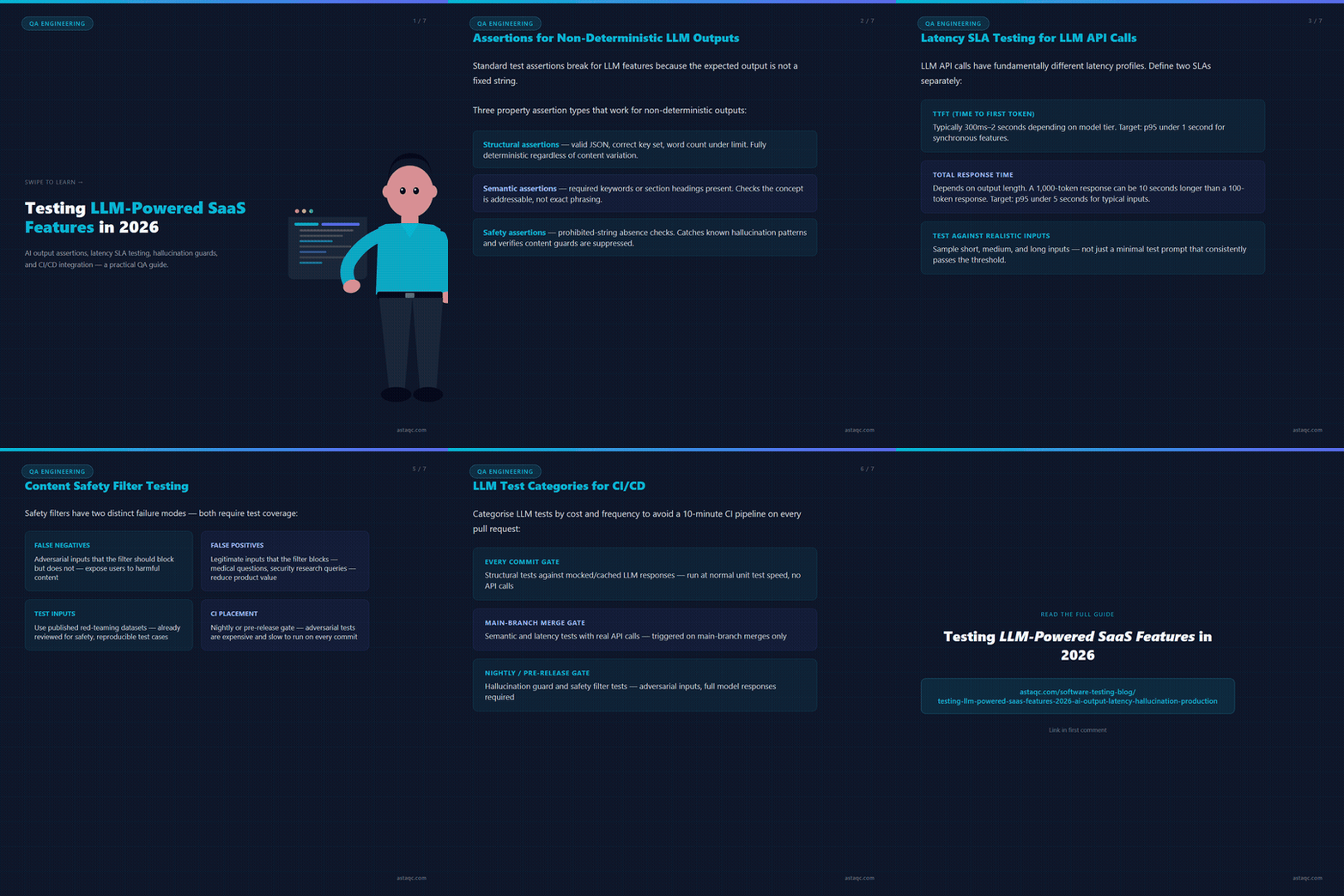
Validating LLM-powered SaaS features in 2026 requires testing at three distinct layers: output quality assertions that check structural and semantic properties without exact string matching, latency SLA tests that measure time-to-first-token and total response time under realistic load, and behavioral tests for hallucination guards and content safety filters that must catch adversarial inputs while passing legitimate ones. Each layer has different tooling requirements and different production failure modes that general application testing misses.
The fundamental challenge is non-determinism. The same prompt sent to an LLM twice produces different outputs, and both may be correct. This breaks the standard automated test assumption that the expected output is a fixed value comparable against the actual output. The alternative is to test output properties rather than output content: does the output satisfy structural constraints, semantic requirements, and safety boundaries — regardless of exact phrasing? Property-based assertions are deterministic even when the underlying output varies, which is the design foundation for reliable LLM feature testing.
This guide covers practical test design for each layer: how to write property assertions that work for non-deterministic outputs, how to design latency tests that reflect real usage, and how to build test suites for hallucination guards and safety filters without generating genuinely harmful content in the test environment. For teams building QA coverage for AI-powered products, Astaqc’s test automation services include specialist coverage for LLM-integrated application testing. Teams looking for a broader overview can read the comprehensive guide to AI in software testing in 2026.
Assertions for Non-Deterministic LLM Outputs
LLM output property assertions fall into three categories. Structural property assertions check format, schema, and length: valid JSON, required keys present, word count under limit, expected section headings present. These are fully deterministic — the structural contract is fixed even when content varies — and they catch the most common LLM integration failure modes in production: malformed JSON, truncated responses, format drift when a model version updates.
Semantic property assertions check that the output addresses the input and contains required elements. For a customer support response feature, required elements might include an acknowledgment of the specific issue, a proposed next step, and a contact reference. A semantic assertion for this feature checks for the presence of each required element using keyword or pattern matching — not that the exact phrasing is present, but that the concept is addressable in the output. Regular expression matching and substring presence checks are the most reliable techniques: they are deterministic, fast, and do not require calling an LLM to evaluate an LLM output.
Factual property assertions cover the specific subset of facts that the application is responsible for getting right: brand names, pricing, product specifications, dates, and other verifiable data points. The practical technique is a prohibited-string list: strings that would indicate a hallucinated fact are listed as assertions that must be absent from the output. This is a negative assertion — it cannot prove the output is correct, but it catches known incorrect values and verifies that known hallucination patterns are suppressed.
| Output Property Type | Test Technique | Deterministic? |
|---|---|---|
| Structural (format, schema, length) | JSON schema validation, regex, word count assertion | Yes |
| Semantic (relevance, required elements) | Keyword match, pattern match, section heading check | Yes for specific patterns |
| Factual (no known hallucinations) | Prohibited-string absence assertions | Yes |
| Safety (harmful content absence) | Safety classifier or prohibited content list | Yes for hard prohibitions |
Latency SLA Testing for LLM API Calls
LLM API calls have fundamentally different latency profiles from database queries or microservice calls. Time-to-first-token (TTFT) — the interval before the first token of a streamed response arrives — is typically 300ms to 2 seconds depending on model tier and provider load. Total response time depends on output length: a 100-token response and a 1,000-token response may have similar TTFT but differ by 10 seconds in total latency. Latency SLAs for LLM-powered features must define TTFT and total response time separately, and test assertions must measure both independently rather than measuring only end-to-end response time.
Latency tests should run against a realistic input distribution, not a minimal test prompt. A five-word question may respond in 500ms. The same feature called with a 10,000-word document may respond in 30 seconds. The SLA applies to real-world usage patterns, not to the best-case input. Building a latency test fixture that samples from short, medium, and long inputs and asserts a percentile latency — p95 under 5 seconds for a typical conversational feature — gives a more accurate picture of production latency compliance than a single test with a minimal input that consistently passes the threshold.
Provider-side latency variation is a second dimension that application-level tests frequently miss. LLM API providers have variable latency depending on load, region, and model version. A latency test that passes today at the p95 threshold may fail next week if the provider changes its routing or the model is updated. Building a scheduled latency baseline test that runs on a recurring schedule and alerts when p95 latency degrades beyond the SLA threshold provides ongoing production monitoring that one-time CI tests cannot. The performance testing services at Astaqc cover LLM latency monitoring as part of AI feature performance validation, including provider comparison and fallback strategy validation.
Concurrency latency testing validates SLA compliance under simultaneous requests. LLM API providers have rate limits and concurrency caps that cause individual requests to queue when burst usage exceeds the limit. A feature that performs within SLA for a single user may fail SLA for 20 concurrent users if the application has not implemented queuing, response caching, or multi-provider fallback. Concurrency latency tests run N parallel requests against the feature and assert that all complete within the SLA threshold. These tests require load testing tooling and careful environment management to avoid interference from other concurrent users sharing the test environment.
Testing Hallucination Guards and Content Safety Filters
Hallucination guards prevent an LLM from generating factually incorrect statements about the domain the application covers. Guards are implemented as system prompt constraints, retrieval-augmented generation (RAG) grounding, or output validation layers. Their testing challenge is that failure is silent: the guard fails and the incorrect content reaches the user without an observable error state. Testing hallucination guards requires constructing inputs that would produce hallucinated outputs without the guard active, running them through the guarded feature, and asserting that the output does not contain the incorrect content that the guard should have prevented.
Hallucination-prone prompts for a specific domain share predictable characteristics: they ask about entities or statistics that are plausible but absent from the retrieval corpus, they request the model to combine information from two sources in a way that could produce incorrect interpolation, or they ask about recent events after the model's knowledge cutoff. Product teams typically know the hallucination categories most likely and most harmful in their domain — a legal research tool worries about incorrect citation formats, a medical information feature worries about incorrect dosage statements, a financial data assistant worries about incorrect price or date assertions. These known categories should be the first targets of hallucination guard test cases.
Content safety filters have two distinct failure modes requiring separate test coverage. False negatives — inputs the filter should block but does not — require adversarial inputs in known sensitive categories. False positives — inputs the filter blocks that it should not — require edge-case legitimate inputs in sensitive domains: medical questions, security research queries, legal discussions that superficially resemble blocked categories. Both failure modes matter in production. A filter with high false negatives exposes users to harmful content. A filter with high false positives blocks legitimate use cases and reduces product value.
| Guard Type | Test for False Negatives | Test for False Positives |
|---|---|---|
| RAG grounding | Out-of-corpus input — assert no hallucinated facts | In-corpus input — assert full correct response returned |
| Safety classifier | Adversarial inputs — assert blocked or reformulated | Sensitive domain legitimate inputs — assert valid response |
| Output validation layer | Input generating prohibited string — assert prohibition triggered | Near-match input — assert not blocked |
Integrating LLM Feature Tests into CI/CD Pipelines
LLM feature tests have a different integration profile from standard unit or integration tests: they are slow, expensive per call, and potentially non-deterministic. A full LLM API call adds 2 to 15 seconds per test case. At 50 test cases per pipeline run, that is 100 to 750 seconds of LLM-specific latency added to every pipeline trigger. Teams that add LLM tests to their CI pipeline without accommodating this profile quickly find that the feedback loop becomes too slow to serve the sprint cadence it supports.
The practical solution is test categorisation by cost and frequency. Structural property tests — JSON schema validation, format checking, length constraints — can run against a mocked or cached LLM response without an API call. These tests run at normal unit test speed and belong in every CI commit gate. Semantic property tests and latency tests require real API calls and should run in an integration gate triggered on main-branch merges rather than on every pull request commit. Hallucination guard tests and safety filter tests require adversarial inputs and real model responses, and should run in a nightly or pre-release gate.
Model version pinning prevents silent behavior changes from reaching production via automatic provider updates. When a provider releases a minor model update, it can change output behavior in ways that break existing semantic tests. Pinning the model version in the test configuration and monitoring provider release notes allows teams to validate a new model version in a staging environment before the main branch starts using it. Teams that do not pin model versions discover behavioral changes from CI failures at inconvenient moments rather than through deliberate validation. For teams building CI/CD pipelines for LLM-powered SaaS products, Astaqc’s software testing services include CI/CD integration design for AI feature testing.
Cache-based testing reduces LLM test cost without sacrificing coverage. Record a set of LLM responses to representative inputs in a development environment, store them as test fixtures, and use those fixtures for tests that validate output processing logic, UI rendering, and hallucination guard behavior against known outputs. The fixture-based tests run without API calls and are deterministic. Reserve live API calls for latency tests and the guard and safety tests that require real model behavior. This two-tier approach typically reduces LLM API test costs by 70 to 90 percent while maintaining coverage of the production failure modes that matter most. The guide to outsourcing software testing covers how QA teams structure specialist test categories, including AI feature testing, within their existing delivery process.
Frequently Asked Questions
How do you write a deterministic test for a non-deterministic LLM output?
Test output properties, not output content. Instead of asserting the output equals a specific string, assert that the output satisfies structural properties (valid JSON, correct key set, word count under limit), semantic properties (contains required keywords or sections), and safety properties (does not contain prohibited strings). These property assertions are deterministic — the property either holds or it does not — even when specific phrasing varies. For properties requiring statistical confidence, run the test multiple times over a fixed input set and assert the property holds in at least N of M runs.
What is the right latency SLA for LLM-powered features?
Define TTFT and total response time SLAs separately. For synchronous features where the user waits for the response, TTFT should be under 1 second for a good user experience, and total response time should be under 5 seconds for typical inputs. For asynchronous features — batch classification, background report generation — total response time SLAs of 30 to 60 seconds are acceptable. Set the SLA at the 95th percentile of observed latency under a realistic input distribution, not the median or best case, and measure against that percentile in latency tests.
How should teams test RAG-grounded features for hallucination?
RAG hallucination tests have two parts. First, test that the retrieval step returns the correct document chunks for a given input — this is a standard retrieval precision test. Second, construct inputs where the correct answer is in the retrieved chunks and a plausible incorrect answer is not, run the feature, and assert the output contains the correct answer. A fixed test set of 50 to 100 such inputs — with known correct answers that can be verified independently — provides a regression suite for hallucination guard behavior that you can run against new model versions or RAG configuration changes without exposing the test environment to genuinely harmful content.
How do you test safety filters without generating harmful content?
Use edge-case inputs in known sensitive categories — medical dosage questions, legal advice requests, security vulnerability descriptions — that test the filter's classification boundary without generating genuinely harmful outputs. Use known adversarial patterns from public red-teaming datasets rather than constructing new adversarial inputs, since published datasets have been reviewed for safety and provide reproducible test cases. For teams building safety filter test suites for production LLM features, Astaqc’s test automation services include AI safety testing as part of LLM feature validation.
How do LLM feature tests fit into a standard QA pipeline?
LLM feature tests fit alongside standard tests in a layered CI structure: structural property tests (mocked, fast) run in the unit test gate; live API tests for semantic validation and latency run in an integration gate on main-branch merges; hallucination and safety tests run in a nightly or pre-release gate. Teams that run all LLM tests in every pull request commit gate encounter cost and time issues; teams that run them in no gate at all miss the most damaging production defects that LLM-powered features introduce. The AI in software testing guide covers how to instrument and monitor LLM feature quality across the full delivery pipeline.
LLM-powered features fail in production in ways that standard test suites cannot detect: the output looks correct but contains a hallucinated fact, or the feature holds its SLA at low load but degrades silently when two dozen users request it simultaneously.

Astaqc Team
November 24, 2026