Testing Containerized Applications in 2026: Docker and Kubernetes Deployment Validation Without Production Risk
Testing containerized applications in 2026 requires validating behavior at four distinct layers simultaneously: the container image itself, the runtime configuration that governs how the container behaves inside its host, the orchestration logic that controls how Kubernetes schedules and scales pods, and the network routing rules that determine how services discover and communicate with each other. Each layer can fail independently and produce bugs that are invisible to application-level tests but immediately apparent in production. This guide covers the practical test strategies teams are applying to Docker-based applications and Kubernetes-orchestrated deployments in 2026, drawing on the testing patterns that have emerged as container orchestration has matured from an infrastructure novelty to the default deployment target for most cloud-native applications.
Why Container Testing Requires a Different Strategy Than Traditional Application Testing
Traditional application testing assumes a stable, consistent runtime environment: the same OS version, the same library dependencies, the same network topology across test and production runs. Container technology was designed to provide exactly this consistency, and for the application code layer it generally delivers it. The testing challenge in containerized systems comes from everything outside the application code: the container runtime configuration, the orchestration layer's scheduling decisions, the service mesh's routing rules, and the interactions between multiple containers in a composed deployment.
The specific failure modes that catch teams without adequate container test coverage include:
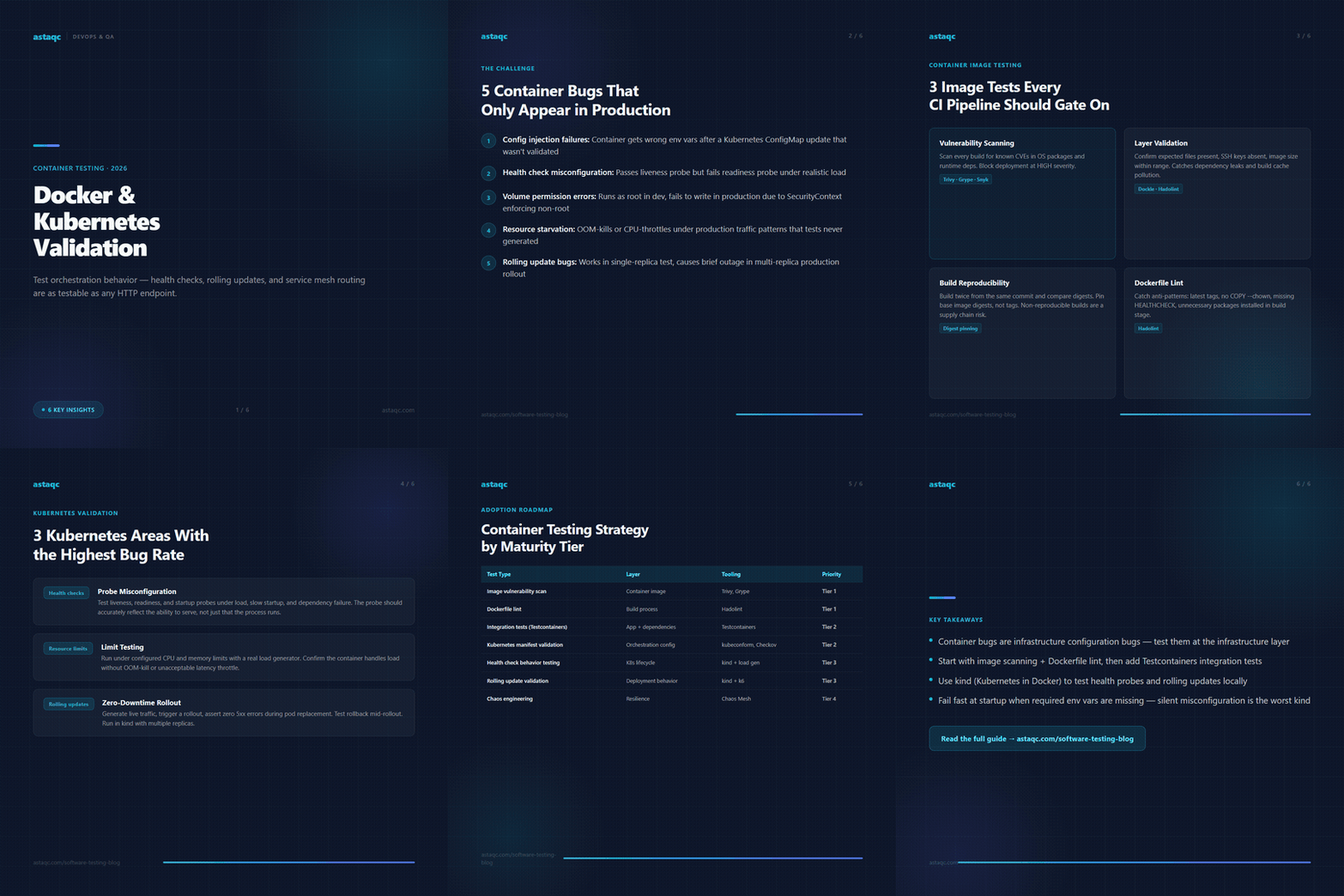
- Environment variable injection failures — the application container receives the correct variables in local testing but not after a Kubernetes ConfigMap or Secret update that wasn't validated before deployment
- Health check misconfiguration — the container starts and passes its liveness probe but fails its readiness probe under realistic load, causing Kubernetes to route traffic before the application is ready
- Volume mount permission errors — the container image runs correctly as root in development but fails to write to a mounted volume in production because the Kubernetes PodSecurityPolicy or SecurityContext enforces a non-root user
- Resource limit starvation — the container runs correctly without limits but OOM-kills or CPU-throttles under production traffic patterns that tests never generated
- Rolling update ordering bugs — the deployment rolls correctly in a single-replica test environment but causes brief service interruption in a multi-replica production deployment because the application's graceful shutdown period is shorter than Kubernetes's termination grace period
These failure modes are not application bugs in the traditional sense — the code is correct. They are infrastructure configuration bugs, and they require infrastructure-level tests to catch. The testing approach that covers them combines container image scanning, configuration validation, and integration tests that exercise the orchestration behavior directly rather than mocking it away. For teams building containerized services that serve external customers, this connects directly to their broader software testing strategy for reliability.
Container Image Testing: Security Scanning, Layer Validation, and Build Reproducibility
Container image testing begins before the container runs. The image is the deployable artifact, and validating its contents, its security posture, and its build reproducibility at the CI stage prevents a category of production incidents that only appear after deployment: vulnerabilities introduced by base image updates, unexpected files included in the image layer, non-deterministic builds that produce different binaries from the same source commit.
Security scanning in 2026 is a table-stakes requirement. Tools like Trivy, Grype, and Snyk Container scan the image's filesystem for known CVEs in OS packages and language runtime dependencies, and they integrate into CI pipelines as a gate that blocks deployment when high-severity vulnerabilities are found. The practical testing workflow treats the scan not as an on-demand operation but as a step in every image build: the CI pipeline builds the image, scans it, and fails the build if the scan produces findings above the configured severity threshold. Teams operating under compliance frameworks (SOC 2, ISO 27001) typically configure the threshold at HIGH and document exceptions for findings without available patches.
Layer validation goes beyond vulnerability scanning to verify the image's contents match expectations. A Dockerfile that uses a package manager to install dependencies can produce different installed package versions when the base image is updated and the lock file isn't pinned. Testing image layer contents with a tool like Dockle or a custom script that inspects the image manifest confirms that the expected files are present, that unexpected files (SSH keys, development credentials, build artifacts that should be excluded) are absent, and that the final image size is within the expected range. Size regressions in a container image are often the first visible symptom of an accidentally included dependency or build cache leak.
Build reproducibility testing verifies that building the same Dockerfile from the same source commit produces a functionally identical image on subsequent builds. Non-reproducible builds are a supply chain risk and a debugging liability: if the image running in production cannot be rebuilt from source, diagnosing a production incident requires working from a potentially different binary than the one that caused it. Pinning base image digests rather than tags and using deterministic dependency resolution (lock files, hash-verified downloads) in the Dockerfile are the standard mitigations. Testing their effectiveness means building the image twice in the same CI pipeline with an identical cache state and comparing the resulting digests.
Kubernetes Deployment Validation: Health Checks, Resource Limits, and Rolling Update Testing
Kubernetes deployment validation covers the gap between a container that runs correctly and a Kubernetes deployment that behaves correctly under orchestration. The three areas with the highest rate of configuration bugs are health check definitions, resource limit specifications, and rolling update parameters.
Health check validation: Kubernetes uses three probe types to manage container lifecycle: liveness probes that restart an unhealthy container, readiness probes that gate traffic routing to a container that is not yet ready to serve requests, and startup probes that give slow-starting containers time to initialize before liveness checks begin. Misconfigured probes produce some of the most disruptive production incidents in containerized deployments because they interact with Kubernetes's reconciliation loop: a liveness probe that fires too aggressively restarts containers that are simply under load; a readiness probe that never fails allows unhealthy containers to receive traffic. Testing health check behavior means exercising the actual probe endpoint under conditions that approximate production: after a slow startup, under CPU pressure, and after a dependency (database, cache) becomes unavailable. The probe should accurately reflect the application's ability to serve requests, not just that the process is running.
Resource limit testing: Containers without resource limits run correctly in test environments with spare capacity and fail in production under realistic load. Testing resource limit behavior requires running the container under the configured limits and verifying that it handles load correctly, that it produces meaningful logs before being OOM-killed if the limit is too low, and that CPU throttling under the configured CPU limit doesn't cause unacceptable latency regression. This is best done in a local Kubernetes cluster (kind, minikube, or k3s) or a dedicated test environment rather than in production, using load generation tools to drive the container to its limits.
Rolling update testing: Kubernetes rolling updates replace running pods one by one while maintaining service availability. The test validates that in-flight requests are completed before old pods are terminated (graceful shutdown), that new pods are healthy and serving traffic before old pods are removed (readiness probe integration), and that the rollout completes without triggering the deployment's progress deadline. Testing rolling updates in a local cluster with multiple replicas, real traffic generation, and rollback triggered mid-rollout covers the most common failure scenarios. The key assertion is that no HTTP requests return 5xx errors during the rollout window.
Container Testing Strategies: Comparison by Layer and Team Maturity
The right container testing strategy depends on the team's current maturity level and the deployment's risk profile. The table below maps test types to the layer they validate and the typical adoption sequence for teams building out their container test coverage.
| Test Type | Layer Validated | Tooling | Adoption Priority |
|---|---|---|---|
| Image vulnerability scan | Container image | Trivy, Grype, Snyk | First (all teams) |
| Dockerfile lint | Build process | Hadolint, Dockle | First (all teams) |
| Integration tests in Docker Compose | Application + dependencies | Docker Compose, Testcontainers | Second |
| Kubernetes manifest validation | Orchestration config | kubeval, kubeconform, Checkov | Second |
| Health check behavior testing | Kubernetes lifecycle | kind, k3s + load generator | Third |
| Rolling update validation | Deployment behavior | kind + k6/Locust | Third |
| Chaos engineering | Resilience under failure | Chaos Mesh, LitmusChaos | Fourth (mature teams) |
| Service mesh policy testing | Network routing + mTLS | Istio test framework, kuma | Fourth (mature teams) |
Teams at the second tier who have image scanning and manifest validation in place typically see the greatest return from adding integration tests using Testcontainers, because the library makes it straightforward to run the application container against real instances of its dependencies (database, cache, message queue) without maintaining a persistent staging environment. The test starts the dependency containers, runs the tests against them, and tears everything down — the same Docker socket available in most CI environments is sufficient to run the full suite.
Frequently Asked Questions
How do you test Kubernetes manifests without deploying to a cluster?
Manifest validation tools like kubeconform and kubeval check YAML manifests against the Kubernetes API schema before they reach a cluster. They catch type errors, missing required fields, and deprecated API versions that would cause the deployment to fail or behave incorrectly. For policy validation — checking that manifests comply with organizational rules like required labels, resource limits, or security context settings — OPA/Gatekeeper's dry-run mode and Checkov both run offline against manifest files. Combining schema validation with policy validation in CI catches the majority of configuration bugs before the manifest ever reaches a cluster.
What is the difference between Testcontainers and Docker Compose for integration testing?
Docker Compose manages a fixed set of containers defined in a YAML file, started and stopped as a group. Testcontainers is a library available in Java, Go, Python, Node.js, and other languages that manages containers programmatically from inside test code, starting specific containers for each test class and stopping them when the test finishes. Testcontainers is better suited to test isolation because each test suite gets a fresh container state, and the container lifecycle is coupled to the test lifecycle rather than managed separately. Docker Compose is simpler to set up for teams that want all services running before the test suite starts and don't need per-test isolation.
How should teams handle environment variable differences between local Docker and Kubernetes?
The root cause of environment variable bugs in containerized deployments is usually that local runs inject variables from a .env file or docker run -e flags, while Kubernetes injects them from ConfigMaps and Secrets. The practical mitigation is to validate the full set of required environment variables at application startup and fail fast with a clear error message if any are missing or empty. This converts a silent misconfiguration into a visible startup failure that is caught immediately in testing. The Kubernetes manifests should reference ConfigMap and Secret keys explicitly rather than mounting the entire object, so that adding a new required variable to the application without updating the manifest produces a startup failure rather than a runtime error.
What is the simplest way to run Kubernetes integration tests locally?
Kind (Kubernetes in Docker) creates a multi-node Kubernetes cluster inside Docker containers on a laptop in under two minutes and tears it down equally fast. For teams that want to validate rolling updates, health check behavior, and pod scheduling without maintaining a cloud cluster, kind is the standard starting point. The cluster state is ephemeral and isolated to the Docker network, so tests that deploy real services and generate load against them can run in CI without shared cluster state affecting results. For teams that need a lighter-weight option, k3s and minikube are alternatives with different tradeoffs between resource usage and feature completeness.
How do you validate that a Kubernetes application handles graceful shutdown correctly?
Graceful shutdown testing requires sending a SIGTERM signal to the container and verifying two things: that in-flight requests complete before the process exits, and that the process exits within the configured terminationGracePeriodSeconds. The test sequence is: start the container under load with active requests in flight, delete the pod (which triggers SIGTERM), assert that all in-flight requests return 2xx responses, and assert that the pod exits within the grace period. Running this test in a kind cluster with a load generator like k6 or Locust gives confidence that the application's shutdown behavior is compatible with Kubernetes's rolling update mechanism. For teams building services where deployment reliability directly affects customer SLAs, this connects to the broader test automation practice of validating infrastructure behavior, not just application code. See hire a QA team for teams that need hands-on expertise in containerized deployment testing, and the complete software testing guide for context on where container testing fits in a broader quality program.
Container testing in 2026 means validating orchestration behavior, not just application code — health checks, rolling updates, and service mesh routing are as testable as any HTTP endpoint.

Astaqc Team
November 27, 2026