October 1, 2026
Authorization Testing in 2026: How to Validate Access Controls, Permission Gates, and Role-Based Boundaries
Authorization testing validates that users can access exactly the resources they are permitted to and cannot access the ones they are not. It is one of the most consistently under-tested areas in web application security: most teams verify that authenticated users can complete the application's core flows but do not systematically test the boundary conditions — whether a standard user can reach an admin endpoint, whether user A can read or modify user B's records, or whether a downgraded role loses access correctly. Broken access control has been the top-ranked OWASP vulnerability category for three consecutive years, and insecure direct object reference (IDOR) bugs — which authorization tests directly target — remain a leading cause of data breaches in applications that pass all their functional tests.
Teams looking for foundational context on testing security controls can review Astaqc's software testing services and the complete software testing guide. This article covers where authorization bugs come from, how to structure authorization tests, tooling options, and how to integrate authorization testing into CI/CD pipelines.
Authorization testing is distinct from authentication testing. Authentication tests verify that a user is who they claim to be — login flows, session management, token validation. Authorization tests verify that an authenticated user can only do what they are permitted to do — access controls, resource boundaries, role-based permissions.
The scope of authorization testing includes: horizontal privilege escalation (user A accessing user B's resources through direct object references), vertical privilege escalation (a standard user accessing admin-level endpoints or performing privileged operations), missing function-level access controls (endpoints or actions that restrict access in the UI but not in the API), and broken role transitions (users who should lose access when demoted or removed retaining it because the server-side role check is missing or cached).
A common pattern that authorization tests must cover is direct object reference manipulation: a user whose record ID is 1001 changes the ID in an API request to 1002 and receives another user's data. Applications that rely only on UI-level access controls — hiding buttons, not rendering admin sections — while leaving the underlying API endpoints unprotected fail this test consistently. Authorization testing must be conducted at the API level, not only through the UI, because UI access controls are trivially bypassed with any HTTP client.
Authorization bugs occur at three levels: missing checks, incorrect checks, and stale checks. Missing checks are the most common: a developer adds a new endpoint or action, tests its core logic, and does not add the authorization gate that limits who can call it. The endpoint works correctly for authorized users and, because no authorization check exists, also works correctly for unauthorized users. The functional test passes; the security test does not exist.
Incorrect checks are subtler. The authorization logic exists but contains a flaw: it checks the wrong attribute (verifying organization membership but not resource ownership), uses the wrong comparison (role greater than or equal to admin instead of equals admin), or trusts a client-supplied value rather than a server-validated one (accepting a user ID from the request body instead of deriving it from the authenticated session). These bugs pass code review because the structure of the authorization check looks correct; the flaw is in the specific condition being evaluated.
Stale checks occur when role or permission changes are not applied consistently. A user is removed from a team, their role is changed, or their account is downgraded, but the server caches a previous authorization decision or checks a denormalized permission value that is not updated. The user's session continues to pass authorization checks for operations they should no longer have access to. These bugs are particularly difficult to find through manual testing because they require testing the post-change state, not just the steady-state permissions.
Organizations can supplement authorization test coverage with Astaqc's test automation services and manual testing capabilities. The manual vs automated testing guide covers when manual exploration complements automated authorization checks.
Testing RBAC requires generating test sessions for each defined role and verifying that each session produces the correct behavior for every protected resource and action. The test structure is a matrix: rows are resources and actions, columns are roles, and each cell is the expected outcome (permitted or denied). A test failure is any cell where the actual outcome differs from the expected outcome — an admin-only endpoint that a standard user can reach, a read-only role that can perform writes, or a resource that returns 200 to a user who should receive 403.
The practical steps for implementing RBAC tests are: identify every role in the system, create test accounts for each role, map every protected endpoint and action to the roles that should have access, and write tests that exercise each endpoint and action for each role, asserting on the response code and response body. For endpoints that should return 403 for unauthorized roles, the assertion should verify both the status code and that the response does not contain sensitive data — some implementations return 403 with partial data in the response body, which passes the status code assertion but leaks information.
Roles that are infrequently tested in practice are the high-risk ones: accounts that have been recently demoted, accounts at role boundaries (the most senior non-admin role should not reach admin endpoints), and service accounts with elevated permissions that may be accessible through the same API surface as user accounts. Authorization test suites that only cover the nominal cases — admin can do admin things, user can do user things — miss the boundary conditions that are most commonly exploited.
| Role | Admin endpoint | Own resources | Other user resources | Org-level reports |
|---|---|---|---|---|
| Admin | 200 (permitted) | 200 (permitted) | 200 (permitted) | 200 (permitted) |
| Member | 403 (denied) | 200 (permitted) | 403 (denied) | 403 (denied) |
| Read-only | 403 (denied) | 200 GET only (permitted) | 403 (denied) | 403 (denied) |
| Recently demoted | 403 (often fails) | 200 (permitted) | 403 (often fails) | 403 (often fails) |
Authorization tests that run only in manual security reviews or before major releases catch bugs late and create slow feedback loops for development teams. Integrating authorization tests into CI/CD pipelines shifts access control validation earlier in the development process, where defects are cheaper to fix. The practical challenge is that authorization tests require authenticated sessions for multiple roles, which means the CI environment needs test accounts with defined roles and the test suite needs a mechanism to create and authenticate those accounts before test execution.
The recommended structure for CI authorization tests is a dedicated test data setup that creates a clean set of test accounts for each role at the start of the test run, executes the authorization matrix against those accounts, and cleans up the accounts after the run. Using shared long-lived test accounts works but creates state dependencies between runs and makes it harder to test role transition scenarios, where the test depends on changing an account's role mid-run and verifying the before and after state.
Authorization tests should run on every pull request for changes that touch any access control logic, role management endpoints, resource ownership logic, or authentication middleware. A failing authorization test on a PR that modifies permission logic provides immediate feedback to the developer, before the change reaches a staging environment where the bug would require a separate QA cycle to detect. Astaqc's test automation services include authorization test suite design and CI/CD integration support. Additional pipeline quality patterns are covered in the outsource software testing guide.
For teams using TestInspector, HTTP request steps with session token injection can be used to test authorization at the API level: create a step that sets the authorization header to a token for a given role, issues a request to a protected endpoint, then asserts on the expected response code and the absence of sensitive fields in the response body. This tests the API directly, bypassing the UI, which is where authorization vulnerabilities are actually enforced. Full details on TestInspector's HTTP testing capabilities are on the TestInspector product page.
Authorization testing requires a different toolset depending on whether the application exposes a REST API, a GraphQL API, or only a browser UI. For REST APIs, tools that can issue raw HTTP requests with arbitrary headers and inspect full response bodies are essential — Postman, curl, or any HTTP client that can be parameterized per role. For GraphQL, field-level authorization must also be tested: a query that returns all fields for an admin role should return a filtered set for a standard user, not a 403, in most implementations.
For browser-based authorization testing, Burp Suite and OWASP ZAP are the standard tools for interactive proxy testing: the tester authenticates as one role, performs actions, then uses the proxy to replay those requests with a different session token. This two-session testing approach is the most effective manual method for finding IDOR vulnerabilities. Both tools support automated scanning, but automated scanners are less reliable for authorization testing than for injection vulnerability scanning — authorization logic is application-specific and scanners cannot know which endpoints should be protected and which should not.
For automated authorization testing in CI, teams typically implement authorization tests as API integration tests rather than browser tests: the test suite creates sessions for each role, issues requests to protected endpoints, and asserts on response codes and bodies. This is faster than browser-based testing and more reliable in CI environments where browser setup adds latency. The browser-based approach is appropriate for verifying that the UI correctly hides or shows features by role, as a complement to the API-level authorization matrix. Astaqc's performance testing and software testing services pages cover the broader test strategy context.
| Approach | Best For | Limitation |
|---|---|---|
| Manual proxy testing (Burp Suite / OWASP ZAP) | Exploratory IDOR detection, session replay across roles | Not automated; cannot run in CI pipelines |
| API integration tests (role matrix) | Automated CI coverage of every endpoint by role | Requires complete endpoint inventory; misses UI-only checks |
| Browser tests with session injection | UI-level access control verification | Slower than API tests; only verifies the UI layer |
| DAST scanners (Burp, ZAP automated) | Coverage breadth across all discovered endpoints | High false positive rate for authorization; misses app-specific logic |
Authorization testing is a systematic QA activity that validates specific access control requirements against defined roles and resources. It runs as part of the development cycle, ideally in CI on every relevant code change. Penetration testing is a security assessment activity that attempts to find exploitable vulnerabilities across the full attack surface using adversarial techniques. Both cover access control but at different stages and with different scopes. Authorization testing catches known requirement violations early; penetration testing finds unknown vulnerabilities that the development team did not anticipate.
Functional authorization tests — verifying the role matrix against documented requirements — are a QA responsibility and do not require security expertise. Security engineers become necessary for adversarial testing: testing authorization logic against boundary conditions, injection points, and attack patterns that are not part of the documented requirements. The most effective programs treat them as complementary: QA builds and maintains the role matrix tests in CI, and security engineers conduct periodic adversarial reviews of the same surface.
Testing JWT-based authorization requires generating valid tokens for each test role and including them in the Authorization header of each test request. The token itself should not be modified unless the test is specifically checking for token validation vulnerabilities — modifying a JWT to change the role claim and verifying the server rejects it is a valid test, but it is different from the role matrix authorization test that verifies correct access for legitimately issued tokens. Most CI authorization test suites issue real tokens through the authentication endpoint with test credentials and use those tokens in subsequent requests.
Status code assertions are necessary but not sufficient. For 403 responses, tests should also verify that the response body does not contain sensitive resource data — some applications return a 403 status code alongside partial data or error messages that reveal resource existence or structure. For 200 responses from non-admin roles, tests should verify that the response does not contain fields that should be restricted to higher roles, such as internal IDs, other users' data, or admin-specific metadata. Asserting only on status codes misses data leakage that the authorization logic was supposed to prevent.
Yes. SOC 2 Type II and ISO 27001 both include access control as a required control domain. Auditors typically review evidence that access control requirements are defined, implemented, and tested. An authorization test suite that runs in CI and produces a pass/fail record for each role and resource provides audit-ready evidence that access controls are validated on an ongoing basis, not just at assessment time. Teams pursuing certification should document their authorization test coverage as part of the access control section of their compliance evidence package.
Astaqc's software testing services include authorization test design, role matrix definition, and CI/CD integration. The test automation services page covers automated test strategy including security-oriented testing. For teams that want hands-on help defining and implementing an authorization testing program, Astaqc provides both assessment and implementation support. The AI in software testing guide covers how AI tools are being applied to security testing workflows in 2026.
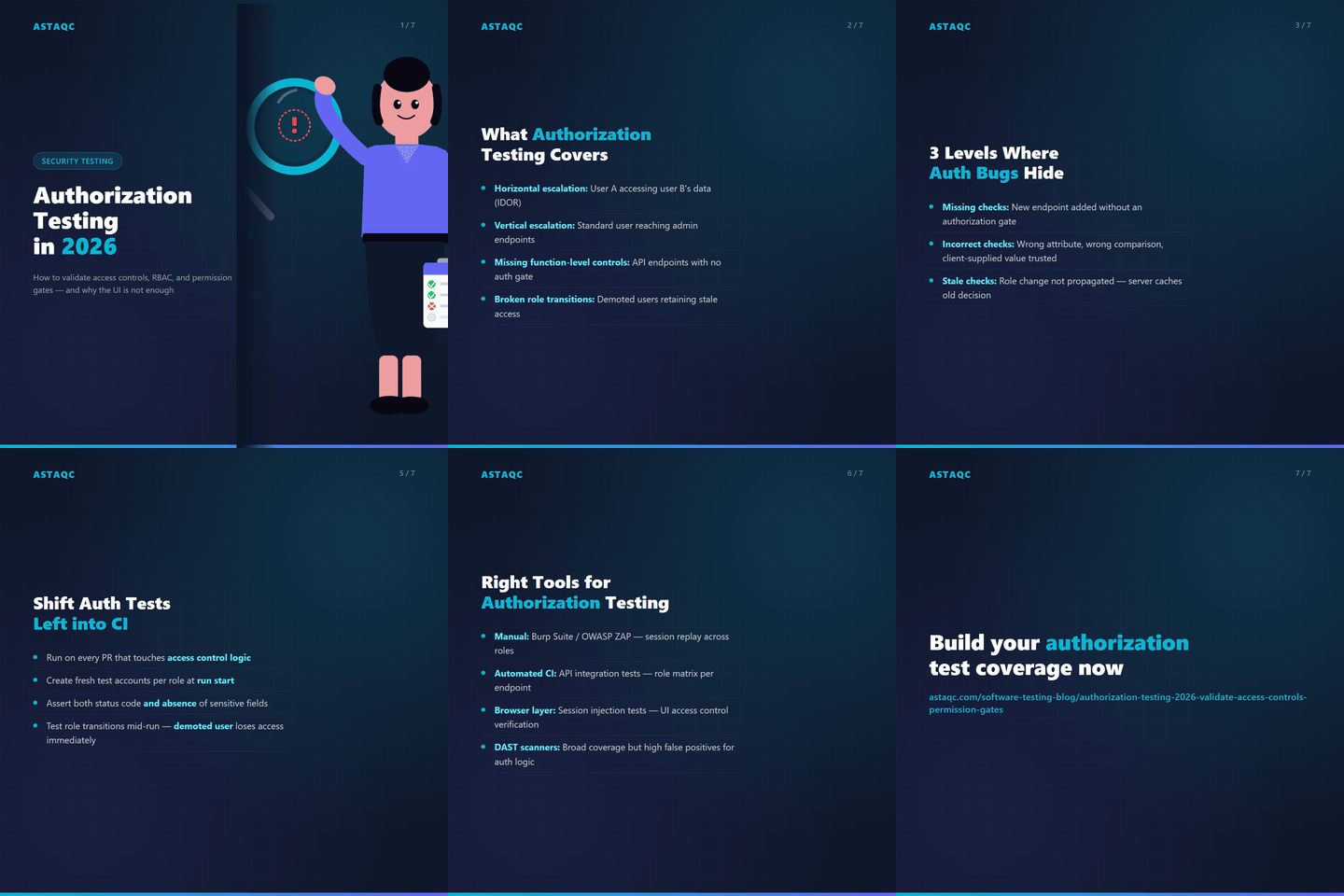
Broken access control is not a niche vulnerability — it is the most common category of web application defect. Authorization tests that run only before major releases are finding bugs too late. The teams catching these defects early run authorization checks on every pull request that touches access control logic.
October 1, 2026


Sign up to receive and connect to our newsletter

We founded ASTAQC as a tight-knit group of professional Software Testers and software developers.
Subscribe to our Newsletter