October 1, 2026
TestInspector vs. Cucumber: When AI-Native No-Code Testing Replaces BDD Frameworks
TestInspector and Cucumber both automate browser-based web testing, but they are designed around different assumptions about who writes tests and what output they produce. Cucumber is a BDD framework that turns Gherkin scenarios into executable tests through step definitions written in code — it produces both running tests and human-readable specifications that stakeholders can review. TestInspector generates and runs tests from an AI chat interface without step definitions or framework code — it produces running tests fast, without the engineering overhead that Gherkin requires. Which one fits your team depends on whether the specification-as-documentation contract BDD provides is worth the ongoing step definition investment, or whether no-code coverage speed is the priority.
Teams evaluating their automation approach can review Astaqc's manual vs automated testing guide and test automation services for broader context on choosing the right automation model.
Cucumber was created to close the communication gap between business stakeholders and engineering teams. Its Gherkin syntax — Given/When/Then scenario blocks written in plain English — produces specifications that product managers and business analysts can read and verify without reading code. A Cucumber scenario is both a specification document and an automated test: it describes what the application should do in language a non-engineer can understand, and it runs as a test through step definitions that map Gherkin text to browser or API interactions.
BDD with Cucumber works well in organizations where alignment between product requirements and test coverage is a persistent problem. When product managers actively review Gherkin scenarios before sprint completion, when acceptance criteria are written in Given/When/Then before development starts, and when engineering treats failing Cucumber scenarios as broken contracts rather than just CI failures, the framework delivers real collaboration value that no code-first tool replicates.
The engineering investment, however, is substantial. Every Gherkin step requires a corresponding step definition — a code block in Java, JavaScript, Ruby, or another supported language that implements the step. Teams building a new Cucumber suite from scratch typically spend the first several weeks creating a step library before they can write scenarios quickly. In stable application domains with predictable UI patterns, the library accumulates and becomes reusable. In applications that change frequently or have complex dynamic behavior, step definition maintenance becomes a continuous tax: selectors break, step parameters change, and adding new scenarios requires developers rather than QA analysts.
TestInspector takes a different approach to the same goal. Instead of starting from a specification language and requiring code to make it executable, TestInspector's AI chat interface generates test steps directly: a QA engineer describes a flow in natural language, and the system produces a structured sequence of steps — navigate, click, fill, assert — that execute immediately in a real browser through Selenium on Chrome, Firefox, Edge, or Safari. No step definitions, no framework configuration, no IDE setup, and no build cycle between writing a test and running it.
The structured step format is readable without being Gherkin — each step is a discrete action (navigate to URL, click element with label, assert text contains value) that QA analysts can read, edit, and extend without developer involvement. Changes take effect immediately. A QA analyst who spots a missing assertion can add it through the TestInspector UI without touching a codebase or waiting for a merge review.
Self-healing automation handles selector drift. When a UI change breaks an element selector, TestInspector retries with AI-suggested alternative selectors rather than failing immediately. This addresses one of the most persistent Cucumber maintenance burdens: step definitions that break when element IDs, classes, or DOM structure changes. TestInspector flags selectors that required AI correction so QA teams can update baseline definitions, rather than letting silent selector drift accumulate into widespread failures.
Additional capabilities relevant to teams evaluating Cucumber alternatives include variable interpolation with {{VAR}}, {{TIMESTAMP}}, {{ALPHANUMERIC}}, and {{TOTP:secret}} for test data management; HTTP request steps (GET/POST/PUT/PATCH/DELETE) with status code and body assertions for API validation alongside UI tests; accessibility assertions via axe-core; scheduling via cron, interval, and one-time triggers; and a CI/CD trigger API for pipeline integration. Tests can be exported to Playwright TypeScript, Selenium IDE, or Gherkin for teams that need a migration path. Full details are available at TestInspector's product page.
Cucumber delivers its full value when the Gherkin specification layer is genuinely used for cross-functional communication. In teams where product managers write or review acceptance criteria in Given/When/Then format, where QA leads maintain a scenario library alongside development, and where failing scenarios are treated as broken product contracts that block release, the framework creates a living documentation layer with measurable communication benefits. The test suite tells you not just whether the application is passing, but whether it is behaving as the product team intended.
The cost-benefit calculation changes significantly when the Gherkin layer is not actually reviewed by non-engineers. When only developers and QA engineers read the scenarios, when product managers do not validate acceptance criteria against Gherkin before sprint close, and when scenarios are written after step definitions rather than before, teams are paying the full step definition maintenance cost without the communication return. In those contexts, Cucumber functions as a slower, more verbose version of a code-first framework like Playwright or Selenium, without the directness that code-first tooling provides.
Framework setup is also a meaningful barrier for teams starting fresh. Configuring a Cucumber project with a browser automation driver (typically Selenium WebDriver or Playwright), managing browser driver versions, building initial step definitions, and setting up a CI runner can take experienced engineers a week and junior engineers considerably longer. For teams without this upfront capacity, the time-to-first-test is measured in days or weeks rather than hours.
| Dimension | Cucumber (BDD) | TestInspector |
|---|---|---|
| Test authoring | Gherkin scenarios + code step definitions | AI chat interface generates structured steps, no code |
| Who can write tests | Engineers for step definitions; product teams for scenarios (in practice, mostly engineers) | QA analysts without development background |
| Stakeholder readability | High — Gherkin is designed for business readers | Moderate — structured steps are readable but not Gherkin |
| Setup time | Days to weeks for initial configuration and step library | Hours — browser extension recording and chat interface |
| Selector drift handling | Manual step definition updates required | AI self-healing with automatic retry and suggestions |
| Browser execution | Depends on configured driver (Selenium, Playwright) | Chrome, Firefox, Edge, Safari via Selenium |
| API testing | Possible through step definitions with REST client | Native HTTP request steps with assertion support |
| CI/CD integration | Through test runner plugin (Maven, Gradle, npm) | API trigger endpoint |
TestInspector is well-suited for QA teams that need to build test coverage quickly without framework investment, for analysts without development backgrounds, for applications that change frequently enough to make selector maintenance a persistent problem, and for organizations where the primary goal is verified coverage rather than specification documentation. The no-code model removes the engineering prerequisite: a QA analyst who has never written code can create a suite that covers the critical paths of a web application and have it running in CI within a day using the browser extension for recording and the chat interface for extending coverage.
The self-healing mechanism and AI selector suggestions significantly reduce the maintenance burden compared to Cucumber step definitions. When a UI change breaks a selector, TestInspector attempts recovery automatically and flags the correction for review, rather than silently failing or requiring immediate developer intervention. For QA teams working on applications under active development, this materially reduces the time spent on test maintenance versus test creation.
The primary limitation is the absence of a Gherkin-style specification contract. TestInspector tests are structured steps — readable by engineers and QA analysts — but they do not produce the natural language business specification that BDD frameworks are designed to create. Teams where the Gherkin contract is a genuine requirement — where product managers validate acceptance criteria against Gherkin scenarios before sprint completion — should keep Cucumber in scope. The two tools serve different organizational needs, and teams that genuinely use BDD for cross-functional alignment should not drop it for coverage speed.
TestInspector's scope is currently limited to web applications. Teams with native mobile or desktop application testing requirements need separate tooling for those layers. Teams assessing their full testing strategy can review Astaqc's software testing services and hire QA team page for end-to-end testing coverage guidance. The outsource software testing guide also covers how to evaluate whether internal tooling or external QA support better fits team capacity.
Only if the BDD specification layer is not genuinely used for cross-functional communication. For teams where Gherkin scenarios are reviewed and validated by product managers as acceptance criteria, Cucumber produces value that TestInspector's structured steps do not replicate. For teams where Gherkin exists as a documentation convention but is only read by engineers, TestInspector's no-code approach produces equivalent test coverage with significantly less maintenance overhead.
Yes. TestInspector was designed for teams where test creation should not require developer time. A product engineer or QA analyst without automation experience can use the browser extension to record a flow, extend it with AI-generated steps, add assertions through the chat interface, and have a running test in CI within a day. Cucumber requires a developer to write step definitions before a non-engineer can author scenarios, which means developer time is required even when the Gherkin layer is owned by a non-engineer.
TestInspector can export to Gherkin, which provides a migration path if needed. More practically, teams evaluating a transition typically run TestInspector alongside Cucumber for new test coverage while the existing Cucumber suite continues running. There is no requirement to migrate existing tests — the evaluation question is whether new coverage is cheaper to add in TestInspector or in Cucumber for the team's specific composition and context.
TestInspector supports variable interpolation with named variables, timestamps, alphanumeric values, and TOTP secrets. Test data can be defined at the variable, suite, or organization level with an inheritance hierarchy. This covers the most common data-driven testing patterns. Cucumber's scenario outline syntax — running the same scenario with multiple data sets from a table — has a more explicit structure, but TestInspector's variable system supports equivalent coverage through parameterized variables and test scheduling.
Astaqc's test automation services cover both tool selection and implementation: evaluating whether BDD, no-code, or code-first automation fits a team's composition, building initial test suites using TestInspector or established frameworks, and integrating test execution with CI/CD pipelines. Teams that want to validate their current approach or build coverage from scratch can engage Astaqc for an assessment. The TestInspector product page covers the full feature set for teams evaluating no-code AI-native testing.
BDD remains worth adopting when the specification contract is the genuine goal — when non-engineering stakeholders will actively participate in writing or reviewing Gherkin scenarios as part of the product development process. When the goal is test coverage speed without a stakeholder collaboration requirement, AI-native no-code tools like TestInspector provide faster time-to-coverage and lower ongoing maintenance cost. The distinction is organizational rather than technical: which tool fits depends on who writes, reads, and acts on the tests.
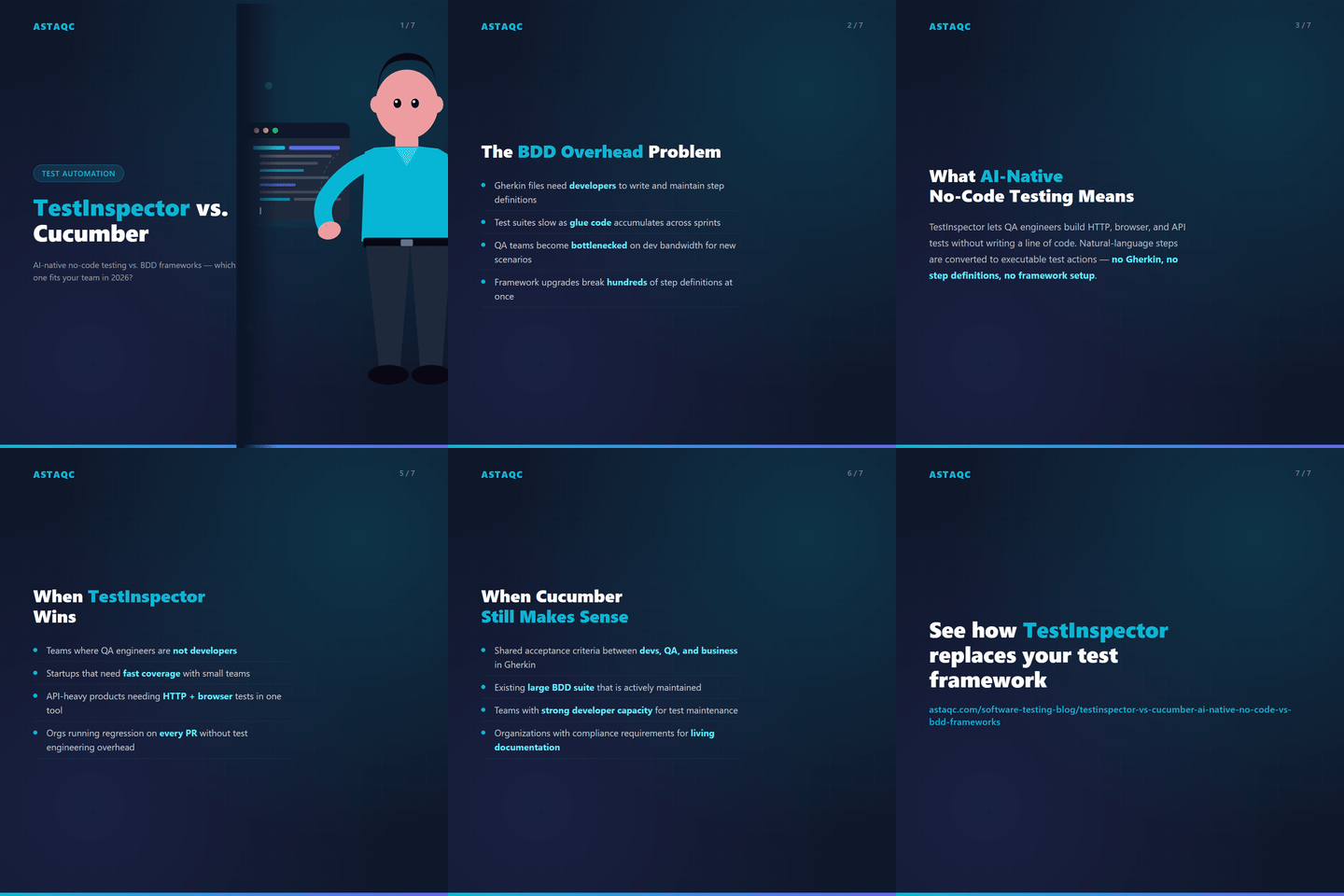
Cucumber's value is the specification contract — business-readable scenarios that are also executable tests. TestInspector's value is coverage speed — no code, no step definitions, no framework overhead. Most teams need one or the other, not both.
October 1, 2026


Sign up to receive and connect to our newsletter

We founded ASTAQC as a tight-knit group of professional Software Testers and software developers.
Subscribe to our Newsletter