August 18, 2026
TestInspector and Perfecto solve different problems in the test automation stack, and the right choice depends entirely on which testing surface the team needs to cover. Perfecto is a cloud-hosted device lab: it provides access to hundreds of real iOS and Android devices and runs test automation code that teams write themselves using Appium, Selenium, or Espresso. TestInspector is an AI-native no-code web test automation platform: it generates, executes, and maintains tests for web applications without requiring any test code. The tools are not direct competitors in the way that two test frameworks compete — they operate at different layers of the testing infrastructure stack and address different primary problems. This comparison is frequently misstated in tool evaluations because Perfecto is positioned as a "test automation platform" in its marketing, which suggests a broader capability set than what it actually provides. Perfecto provides the infrastructure for test execution on real devices; it does not provide test authoring, test logic generation, or test maintenance tooling. Teams that buy Perfecto still need a test framework, a test author, and a CI/CD integration to make Perfecto useful. Teams that buy TestInspector get all of those layers included for web application testing surfaces. The distinction matters because teams evaluating tools to reduce QA overhead or eliminate the need for dedicated test automation engineers will find that Perfecto does not address those problems, while TestInspector is specifically designed to solve them. For a full overview of where automated testing tools fit into a broader QA strategy, the complete software testing guide covers the tool landscape. Teams that need managed QA support alongside tool evaluation can reach Astaqc's software testing services team directly.
Perfecto is a cloud-hosted testing platform that provides access to hundreds of real mobile devices and desktop browsers for test execution. The core offering is a managed device lab: teams connect their existing test automation code to Perfecto's cloud infrastructure and run tests on physical iOS devices, Android devices, and a wide range of browser and OS combinations. Perfecto provides device access, parallel execution infrastructure, test result dashboards, and integrations with CI/CD systems. What Perfecto does not provide: test generation, test logic, test case management, or test maintenance tooling. Teams using Perfecto are responsible for writing all automation code, maintaining selectors and test steps as the application changes, and managing the framework configuration required to connect their code to the Perfecto cloud. Perfecto's pricing is usage-based: teams pay per device minute and per concurrent device session, with additional costs for certain features like Perfecto Visual Analysis for screenshot comparison. For teams running large native mobile test suites, Perfecto's device breadth and reliability are significant advantages. For web application teams without a native mobile surface, the value proposition is weaker because the primary differentiator — real physical device access — is not relevant to the testing surface they need to cover. For web testing specifically, Perfecto's real-browser capabilities are available from multiple platforms, and Perfecto's additional overhead of framework configuration and test code authorship may exceed the benefits of running tests on Perfecto's specific infrastructure.
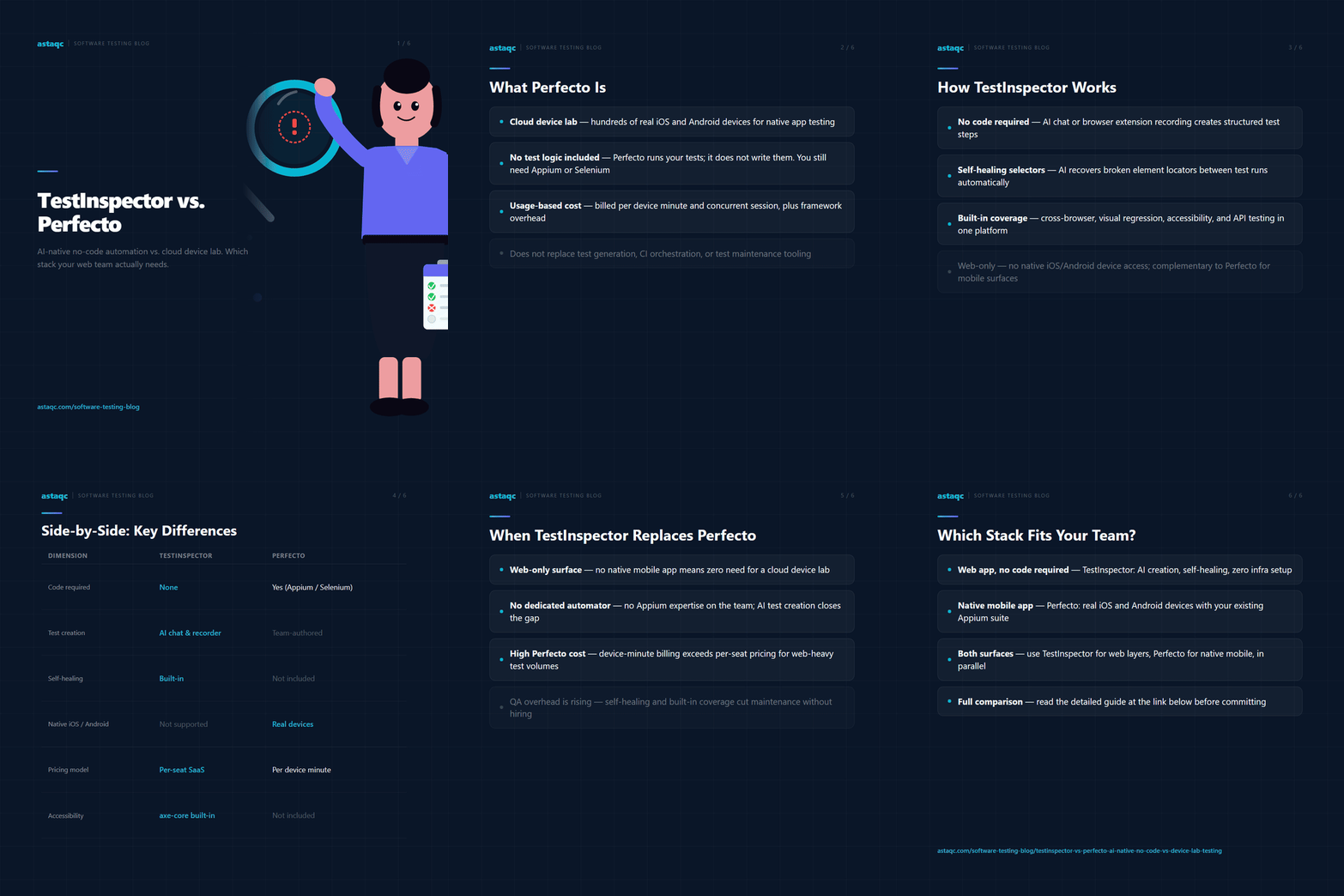
TestInspector is an AI-native no-code platform for web application test automation. Tests are created through an AI chat interface that converts natural language descriptions into structured test steps — GET, click, assert, and input actions — rather than generating automation code. Teams can also record tests directly using a browser extension that captures interactions on the live application. There is no framework to configure, no WebDriver to install, and no browser driver version to manage. The platform handles cross-browser execution on Chrome, Firefox, Edge, and Safari via managed cloud infrastructure, updating browser environments automatically.
Self-healing is built into the execution model: when element selectors change between test runs, TestInspector automatically retries with AI-generated alternative selectors. When automatic resolution fails, the platform surfaces a selector suggestion for review rather than leaving the test broken. This addresses the primary driver of test suite maintenance cost in conventional Selenium or Playwright stacks. Visual regression is also built in, using SSIM screenshot comparison with baseline approval, crop selectors, and exclusion regions for dynamic content sections.
Additional capabilities include: variable interpolation ({{VAR}}, {{TIMESTAMP}}, {{ALPHANUMERIC}}, {{TOTP:secret}}) with test-to-suite-to-org scope hierarchy and encrypted storage for sensitive values; HTTP request steps (GET, POST, PUT, PATCH, DELETE) with status code and response body assertions for API testing within the same platform; accessibility assertions using axe-core with severity level filtering for WCAG compliance; built-in scheduling via cron, interval, and one-time triggers; live WebSocket run streaming; CI/CD trigger API for pipeline integration; MCP tokens for Claude Code and Cursor integration; and test export to Playwright TypeScript, Selenium IDE, and Gherkin.
For web application teams, TestInspector consolidates three infrastructure layers that Perfecto-based stacks require into a single no-code platform: the automation framework, the browser execution environment, and the test management and scheduling layer. The TestInspector platform reduces both the initial setup cost and the ongoing maintenance burden that code-based frameworks carry. Teams using Astaqc's manual testing services can pair manual exploratory coverage with TestInspector automated regression without requiring a separate automation engineering discipline.
| Dimension | TestInspector | Perfecto |
|---|---|---|
| Primary function | AI-native no-code web test automation platform | Cloud device lab for mobile and desktop test execution |
| Test creation | AI chat interface and browser extension recording | Team-authored code in Appium, Selenium, or other framework |
| Code required | No — structured steps generated by AI or recorded | Yes — automation code in a framework of team's choice |
| Native iOS and Android | Not supported | Supported — real physical devices available |
| Cross-browser web testing | Chrome, Firefox, Edge, Safari — managed cloud infrastructure | Yes — real browsers across OS and version combinations |
| Self-healing | Built-in AI selector recovery with human review for failures | Not included — framework and team responsibility |
| Visual regression | SSIM screenshot comparison with baseline approval — built-in | Perfecto Visual Analysis add-on (additional cost) |
| Scheduling | Cron, interval, and one-time — built-in | Via CI/CD pipeline integration only |
| Pricing model | Per-seat SaaS subscription | Usage-based: device minutes and concurrent sessions |
| Infrastructure configuration | Zero — no driver config, no framework installation | Framework configuration and cloud account setup required |
| Accessibility testing | axe-core integration with severity filtering — built-in | Not included natively |
The comparison is cleanest on the "Code required" and "Native iOS/Android" rows. If the test surface is entirely web and the team wants no-code execution, TestInspector eliminates the framework layer entirely. If native mobile testing on real hardware is a requirement, Perfecto remains necessary regardless of what the web automation stack looks like — and TestInspector can handle the web surface while Perfecto handles the native mobile layer.
For web application teams, the clearest signal that a Perfecto-based stack should be evaluated for replacement is when test maintenance overhead has grown disproportionately relative to new test coverage. In conventional Selenium or Playwright frameworks running against Perfecto or similar cloud infrastructure, selector drift — the breakdown of element locators when the application UI changes — is the primary driver of maintenance time. QA engineers spend time debugging failures caused by changed class names, updated IDs, or restructured component trees rather than writing new test coverage. TestInspector's self-healing model substantially reduces this category of maintenance, because the platform handles routine selector recovery automatically.
Additional signals that favor TestInspector for web teams: the QA team does not include dedicated automation engineers and the test suite is not growing as fast as the application; the team is evaluating AI coding tools (Claude Code, Cursor) and wants test generation integrated into the AI-assisted workflow via MCP tokens; visual regression coverage is needed but adding a dedicated visual testing tool would require additional integration work; or accessibility testing needs to run in CI but axe-core integration into the current framework has not been implemented.
For teams using Astaqc's test automation services, TestInspector is available as part of the managed automation engagement. Teams evaluating the full range of testing coverage options — including performance testing, manual testing, and automated regression — can use Astaqc's coverage assessment to determine where the automation effort is most productive and which tools fit the testing surface.
Perfecto is the right choice when native mobile app testing on real physical devices is a non-negotiable testing requirement. Applications with device-specific features — camera, GPS, push notifications, biometric authentication, platform-specific gesture handling, or hardware-level integration — require real device hardware that no browser-based or simulated environment can replicate. For these test scenarios, the Perfecto device cloud (or an equivalent like BrowserStack, Sauce Labs, or a managed AWS Device Farm setup) is the correct infrastructure regardless of which framework generates the test scripts.
Teams with both web and native mobile surfaces can use TestInspector and Perfecto for different layers without overlap. Web surfaces go to TestInspector; native iOS and Android surfaces go to Perfecto with an appropriate mobile automation framework. The cost structure differs: TestInspector is a per-seat subscription; Perfecto scales with device usage. For teams doing performance testing at scale across real device types, the performance testing services overview describes where device-specific performance data is relevant in testing strategy. For broader questions about how to structure a QA function, the QA outsourcing guide covers the tradeoffs of different staffing and tooling models.
TestInspector tests web applications in cloud-managed browsers, which includes responsive mobile web when the application is accessed through Chrome or Safari on a mobile browser viewport. It does not run tests on native iOS or Android app binaries (.ipa or .apk files). For native mobile app testing that requires device APIs, real device hardware, or platform-specific UI testing, Perfecto or an equivalent device cloud is required. The distinction is between mobile web (covered by TestInspector) and native mobile (requires real device infrastructure).
TestInspector runs on managed cloud browsers and supports parallel test execution across multiple browser types. Perfecto runs tests on real devices, which have different performance characteristics than cloud browser instances. For web application tests, TestInspector execution times are comparable to Selenium-on-cloud setups and are not a meaningful differentiator from Perfecto's web browser execution. The more relevant comparison is the total time from test suite failure to resolution, where TestInspector's self-healing reduces the debug and fix cycle substantially compared to a framework running against Perfecto without built-in recovery.
Moving to TestInspector for web testing typically involves building a new test suite through the AI chat interface or browser extension, not migrating existing Selenium or Appium scripts. TestInspector's structured step format does not accept code imports. Existing test cases can serve as a coverage reference for building the new suite, and the AI chat interface can generate test steps from test plan descriptions. The migration effort for a typical web application test suite is smaller than rewriting tests into a different framework, because the AI interface and recording tools reduce the per-test authoring time significantly.
For web testing specifically, the main area where Perfecto provides broader coverage is specific browser-version and OS-combination testing. Perfecto's device cloud includes older browser versions and less common OS combinations that teams with strict legacy browser support requirements need to test against. TestInspector covers current stable versions of Chrome, Firefox, Edge, and Safari. For most modern web applications, current stable browser versions on standard OS environments represent the full realistic test surface.
For teams with both surfaces, the most practical structure is to use TestInspector for all web application testing and Perfecto (or an equivalent device cloud) for native mobile testing. The tools do not overlap in their testing surfaces, so running both does not create redundancy. TestInspector handles web UI tests, API tests, visual regression, accessibility assertions, and scheduled monitoring for the web surface. The mobile automation framework running against Perfecto handles device-specific tests for the native app. Teams that want to consolidate tooling and QA management can work with Astaqc's QA team engagement to manage both surfaces under a single testing strategy. For overall software testing cost context, the software testing cost guide covers how multi-tool stacks compare to consolidated approaches on a total cost basis.
Perfecto and TestInspector address different layers of a testing stack. Perfecto provides real device infrastructure for native mobile testing. TestInspector provides AI-native no-code automation for web applications. Web-only teams using a Perfecto-plus-Selenium stack carry framework and infrastructure overhead that TestInspector eliminates; teams with native mobile requirements continue to need real device coverage that Perfecto provides.
August 18, 2026


Sign up to receive and connect to our newsletter

We founded ASTAQC as a tight-knit group of professional Software Testers and software developers.
Subscribe to our Newsletter