API Versioning Testing in 2026: Validating Backward Compatibility, Breaking Changes, and Migration Paths in Every CI/CD Pipeline Run
Why API Versioning Testing Breaks Down in Practice
Most teams test their API endpoints. Very few teams test their API versioning strategy. The distinction matters: testing an endpoint confirms that it returns the expected response today. Testing your versioning strategy confirms that changes to that endpoint are safe for every consumer that depends on the previous behavior — including consumers your team does not control.
The practical failure mode is consistent: a developer adds a new required field to a request body, removes a deprecated response field, or changes an enum value from a string to an integer. The developer's existing tests pass. The pipeline is green. The change ships to production. Twenty minutes later, mobile clients on the old version start returning errors, a third-party integration stops posting data, and an internal microservice throws a null-pointer exception on the field that is no longer present.
These failures share a root cause: no test validated the contract between the new version and the consumers of the old version. API versioning testing is the practice of making that contract explicit, testing it automatically, and blocking deployments that would break it.
Classifying Breaking vs Non-Breaking API Changes
The first requirement for a versioning test strategy is a consistent classification of what constitutes a breaking change. Without this classification, every change requires manual review, and the review is inconsistent because different developers have different mental models of what is safe.
| Change Type | Breaking? | Why | Safe Migration Path |
|---|---|---|---|
| Remove a response field | Breaking | Consumers reading that field get null/undefined or an error | Deprecate in v1, remove in v2 |
| Add a required request field | Breaking | Old consumers omit the field and get validation errors | Make optional with default, or bump version |
| Change a field type | Breaking | Consumers parsing the old type get serialization errors | New field name in new version |
| Add an optional response field | Non-breaking | Consumers that do not read the field are unaffected | Ship directly |
| Change an HTTP status code | Breaking | Consumers branching on status codes handle the wrong case | Bump version, document change |
| Add a new endpoint | Non-breaking | Consumers not using the endpoint are unaffected | Ship directly |
This classification should be documented as a team standard and encoded into your contract testing toolchain. Tools like Pact, OpenAPI diff, and Spectral can automate the classification step — they compare the new API schema against the previous version and report any changes that meet the breaking-change definition. The output of this comparison becomes a CI/CD gate: if breaking changes are present and no version bump is planned, the pipeline fails.
REST and GraphQL Versioning Compatibility Testing Patterns
REST and GraphQL use different versioning models, and the compatibility testing approach differs accordingly.
REST API Versioning
REST APIs typically version via URL path (/api/v1/users), request header (Accept: application/vnd.api+json;version=2), or query parameter (/api/users?version=2). URL versioning is the most testable pattern because each version is a distinct endpoint that can be tested independently.
For REST, the core compatibility tests are:
- Schema contract tests: Generate or maintain an OpenAPI/Swagger spec for each active version. On each deploy, diff the new schema against the pinned previous-version spec using a tool like oasdiff, openapi-diff, or Spectral. Any breaking diff fails the pipeline.
- Consumer-driven contract tests: Each consumer of the API records their expectations as a Pact contract. The API provider runs the consumer contracts as a test suite on each deploy. If the provider's response no longer matches the consumer's recorded expectations, the test fails.
- Backward compatibility regression tests: Run the full test suite from the previous version against the new version's endpoint. This catches behavioral regressions that schema diffing misses — a field that is present in the schema but no longer returns a value under certain conditions.
GraphQL API Versioning
GraphQL's official guidance discourages versioning in favor of schema evolution: add fields without removing old ones, deprecate fields explicitly, and remove them only after all consumers have migrated. This approach works, but it requires discipline and tooling to enforce.
For GraphQL compatibility testing:
- Schema inspection: Use graphql-inspector to diff new schemas against the previous version and classify breaking changes automatically.
- Deprecation coverage: Run queries that use deprecated fields against the new schema. If a deprecated field is removed before coverage drops to zero, the test fails.
- Field usage analysis: For internal APIs, instrument field usage in production to confirm that deprecated fields have zero active consumers before removing them. For external APIs, this is not possible — keep deprecated fields for a documented window (commonly 90 days).
Both REST and GraphQL versioning tests integrate with the test automation pipeline as schema-level gates that run before the full integration test suite.
Building API Versioning Tests Into the CI/CD Pipeline
An API versioning test strategy only works if it runs in the pipeline on every change. Here is the standard integration pattern for a CI/CD-integrated versioning test suite.
Stage 1: Schema Diff (Pull Request Gate)
When a developer opens a pull request that modifies an API endpoint, the pipeline runs a schema diff between the branch's API definition and the main branch's pinned spec. If the diff contains breaking changes and the PR does not include a version bump, the check fails. This gate catches breaking changes at the earliest possible point — before the code is merged.
Tools for this stage: oasdiff (REST/OpenAPI), graphql-inspector (GraphQL), Spectral (linting for API style rules alongside breaking change detection).
Stage 2: Contract Tests (Build Gate)
After the PR merges, the full build runs consumer-driven contract tests. Each consumer of the API has a Pact contract that defines the requests it makes and the responses it expects. The API provider runs these contracts as a test suite. If any consumer contract fails, the build fails.
Pact Broker (or PactFlow for managed hosting) stores contracts and their verification history. The pipeline queries the broker to determine whether all consumers are compatible before promoting the build to staging.
Stage 3: Backward Compatibility Tests (Staging Gate)
Before promoting from staging to production, run the previous version's full integration test suite against the new version. This validates behavioral compatibility, not just schema compatibility. A change that passes schema diffing and contract tests can still break behavioral expectations that were not expressed in either the schema or the recorded consumer contracts.
To run this stage, maintain a pinned test suite for each active version. The suite is updated only when a new version is released, not on every deploy. It becomes the regression guard for all changes within that version's lifecycle.
Stage 4: Migration Path Smoke Tests (Production Gate)
When shipping a new major version alongside an existing one, add smoke tests that validate the migration path: requests using the old version's format are rejected with a clear deprecation message, requests using the new version's format succeed, and the deprecation headers (Sunset, Deprecation) are present on old-version responses.
These tests confirm that consumers have a working migration target and that the old version's sunset schedule is enforced. For teams implementing performance testing alongside versioning tests, the migration smoke tests also measure whether the new version's response times are within acceptable bounds of the old version.
Common API Versioning Test Coverage Gaps
Even teams with mature CI/CD pipelines and schema diffing in place tend to have the same coverage gaps in their API versioning test suites.
Gap 1: Testing Only the Happy Path
Contract tests and schema diffs focus on successful responses. They rarely cover error response formats, which are equally part of the contract. A change that modifies the structure of a 400 or 422 error response can break consumers that parse error messages to display to users. Add error format assertions to your consumer contracts explicitly.
Gap 2: No Version Sunset Enforcement
Teams deprecate old API versions with a planned sunset date, then discover months later that internal consumers are still using the deprecated version. Without a test that counts active consumers of each version, sunset enforcement is manual and unreliable. Instrument your API gateway to log version usage, and add a pipeline check that blocks the sunset if active traffic on the deprecated version is still above a threshold.
Gap 3: Undocumented Implicit Contracts
Some consumer dependencies are not expressed in the schema or consumer contracts. For example, a consumer may depend on the order of items in an array response, the precision of a floating-point field, or the format of a timestamp string. These implicit contracts are invisible to schema diffing and contract testing. The only way to find them is through behavioral tests that compare actual response values between versions, not just structure.
Gap 4: Testing Versioning in Isolation
Versioning test suites often test a single API in isolation. In a microservices architecture, an API may call downstream APIs, and a change to a downstream API's version can propagate a breaking change to the upstream consumer through a chain of version dependencies. End-to-end contract testing across service boundaries catches these chain breaks. See the manual vs automated testing guide for context on where end-to-end tests fit in the broader test pyramid.
Gap 5: Missing Authentication Version Compatibility
When an API's authentication mechanism changes between versions (from API keys to OAuth 2.0, from one token format to another), consumers must migrate their authentication in lockstep with the API version. Test that the new version rejects old authentication formats with a clear error message, and that the old version continues accepting old authentication until its sunset date. Authentication migration failures are among the hardest to debug in production because they often manifest as intermittent errors under specific token refresh conditions.
Frequently Asked Questions
What is the difference between API versioning and API change management?
API versioning is the mechanism — URL paths, headers, or parameters that allow multiple versions of an API to coexist. API change management is the process — how changes are classified, communicated, tested, and deprecated. Good versioning without change management means multiple versions exist but consumers do not know what changed or when old versions will be removed. Good change management without clear versioning creates consumer confusion about which behavior they are testing against. Both are needed. This post focuses on the testing layer, which spans both: the tests validate the versioning mechanism and enforce the change management rules.
How do consumer-driven contract tests differ from API schema tests?
Schema tests validate that the API's declared interface matches its implementation — that the OpenAPI spec accurately describes what the endpoint returns. Consumer-driven contract tests validate that the API's behavior matches the expectations of specific, named consumers. Schema tests catch regressions in the API's declared contract. Consumer tests catch regressions in the specific subset of that contract that real consumers actually use. Both are necessary because a schema can be internally consistent while still breaking a consumer that uses it in an unexpected way. Consumer contracts are living documentation: they describe how the API is actually used, not how the API was designed to be used.
How do I handle API versioning tests for internal APIs that only have internal consumers?
Internal APIs have the advantage that you can enumerate all consumers. Use this advantage: instrument version usage at the API gateway, generate consumer contracts automatically from integration test traffic, and enforce that every internal consumer of an API has an up-to-date contract registered in Pact Broker. When the API changes, the CI/CD pipeline can query Pact Broker to confirm that every consumer has verified compatibility with the new version before the change is promoted. For internal APIs, the "external consumer survival window" (the 90-day deprecation window for external APIs) can be compressed to whatever migration timeline is realistic for your internal teams. Test the compressed timeline explicitly: if your policy is a 2-week migration window, add a test that rejects the sunset unless active traffic on the deprecated version has been zero for at least 2 weeks.
What tools are most commonly used for API versioning tests in 2026?
The 2026 standard toolchain for API versioning testing is: oasdiff or openapi-diff for REST schema diffing, graphql-inspector for GraphQL schema diffing, Pact (OSS) or PactFlow (managed) for consumer-driven contract testing, Spectral for API style and consistency linting, and pytest-bdd or Newman (Postman) for behavioral backward compatibility regression suites. For teams using AsyncAPI (event-driven or Kafka-based APIs), Microcks adds contract testing for async API schemas. The choice between OSS and managed tooling is usually driven by whether the team needs cross-team Pact Broker hosting (which PactFlow provides) or is comfortable self-hosting.
How should API versioning tests be organized alongside unit and integration tests?
API versioning tests fit into the pipeline at a layer above unit tests and alongside integration tests, but with a distinct focus. Unit tests validate internal logic. Integration tests validate that an endpoint produces the correct response for a given input. Versioning tests validate that the endpoint's response is still compatible with the previous version's contract. These can be organized as a separate test suite — tests/versioning/ alongside tests/unit/ and tests/integration/ — or integrated into the existing integration test suite with version-specific fixtures. The key requirement is that versioning tests run against the actual deployed artifact, not a mock. The TestInspector no-code testing platform supports API assertion steps that can be used for version contract smoke tests without writing test code, complementing the code-level contract tests in Pact.
API Versioning Testing Visual Summary
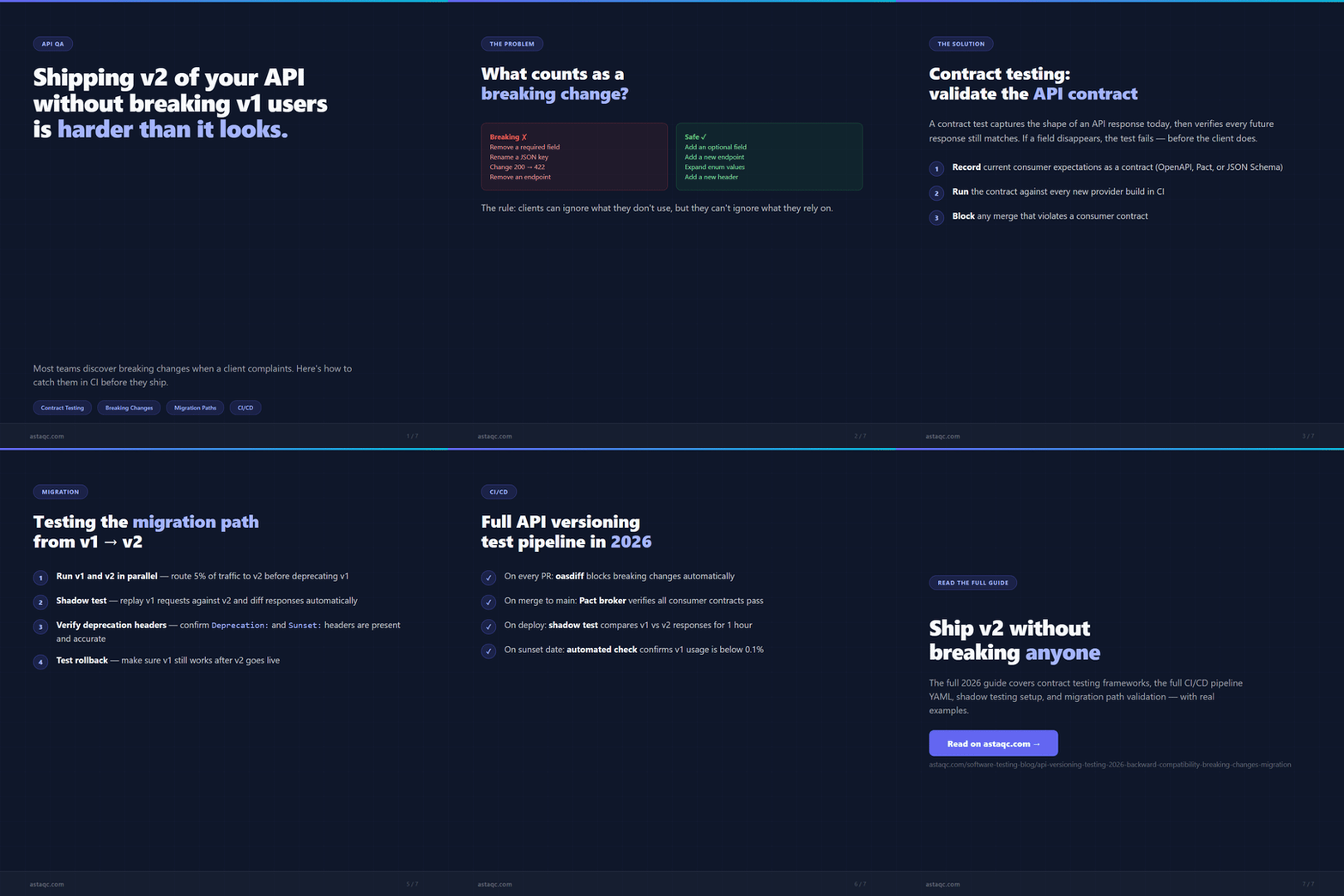
An API version bump without a contract test is a promise you have no way to keep — your consumers find the breaking change before your pipeline does.

Astaqc Team
November 16, 2026


Published by the Astaqc engineering team. Astaqc Consulting is a software testing company based in India, delivering test automation, manual testing, and performance testing services.