October 16, 2026

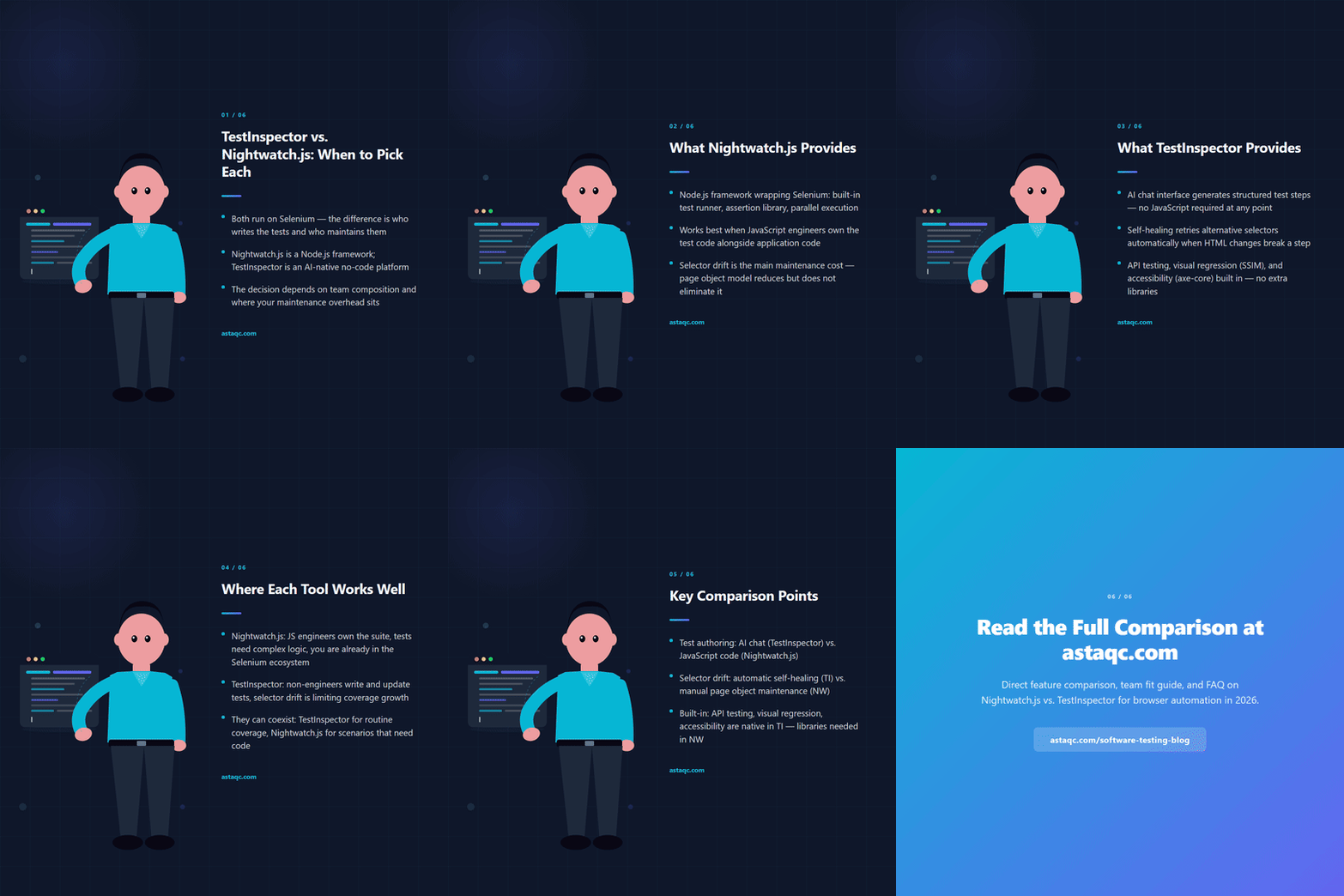
Nightwatch.js is a Node.js-based test automation framework that wraps Selenium WebDriver, giving JavaScript developers a way to write browser automation tests using a built-in test runner, assertion library, and parallel execution support. TestInspector is an AI-native no-code platform that generates browser tests through a chat interface and runs them on Selenium-powered browsers without any test code. The core question when choosing between them is whether the team has the JavaScript development capacity to build and maintain a test framework, or whether the bottleneck is the time cost of writing code for every new test scenario.
Both tools use Selenium under the hood and support the same set of browsers, but the experience of writing, maintaining, and scaling tests differs substantially. For teams evaluating their broader automation strategy, Astaqc's test automation services cover how these tool decisions fit into a full coverage model. The manual vs. automated testing guide covers the selection criteria that apply before choosing a specific framework.
Nightwatch.js is designed for JavaScript and TypeScript development teams that want to write end-to-end browser tests in a familiar language. It provides a Selenium session manager, a fluent assertion API, a parallel test runner, an HTML reporter, and support for Chrome DevTools Protocol in addition to WebDriver. Version 3 added Appium integration for mobile browser testing.
Teams use Nightwatch.js when QA work sits close to the development team and engineers are willing to write and own the test code. It works well in JavaScript monorepos where test code lives alongside application code, shares TypeScript definitions, and is reviewed in the same pull request workflow. The learning curve is lower than raw Selenium because the framework handles session lifecycle and provides a structured assertion API, but test authors still need to understand DOM selectors, asynchronous JavaScript, and the application's structure.
The maintenance cost of a Nightwatch.js suite scales with the application's change velocity. Selector drift — tests that break when HTML changes — requires engineering time to diagnose and fix. The standard mitigation is a page object model: centralizing selectors so that an HTML change requires one update to the page object rather than updates to every test that uses it. Building a maintainable page object layer takes time and evolves with the application. Teams that underinvest in this layer accumulate tests that break frequently, eroding confidence in the suite and creating a maintenance backlog.
Nightwatch.js integrates with CI/CD pipelines through its command-line runner and produces JUnit XML output consumed by most CI platforms. Environment configuration is handled through environment-specific configuration files, and the test runner supports selecting tests by tag or suite name for selective execution.
TestInspector takes a different approach to the same underlying problem: automating browser-based application testing. Rather than writing JavaScript to drive a browser, users describe test scenarios to an AI chat interface, which generates structured test steps — sequences of browser actions, assertions, variable references, and HTTP requests — that run on Selenium on Chrome, Firefox, Edge, and Safari.
The self-healing mechanism in TestInspector targets selector drift directly. When a selector in a test step fails because the application's HTML has changed, TestInspector uses AI to identify alternative selectors based on the element's visible characteristics and surrounding DOM context, then retries the step automatically. Teams report that this reduces the manual intervention triggered by application updates, particularly for teams without dedicated automation engineers who can diagnose selector failures quickly.
Variable interpolation supports {{VAR}}, {{TIMESTAMP}}, {{ALPHANUMERIC}}, and {{TOTP:secret}} syntax, with scoping at the test, suite, and organization level and encrypted storage for sensitive values. Visual regression uses SSIM screenshot comparison against approved baselines, with crop and exclusion regions for areas that change legitimately between runs. HTTP request steps (GET, POST, PUT, PATCH, DELETE) with status code and response body assertions allow API validation within the same test that covers the browser interface, without switching to a separate tool.
Accessibility testing via axe-core integrates into test steps with configurable severity levels — critical, serious, moderate, minor — so WCAG 2.1 violations can be asserted as test failures in the same run that validates functional behavior. CI/CD integration works through a trigger API; tests can be scheduled on cron, interval, or one-time triggers, or kicked off from a deployment pipeline via HTTP. MCP tokens connect TestInspector to Claude Code, Cursor, and Claude Desktop, enabling AI-generated tests from within the development environment. The full capability description is on the TestInspector page.
Test export supports Playwright TypeScript, Selenium IDE (.side), and Gherkin, providing a path to transfer tests to a code-first framework if the team's automation strategy changes. Multi-tenant organization management supports owner, admin, and member roles for team-based test ownership.
The decision between Nightwatch.js and TestInspector depends on the team's composition, the application's change velocity, and how much engineering time is available for test maintenance.
Nightwatch.js works well when the engineering team owns the test suite and JavaScript is the natural language for that work; tests need complex conditional logic, data-driven parameterization, or custom reporter integrations that are easier to express in code; the team is already using Selenium-based tooling and wants a structured wrapper with an opinionated test runner; and the CI pipeline requires fine-grained control over test execution that configuration files handle easily.
TestInspector works well when QA engineers or product managers without JavaScript skills need to write and update tests without developer involvement; selector maintenance overhead is limiting coverage growth because keeping page objects current takes longer than adding new tests; the team needs multi-layer coverage — functional, API, visual regression, and accessibility — without a separate tool for each layer; and test creation speed matters more than framework flexibility.
Teams at the intersection — JavaScript engineers who want no-code velocity for routine scenarios but code-first precision for complex ones — can use both. TestInspector's export to Playwright TypeScript or Selenium IDE provides a migration path, and its CI trigger API integrates alongside code-first pipelines. The broader question of which automation approach suits different team sizes and application types is covered in Astaqc's manual vs. automated testing guide and the software testing services overview.
| Dimension | TestInspector | Nightwatch.js |
|---|---|---|
| Test authoring | AI chat interface generates structured steps; no code required | JavaScript or TypeScript; requires knowledge of Selenium API and DOM selectors |
| Selector drift handling | AI self-healing retries with alternative selectors automatically | Manual fix required; page object model reduces but does not eliminate this |
| Browsers supported | Chrome, Firefox, Edge, Safari via Selenium | Chrome, Firefox, Edge, Safari via Selenium; IE via legacy configuration |
| API testing | HTTP request steps built into the test runner; no separate tool | Not built in; requires external library integration (Axios, Supertest) |
| Visual regression | SSIM screenshot comparison with baseline approval workflow | Not built in; requires integration with Percy, Applitools, or custom solution |
| Accessibility testing | axe-core integrated as a test step; WCAG severity levels as pass/fail criteria | Not built in; requires axe-webdriverjs or similar library |
| Scheduling | Built-in cron, interval, and one-time scheduling | Requires external CI scheduling (cron job or pipeline schedule) |
| Test maintenance model | AI self-healing reduces manual update frequency; visual run logs aid diagnosis | Code maintenance required; page objects reduce but do not eliminate work |
| CI/CD integration | HTTP trigger API; results delivered via webhook or pull | CLI runner; JUnit XML output; integrates with any CI platform |
| Test export | Playwright TypeScript, Selenium IDE, Gherkin | Tests are JavaScript/TypeScript files — portable across environments |
Nightwatch.js is a more flexible, code-first tool with a larger ecosystem for customization and extension, while TestInspector is a more constrained, no-code platform with built-in capabilities that would require additional libraries in a Nightwatch.js setup. The right choice depends on what the team is optimizing for: flexibility and developer integration versus coverage velocity and maintenance reduction. For teams assessing which type of automation support suits their stage, Astaqc's hire a QA team page describes how automation skill requirements vary by team size and maturity.
Yes. Both tools integrate with CI/CD pipelines: Nightwatch.js through its CLI runner and TestInspector through its HTTP trigger API. A pipeline can run TestInspector tests for smoke and regression coverage, then Nightwatch.js tests for scenarios that require custom logic. Teams doing this typically start with one tool and add the other when they hit the limit of what the first tool handles well — Nightwatch.js when coverage requires complex programming logic, TestInspector when maintenance overhead is limiting coverage growth.
TestInspector's structured steps cover the scenarios most applications require: linear action sequences, variable interpolation, assertion branching, HTTP request steps, and multi-step authentication flows. Scenarios that require true conditional branching — if this element is present, do X, otherwise do Y — are more naturally expressed in code. For those cases, Nightwatch.js or Playwright is the better fit. Most teams find that conditional logic accounts for a small fraction of their test scenarios, and the maintenance savings from no-code tooling outweigh the limitation on edge cases where code would be more expressive. Astaqc's test automation services help teams map their test scenarios to the right tool class before committing to a framework.
Both tools run tests on Chrome, Firefox, Edge, and Safari via Selenium. Nightwatch.js supports Internet Explorer through its legacy Selenium 2 driver configuration, which is relevant only for applications that still require IE support. TestInspector focuses on modern browsers. For cross-browser testing strategy, Astaqc's AI in software testing guide covers how AI-native tools are changing what cross-browser coverage means in practice.
TestInspector requires no test code. Setup involves configuring the browser extension for test recording, setting organization variables and credentials, and connecting the CI trigger API to the deployment pipeline. Ongoing maintenance is handled through the test editor interface — adjusting steps, updating selectors manually when the AI suggestion is not right, and reviewing visual regression baselines when the UI changes legitimately. No JavaScript knowledge is required at any point in the workflow.
The typical migration is additive rather than replacement: teams recreate their most frequently maintained tests in TestInspector first — the ones that break most often due to selector drift — and measure whether the maintenance reduction justifies expanding coverage in the no-code tool. TestInspector's Selenium IDE export provides a compatibility check: tests exported from TestInspector can be run alongside existing Nightwatch.js tests. Full migration depends on whether any Nightwatch.js tests use custom JavaScript logic that the TestInspector step model cannot replicate.
Playwright is generally preferred over Nightwatch.js for new code-first automation projects in 2026. Playwright has faster locator APIs, built-in support for parallel execution across browser contexts, and more active community maintenance. Nightwatch.js is more relevant for teams with existing suites who want to continue in that ecosystem. Teams evaluating code-first options should consult the automated testing guide for a framework-level comparison before committing to a new tool.
Nightwatch.js gives JavaScript teams a structured framework; TestInspector removes the framework entirely. The right choice depends on whether your bottleneck is test complexity or test maintenance overhead.
October 16, 2026


Sign up to receive and connect to our newsletter

We founded ASTAQC as a tight-knit group of professional Software Testers and software developers.
Subscribe to our Newsletter


