October 8, 2026
How TestInspector Exposes Hidden Gaps in Your Test Automation Coverage: Run History, Assertions, and Coverage Baselines
TestInspector exposes hidden gaps in test automation coverage through three mechanisms that work together: run history that shows which tests have actually executed recently versus which have been added to a suite but excluded from scheduled runs, multi-layer assertions that distinguish between tests checking element presence and tests validating functional correctness, and visual regression baselines that add a second assertion layer on top of HTTP and functional checks. Teams that conduct a coverage audit using TestInspector's suite hierarchy and run logs consistently find that between 15 and 30 percent of their nominal test count produces no meaningful detection signal — tests that run, pass, and report green on every CI trigger without catching any defect class that matters. Identifying these gaps is the first step toward a test suite that provides genuine confidence rather than nominal coverage. Astaqc's test automation services include suite coverage audits as a standard engagement deliverable, and the complete software testing guide covers assertion quality as a foundational dimension of test suite reliability.
TestInspector records a full run history for every test step and suite in an organization, showing when each test last executed, whether it passed or failed, and which runs included it. This history exposes a gap that code-first frameworks make invisible: tests that exist in the repository but are never triggered. In a typical organic test suite, 10–20% of tests have not executed in the past 30 days. Some were added for a feature that was later removed and never cleaned up. Others were part of a suite that was deprioritized when the scheduling configuration changed. A few were excluded from CI runs because they were flaky and no one investigated the root cause.
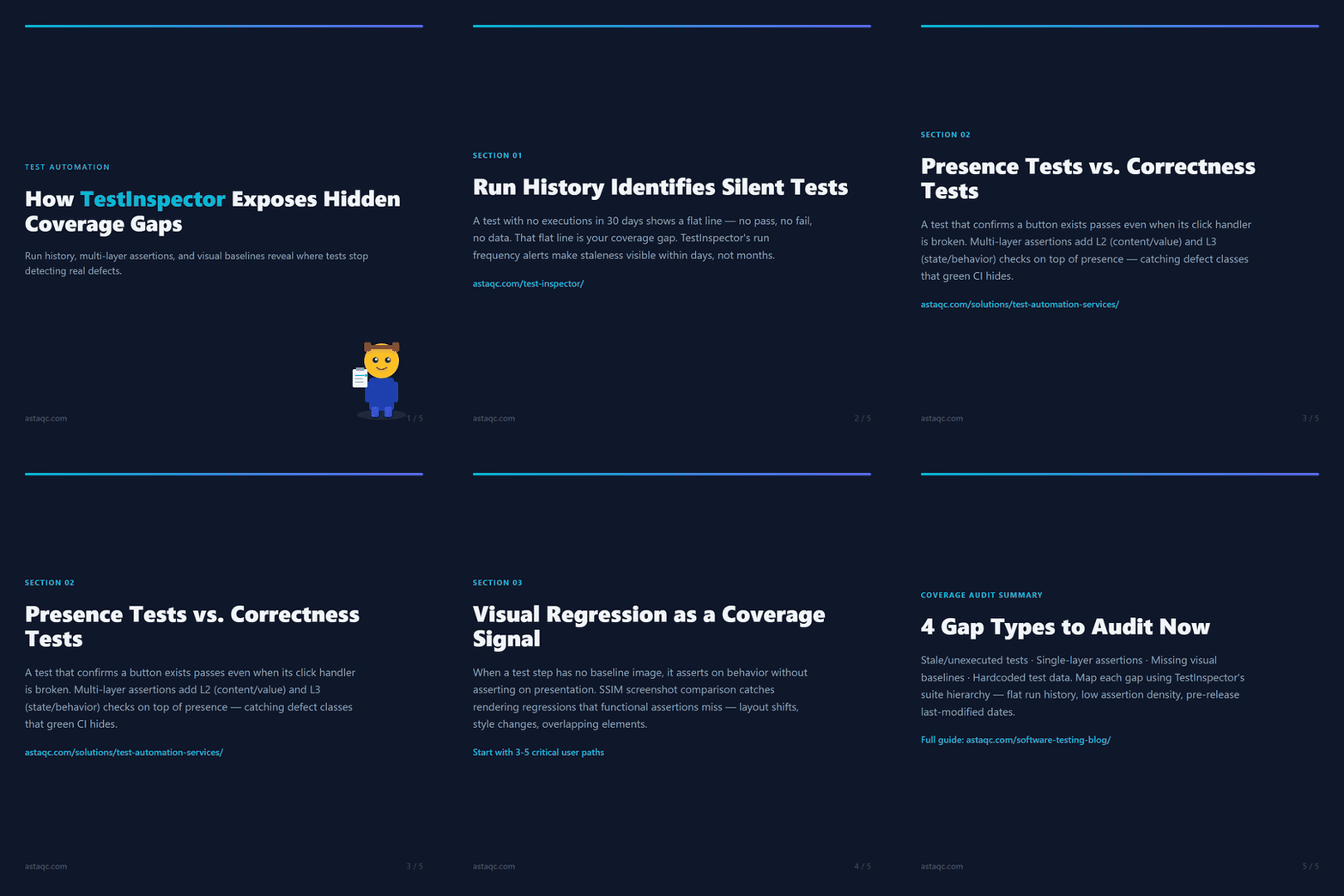
The run history timeline in TestInspector makes this visible. A test with no execution in 30 days shows a flat line on the history chart — no pass, no fail, no data. This is different from a test that fails intermittently, which shows a mixed pass/fail pattern, and different from a test that always passes, which shows a continuous green line. The flat line pattern is the most damaging, because it means the coverage the test is supposed to provide does not exist. The feature it covers changes with every sprint, the assertions it carries become stale, and the test eventually passes trivially if it is ever run again — not because the feature works, but because the assertions no longer reflect the current behavior. TestInspector's test scheduling and run monitoring features allow teams to set minimum run frequency requirements per suite, generating alerts when a test has not executed within its configured interval. This turns test staleness from an invisible accumulation problem into an auditable, actionable signal.
The concrete action from run history analysis is a sweep: list every test not executed in the past 14–30 days, re-run each one, and assess the result. If the test passes, investigate why it was excluded from the regular schedule and restore it to the active run queue. If the test fails, determine whether the failure is a real defect — the feature broke while tests were not watching — or a stale assertion, where the feature was intentionally changed and the test was not updated. Either outcome is useful information: the coverage gap has been converted from invisible to visible, and the team can now decide whether to update, delete, or escalate it.
The most common assertion gap in no-code test suites is presence testing — tests that verify an element exists or an HTTP response returns 200 without asserting on the element's content or the response body's correctness. A test that navigates to a checkout page and asserts that a "Place Order" button is visible passes whether the button is wired to the correct payment flow or disabled by a JavaScript error that silently suppresses the click handler. A test that hits an API endpoint and asserts on status code 200 passes whether the response body contains the expected order record or an empty array caused by a broken database query. Both tests run green in CI. Neither catches the defect.
TestInspector's multi-step test structure makes assertion layers explicit. Each step in a test has a defined action (navigate, click, type, request) and one or more assertions attached to that action. A well-constructed test step that validates a form submission includes: an assertion on the response status code (200 or 201), an assertion on a specific field in the response body (order ID, confirmation number), an assertion that a success message element is visible, and an assertion on the element's text content matching the expected value. A test step that only checks the first layer has a coverage gap at every subsequent layer. Astaqc's software testing services include assertion quality review as part of test suite health assessments, and the manual versus automated testing guide covers how manual testers naturally apply multi-layer validation and how automated tests should mirror that pattern.
| Assertion Layer | What It Catches | What It Misses |
|---|---|---|
| HTTP status code | Server errors (500s), missing routes (404s) | Wrong data returned, empty responses, business logic errors |
| Element presence | Complete page crashes, missing DOM sections | Wrong values, disabled interactions, incorrect state |
| Text content assertion | Label changes, wrong values, error messages shown | Layout regressions, visual-only changes |
| Response body assertion | Incorrect data returned, missing fields, type mismatches | Performance degradation, UI rendering issues |
| Visual regression (screenshot) | Layout shifts, style regressions, rendering differences | Backend-only logic errors, non-visual state changes |
Visual regression testing in TestInspector uses SSIM (Structural Similarity Index Measure) screenshot comparison against approved baselines to detect rendering changes that functional assertions cannot catch. A button whose click handler is broken but whose DOM element remains present passes a presence assertion. A form that submits successfully but renders the confirmation message in the wrong position, with the wrong font, or behind an overlapping element passes all text-content assertions. Visual regression catches both cases by comparing the actual screenshot against the baseline and flagging any region where the SSIM score falls below a configurable threshold.
Beyond catching visual defects, visual regression baselines serve as a coverage completeness signal. When a test step has no baseline image configured, the test is asserting on behavior without asserting on presentation. For user-facing flows — login, checkout, dashboard, settings — presentation errors are directly visible to users and often more impactful than the backend logic errors that functional assertions catch. A test suite with strong functional coverage but no visual baselines on the primary user flows has a systematic coverage gap on the most visible defect class. Configuring baselines on critical paths is a targeted way to improve coverage completeness without adding new test cases. TestInspector's baseline approval workflow allows teams to review baseline images and mark exclusion regions (dynamic content, timestamps, user-specific data) before the baseline goes live, reducing false positives from expected variation while preserving sensitivity to real rendering changes. The TestInspector visual regression documentation covers baseline management, exclusion selector configuration, and SSIM threshold calibration for different tolerance requirements.
The baseline inventory is a direct proxy for visual coverage completeness. Export the list of tests that have active baselines and compare it to the list of tests that cover user-facing flows. The gap between the two lists is the set of user-facing flows with no visual regression coverage. For each flow in the gap, assess the defect impact of a visual regression: a broken layout on the checkout confirmation page has higher business impact than a broken layout on an internal admin report. Prioritize baseline configuration by business impact, starting with the three to five flows where a visual regression would cause the most user-visible damage. Astaqc's test automation services include visual regression baseline strategy as part of comprehensive QA framework engagements.
TestInspector organizes tests in a three-level hierarchy: individual tests, suites that group related tests, and organization-level configuration. This hierarchy is the structural framework for a coverage audit. A well-organized suite hierarchy maps test suites to application features, user flows, or risk areas. A coverage audit works by mapping that hierarchy against the application's feature surface and identifying which features have no corresponding suite, which suites have tests that all share the same low assertion density, and which suites have not been modified since the features they cover were last changed.
The suite-level view in TestInspector shows execution frequency, pass rate, and last-modified date for each suite. A suite with a high pass rate but a last-modified date that predates a significant feature release warrants scrutiny: either the tests were updated to match the new behavior (correct) or the assertions are no longer aligned with what the feature actually does (coverage gap). The run history for that suite will show whether the tests have been executing continuously or were excluded from runs around the time of the release. A gap in run history that coincides with a feature release often indicates tests that were temporarily disabled to unblock CI and never re-enabled.
Variable interpolation coverage is a dimension unique to TestInspector suites and easy to overlook. TestInspector supports {{VAR}}, {{TIMESTAMP}}, {{ALPHANUMERIC}}, and {{TOTP:secret}} variable types with scoping at the test, suite, and org level. A coverage gap exists when tests use hardcoded values that do not change between runs. Hardcoded values cause tests to pass on repeated runs against cached state and fail only when the hardcoded record is modified or deleted. Replacing hardcoded values with dynamic variables ensures each run creates fresh state and assertions validate against real application behavior. Astaqc's AI in software testing guide covers AI-assisted variable configuration. Astaqc's hire QA team services provide dedicated engineers who include coverage audit methodology in their engagement scope.
| Coverage Gap Type | How to Identify in TestInspector | Remediation |
|---|---|---|
| Stale/unexecuted tests | Flat run history (no executions in 30+ days) | Re-run, assess staleness, restore to active schedule |
| Single-layer assertions | Steps with only presence/status assertions | Add content assertions to each interaction step |
| Missing visual baselines | User-facing flow tests with no baseline image | Configure and approve baselines on critical paths |
| Hardcoded test data | Variable fields with literal email/ID values | Replace with {{TIMESTAMP}} or {{ALPHANUMERIC}} variables |
| Feature coverage gaps | Suite hierarchy missing sections of feature surface | Add suites mapped to uncovered features, starting with high-risk areas |
Prioritize by defect impact: identify the user flows where a defect would have the highest business cost — checkout, authentication, core feature workflows — and audit those flows for all three gap types (stale tests, single-layer assertions, missing baselines) before auditing lower-risk flows. A single high-impact flow with thorough multi-layer coverage provides more protection than ten low-impact flows with presence-only assertions. Astaqc's test automation services include risk-stratified coverage prioritization as part of QA framework assessments.
There is no universal correct number, but a useful minimum is two assertions per significant interaction step: at least one functional assertion (status code, field value, element text) and one structural assertion (correct page loaded, expected DOM section visible). For API steps, three assertions are typically appropriate: status code, at least one response body field, and absence of an error flag. For UI form submissions, four assertions cover the typical gap: response status, success message visibility, success message content, and absence of error state on the form.
TestInspector shows which tests exist and how they are organized, but identifying which features have no corresponding test requires cross-referencing the suite hierarchy against the application's feature map manually. The most efficient approach is a feature inventory: list every user-facing flow and backend API endpoint in a document and map each one to a TestInspector suite. The gaps are immediately visible. This audit typically takes two to four hours for a mid-size application. Astaqc's software testing services include feature-to-coverage mapping as part of initial QA engagements.
Start with three to five critical user paths, not the entire test suite. Choose the flows where a visual regression would be most damaging — typically checkout, onboarding, login, and the primary dashboard view. Configure TestInspector to take a screenshot on the final assertion step of each flow and approve the initial baselines. Once those baselines are in place, any deployment that introduces a rendering regression on those flows will fail those tests. This gives meaningful visual coverage on the highest-risk paths in a single afternoon without requiring a comprehensive visual regression strategy up front.
Coverage quality degrades predictably through three mechanisms: tests get disabled to unblock CI, new features ship without corresponding test additions, and assertion layers get simplified to pass-rate targets. The remedy is structural: set minimum run frequency alerts on critical suites in TestInspector so disabled tests are flagged within days, and include coverage audit checkpoints in sprint retros rather than treating them as a dedicated one-time exercise. Astaqc's outsource software testing guide covers how external QA support maintains coverage quality during high-velocity development phases when internal teams are capacity-constrained.
A test that runs, passes, and never fails is not proving the feature works — it is proving the assertion is too weak to notice when the feature breaks. Run history, assertion depth, and visual baselines together show where that gap lives in your suite.
October 8, 2026


Sign up to receive and connect to our newsletter

We founded ASTAQC as a tight-knit group of professional Software Testers and software developers.
Subscribe to our Newsletter