August 11, 2026
WebSocket applications behave differently from HTTP applications in ways that make standard test automation approaches insufficient. An HTTP request completes synchronously: a client sends a request, the server responds, and the interaction is done. A WebSocket connection is a persistent, bidirectional channel where both client and server can send messages at any time, without a request-response pairing, and where the test must validate not just what a message contains but when it arrives, in what order, and whether the connection remains stable under realistic conditions. Testing these properties requires strategies that most web test frameworks were not designed for.
In 2026, WebSocket interfaces are standard in a wide range of production applications: real-time dashboards, collaborative editing tools, live data feeds, game backends, chat systems, and notification services. QA teams testing these applications cannot rely on Selenium or Playwright UI automation alone — those tools interact with the browser but do not provide direct access to WebSocket message streams. Effective WebSocket testing requires a combination of protocol-level testing for connection and message behavior and UI-level testing for what the application renders when those messages arrive. The test automation services team at Astaqc helps engineering teams build WebSocket test strategies for production applications.
For teams evaluating whether their WebSocket test coverage is part of a broader automation strategy, the complete software testing guide covers how to scope coverage across application layers. Teams that need structured performance validation for WebSocket-based systems can also review the Astaqc performance testing services.
HTTP testing validates a defined contract: a specific request to a specific endpoint returns a specific response within a defined timeout. The request and response are coupled — every request has exactly one response, and the test can wait for that response before asserting. This synchronous, paired structure makes HTTP testing tractable with standard assertion patterns.
WebSocket testing breaks each of these assumptions. The connection is established once and then both sides send and receive independently. Messages from the server arrive at unpredictable times based on application events, not in response to client requests. Multiple messages may arrive in rapid succession, or no message may arrive for an extended period. The sequence of messages may be semantically significant — receiving a "trade executed" message before a "price updated" message and after a "trade submitted" message represents correct ordering; receiving them in a different sequence indicates a bug. A WebSocket test must handle all of this: establishing and validating the connection, listening for specific messages in a potentially noisy stream, asserting on message content and timing, and verifying that the application UI updates correctly when those messages arrive.
The statefulness of WebSocket connections introduces additional complexity. If the connection drops and reconnects, the test must determine whether the application state was preserved or reset. If the server sends an error frame rather than a data message, the test must verify the application handles it gracefully. Timing-dependent behaviors — messages that should arrive within a specific window after a triggering action — require tests that can assert on both content and arrival time, not just content.
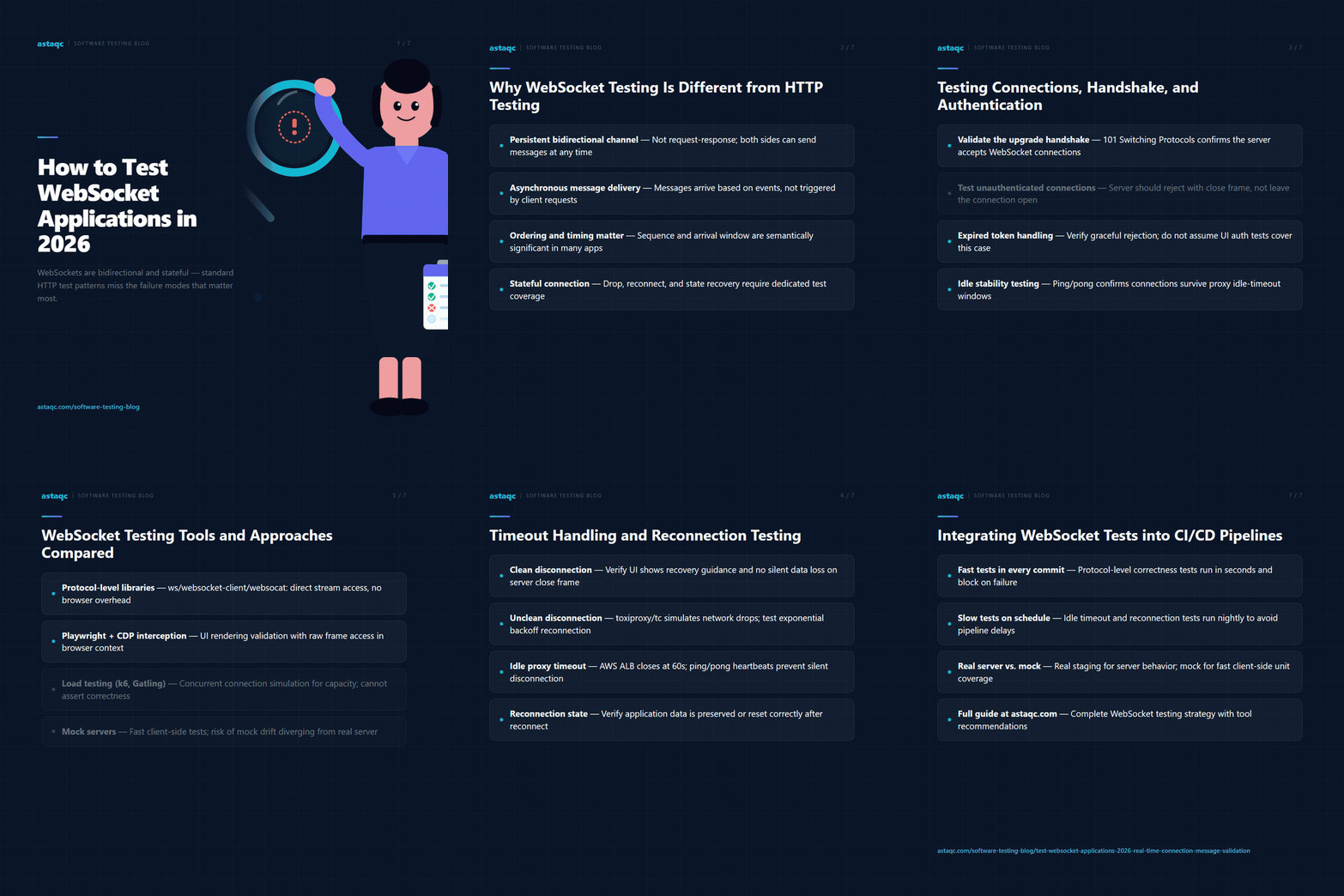
The WebSocket protocol begins with an HTTP upgrade handshake: the client sends a standard HTTP GET request with an Upgrade header, and the server responds with 101 Switching Protocols. The connection is then persistent. Testing this handshake verifies that the server accepts WebSocket connections, returns the correct upgrade response, and establishes the persistent channel without dropping it immediately.
Testing tools that operate at the protocol level — libraries like ws in Node.js, websocket-client in Python, or purpose-built tools like websocat — can initiate a WebSocket connection and verify the handshake independently of any browser UI. A basic connection test connects to the WebSocket endpoint, waits for the open event, sends a known message, waits for the expected response, and asserts on the response content and timing. This validates the server's WebSocket behavior without requiring a browser to render the client application.
Authentication is a common failure point. Many WebSocket applications authenticate using a token passed as a query parameter in the upgrade URL (e.g., wss://app.example.com/ws?token=JWT) or in an initial message after connection. Testing authentication coverage includes: connecting without a token and verifying the server closes the connection with an appropriate error frame; connecting with an expired token and verifying graceful rejection; connecting with a valid token and verifying that the server sends the expected initial messages. These cases are distinct from UI authentication testing and require protocol-level test tooling to cover them explicitly. For teams building WebSocket authentication into a broader security test plan, the Astaqc software testing services team covers authentication and authorization testing.
Connection stability testing validates that the WebSocket connection remains open under realistic conditions. Idle connections — connections where no message is sent for an extended period — are dropped by intermediate proxies and load balancers that have shorter timeout configurations than the application assumes. A stability test establishes a connection, waits for the idle timeout duration, sends a ping, and verifies the pong response arrives, confirming the connection is still active. Connections that survive idle periods in testing survive them in production. The manual testing vs. automated testing guide provides context on how protocol-level tests fit alongside manual exploratory verification.
Message validation for WebSocket applications covers three distinct properties: structure (does the message contain the expected fields with the expected types), ordering (do messages arrive in the sequence the application depends on), and timing (does the message arrive within the window the application expects).
Structure validation uses the same assertion patterns as API response testing: parse the received message (typically JSON), assert on field presence and value. The distinction from HTTP testing is that WebSocket messages arrive asynchronously — the test must listen for a message matching a specific pattern in a stream that may include other messages before and after the target. A naive assertion that waits for the next message and asserts its content fails when the server sends interim messages, heartbeat pings, or status updates before sending the target message. Effective WebSocket tests use a message filter — "wait for the next message where type === 'trade_executed' and assert that amount is a positive number" — rather than asserting on the immediately next message.
Ordering validation tests that sequences of semantically related messages arrive in the correct order. A trading application where a "trade_submitted" event must precede a "trade_executed" event requires an ordering assertion that collects all messages over a window and verifies the sequence. This is not expressible as a simple "wait for X, then wait for Y" pattern when other messages can arrive between X and Y. Test infrastructure must collect all messages in a window and assert on the full sequence, filtering irrelevant message types before checking order.
Timing validation asserts that a message arrives within an expected window after a triggering action. Sending a trade submission and receiving a confirmation within 500 milliseconds under test conditions validates the system's responsiveness. Receiving the same confirmation after 3 seconds indicates a performance problem that users will experience as latency. Timing assertions require test tooling that records a timestamp at the trigger action and asserts on the elapsed time when the expected message arrives. The outsourcing guide covers how to scope WebSocket testing within a broader managed QA engagement.
| Approach | What It Tests | Strengths | Limitations |
|---|---|---|---|
| Protocol-level library (ws, websocket-client, websocat) | Connection establishment, message send/receive, server behavior | Direct access to WebSocket stream; no browser overhead; fast execution | Does not test browser rendering or UI state after message receipt |
| Playwright / Selenium with WebSocket interception | UI behavior when WebSocket messages arrive; visual state after events | Tests the user-visible outcome of WebSocket messages; integrates with existing UI test suite | Indirect access to message content; cannot easily assert on message ordering or timing |
| Browser DevTools Protocol (CDP) with Playwright | Raw WebSocket frames at the browser level — both client and server messages | Full message visibility within a browser context; can assert on exact frames sent and received | Requires CDP expertise; complex to implement for ordering and timing assertions |
| Load testing tools (k6, Gatling WebSocket plugins) | Connection concurrency, message throughput under load, server capacity | Simulates realistic concurrent connection counts; identifies capacity limits | Does not validate correctness of individual messages; requires separate correctness test layer |
| Mocking / mock WebSocket server | Client-side application behavior against controlled server responses | Deterministic test inputs; fast execution; no real server required | Does not test real server behavior; mock drift is a persistent risk |
| Contract testing (AsyncAPI) | Message schema conformance — server sends what the contract says it will send | Decouples client and server test cycles; catches schema drift early | Does not test ordering, timing, or behavioral flows; requires contract maintenance |
Most teams testing WebSocket applications in production use a combination: protocol-level tests for server behavior and message correctness, UI-level Playwright tests for rendering validation, and load testing for capacity. The Astaqc test automation services team can assess which combination fits your application architecture and team capabilities.
WebSocket connection failures in production fall into two categories: clean disconnections (server sends a close frame) and unclean disconnections (the connection drops without a close frame, typically due to network issues, proxy timeouts, or server crashes). Both categories require explicit test coverage because the application's behavior after each type of disconnection is distinct.
Clean disconnection testing: initiate a WebSocket connection, have the test infrastructure send a server-side close frame (or use a controlled server that closes after a specific event), and verify that the client application handles the closure gracefully. Graceful handling means displaying an appropriate message to the user, stopping any in-progress operations that depended on the connection, and offering a reconnection path without data loss. Applications that freeze, display an error without recovery guidance, or silently fail to update live data are defects that clean disconnection tests expose.
Unclean disconnection testing simulates network interruptions. Tools like toxiproxy or tc (Linux traffic control) can introduce network latency, packet loss, or connection drops in a test environment. A WebSocket application with properly implemented reconnection logic detects the dropped connection via the pong timeout (when the server fails to respond to a ping within a configured interval), closes the socket, and initiates a reconnection with exponential backoff. The test verifies this sequence: connection drop at a known time, reconnection attempt within the expected window, and restoration of live data state after reconnection. The Astaqc manual testing team can conduct exploratory disconnection testing for applications where the reconnection logic is complex or environment-dependent.
Idle timeout testing validates the connection's behavior when no messages are exchanged. Intermediate proxies — nginx, HAProxy, AWS ALB — have default idle timeouts that close persistent connections after 60 seconds (AWS ALB default) or similar intervals. Applications that expect the WebSocket to stay open for minutes or hours without activity must implement periodic ping/pong heartbeats to keep intermediate proxies from closing the connection. Testing this requires a long-running test that maintains a connection without exchanging messages and verifies it is still open after the proxy's timeout duration. This is often discovered in production rather than in testing because developers test on localhost where no proxy exists. For context on how to structure environment-specific test coverage, the Astaqc testing documentation team can help define test environment requirements and test plans.
WebSocket tests present specific challenges for CI integration that HTTP tests do not. Protocol-level WebSocket tests run as standard test scripts and integrate into CI pipelines the same way any Node.js or Python test suite does — they run in the pipeline, report pass/fail, and block the pipeline on failure. The practical challenges are environment setup and test execution time.
Environment setup requires a running WebSocket server in the CI environment. Some teams use a real staging WebSocket server accessible from the CI runner; others use a mock WebSocket server that runs in the same CI process and provides controlled responses. The real server approach validates actual server behavior but introduces external dependencies — the test fails if the staging server is down for reasons unrelated to the code change. The mock server approach is faster and more reliable but risks mock drift: the mock's behavior diverges from the real server's behavior over time, making tests pass against the mock while the real server behaves differently.
Long-running WebSocket tests — idle timeout tests, stability tests, reconnection tests with backoff delays — can take minutes to complete. Standard CI pipelines expect unit and integration tests to complete in seconds. Teams separate WebSocket stability tests into a slow test suite that runs on a schedule (nightly or pre-release) rather than on every commit, while keeping fast protocol-level correctness tests in the main pipeline. This distinction keeps per-commit feedback fast while maintaining coverage of time-dependent behavior. For teams building CI/CD quality gates around WebSocket applications, the AI in software testing guide covers how automated testing fits into modern deployment pipelines. The Astaqc QA team can implement WebSocket testing infrastructure for teams that need managed execution rather than in-house tooling development.
Playwright can interact with the browser UI that renders WebSocket data and can intercept WebSocket frames using the Browser DevTools Protocol (CDP) via the page.on('websocket') event and frame listeners. This provides access to sent and received frames within a browser context. For assertions on message content and ordering, CDP interception is workable but requires careful handling of the asynchronous frame stream. Playwright does not provide purpose-built WebSocket message assertion utilities — teams implement these using event listeners and collected message arrays.
Authentication testing for WebSocket connections requires two test scenarios: verifying that unauthenticated connections are rejected (server sends a close frame with an appropriate error code or drops the connection), and verifying that authenticated connections are accepted and receive the expected initial messages. Protocol-level tests handle both cases by sending the upgrade request with and without the authentication token and asserting on the server's response. Browser-level tests can validate the full authentication flow including login form interaction before the WebSocket connection is established.
The most common gap is idle timeout behavior. Teams test message send and receive but do not test what happens when the connection is open but idle for longer than the intermediate proxy's timeout. In production, users on long-idle sessions — a dashboard left open overnight, a user who stepped away from a real-time feed — find that live updates stop arriving without explanation. The application thinks it has an open connection; the proxy has silently closed it. Testing idle timeout behavior with ping/pong validation and reconnection logic catches this before production users encounter it.
The answer depends on what the test is validating. Tests that validate server behavior — authentication handling, message format correctness, ordering logic — should run against a real server. Tests that validate client-side behavior — how the UI renders when a message arrives, how the application handles a close frame, how reconnection logic engages — can use a mock server that provides controlled inputs. Most production WebSocket test suites use both: a mock server for fast client-side unit and integration tests, and a real staging server for end-to-end protocol validation tests.
Basic timing assertions — verifying that a message arrives within a specified window after a triggering action — can be implemented in protocol-level test scripts without a dedicated load testing tool. A single-connection timing test sends a message, records the timestamp, waits for the expected response, and asserts that the elapsed time is within the acceptable range. This validates responsiveness under single-connection conditions. For realistic performance validation under concurrent connections, dedicated load testing tools such as k6 (which supports WebSocket protocol natively) or Gatling provide connection concurrency simulation that single-connection scripts cannot replicate. The Astaqc performance testing services team can design and execute WebSocket load tests for teams that need external validation.
WebSocket messages are transmitted as text or binary frames. Most application-layer WebSocket APIs use JSON-encoded text frames, which are straightforward to parse and assert on in any test language. Binary frames require format-specific deserialization — Protocol Buffers, MessagePack, or custom binary formats — before asserting on content. For JSON-based WebSocket APIs, assertion patterns mirror REST API assertions: parse the received JSON, assert on specific fields, and validate field types and values. For binary protocols, the test layer must include the deserialization step, which adds complexity but does not change the fundamental assertion approach.
WebSocket testing cannot be reduced to "send a message, check the response." A WebSocket channel is stateful, bidirectional, and time-dependent — the test must validate connection establishment, message ordering, arrival timing, and the application's behavior when the connection drops and recovers. Teams that rely on HTTP testing patterns for WebSocket applications will miss the failure modes that matter most in production.
August 11, 2026


Sign up to receive and connect to our newsletter

We founded ASTAQC as a tight-knit group of professional Software Testers and software developers.
Subscribe to our Newsletter