September 24, 2026
The practical question for QA engineers in 2026 is not whether AI is changing the testing landscape—it clearly is—but which parts of a QA engineer’s work AI changes and which parts it leaves untouched or makes more valuable. AI tools can generate test cases, identify failing selectors, and classify defects faster than a human engineer working from a test case document. They cannot decide what is worth testing, assess whether a test suite covers the right behaviors, or interpret ambiguous product requirements well enough to design a meaningful test scenario. The engineers who stay relevant in 2026 are the ones who sharpen their judgment on the second category while using AI tools to remove the manual labor from the first. This guide covers what AI is actually automating in QA, which skills become more valuable as a result, and how to update your practice without discarding what already works.
For context on how AI fits into a complete testing strategy, see Astaqc’s AI in software testing guide and software testing services. Teams working through this transition with external support can engage Astaqc’s QA team services for structured skill development alongside test coverage expansion.
AI tools in 2026 automate a specific set of testing activities well: generating test cases from user stories or acceptance criteria, identifying unstable selectors and suggesting replacements, classifying defect reports by component and severity, and producing basic test scripts from recorded browser interactions. Each of these was previously a manual, time-consuming activity that required a QA engineer to translate a human-readable requirement into a machine-executable test. AI narrows the translation gap, but it does not eliminate the need for someone to verify that what the machine produced is testing the right thing.
Test case generation from requirements is the clearest example. Given an acceptance criterion like “users should be able to reset their password via email verification,” an AI tool can generate a list of test cases covering happy path, invalid email, expired token, rate limiting, and account lockout scenarios. A QA engineer reviewing this list may identify that the acceptance criterion does not specify behavior for users who reset their password while already logged in, or that the “expired token” test case assumes a specific token lifetime that has not been defined in the requirement. The AI generates plausible tests from the requirement as written; the QA engineer catches what the requirement fails to specify. That judgment—knowing what a requirement omits—is not something AI tools reliably produce in 2026.
Selector maintenance through self-healing AI is a second area of genuine automation. Tools like TestInspector’s self-healing mechanism and Playwright’s auto-retry both reduce the manual effort required when application changes break test selectors. Self-healing generates alternative selectors when a primary locator fails, recovers the test run, and surfaces the fix for engineering review. This does not eliminate selector maintenance, but it changes the engineer’s role from diagnosing broken selectors to reviewing proposed fixes—a substantially faster activity. For teams with large scripted test suites, this automation compounds: 20–30 selector repairs per sprint that each took 15–30 minutes become 20–30 review approvals that take 2–3 minutes each. Astaqc’s test automation services include evaluation of self-healing tooling as part of suite modernization engagements.
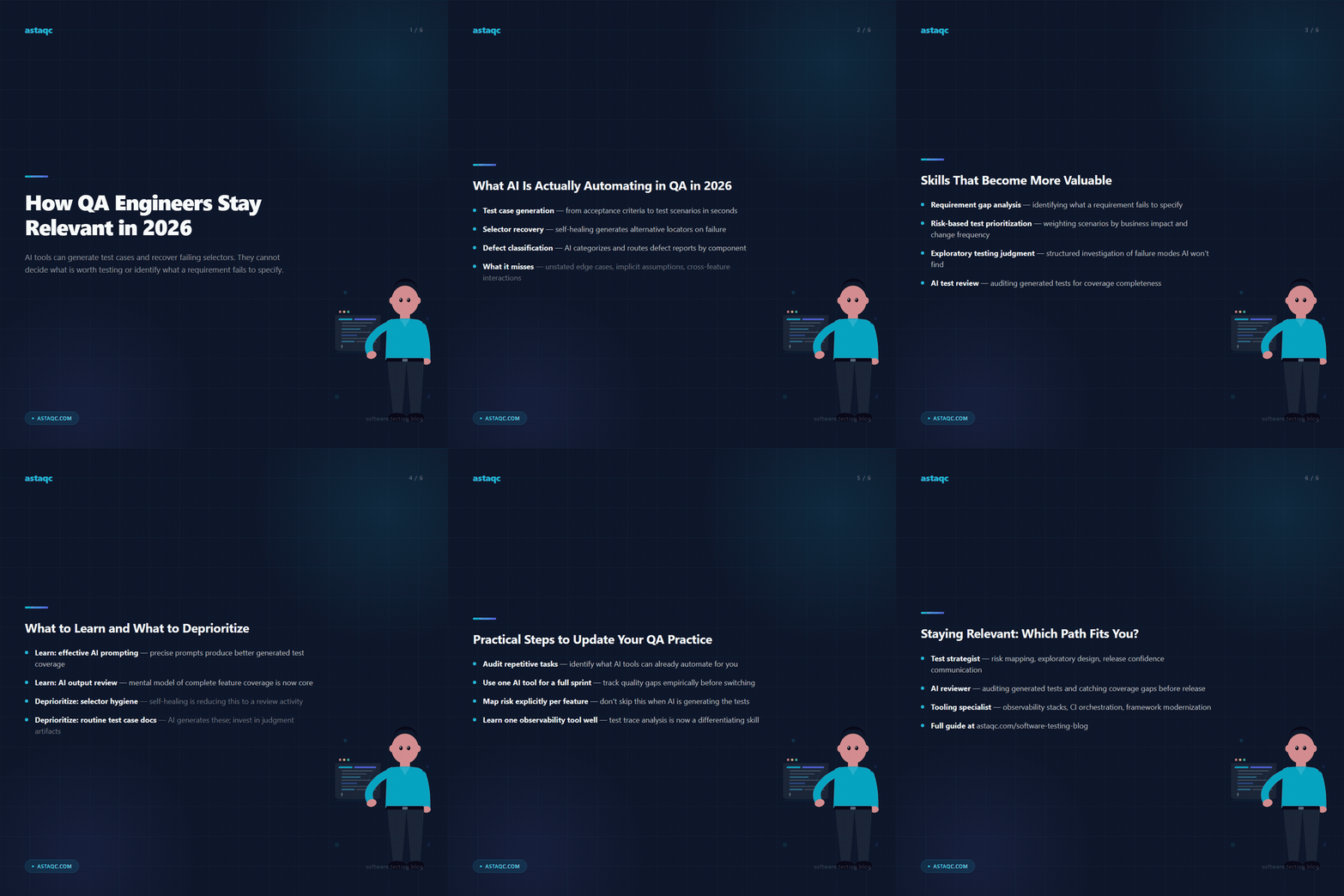
When AI tools handle test case generation, selector recovery, and defect classification, the skills that differentiate QA engineers shift toward the activities those tools cannot do well. The following table maps the skill areas that gain value as AI automates the repetitive layer of QA work, why each becomes more important, and where AI consistently underperforms.
| Skill | Why It Becomes More Valuable | Where AI Underperforms |
|---|---|---|
| Requirement analysis and gap identification | AI generates tests from written requirements; an engineer identifies what the requirement fails to specify | Implicit assumptions, unstated edge cases, cross-feature interactions |
| Test strategy and risk-based prioritization | AI produces test cases but does not weigh which scenarios carry the most regression risk | Business context, user impact assessment, technical debt awareness |
| Exploratory testing judgment | AI-based tools follow specified paths; structured exploration by an engineer surfaces unexpected failure modes | Curiosity-driven investigation, novel failure pattern recognition |
| Cross-system test design | Complex multi-service scenarios require understanding system boundaries and data flow that AI does not have | End-to-end flow design across services with different data contracts |
| AI-generated test review | As AI generates more tests, reviewing them for correctness and coverage completeness becomes a primary QA activity | Self-assessment of its own output quality |
| Quality reporting and stakeholder communication | AI tools surface data; engineers interpret what it means for release decisions and communicate risk to stakeholders | Judgment on acceptable risk, release confidence framing |
The common thread is judgment: the capacity to evaluate what an AI-generated artifact does and does not cover, to make risk-based decisions that require business context, and to investigate anomalies that scripted tests and AI classifiers are not designed to surface. These skills have always been part of senior QA engineering; what changes in 2026 is that they become more central to the work at all seniority levels, because the repetitive layer is increasingly automated. A QA engineer whose primary contribution was writing test cases from acceptance criteria or maintaining selector-stable tests will find that contribution compressed. A QA engineer whose primary contribution is test strategy, exploratory investigation, and quality communication will find that AI tooling makes them more productive. For more on how QA skill development maps to team structure, see Astaqc’s guide to building and scaling QA capability.
For QA engineers updating their skill set for 2026, the learning priorities are clearer when framed as tradeoffs: what to invest time in, and what to let AI tooling handle.
Learn: How to prompt AI tools effectively for test generation. Every major AI-assisted testing tool—TestInspector’s chat interface, Copilot for test generation, purpose-built LLM test generation APIs—improves significantly with better prompting. An engineer who knows how to write a prompt that specifies preconditions, the action sequence, the expected outcome, and the edge cases to cover will get substantially better AI-generated tests than one who writes “test the login page.” Prompt quality is a learnable skill, and it directly multiplies the output quality of AI test generation tools. This is not about writing code; it is about being precise about what to test and expressing that precision in a form the AI can use.
Learn: How to review and validate AI-generated tests for coverage completeness. As AI generates more tests, the QA engineer’s role shifts from authoring tests to auditing AI output. This requires a mental model of what a complete set of tests for a feature looks like: happy path, error handling, boundary conditions, integration with adjacent features, and user permission variations. Without that mental model, reviewing AI-generated tests becomes a surface-level check for obvious errors rather than a coverage audit. Building this mental model is a core skill investment for QA engineers in 2026.
Learn: How to work with observability data from test runs. AI-native testing platforms and modern scripted frameworks produce increasingly rich run data: per-step timing, failure context, environment metadata, retry histories. Engineers who can read this data—not just the pass/fail summary, but the trace-level details—can diagnose failures faster and identify systemic patterns before they compound into CI stability problems. For teams building this capability, Astaqc’s testing documentation services include observability stack documentation as part of infrastructure deliverables.
Deprioritize: Maintaining hand-written selector logic as a primary skill. Selector writing and maintenance in Playwright or Selenium is a skill that is being actively automated by self-healing mechanisms. Engineers who spend significant time developing selector hygiene expertise are investing in a skill that AI tooling is reducing to a review activity. Understanding how selectors work is still useful for reviewing AI-generated alternatives, but it is no longer the differentiating competency it was in 2020–2023.
Deprioritize: Manual test case documentation for routine regression scenarios. Writing detailed manual test case documents for regression scenarios that will be executed the same way every sprint is a use of time that AI tools now handle. Investing in documenting judgment calls, risk assessments, and non-obvious test design decisions—the things an AI needs human context to produce—is more valuable than writing step-by-step documents for standard scenarios that AI can generate on demand. For context on where manual testing adds value that automated coverage cannot, Astaqc’s manual testing services cover this distinction in detail.
Updating a QA practice for an AI-changed landscape does not require rebuilding from scratch. The following steps are practical, sequential, and applicable to engineers at any seniority level.
Audit your current work for automation candidates. Identify the activities in your current week that are repetitive, low-judgment, and process-driven: writing test cases from acceptance criteria that follow a standard format, running the same regression test sequence in a staging environment before each release, categorizing defect reports by component. For each of these, identify whether an AI tool currently automates them or could with a small setup investment. The goal is to shift your time from these activities toward the judgment-intensive work described in the previous section.
Build one AI-assisted test generation workflow and use it for a month. Rather than evaluating every AI testing tool on the market, pick one—TestInspector’s chat interface, Copilot for test functions in your existing framework, or a standalone LLM API prompt—and use it for all test case generation for a single sprint or a single feature. Track the quality of the output: how often did the generated tests cover scenarios you would not have written, and how often did they miss scenarios you had to add? This empirical data is more useful than vendor comparisons for understanding where AI generation fits in your workflow.
Spend explicit time on risk mapping for each feature. Risk-based test prioritization—deciding which scenarios carry the most regression risk given what changed in a release—is the judgment activity most compressed when test authorship is automated. Without the time previously spent writing tests, it is easy to skip this analysis and assume that AI-generated coverage is sufficient. Build the habit of explicitly mapping risk before starting test generation: which paths carry the most user impact if broken, which changed in this sprint, and which have a history of regression. See Astaqc’s manual vs. automated testing guide for a framework on making this risk assessment systematic.
Learn one observability tool well enough to use it when diagnoses matter. Whether your team uses Playwright traces, TestInspector’s run logs, or a dedicated observability platform, invest in understanding what data the tool collects and how to query it for the failure types that actually occur in your CI. The engineers who can quickly identify whether a CI failure is caused by a flaky test, a real regression, or an environment problem save the team significant time per sprint. For teams scaling this capability, Astaqc’s test automation services include observability instrumentation and training as part of suite modernization engagements. The performance testing services complement this with load-level instrumentation for teams whose observability needs extend to performance regression detection.
AI tools are replacing specific activities that QA engineers have historically spent significant time on: writing test cases from requirements, maintaining selector-stable regression tests, categorizing defect reports. Engineers whose entire value was in those activities will find their roles compressed. Engineers whose value is in judgment—test strategy, risk assessment, exploratory investigation, quality communication—will find AI tooling makes them more productive. QA teams are getting smaller at the junior level and more technically demanding at the mid-senior level in organizations that are actively adopting AI testing tooling. The historical parallel is code review after IDEs introduced code completion: the work changed, the need for human judgment did not.
Python and TypeScript remain the most practically useful languages for QA engineers who interact with code-level testing. Python because it is the language of most scripting, data manipulation, and API testing work; TypeScript because Playwright, the dominant scripted test framework, is TypeScript-first. Beyond language fluency, the more differentiating programming skill in 2026 is API literacy: being able to read and write API tests, interpret OpenAPI specifications, and design contract tests. These skills are more transferable across testing tool generations than framework-specific knowledge.
Frame your contribution as the judgment layer above the AI’s generation. The AI produced 40 test cases; you reviewed them, identified 8 missing scenarios, added 5, and removed 3 that were testing implementation details rather than behavior. You identified that the payment flow had no test coverage for currency conversion edge cases, which is now covered. You assessed the release candidate and recommended shipping based on the current test suite state and the known risk surface. These contributions are not visible in a test count metric, but they are the contributions that determine whether test coverage translates to release confidence.
Yes, for engineers who work with scripted test frameworks. Copilot and similar tools reduce the time to write test boilerplate—setup/teardown logic, data fixtures, assertion helpers—and are increasingly capable at generating initial test functions from a function signature and a docstring. The risk is accepting generated test code without understanding it; an assertion that passes because it tests the wrong thing provides false confidence. The practice of using AI coding tools effectively: generate, read, understand, and verify that the assertion actually validates the intended behavior. Engineers who develop this practice write scripted tests faster and with fewer maintenance-prone patterns.
In teams where AI handles most routine test generation, QA engineers spend more time on three activities: reviewing AI-generated tests for coverage completeness and assertion quality; conducting structured exploratory sessions on new features and recent changes, looking for failure modes that automated tests are not designed to surface; and participating in requirements and design discussions earlier, because identifying testability problems and coverage gaps before implementation is more efficient than addressing them after. The day looks less like a production line—write tests, run tests, report results—and more like a consulting engagement within the team, where the QA engineer’s judgment is applied to questions the AI cannot answer: what are we not testing, what risk are we accepting, and is this release ready. For more on how Astaqc supports teams building this kind of embedded QA capability, see the complete software testing guide.
AI narrows the translation gap between a requirement and a test case, but it does not replace the judgment required to identify what a requirement fails to specify. That judgment is what distinguishes a QA engineer who stays relevant in 2026 from one whose primary activities are compressed by automation.
September 24, 2026


Sign up to receive and connect to our newsletter

We founded ASTAQC as a tight-knit group of professional Software Testers and software developers.
Subscribe to our Newsletter