August 24, 2026
Testing distributed systems requires strategies that validate behavior emerging from component interaction, not just individual service correctness. Eventual consistency, message queue reliability, and service mesh routing create failure modes that unit and integration tests cannot surface because they test components in isolation rather than under the conditions of real distributed execution. A distributed system where every service passes its tests can still fail in production when network partitions cause message redelivery, when eventual consistency windows exceed what the application assumes, or when service mesh circuit breakers activate under load patterns not covered in testing. The testing strategies that matter are the ones that reproduce the failure conditions that distributed execution makes possible.
Service-level testing validates that an individual service handles its inputs and produces its outputs correctly when its dependencies behave as expected. Distributed system testing validates that the system as a whole behaves correctly when dependencies do not behave as expected: when messages arrive out of order, when services are temporarily unavailable, when network latency extends beyond what connection timeouts assume, or when a partial failure leaves the system in an intermediate state that no individual service’s tests anticipated. The failure modes that matter in distributed systems are emergent — they arise from interaction between components, not from defects within any single component.
This distinction has a practical consequence for test scope. A microservices application with 20 services can have complete unit test coverage for every service and still have critical, user-affecting behavior gaps that no test covers. The gaps are in the integration surfaces: what happens when service A sends an event that service B cannot process and retries; what state the system is in when a saga fails mid-sequence; whether the read model in service C reflects the write from service A within the consistency window that the client assumes. These are integration and system-level concerns that require tests that span service boundaries and tolerate or deliberately introduce the timing and state conditions of distributed execution. For teams building a comprehensive test strategy for distributed systems, Astaqc test automation services can assess current test coverage gaps specific to distributed and microservices architectures. The complete software testing guide provides foundational context for where distributed system testing fits within a layered quality strategy.
Eventual consistency is the guarantee that, absent further writes, all replicas of a dataset will converge to the same value. The testing challenge is that the convergence period is variable and non-zero. A read issued immediately after a write may return stale data, and the application must handle that correctly. Most applications make an implicit assumption about the consistency window — either that it is short enough to be ignored, or that the application handles stale reads correctly. Distributed system testing makes these assumptions explicit and verifiable.
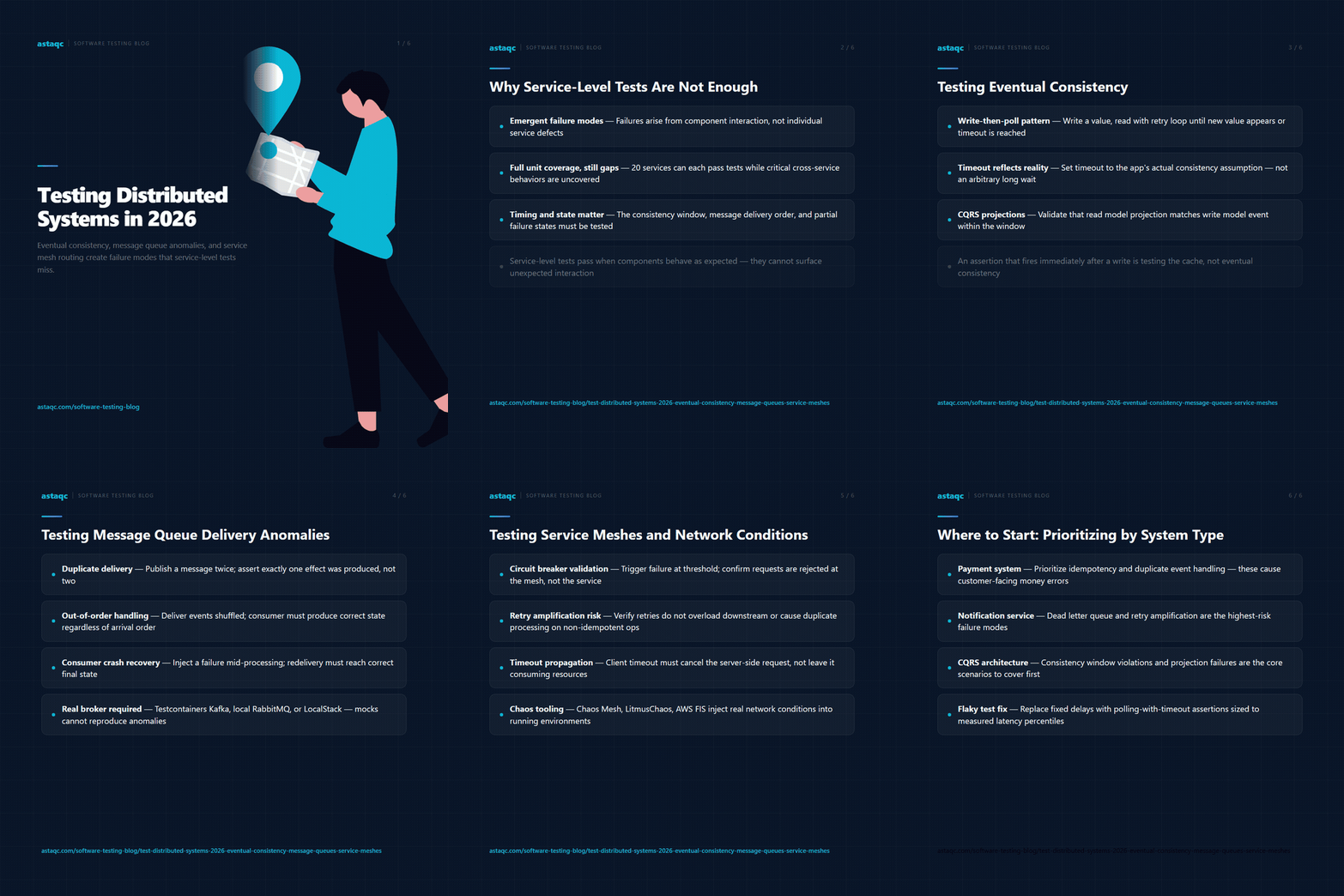
The basic pattern for testing eventual consistency is write-then-read with assertion retries. The test writes a value, reads from the system, and if the read returns the old value, retries with a short delay until either the new value is returned or a timeout is reached. If the timeout is exceeded, the test fails: the consistency window exceeded what the test was willing to wait, which may indicate a replication delay, a caching misconfiguration, or a read routing issue. The timeout value should reflect the application’s actual consistency window assumption, not an arbitrary long wait — if the application assumes convergence within 500ms and the test times out at 5 seconds, the test is passing scenarios the application cannot handle in production.
Beyond the basic read-after-write pattern, eventual consistency testing should cover conflict resolution for concurrent writes: two services writing to the same record simultaneously and the final state reflecting the expected resolution strategy, whether that is last-write-wins, version-vector merging, or application-level conflict detection. For CQRS architectures where the write and read models are separate projections, the test should validate that the event consumed by the read model projection matches what the write model emitted, and that the projection produces the correct read model state after processing the event. For teams using no-code API testing tools, sequential HTTP request steps can implement the write-then-poll pattern without requiring custom test framework code. For teams that need structured test coverage design for eventually consistent systems, Astaqc software testing services can map consistency requirements to explicit test scenarios. The manual testing guide covers when manual exploratory testing should supplement automated consistency tests to catch edge cases in projection behavior.
Message queue testing validates that events are produced correctly, consumed correctly, and that the system handles delivery anomalies — duplicate delivery, out-of-order delivery, and consumer failures — without producing incorrect state. Most event-driven test strategies cover the happy path — a message is produced, delivered once, and consumed — but do not cover the delivery anomalies that distributed message brokers guarantee will eventually occur in production.
The three delivery anomalies that require explicit test coverage are: duplicate delivery (brokers with at-least-once delivery semantics such as Kafka and SQS may deliver the same message more than once, requiring the consumer to be idempotent); out-of-order delivery (messages may arrive in a different order than they were produced, particularly across partitions); and consumer failure with redelivery (when a consumer fails mid-processing, the broker redelivers the message and the consumer must produce correct final state rather than partial state or duplicate effects).
| Test Category | What It Validates | Required Infrastructure |
|---|---|---|
| Happy-path event flow | Event produced, delivered once, consumer produces correct state | Test broker instance or embedded broker |
| Idempotent consumer | Duplicate delivery produces same state as single delivery | Test broker + consumer under test + state store |
| Out-of-order delivery | Consumer handles events in shuffled arrival order correctly | Test broker with delivery order control |
| Consumer failure and recovery | Crash mid-processing followed by redelivery produces correct final state | Fault injection in consumer + broker retry config |
| Dead letter queue behavior | Unprocessable messages route to DLQ; DLQ consumer handles them correctly | DLQ configured in test broker + DLQ consumer |
| Backpressure handling | Consumer slows under load without losing messages or corrupting state | Load test tooling + broker + consumer under test |
The test infrastructure for message queue testing requires a real broker instance rather than a mock, because mock brokers typically do not reproduce the delivery anomalies that make real message queue testing valuable. Embedded Kafka via Testcontainers, local RabbitMQ, and LocalStack for SQS are the standard test infrastructure choices in 2026 for running broker-backed tests in CI without requiring a shared message broker environment. For teams building out message queue test coverage, Astaqc hire QA team can provide engineers experienced in event-driven architecture testing. The outsourced QA guide covers how to structure engagement models for teams that need distributed system test expertise without building it in-house.
Service meshes — Istio, Linkerd, Consul Connect — add a sidecar proxy layer to service communication that handles mTLS, load balancing, circuit breaking, retries, and traffic shaping. Testing service mesh behavior requires tests that validate the proxy layer configuration, not just the application logic. A service can be correctly implemented and still fail in production because the service mesh circuit breaker is misconfigured, because retry amplification causes downstream overload, or because traffic policies route requests to a canary deployment in ways the application does not handle correctly.
The service mesh behaviors that require explicit test coverage are circuit breakers, retry policies, and timeout propagation. Circuit breaker testing requires a test that deliberately causes a service to fail at the threshold that should trigger the circuit breaker, then verifies that subsequent requests are rejected at the mesh layer before reaching the service, and that the circuit reopens after the configured recovery window. Retry policy testing verifies that the mesh retries the correct number of times on the correct status codes, that retries do not amplify load beyond what the downstream can handle, and that retry behavior does not cause duplicate processing for non-idempotent operations. Timeout propagation testing verifies that a timeout set at the client propagates through the mesh to the downstream service, so that a request that times out at the client is also cancelled at the server rather than continuing to consume resources.
Chaos engineering frameworks — Chaos Mesh, LitmusChaos, AWS Fault Injection Service — provide the tooling to inject network conditions into running test environments. A chaos test for a distributed system typically runs the application under a defined scenario, injects a failure such as a pod failure, a network partition, or a latency spike, and asserts that the system recovers within defined bounds without data loss, duplicate processing, or extended user-facing errors. For teams assessing whether their distributed system handles network failure scenarios correctly, Astaqc performance testing services cover load and failure injection testing for service-oriented architectures. The AI in software testing guide covers how AI-assisted test generation tools are being applied to distributed system test scenario generation in 2026, particularly for generating chaos experiment definitions from architecture diagrams and service dependency maps.
Integration testing validates that two or more components work correctly together under normal conditions — the API contract between a service and its database, or between two services in a synchronous call chain. Distributed system testing extends this by validating behavior under abnormal conditions that distributed execution makes possible: message redelivery, network partitions, eventual consistency delays, and service mesh policy activation. Integration tests pass when every component behaves as specified; distributed system tests also validate that the emergent behavior under failure conditions matches what the application is designed to handle.
They do not require production-scale infrastructure, but they do require the real components they are testing rather than mocks. A distributed system test for Kafka consumer idempotency needs a real Kafka broker (or an embedded test equivalent like Testcontainers Kafka) and the real consumer implementation against a real database. What it does not need is production-scale cluster sizes, production data volumes, or a multi-region deployment. The test environment can be ephemeral and lightweight as long as it runs the real broker, real consumer, and real state store.
Prioritize the failure modes that have caused or would cause the highest-impact production incidents for the specific system. For a payment processing system, idempotency and duplicate event handling are the highest-risk scenarios. For a notification system, dead letter queue behavior and retry amplification are the priority. For a CQRS system, eventual consistency window violations and projection failures are the focus. The failure modes that matter most are specific to the system’s architecture and business consequences — the prioritization should be driven by incident history and risk assessment for the specific application, not by a generic taxonomy of distributed system failure modes.
No-code tools with HTTP request steps can cover the API-facing aspects of distributed system testing: write-then-poll eventual consistency checks, API calls that trigger event production, and read endpoint assertions that verify event processing results. They cannot directly inject messages into brokers, simulate consumer crashes, or control service mesh policies. The practical approach is to use no-code tools for API-level scenario coverage and code-based tests for infrastructure-level failure injection, with the two suites running in different CI stages against the same test environment. For teams structuring a mixed test approach, Astaqc test automation services can help define the boundary between no-code and code-based test coverage for a specific distributed architecture.
Flakiness in distributed system tests comes from timing assumptions baked into test assertions: an assertion that fires immediately after a write before an eventual consistency window closes, a timeout that is too short for the actual message delivery latency in the test environment, or a chaos experiment that checks recovery before the system has actually recovered. The remediation is to replace timing assumptions with polling-with-timeout assertions, to instrument the test environment to report when state transitions have completed rather than relying on fixed delays, and to set timeouts based on measured latency percentiles in the test environment rather than estimated values. For teams building resilient distributed system test suites, Astaqc testing documentation services can help define assertion patterns and timeout policies that reduce flakiness without increasing test runtime unnecessarily.
A distributed system where every service passes its tests can still fail in production when network partitions cause message redelivery, when eventual consistency windows exceed what the application assumes, or when service mesh circuit breakers activate under load patterns not covered in testing. The testing strategies that matter are the ones that reproduce the failure conditions that distributed execution makes possible.
August 24, 2026


Sign up to receive and connect to our newsletter

We founded ASTAQC as a tight-knit group of professional Software Testers and software developers.
Subscribe to our Newsletter