October 22, 2026

Test debt is the accumulated cost of maintaining tests that no longer serve their intended purpose — tests that are flaky, redundant, brittle, or so expensive to maintain that the engineering team avoids changing them. Paying down test debt requires identifying which tests contribute to it, understanding why they accumulated, and removing or refactoring them in order of business impact before the maintenance burden prevents the team from adding valuable new coverage. In 2026, test debt is one of the primary reasons mature QA teams spend more time on maintenance than on new test creation. Astaqc's software testing services page covers how test suite audits identify and address test debt in client QA engagements.
Test debt is the testing equivalent of technical debt: it is the gap between the test suite you have and the test suite you would design if you started today with everything you now know about the application, the team, and the failure modes you have actually encountered. Like technical debt, it accumulates through rational short-term decisions: a test written for a feature that was later removed but the test was not deleted, a parameterized test added quickly to cover a bug fix that duplicates coverage from an existing test, a selector-heavy E2E test written before the team adopted a stable selector strategy that now requires updates on every UI change.
Test debt manifests in four distinct types. Flaky tests are tests that produce inconsistent results on the same code — they pass sometimes and fail sometimes without any change to the application. Redundant tests are tests that cover the same behavior as other tests in the suite, so deleting them would not reduce coverage. Brittle tests are tests that are structurally fragile and break frequently due to minor application changes that do not affect the behavior being tested. Orphaned tests are tests for features or behaviors that no longer exist in the application.
| Test Debt Type | Primary Cost | How It Accumulates |
|---|---|---|
| Flaky | Debugging time, lost confidence in suite results | Timing issues, external dependencies, environment inconsistency |
| Redundant | Execution time, maintenance overhead | Bug-fix tests that duplicate existing coverage, copy-paste test creation |
| Brittle | Maintenance time, update friction blocking refactoring | Selector-heavy tests, hardcoded data, implementation-coupled assertions |
| Orphaned | Noise in failures, confusion in maintenance | Feature removal without test deletion, deprecated API tests |
Astaqc's manual vs. automated testing guide covers how test suite composition decisions affect long-term maintenance cost, including the trade-offs between high-coverage automated suites that accumulate debt and smaller, curated suites that are easier to maintain.
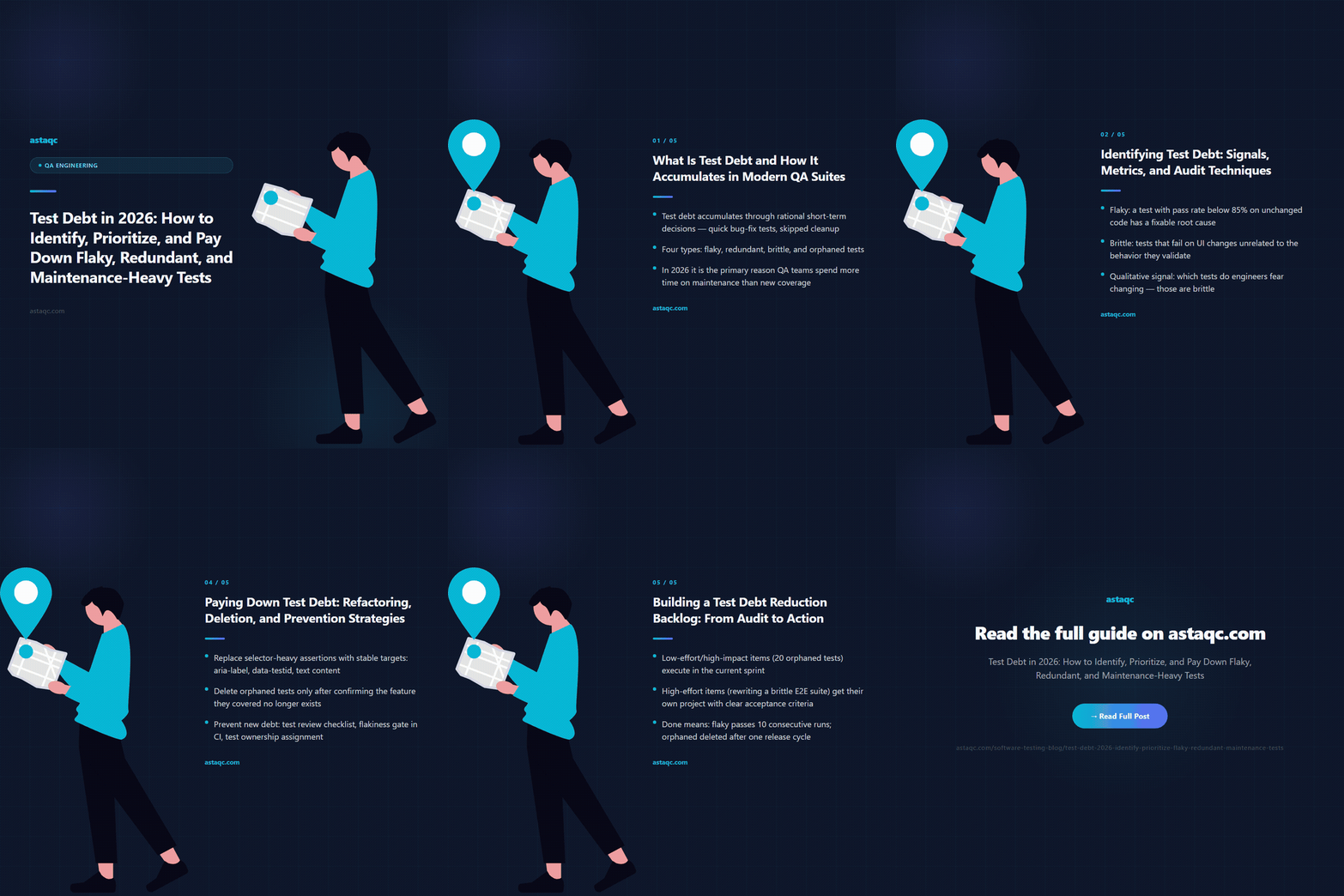
Test debt is identifiable through a combination of quantitative signals from the CI run history and qualitative signals from the engineers who maintain the suite. The quantitative signals are faster to gather but require interpretation. The qualitative signals require interviews or surveys but reveal debt patterns that metrics miss.
The primary quantitative signals for each debt type are: for flaky tests, pass rate variance over the last 30 CI runs for each test — a test that passes 70% of the time with no code changes is flaky; for redundant tests, coverage overlap analysis showing which tests assert the same behavior as other tests in the suite; for brittle tests, failure-to-application-change ratio — tests that fail disproportionately often relative to the volume of production code changes; for orphaned tests, tests that reference application paths, API endpoints, or UI elements that no longer exist in the current codebase.
The most practical audit technique is the failure-mode trace. For each test that failed in the last 30 CI runs, record whether the failure indicated a real application regression, a flaky environment issue, a selector/locator change in the UI, or a test setup failure. Tests where fewer than 25% of failures indicated real regressions are strong candidates for either flaky-test treatment (if the failure mode is inconsistent) or brittle-test treatment (if the failure mode is consistently triggered by UI changes that do not affect functionality).
Qualitative signals come from asking the engineers who maintain the suite two questions: which tests do you fear changing, and which tests do you skip or suppress when their failures block a release? Tests that engineers fear changing are brittle tests — the maintenance overhead is high enough that engineers avoid touching them. Tests that are skipped or suppressed at release time are tests the team has implicitly decided are not reliable enough to trust. Both signals identify debt that would not appear in pass-rate metrics because the tests either rarely fail or are being actively managed around. Astaqc's outsource QA guide covers how test suite audits are structured in external QA engagements, including the interview and metric-collection phases used to surface debt in inherited suites.
Not all test debt has the same cost, and not all of it should be paid down at the same rate. The prioritization framework has two dimensions: the maintenance cost the debt is currently imposing, and the coverage risk created by removing or fixing the test. High-cost, high-risk debt is refactored first. High-cost, low-risk debt is deleted first. Low-cost debt is deferred or addressed incrementally as tests in the affected area are modified for other reasons.
The highest-priority category is flaky tests that cover critical application behavior. A flaky test that covers the checkout flow imposes high maintenance cost (engineers spend time diagnosing intermittent CI failures) and creates high coverage risk if deleted (the checkout flow has reduced coverage). The correct resolution is not deletion but stabilization: identifying the source of flakiness — a timing issue, an external dependency, a shared state problem — and fixing the root cause. Stabilized, the test continues to provide coverage without the maintenance overhead.
The second-highest priority is brittle tests that block refactoring. A brittle test that fails every time the team changes a UI component is not just a maintenance cost on its own; it is a friction multiplier that makes the entire codebase harder to change. Teams that are slowing down refactoring efforts to avoid breaking tests that are testing implementation details rather than behavior are paying a compound cost. These tests should be rewritten to assert behavior at a higher level — through the user interface or the API — rather than through the implementation detail that changes with every refactor.
Redundant tests and orphaned tests are the lowest-risk to remove, and removing them reduces execution time and simplifies the suite without reducing meaningful coverage. The risk in removing redundant tests is misidentifying coverage overlap — asserting that two tests cover the same behavior when they actually cover slightly different scenarios. Before deleting a redundant test, verify that the behavior it covers is fully represented by the test it is being merged with. Astaqc's AI in software testing guide covers how AI tools are beginning to assist with coverage overlap analysis and redundant test identification, reducing the manual effort required in this prioritization phase.
Paying down test debt requires dedicated time allocation, clear ownership, and a definition of done for each debt category. The common mistake is attempting to address all test debt in a single sprint or project. Test debt accumulated over months or years is better addressed through a sustained cadence: a fixed proportion of each sprint allocated to debt reduction, applied systematically to the highest-priority items from the audit.
Refactoring brittle tests follows the same principles as refactoring production code: reduce coupling, increase abstraction, replace implementation-detail assertions with behavior assertions. A test that fails when a CSS class changes should be refactored to use a stable selector strategy: semantic HTML attributes (aria-label, role), data test attributes (data-testid), or text content that is controlled by the application rather than the styling layer. A test that hardcodes a specific ID value should be refactored to use a dynamic reference obtained during the test run. Each refactoring removes one specific source of brittleness without changing the behavior the test validates.
Deleting orphaned tests requires confirming that the feature or behavior the test was written for no longer exists. The confirmation is usually straightforward for UI-based tests — the element the test targets does not exist in the current application — but can be ambiguous for API-based tests where the endpoint still exists but the behavior it exposed has been significantly changed. When in doubt, suppress the test for one release cycle, confirm that no production incident occurs that the test would have caught, and then delete it with confidence.
Prevention strategies reduce the rate at which new test debt accumulates. The three most effective are: a test review checklist that includes questions about selector stability, coverage overlap, and dependency on external state; a flakiness gate in CI that marks any test with a pass rate below a defined threshold for remediation before the next release; and a test ownership assignment that makes the engineer who writes a test responsible for maintaining it, which aligns the incentive for writing stable, maintainable tests with the person best positioned to do so. Astaqc's performance testing page covers how performance regression tests are particularly susceptible to accumulating debt as application baselines change, and Astaqc's software testing cost guide covers how sustained test debt reduction is budgeted in mature QA organizations.
A test debt audit produces a list of tests and the debt category each one falls into. Converting that list into an actionable backlog requires estimating the effort to address each item and ordering it by the cost-to-fix relative to the maintenance-cost-saved. Low-effort, high-impact items — deleting twenty orphaned tests that reference a removed feature — should be executed immediately. High-effort items — rewriting a suite of brittle E2E tests against a stable selector strategy — should be scheduled as a dedicated project with clear acceptance criteria.
The backlog should include a definition of done for each debt type. For flaky tests: the test passes on ten consecutive CI runs without a code change. For brittle tests: the test passes without modification through a defined set of UI changes that previously broke it. For redundant tests: the test is deleted and the coverage it provided is confirmed to be present in the remaining tests. For orphaned tests: the test is deleted and the CI suite runs without it for one release cycle without a coverage-related production incident. These definitions prevent debt items from being marked complete prematurely and ensure the reduction has the intended effect. Astaqc's dedicated QA team page covers how test debt reduction is structured as a project in QA engagements that involve inheriting and improving existing test suites, including the audit-to-backlog workflow described here.
The most effective approach is to quantify the current cost of test debt in terms that map to business impact. Count the number of CI runs in the last quarter where a flaky test blocked a deployment and estimate the delay cost. Count the number of engineering hours spent debugging intermittent CI failures rather than adding new coverage. Count the number of production incidents that occurred in areas where test debt had reduced coverage confidence. These numbers translate the abstract concept of test debt into concrete engineering productivity loss that justifies a sustained reduction investment.
Yes, and more often than most teams acknowledge. A test that has not detected a real regression in the last 12 months, imposes significant maintenance overhead, and duplicates coverage provided by a more stable test at a different level is a candidate for deletion. The fear that deleting a test reduces safety is only valid if the test is actually providing detection capability that no other check provides. Performing the coverage overlap analysis before deletion, and monitoring production for one release cycle after, gives the confidence to delete rather than maintain tests that are consuming resources without contributing detection.
Flaky tests are the most damaging form of test debt because they erode the team's trust in the entire test suite, not just the flaky tests themselves. When engineers learn to expect some CI failures as noise, they begin to dismiss failures as noise even when they indicate real regressions. This erosion of trust is cumulative and hard to recover from. Flaky tests should be treated as higher priority than other debt types specifically because of this trust erosion effect — even a single high-profile flaky test in a critical area can reduce the team's confidence in the suite's reliability across all areas.
Track four metrics on a monthly cadence: flaky test count (tests with a pass rate below a defined threshold), orphaned test count (tests referencing removed features or endpoints), average time spent on test maintenance per sprint, and the ratio of new tests added to tests refactored or deleted. A healthy suite has a declining flaky test count, an orphaned count near zero, a stable or declining maintenance time per sprint, and a refactor/delete ratio that is actively managed rather than near zero. These metrics together give a clear picture of whether test debt is accumulating faster than it is being paid down.
Yes. Manual test cases accumulate debt in the same ways: test cases for removed features remain in the test plan, test cases for changed flows reference UI elements that no longer exist, and test cases for behaviors now covered by automation continue to consume manual testing time. The audit process is the same — identifying which manual test cases are orphaned, redundant with automated coverage, or outdated — and the prioritization follows the same logic. Astaqc's manual testing services page covers how manual test case maintenance is structured in ongoing QA engagements, including the cadence for reviewing and retiring outdated test cases as applications evolve.
Test debt is not measured in lines of test code or test count — it is measured in the engineering hours spent maintaining tests that no longer contribute to confidence, and the coverage gaps that accumulate while teams avoid adding tests to suites they cannot change without breaking.
October 22, 2026


Sign up to receive and connect to our newsletter

We founded ASTAQC as a tight-knit group of professional Software Testers and software developers.
Subscribe to our Newsletter