October 30, 2026

Shadow testing mirrors live production traffic to a new service version in parallel, compares the responses, and surfaces differences — without the parallel service’s responses ever reaching the user. The production service handles every request normally; the shadow service receives an identical copy of each request, processes it independently, and returns a response that the shadow testing framework captures and compares against the production response. Users see only the production response at all times.
Shadow testing addresses a specific gap in the pre-production testing stack. End-to-end tests use representative scenarios, load tests approximate production volume, and staging environments hold copies of production data that may lag the real database by hours or days. Shadow testing uses actual production requests in real time against the full production data state — making it the highest-fidelity validation method available before a deployment serves real users.
The conditions where shadow testing provides value that no other method covers:
Shadow testing is not a replacement for pre-production testing — it is the final validation layer before a production cutover for high-risk changes. For the broader strategy context, the test automation strategy guide for 2026 covers how shadow testing fits within the coverage model alongside unit, integration, and end-to-end tests.
Traffic mirroring requires a layer in the request path that duplicates the incoming request before it reaches the primary service. The three standard implementation patterns are proxy-level mirroring, service mesh mirroring, and load balancer mirroring. Each operates at a different layer and has different operational trade-offs.
| Pattern | Implementation | Best for | Limitation |
|---|---|---|---|
| Nginx mirror module | mirror directive in server block | Simple HTTP services behind Nginx | Fire-and-forget; Nginx does not capture shadow responses for comparison |
| Envoy shadow policy | shadow and shadow_policy in route config | Istio or Envoy-based service meshes | Still fire-and-forget unless responses are captured at the shadow service level |
| AWS ALB mirroring | Traffic mirroring target group on ALB listener rule | AWS-native architectures | Requires VPC Traffic Mirroring; not available on all instance types |
| Application-level proxy (Diffy, custom) | Proxy fans out to both services and compares responses | Full response comparison with divergence reporting | The proxy adds a hop; must not add latency to the primary path |
For teams that need response comparison rather than fire-and-forget mirroring, the application-level proxy pattern — implemented with tools like Twitter’s open-source Diffy — captures both the production and shadow responses and computes a diff. The diff is logged, compared against a divergence threshold, and surfaced as a report. A deployment with a zero or near-zero divergence rate on shadow traffic is a strong signal that the change is safe to cut over.
The critical implementation requirement is that the shadow service must not produce side effects that affect production state. Write operations — POST, PUT, PATCH, DELETE — must either be blocked at the shadow service level, sent to a shadow database, or replayed against a read-only replica. A shadow service that processes write requests against the production database produces duplicate records or corrupt state. For teams designing a shadow testing architecture, Astaqc’s software testing services include shadow testing design as part of pre-production validation engagements.
Shadow testing, canary deployments, and blue-green deployments all serve the goal of reducing deployment risk, but they operate at different stages and make different trade-offs between risk, complexity, and validation fidelity.
| Technique | Real user traffic? | User impact if new version is broken? | When to use |
|---|---|---|---|
| Shadow testing | Yes (mirrored, not served) | Zero — users see only production responses | Pre-cutover validation for high-risk changes; refactors; DB migrations |
| Canary | Yes (served to a percentage) | Limited to the canary percentage (1–5%) | Progressive rollout of new features; monitoring real-cohort impact |
| Blue-green | Yes (switched at cutover) | Full blast at cutover if rollback is not immediate | Full environment swap with instant rollback; major version migrations |
Shadow testing exposes zero users to the new version — it is the only technique that provides full production-traffic validation without any risk to the user experience. This makes it the correct choice for validating a change before any real traffic is served to the new version, whereas canary and blue-green are deployment strategies for rolling out a change that has already been validated as correct.
In practice, shadow testing precedes a canary deployment for high-risk changes. The workflow is: run shadow testing for 24 to 72 hours to validate that the divergence rate is within the acceptance threshold, then begin a canary rollout to 1–5% of real traffic once the shadow signal is clear. Shadow testing validates correctness; canary deployment validates performance, error rates, and business metrics under real load with actual users.
Blue-green deployment is a fast rollback mechanism, not a testing strategy. A blue-green deployment with no shadow testing is an instantaneous switch to a new version that has only been validated in pre-production environments, which still carries the risk that production traffic patterns expose defects that synthetic tests did not exercise. Shadow testing before the blue-green switch is what closes that gap. The complete software testing guide covers how deployment-integrated testing approaches fit within the broader testing strategy.
The core assertion in shadow testing is response equivalence: the shadow service must return a response that is functionally identical to the production response for the same input. Functional identity does not mean byte-for-byte equality — it means the semantically relevant fields match within the acceptance criteria defined for the service.
The fields to compare and the acceptable divergence thresholds depend on the service type:
Non-determinism in shadow responses is the most common source of false positives in shadow testing. It appears in services that include timestamps, random values, or session-specific tokens in responses. The standard mitigation is a field exclusion list: the comparison logic strips excluded fields before diffing, treating them as expected-to-differ fields rather than divergences.
Diffy’s response diffing uses a three-way comparison — production, shadow, and a second production call — to distinguish non-determinism from actual divergence. If the two production calls return different values for a field, that field is marked as inherently non-deterministic and excluded from the shadow comparison automatically. This calibration step runs before the shadow validation period begins and prevents non-determinism from generating false failure signals throughout the shadow run.
The divergence threshold for accepting a shadow result depends on the risk profile of the change. For a refactored business logic layer where zero divergence is expected, a 0.1% divergence rate over 50,000 requests is a signal worth investigating before cutover. For a search ranking model where some divergence is expected from algorithmic changes, the threshold is set based on the business definition of equivalent results. For teams using test automation services to design shadow testing pipelines, the divergence threshold and exclusion list definitions are part of the test design specification and become part of the release sign-off evidence. See the software testing cost guide for context on how shadow testing infrastructure costs are evaluated against deployment risk reduction.
Modern distributed architectures introduce shadow testing challenges that do not exist in monolithic services. Event-driven architectures, gRPC services, and AI inference endpoints each require specific adaptations to the traffic mirroring pattern.
Event-driven architectures: services that consume from Kafka or SQS cannot be mirrored at the load balancer layer. The shadow testing pattern for event-driven services replays the production event stream to a shadow consumer instance. The shadow consumer processes each event independently and writes its outputs to a shadow topic or database. The comparison layer reads from both production and shadow output streams and diffs the results. AWS EventBridge Replay and Kafka MirrorMaker are the standard tools for this pattern in their respective ecosystems.
gRPC services: Envoy’s shadow policy supports gRPC traffic with the same configuration as HTTP/2, making traffic mirroring straightforward for gRPC services deployed behind an Envoy proxy. The key difference is serialization: gRPC responses are Protocol Buffer-encoded, so the comparison layer must deserialize both responses before diffing the fields. A Protobuf-aware diff tool handles this correctly; byte-level comparison of the raw response body will always show differences due to field ordering in the serialized output.
AI inference endpoints: language model and embedding service responses are inherently non-deterministic. Shadow testing an AI inference endpoint validates inference latency, error rates, and token usage patterns rather than output equivalence. The shadow comparison for an LLM endpoint might assert that the shadow latency p95 is within 20% of the production latency p95, that the error rate is below 0.1%, and that the response length distribution matches the production baseline within a configurable tolerance band. Output quality comparison requires a separate evaluation pipeline outside the shadow testing framework.
For teams migrating from one cloud provider to another, shadow testing the migrated service against the original before cutting over DNS provides the highest-confidence signal that the migration is safe. The production service in the source environment handles live traffic; the shadow service in the target environment receives the mirrored requests and processes them against the target infrastructure. Divergence in this context catches platform-specific behaviour differences — different default values for database connection pooling, different floating-point rounding in the target runtime, different character encoding defaults — before any user traffic touches the new environment.
For teams building out shadow testing infrastructure from scratch, Astaqc’s performance testing service includes shadow testing architecture design as part of pre-production validation engagements. The manual testing vs automated testing guide covers where shadow testing fits within the decision framework for when to use automated validation versus manual exploration for complex system changes.
Shadow testing mirrors production traffic to a new service version in parallel, compares responses, and surfaces differences without the new version’s responses ever reaching users. Canary deployments serve the new version to a percentage of real users. Shadow testing provides zero-user-impact validation of correctness; canary deployments provide real-user validation of the full production experience including latency, error rates, and business metrics. Shadow testing precedes canary deployment for high-risk changes.
The standard approaches are routing the shadow service’s write requests to a dedicated shadow database or replicated read replica, intercepting write operations at the shadow service layer and logging them without executing them, or configuring the shadow service to run in a read-only mode where write requests return a synthetic success response without touching any data store. The chosen approach depends on whether the test needs to validate the full write path or only the read and computation logic.
The most widely deployed tools are Nginx’s mirror module for simple HTTP mirroring, Envoy’s shadow policy for service mesh architectures, and Twitter’s open-source Diffy for application-level response comparison with non-determinism calibration. AWS ALB traffic mirroring covers AWS-native setups. For event-driven architectures, AWS EventBridge Replay and Kafka MirrorMaker handle event stream replay to shadow consumers.
The minimum shadow period is determined by the traffic volume needed to reach statistical significance on the divergence measurement and by the time-of-day traffic patterns the service experiences. A service handling 10,000 requests per hour can collect meaningful divergence data in 2 to 4 hours; a low-traffic internal service may need 48 to 72 hours to see a representative sample. Shadow testing should run through at least one full traffic cycle — including peak hours and off-peak periods — before the divergence result is considered reliable.
For AI inference endpoints, shadow testing validates operational metrics — latency, error rates, token usage, timeout rates — rather than output equivalence, since model outputs are inherently non-deterministic. Output quality comparison for LLM changes requires a separate evaluation pipeline such as an LLM judge or human evaluation sample. Shadow testing and model evaluation are complementary: shadow testing confirms the new endpoint is operationally stable, and model evaluation confirms the outputs meet quality standards.
There is no universal threshold. For refactored business logic where zero divergence is expected, any divergence above 0.1% over 50,000 requests warrants investigation before cutover. For search ranking or recommendation services where algorithmic differences are expected, the threshold is derived from the business definition of equivalent results. Payment and financial calculation services should have zero tolerance for any divergence in monetary values regardless of the overall divergence rate.
Shadow testing in 2026 is the highest-fidelity validation method available before a production cutover. It uses real traffic, real production data, and real system state — inputs that no pre-production environment can fully replicate — while exposing zero users to the new version during the validation period. For high-risk changes where the cost of a production incident exceeds the cost of running a shadow test for 24 to 72 hours, shadow testing is the right pre-cutover standard.
The implementation complexity depends on the architecture: simple HTTP services behind Nginx or Envoy can add traffic mirroring with a configuration change, event-driven architectures require an event replay mechanism, and response comparison infrastructure requires a comparison service with non-determinism calibration. The operational investment is proportional to the risk reduction value, which is highest for changes to core business logic, database query layers, and infrastructure migrations.
For expert guidance on designing shadow testing infrastructure for your architecture, Astaqc’s QA team hire service provides engineers experienced in production traffic mirroring, divergence analysis, and pre-cutover validation across distributed systems. See the AI in software testing guide for context on how shadow testing fits within the broader 2026 QA toolchain alongside AI-native test automation and automated coverage measurement.
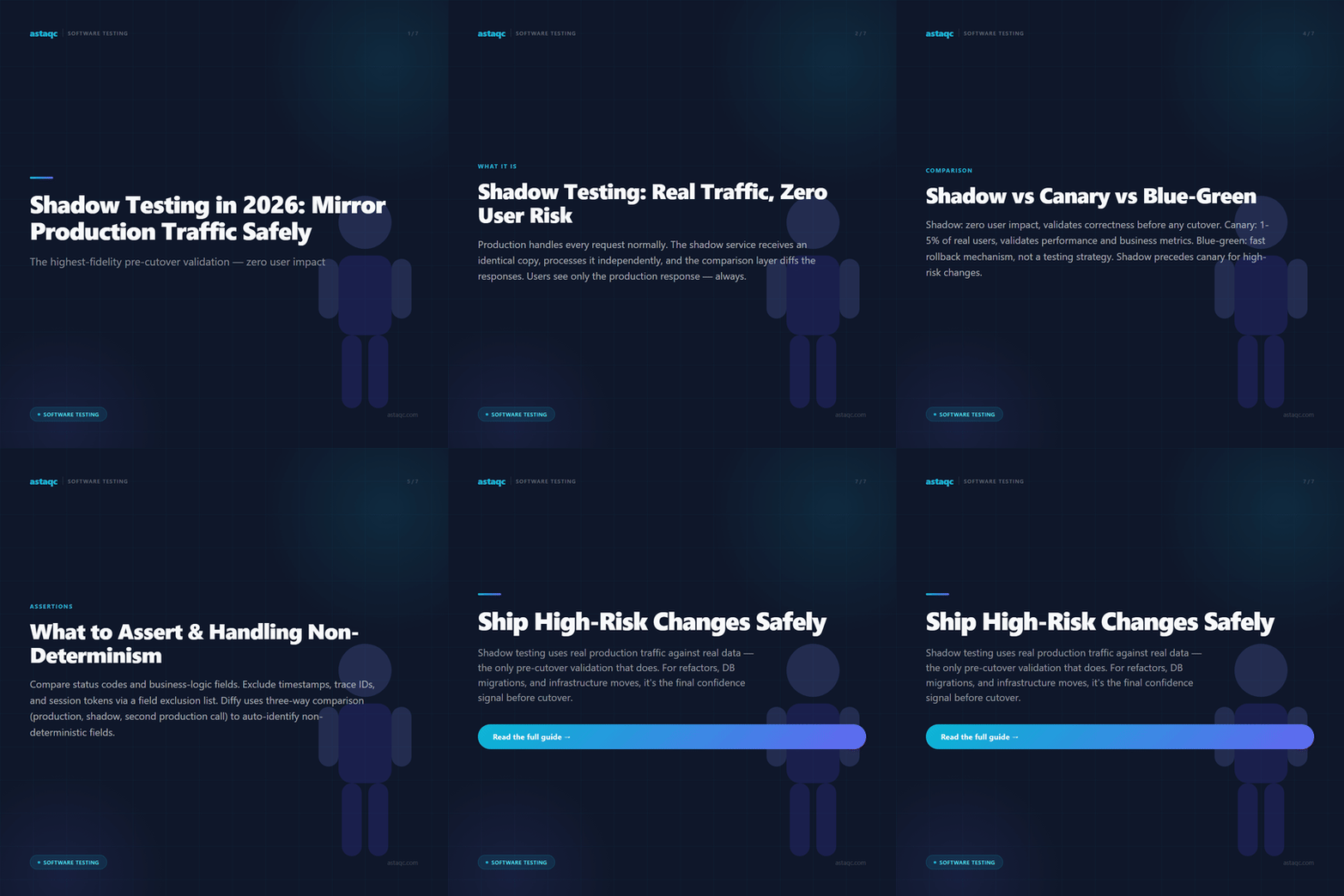
Shadow testing is the only pre-cutover validation technique that uses actual production requests, real production data, and live system state — while exposing zero users to the new version during the validation period.
October 30, 2026


Marcus Chen is a software testing engineer specializing in API testing, performance engineering, and security QA. He has led QA programs for enterprise SaaS, fintech, and healthcare technology companies across three continents.

Sign up to receive and connect to our newsletter

We founded ASTAQC as a tight-knit group of professional Software Testers and software developers.
Subscribe to our Newsletter