
October 29, 2026

Infrastructure as code moved the blast radius of configuration errors from the operations runbook to the pull request. When a Terraform plan misconfigures a security group or a Kubernetes manifest sets the wrong resource limit, the error propagates quietly through CI, passes the deployment pipeline, and surfaces in production as a degraded service or a security incident.
The traditional boundary between application testing and infrastructure management dissolved when teams adopted IaC. A QA engineer reviewing a feature branch now shares responsibility with the platform team for the Terraform modules and Helm charts that support it. Infrastructure testing — the practice of validating IaC artifacts before they apply — fills the gap between a merge and a stable deployment.
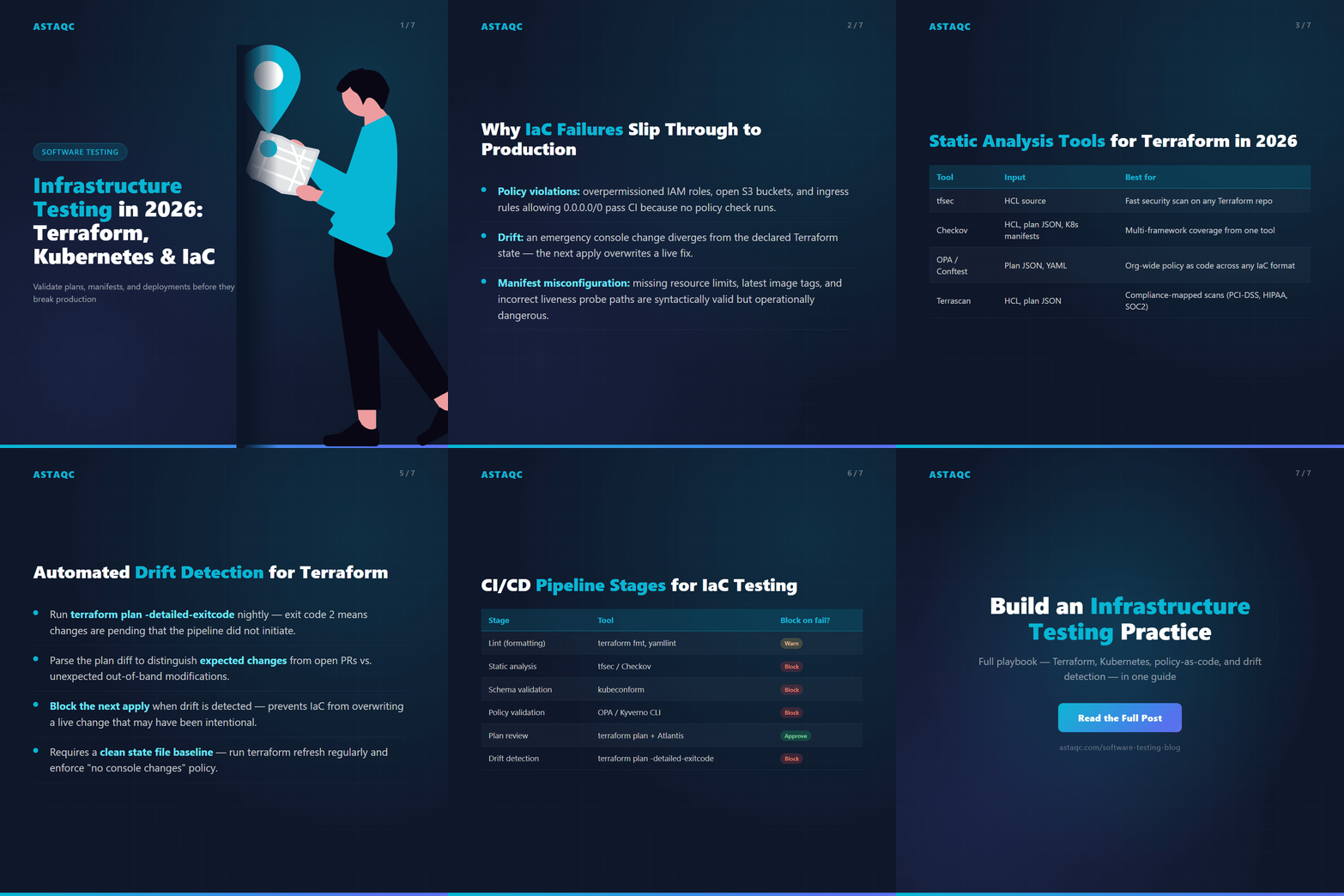
In 2026, three categories of infrastructure failure account for the majority of post-deployment incidents in IaC-driven environments:
Each category requires a different test type. Static analysis catches policy violations before a plan runs. Drift detection catches the divergence between state and reality. Manifest linting catches misconfiguration in the Kubernetes layer. Together they form the infrastructure testing layer that sits between the IaC commit and the production apply. For an overview of where infrastructure testing fits within a broader test automation strategy for 2026, see the coverage model guide.
Terraform's terraform plan command shows what the apply will do, but it does not evaluate whether those changes comply with policy. Static analysis tools parse the plan output or the HCL source and check it against a rule set before the apply runs. The four tools that cover most production use cases in 2026 are compared below.
| Tool | Input | Rule language | Best for |
|---|---|---|---|
| tfsec | HCL source | Built-in + YAML custom checks | Fast security-focused scan on any Terraform repo |
| Checkov | HCL, plan JSON, CFN, K8s manifests | Python + built-in policies | Multi-framework coverage from a single tool |
| OPA / Conftest | Any structured data (plan JSON, YAML) | Rego | Organization-wide policy as code across any IaC format |
| Terrascan | HCL, plan JSON | Rego | Compliance-mapped scans (PCI-DSS, HIPAA, SOC2 baselines) |
Static analysis runs as part of the PR pipeline, before a plan is even generated against a real environment. The correct sequence is: lint HCL with tflint to catch syntax and provider errors, run tfsec or Checkov for security policy, and generate the plan for review. The plan JSON is then available for deeper policy checks with Conftest if the org has custom Rego rules.
A Kubernetes manifest that passes kubectl apply --dry-run=client is not a validated manifest. Client-side dry-run checks syntax and basic schema compliance but does not validate against admission webhooks, resource quotas, network policies, or the actual API server's admission pipeline. Server-side dry-run (kubectl apply --dry-run=server) is closer but still skips some webhook behaviors and requires a cluster connection.
The standard toolchain for manifest validation in 2026 combines three passes:
--strict and the target Kubernetes version flag to match the cluster's actual API server version.The output of these three passes is a structured report that can gate the PR merge. A manifest that fails a Polaris security check or a kubeconform schema check does not proceed to the cluster. This is the manifest equivalent of failing a unit test — the defect is caught at authoring time, not after the deployment runs.
For teams maintaining large Kubernetes environments, Astaqc's software testing services include infrastructure testing audits that evaluate the existing CI pipeline against current manifest validation standards and produce a remediation plan covering gaps in schema validation, policy enforcement, and drift detection coverage.
Drift is the condition where the live state of infrastructure differs from the declared state in the IaC repository. It happens when a change is applied directly to a resource — through the cloud console, a CLI command, or an emergency hotfix — without going through the IaC pipeline. Terraform's terraform plan detects drift when it compares the state file against the live resource, but only if the plan is run against the correct environment.
Automated drift detection runs terraform plan on a schedule — typically nightly — and alerts when the plan output contains changes the pipeline did not initiate. The pipeline for this is:
terraform plan -detailed-exitcode: exit code 2 means changes are pending, code 0 means no drift.The key constraint is that drift detection requires a clean baseline: the state file must reflect reality at the point the IaC pipeline last applied. If state file drift accumulates, terraform plan produces false positives that obscure real drift. Regular terraform refresh runs and strict enforcement of the "no console changes" policy are prerequisites for reliable drift detection.
Infrastructure testing does not replace application CI — it runs as a parallel pipeline that gates infrastructure changes the same way application tests gate code changes. The pipeline stages that cover the full IaC testing lifecycle are:
| Stage | Tool | What it catches | When it runs |
|---|---|---|---|
| Lint | tflint, helm lint | Syntax errors, deprecated providers, missing variables | On every commit |
| Static analysis | tfsec, Checkov, Conftest | Security policy violations, compliance gaps | On PR open and each push |
| Schema validation | kubeconform | Deprecated API versions, missing required fields | On PR open and each push |
| Policy validation | Polaris, Kyverno CLI | Resource limits, image pinning, security contexts | On PR open and each push |
| Plan review | Terraform plan + Atlantis | Unexpected resource changes, destructive operations | On PR open, requires human approval |
| Drift detection | Terraform plan (scheduled) | Out-of-band changes to live infrastructure | Nightly |
The plan review stage is the only stage that requires human sign-off. Every other stage is automated and runs without waiting for a human decision. This keeps the feedback loop short for the 90% of changes that pass all automated checks, while enforcing human review for the changes that carry the most risk.
Atlantis or Spacelift are the standard Terraform PR workflow tools for surfacing plan output directly in the pull request as a comment, making the plan change visible to reviewers without requiring them to run Terraform locally. For teams that prefer a simpler setup, a GitHub Actions workflow that runs terraform plan and posts the output as a PR comment achieves the same result.
Static analysis and schema validation cover the pre-apply checks, but some infrastructure failures only surface when the IaC actually runs against a real environment. Resource dependency ordering errors, provider authentication issues, and race conditions in resource creation do not appear in a plan — they appear in the apply. Ephemeral environment testing addresses this by running the apply against a temporary, isolated environment that is destroyed after the test completes.
The pattern for ephemeral IaC testing is:
workspace-pr-1234-xyz.terraform apply against the temporary workspace with a reduced configuration — a single-AZ version of a multi-AZ setup, or a dev-sized instance of a production resource.terraform destroy as part of the pipeline teardown, regardless of test outcome.The cost of ephemeral IaC testing is the provisioning time and the short-lived resource charges. For most infrastructure changes, the provisioning time is the binding constraint: a full Kubernetes cluster takes 8 to 12 minutes to provision, which is too slow for a PR feedback loop but acceptable for a nightly suite. Simplified test environments that provision only the changed resources keep the feedback loop under 3 minutes for most changes.
Terratest is the standard library for this pattern in the Go ecosystem. It provides helpers for running Terraform, checking outputs, and cleaning up regardless of test outcome. For teams that do not use Go, Pulumi's testing framework and the CDK's integ-runner cover the same pattern in TypeScript and Python.
For teams building out infrastructure testing from scratch, the complete guide to software testing provides the conceptual foundation for how infrastructure testing fits within the broader testing pyramid. Test automation services at Astaqc include IaC pipeline audits that assess the current state of infrastructure testing coverage and produce a prioritized remediation roadmap.
Infrastructure testing is the practice of validating infrastructure as code (IaC) artifacts — Terraform configurations, Kubernetes manifests, Helm charts, CloudFormation templates — before they are applied to a live environment. It encompasses static analysis for security policy violations, schema validation for manifest correctness, drift detection for live environment state, and ephemeral environment testing for apply-time failures. The goal is to catch infrastructure defects at the same stage that unit tests catch application defects: before the code reaches production.
terraform validate checks HCL syntax and internal consistency without communicating with a provider or accessing state. It runs offline and fast but catches only syntactic errors. terraform plan communicates with the provider API, reads the state file, and produces the full change set that an apply would execute. Plan output is required for meaningful static analysis and drift detection; validate output is only useful as a fast pre-commit check for syntax errors.
The standard three-pass approach: schema validation with kubeconform to check API version compliance and field requirements, policy validation with Polaris or Kyverno CLI to enforce resource limits and security context settings, and Helm linting for chart-based deployments. Server-side dry-run with kubectl apply --dry-run=server adds admission webhook validation but requires a cluster connection. The first three passes run entirely offline and gate the PR before a cluster is involved.
Infrastructure drift occurs when a resource's live state diverges from the declared state in the IaC repository. Common causes: emergency console changes applied outside the pipeline, manual CLI fixes during an incident, and cloud provider auto-scaling that modifies resource attributes not tracked in state. Detection runs terraform plan -detailed-exitcode on a schedule; exit code 2 signals pending changes. The plan diff distinguishes between expected changes from open PRs and unexpected drift from out-of-band modifications.
Static analysis, linting, and schema validation should run on every PR — they are fast (under 2 minutes for most repositories) and catch the most common categories of infrastructure defect without requiring a live environment. Plan review should require human sign-off before merge. Ephemeral environment testing is better suited to a nightly schedule or to PRs that change core infrastructure modules, since provisioning time makes it too slow for a standard PR feedback loop on every commit.
Open Policy Agent (OPA) is a general-purpose policy engine that evaluates structured data against rules written in the Rego language. In infrastructure testing, Conftest uses OPA to validate Terraform plan JSON, Kubernetes manifests, Helm chart values, and any other structured IaC artifact against organization-defined policies. The advantage over tool-specific rule sets is that a single policy library covers multiple IaC formats, and the policies are version-controlled alongside the infrastructure code they govern.
Infrastructure testing in 2026 is not optional for teams running IaC in production. The incident cost of a misconfigured security group, a Kubernetes deployment without resource limits, or a Terraform apply that overwrites a live hotfix is higher than the engineering cost of the CI pipeline that prevents it. Static analysis, manifest validation, drift detection, and ephemeral environment testing each address a distinct failure mode that the others cannot catch.
For teams starting from scratch, the fastest path to coverage is: add tfsec or Checkov to the PR pipeline this week, add kubeconform and Polaris for Kubernetes manifests, and schedule a nightly terraform plan drift check. The more advanced stages — Conftest policies, Terratest ephemeral environments — build on that foundation once the baseline is in place.
For expert guidance on building an infrastructure testing practice that fits your team's stack and delivery pace, Astaqc's QA team hire service provides engineers with hands-on experience in IaC testing pipelines across AWS, GCP, and Azure. See the manual testing vs automated testing guide for context on how infrastructure testing relates to the broader testing strategy.
The gap between a passing Terraform plan and a healthy production cluster is where infrastructure incidents live. Policy checks, drift detection, and manifest validation close that gap before the deployment runs.
October 29, 2026


Marcus Chen is a software testing engineer specializing in API testing, performance engineering, and security QA. He has led QA programs for enterprise SaaS, fintech, and healthcare technology companies across three continents.

Sign up to receive and connect to our newsletter

We founded ASTAQC as a tight-knit group of professional Software Testers and software developers.
Subscribe to our Newsletter


