September 16, 2026
Service contract testing is a technique for verifying that a service’s API behaves consistently with what its consumers expect, without requiring both services to be deployed and running at the same time. In a microservices architecture where dozens of services communicate over HTTP or message queues, the traditional approach to integration testing—spinning up all services together in a shared environment—becomes a coordination problem: slow builds, flaky environments, and failures that are difficult to trace to a specific service boundary. Contract testing addresses this by splitting the integration verification into two independent checks: the consumer verifies that its expectations are met by a mock of the provider, and the provider verifies that it satisfies those expectations against its own implementation. When both checks pass, integration confidence is established without requiring both services to be live simultaneously.
The practical relevance of contract testing in 2026 has increased as API surfaces have grown more complex and as teams have adopted continuous delivery practices that require fast, reliable feedback. An API that changes a response field name, removes an endpoint, or alters a required parameter can silently break downstream consumers if no formal contract exists between them. The “contract discovery bottleneck”—the challenge of knowing which consumers depend on which provider behaviors—is a recognized pain point in mature microservices organizations. Contract testing provides a systematic answer to that problem by making consumer expectations explicit and verifiable. This guide covers how contract testing works in practice, which tools handle it in 2026, the scenarios where it provides the most value, and how to integrate it into a CI/CD pipeline. For context on broader integration strategies, see Astaqc’s testing guide for modern teams.
Contract testing requires defining a formal description of what a consumer expects from a provider. In the most common implementation—consumer-driven contract testing with Pact—the consumer writes a test that describes the HTTP interactions it requires: the request format it will send and the response format it expects to receive. Running that test generates a contract file (a Pact file in JSON format) that captures those expectations. The provider then runs a separate verification step that replays each interaction in the contract against the provider’s actual implementation and confirms that the response matches what the consumer specified.
The critical mechanism is that neither side needs the other to be running during their respective tests. The consumer test runs against a mock provider generated from the same expectations captured in the contract. The provider verification test runs against the provider’s implementation directly, replaying the interactions from the contract file. If the provider’s behavior has changed in a way that violates the contract—a field was renamed, a required parameter was added, a status code changed—the verification fails. That failure is visible in the provider’s build before any deployment to a shared environment.
Pact Broker (or its hosted version, PactFlow) acts as the registry that connects the consumer contract to the provider verification. Consumers publish their contracts to the broker; providers pull them down during CI and run verification. The broker tracks which versions of which contracts have been verified by which versions of which providers, and exposes a “can I deploy” query that CI pipelines can use to determine whether a given version of a service is safe to deploy—meaning all consumer contracts it must satisfy have been verified against this version. This workflow closes the loop between consumer expectations and provider behavior across independent deployment pipelines. Astaqc’s test automation services team has implemented this workflow for several client architectures, and the “can I deploy” gate is consistently the most impactful part of the integration.
Pact remains the dominant framework for consumer-driven contract testing across multiple language ecosystems. The Pact ecosystem covers JavaScript/TypeScript (pact-js), Java/Kotlin (pact-jvm), Python (pact-python), Ruby (pact-ruby), Go (pact-go), .NET (pact-net), and Swift (pact-swift). Pact V4 introduced FFI-based matching rules that are consistent across language implementations, which matters for organizations where the consumer and provider are written in different languages. Pact also supports non-HTTP protocols—message contract testing for event-driven architectures using Kafka or SNS/SQS, where the “interaction” is a message payload rather than an HTTP request/response pair.
Spring Cloud Contract is the dominant choice in Spring Boot microservices environments. Unlike Pact, Spring Cloud Contract is provider-driven: the provider defines the contracts as Groovy DSL or YAML files, and the framework generates both the consumer stubs and the provider verification tests from those definitions. This inverts the ownership model—the provider controls the contract, not the consumer—which fits organizations where provider teams own API versioning and consumer teams consume generated client libraries. Spring Cloud Contract integrates naturally with Spring MVC test, WireMock stub generation, and Maven/Gradle build systems.
OpenAPI-based contract testing tools (Schemathesis, Dredd, and Specmatic) take a different approach: they derive consumer expectations from an OpenAPI specification rather than from consumer-written tests. Schemathesis generates property-based test cases from an OpenAPI or GraphQL schema and runs them against the live API, checking for specification violations and unexpected errors. This approach does not require consumers to write contract tests—the specification itself is the contract—but it also does not capture consumer-specific expectations; it verifies general specification conformance rather than consumer-driven behavior. Specmatic goes further by supporting both specification-based stubs for consumer tests and provider verification from the same OpenAPI or AsyncAPI document. For teams that already maintain comprehensive OpenAPI specs, Specmatic can provide contract testing coverage with less ceremony than Pact. Astaqc’s API testing guide covers these tools in the context of a broader API quality strategy.
| Aspect | Pact (consumer-driven) | Spring Cloud Contract (provider-driven) | OpenAPI-based (Specmatic / Schemathesis) |
|---|---|---|---|
| Contract ownership | Consumer writes expectations | Provider defines contracts | OpenAPI spec is the contract |
| Consumer stubs | Generated from consumer test output | Generated from provider contract files | Generated from OpenAPI spec (Specmatic) |
| Provider verification | Runs consumer contract against live provider | Runs generated tests against provider | Runs spec-derived tests against live API |
| Protocol support | HTTP + message (Kafka, SNS/SQS) | HTTP (Spring ecosystem) | HTTP + AsyncAPI (Specmatic); HTTP (Schemathesis) |
| Language support | JS/TS, Java, Python, Ruby, Go, .NET, Swift | JVM (Spring Boot focus) | Any (spec-based, language-agnostic) |
| Requires consumer participation | Yes — consumers must write Pact tests | No — stubs delivered to consumers | No — spec covers all consumers |
| Captures consumer-specific behavior | Yes — each consumer’s exact expectations | Partially — per-consumer contract files possible | No — general spec conformance only |
| Contract registry | Pact Broker / PactFlow | Source control or artifact repository | OpenAPI spec in source control |
| Best fit | Multi-team orgs with many consumers per provider | Spring Boot microservices teams | Teams with maintained OpenAPI specs |
The right tool depends on where contract ownership sits in the organization. Consumer-driven contracts (Pact) are the best fit when consumers and providers are owned by different teams that need to negotiate API changes independently: the consumer’s expectations are explicit, the provider knows exactly what it must not break, and the “can I deploy” gate prevents breaking changes from reaching production. Provider-driven contracts work better when the provider team wants control over what it commits to support. OpenAPI-based tools work best when a comprehensive, maintained specification already exists—they add contract testing coverage with minimal new tooling investment but do not give per-consumer visibility.
The scenarios where contract testing provides the most concrete value are those where API changes are made without coordination between teams. In a large microservices organization, a backend team might rename a JSON field from user_id to userId as part of a style normalization effort, not realizing that four separate consumer services are parsing that field by name. Without contract testing, this change passes all provider-side unit tests and integration tests in isolated environments and only fails when the renamed field reaches a consumer service in production. With contract testing, the provider’s CI pipeline runs the consumer contracts before deployment, the verification step fails on the renamed field, and the change is blocked at the build stage.
The same pattern applies to removing a field that some consumers use but others don’t, adding a required request parameter to an existing endpoint, changing an HTTP status code for a specific error condition, or altering the structure of a nested object in a response. All of these changes are easy to miss in code review because the provider’s own tests may pass perfectly—the issue only manifests at the integration boundary. Contract testing makes that boundary explicit and machine-checkable. Astaqc’s QA teams routinely recommend contract testing as a first line of defense in environments where independent deployment velocity is a priority and integration failures have historically caused production incidents.
A practical integration path into an existing CI/CD pipeline starts with identifying the highest-traffic or most-critical service boundaries—the API calls that, if they broke, would cause immediate user-facing impact. Implement Pact tests for consumer services at those boundaries first. Publish contracts to a Pact Broker (or PactFlow if the team needs the managed hosting). Add provider verification to the provider service’s build pipeline. Enable the “can I deploy” check as a gate on provider deployments. Run in parallel with existing integration tests for one release cycle to establish baseline confidence, then progressively expand contract coverage to additional service boundaries. The investment scales with the number of service boundaries covered, not with the total size of the codebase. For teams starting from zero automation coverage, Astaqc’s testing services can provide the initial implementation and handover training.
Integration testing typically requires both services (or all services in a dependency chain) to be running in a shared environment and verifies that they work correctly together. Contract testing verifies each service independently: the consumer verifies that its expectations are satisfied by a mock of the provider, and the provider verifies that it satisfies those expectations without needing the consumer to be running. Integration testing catches broader issues including infrastructure configuration, network routing, and data migration effects; contract testing specifically catches API interface mismatches at the boundary between services. The two approaches are complementary rather than substitutes.
No. Contract testing verifies that the API interfaces between services are compatible, but it does not verify that the business logic of the entire system produces correct outcomes for complete user workflows. End-to-end tests are still needed to verify cross-service flows—a checkout process that touches a product service, an inventory service, a payment service, and an order service needs an end-to-end test to verify the full workflow. Contract testing reduces the number of integration failures that reach end-to-end tests, which makes end-to-end test suites faster and more reliable by removing a category of failures that would otherwise appear as intermittent or hard-to-diagnose failures.
Pact contract tests typically use fixed, hardcoded authentication tokens or disable authentication entirely in the test environment. The provider verification step runs against the provider’s implementation with a test configuration that accepts a specific token value or bypasses authentication middleware. This is intentional: contract tests verify API behavior, not authentication configuration. Authentication correctness is verified separately by security-focused tests. If authentication behavior is part of the contract—for example, the consumer needs to verify that a missing token returns 401—that specific interaction can be included in the Pact test as a distinct interaction.
The “can I deploy” check is a query to Pact Broker that asks whether a specific version of a service is safe to deploy to a given environment, given the versions of other services already running there. It checks whether all consumer contracts that the service must satisfy have been verified against this specific version of the provider, and whether the consumer’s own version has had all of its contracts verified by the relevant providers. It is typically implemented as a CI gate: the build step that runs “can I deploy” blocks deployment if the answer is no. This prevents a version of a service from being deployed that would break a consumer that is already running in production.
Pact handles API versioning by tracking contracts per consumer version and per provider version. When a provider needs to make a breaking change to an API, the provider team can check which consumer contracts currently depend on the old behavior, coordinate with those consumer teams to update their contracts, and verify that the new provider version satisfies the updated consumer contracts before the breaking change is deployed. This makes the cost of breaking changes explicit and auditable. The Pact Broker’s “can I deploy” query blocks deployment of the new provider version until all consumer contracts have been updated and verified, preventing silent breakage.
Contract testing sits between unit tests and integration tests in the test pyramid. Like unit tests, contract tests run fast and do not require external services; each side (consumer and provider) runs independently. Like integration tests, contract tests verify behavior at a service boundary rather than within a single unit. For teams following a test pyramid strategy, contract tests are meant to replace the majority of the integration tests that would otherwise require a shared environment, keeping the fast-feedback loop of lower-level tests while catching the integration mismatches that unit tests cannot catch. See Astaqc’s testing cost guide for how teams typically allocate testing effort across layers.
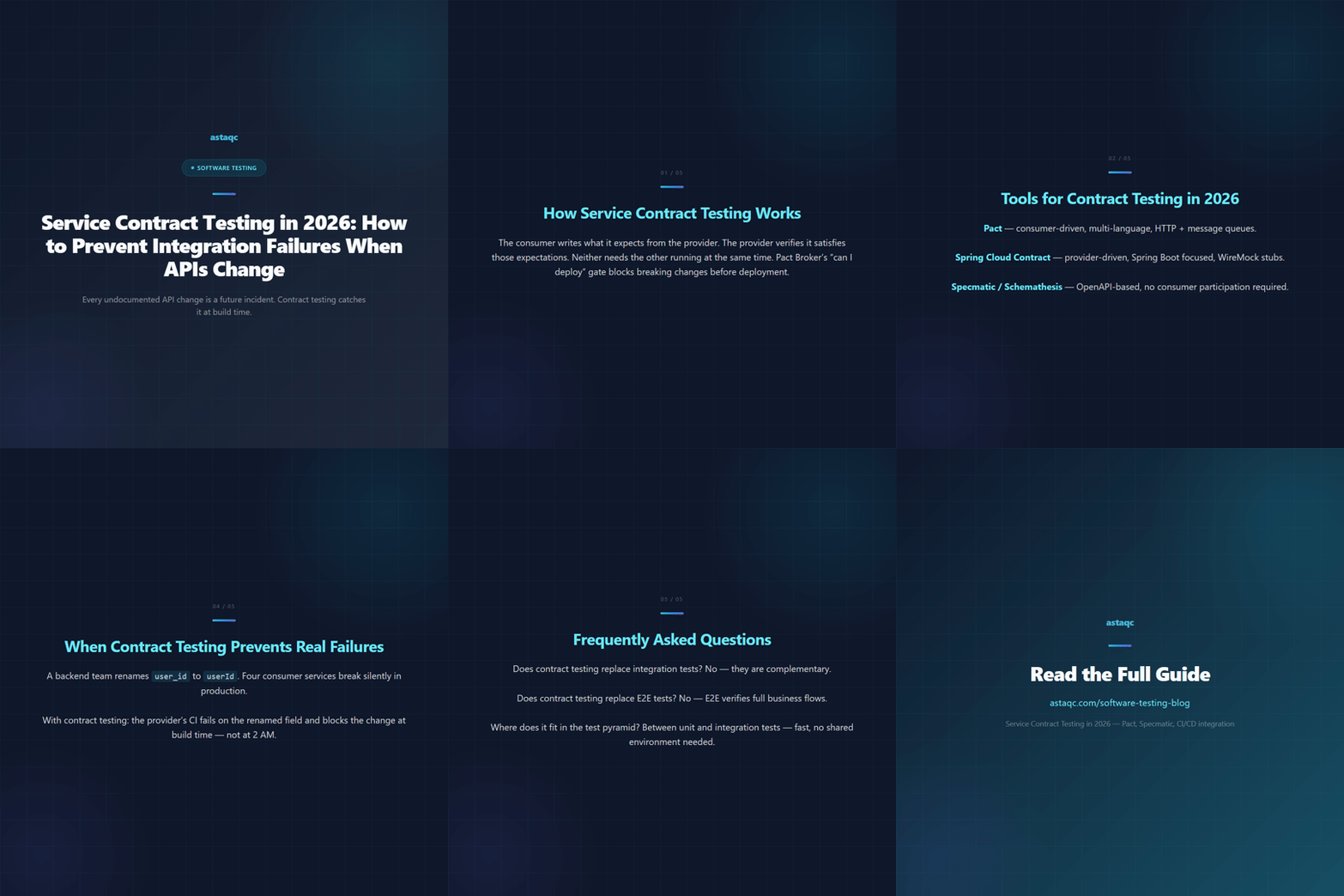
Every undocumented API change is a future incident waiting to happen. Contract testing makes the cost of that change visible at development time instead of at 2 AM on a production incident call.
September 16, 2026


Sign up to receive and connect to our newsletter

We founded ASTAQC as a tight-knit group of professional Software Testers and software developers.
Subscribe to our Newsletter