September 14, 2026
Multi-environment testing failures in 2026 almost always trace to one of three root causes: hardcoded environment values embedded in test files, environment-specific data assumptions that are never enforced, or deployment timing mismatches where a test suite runs before the target environment is fully updated. The fix in each case is not more tools—it is configuration discipline that separates environment-specific values from test logic, verifies environment state before running tests, and handles data differently across environments without duplicating test code. This guide covers the practical patterns that prevent the most common multi-environment failures in teams running staging, QA, and production test suites simultaneously.
The problem compounds as teams grow. A two-person QA team managing a single staging environment can absorb configuration inconsistencies manually. A team running four environments—development, QA, staging, and production—with automated CI/CD pipelines and multiple feature branches in flight simultaneously cannot. At that scale, undisciplined environment configuration produces a specific failure pattern: tests pass in staging, fail in QA, and the diagnosis takes longer than the fix because no one can quickly determine whether the failure is a real defect or an environment configuration difference. Astaqc's software testing services team sees this pattern consistently in organizations that have scaled their deployment pipeline faster than their test infrastructure.
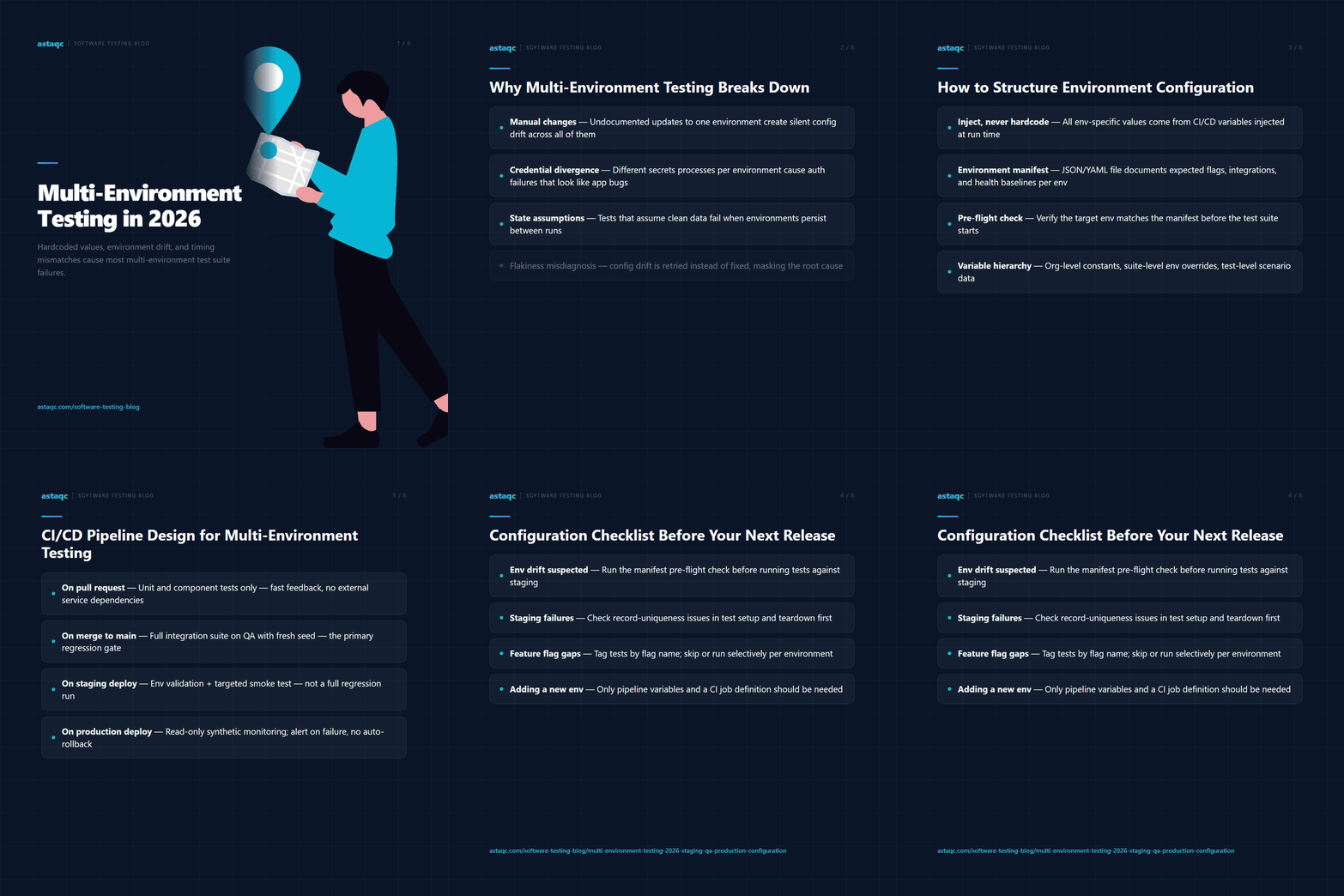
The most common root cause of multi-environment test failures is configuration drift: the staging environment and the QA environment have diverged in ways that are not tracked, and no one catches it until a test suite run produces an unexpected result. Configuration drift happens through three mechanisms.
Manual environment changes that are not recorded. A developer manually updates a database connection string in staging to unblock a debugging session. A QA engineer adjusts a feature flag in QA to test an edge case. Neither change is documented or replicated to the other environments. Two weeks later, a test that passes in QA fails in staging, and the diagnosis begins with no audit trail of what changed.
Secrets and credentials managed separately per environment. When each environment's credentials are managed by a different team member using different processes—one environment uses a shared password file, another uses a secrets manager, another has credentials stored in CI/CD pipeline variables—the risk of divergence is constant. Credential rotation in one environment that is not replicated to others produces authentication failures that appear to be application bugs.
Test data that assumes environment-specific state. A test that creates a user and then logs in assumes the user does not already exist. In a QA environment that is reset weekly, this assumption holds. In a staging environment that is never reset, this assumption fails the third time the test runs, producing a spurious conflict error. Test data management and environment lifecycle management are inseparable; teams that treat them as separate concerns accumulate state-dependent test failures that are hard to reproduce and harder to diagnose. Astaqc's test automation services include environment configuration audits that identify these drift patterns before they produce CI/CD failures.
The baseline pattern for environment configuration in 2026 is environment variable injection at the CI/CD pipeline level, with no environment-specific values stored in test files. Every value that differs between environments—base URLs, credentials, feature flag states, API keys—is injected as an environment variable when the test run starts. The test code reads from those variables and never contains hardcoded values.
This pattern has three practical requirements. First, every environment-specific value must be identified and moved out of test code before the pattern can be applied consistently. In repositories with existing tests, this is a refactoring step that takes time but eliminates a class of failures permanently. Second, the CI/CD pipeline must have a mechanism to store per-environment values—most pipelines provide environment-scoped variable groups or secret stores that map cleanly to this model. Third, developers and QA engineers must be trained not to add hardcoded values to test files, which requires code review enforcement, not just documentation.
Beyond the baseline, teams running more than two environments benefit from an environment manifest: a structured file (typically JSON or YAML) that documents every environment's expected configuration state. The manifest does not store secrets—it stores structural properties: which feature flags are enabled, which service integrations are active, what the expected response time baseline is for health check endpoints. A CI/CD pre-flight step that reads the manifest and verifies the target environment matches before running tests catches configuration drift before it causes test failures. This pre-flight pattern is the most effective single addition for teams that have eliminated hardcoded values but still see environment-specific test failures.
Variable scoping in test platforms matters here as well. TestInspector's variable hierarchy—test level, suite level, organization level—maps directly to this configuration model: org-level variables carry values that are constant across all environments, suite-level variables carry environment-specific overrides, and test-level variables carry scenario-specific data. Encrypted storage for credentials at the org level, with suite-level overrides for per-environment credential sets, gives teams the configuration structure they need without duplicating test definitions across environments. See the complete guide to software testing for a broader treatment of how configuration management fits into an overall test strategy.
Test data management is the most environment-specific part of test infrastructure. What works in QA—a database that is reset before each test run—does not work in staging, where resets would disrupt manual testing. And what works in staging does not work in production, where test data must never be written to real user records without explicit safeguards. The table below describes the standard approach for each environment type.
| Environment | Data Strategy | Reset Approach | Key Risk |
|---|---|---|---|
| Development | Synthetic data seeded per developer | Developer-managed; reset before each local test run | Data drift between developers; tests pass locally but fail in CI |
| QA / integration | Seed script runs before each CI test run; data is deterministic | Automated reset via migration rollback or seed script at run start | Seed script diverges from production schema after schema migrations |
| Staging | Anonymized copy of production data, refreshed on a schedule | Weekly or per-release refresh; not reset per test run | Tests that create unique records fail on subsequent runs without cleanup |
| Production | Read-only synthetic monitoring; no test data writes to real user tables | No reset — production data is never touched by test runs | Synthetic monitor creates real accounts or charges real payment methods if test data isolation fails |
The most frequent source of multi-environment test data failures is the staging environment. Tests designed for a QA environment with deterministic data assume they can create records freely. On staging, where the database persists between runs, a test that creates a user with a specific email will fail on its second execution with a duplicate key error. The fix is either a test setup step that deletes the record if it exists before creating it (a teardown-aware test), or a unique data generation strategy that produces a distinct record per test run using a timestamp or random suffix. Both approaches work; the teardown-aware approach is easier to audit, and the unique data approach is easier to parallelize. Astaqc's manual testing services team uses the teardown-aware pattern for staging-environment smoke tests to ensure each run starts from a known, verifiable state.
The CI/CD pipeline structure for multi-environment testing determines which tests run, against which environments, and at what point in the deployment flow. The most common mistake in pipeline design is running the same test suite against every environment rather than designing separate test scopes per environment. Running a full regression suite against production after every deployment is slower than necessary and risks creating unwanted data in a live environment. Running only a smoke test against production after deployment and reserving the full regression suite for staging is faster and safer.
A practical pipeline structure for teams running three or more environments:
The environment validation step before the staging smoke test is worth implementing as a standalone job that can be run independently of the test suite. When staging is broken due to a misconfiguration rather than a code defect, running the test suite against it produces a flood of false failures that are expensive to triage. A sixty-second environment health check job that verifies connectivity, authentication, and feature flag state before tests start saves that triage cost. The health check job can also be used to verify staging after manual changes, which is the most common source of configuration drift described earlier.
Parallel test execution across environments is a separate consideration. Running test suites in parallel against multiple environments simultaneously requires that each environment has sufficient capacity to handle the load. For teams that share a single staging environment between multiple feature branches, parallel test runs against staging can produce interference—one run's data creation conflicts with another run's assertions. The cleanest solution is ephemeral staging environments spun up per feature branch, but this requires infrastructure tooling that adds setup cost. For teams without ephemeral environment support, serializing staging runs is simpler and avoids interference at the cost of longer CI wait times. Astaqc's performance testing services include environment capacity assessments that help teams determine whether parallel staging runs are safe for their infrastructure. The broader guidance on pipeline design is covered in the guide to scaling QA operations.
The most practical starting point is a grep across the test directory for known environment-specific strings: base URLs, email domains used for test accounts, database host names, API endpoint roots. Each match is a candidate for replacement with an environment variable reference. Replacing one category at a time—all base URLs first, then all credential values—is easier to review and test than a broad refactoring across all value types simultaneously. Once the variables are externalized, CI/CD pipeline environment groups or secrets stores replace the hardcoded values in each environment's configuration.
Feature flags that affect test behavior need to be part of the environment manifest, not assumed. Before a test suite runs, a pre-flight check should verify that the expected feature flags are in the expected state for the target environment. Tests that branch on feature flag state—taking one path when a flag is enabled and another when it is disabled—should be tagged with the flag name so that CI tooling can skip or run them selectively based on the environment's flag configuration. Undocumented feature flag differences between environments are one of the most common causes of tests that pass in staging and fail in production.
The safest pattern is to run the migration against the QA environment first, execute the full integration test suite to confirm the migration does not break existing test coverage, and promote to staging only after the suite passes. The migration script itself should be idempotent—safe to run multiple times without producing errors—so that re-running it against an environment where it has already been applied does not cause a failure. Production migration deployment should be preceded by a staging run against a recent anonymized data copy, not just a QA environment with synthetic data, because production data volume and distribution can expose migration performance problems that synthetic data does not.
Production test coverage should be limited to read-only synthetic monitoring: requests that verify the application responds correctly without creating, modifying, or deleting any data. The appropriate scope is the smallest set of checks that would detect a deployment failure or infrastructure problem within five minutes of a production release. Typically this is five to fifteen checks covering login, critical navigation paths, and key API health endpoints. Full regression testing against production is not appropriate—it is slow, creates noise for real users, and risks data contamination even with careful test data handling.
Adding a new environment should require only two changes to the test infrastructure: a new entry in the CI/CD pipeline's environment variable group for that environment's configuration values, and a new CI/CD job definition that specifies which test scope to run against the new environment. If adding a new environment requires changes to test code, the test suite has environment-specific logic embedded in it rather than injected from outside. That is the configuration smell to fix before adding the environment, not after. A well-structured test suite should be environment-agnostic at the code level—the only environment-specific information should come from the injected variables at run time. Astaqc's testing documentation services help teams create environment runbooks that specify exactly what configuration is required for each environment before a test suite can be added to it.
Between test suite runs, environment health monitoring should cover service availability (HTTP 200 from health check endpoints), database connectivity, and external service integration status. Alerting on environment health separately from test suite failures makes it faster to distinguish between a real application defect (tests fail, environment is healthy) and an environment problem (tests fail, environment health check is also failing). Teams that conflate environment monitoring with test suite monitoring spend significant time triaging test failures that are actually environment outages. A simple uptime check against each environment's health endpoint, alerting to a shared channel when the check fails, is sufficient for most teams to separate the two failure modes.
A test suite that passes in staging and fails in QA is not a flaky test—it is a configuration problem. Treating it as flakiness leads to retries. Treating it as configuration drift leads to a fix.
September 14, 2026


Sign up to receive and connect to our newsletter

We founded ASTAQC as a tight-knit group of professional Software Testers and software developers.
Subscribe to our Newsletter