September 1, 2026

Building deterministic test assertions for LLM-powered features requires separating the non-deterministic output of a language model from the deterministic behaviors you can actually assert on. An LLM will not return the same text on every call, but it will reliably return a response within a declared latency budget, that response will conform to a declared type contract if structured output is enforced, required fields in a structured output will be present or absent as declared, and any forbidden patterns—hallucinated citations, PII, out-of-scope content, regex-violating formats—can be detected with deterministic checks. A test suite for LLM features asserts on these properties, not on exact output text. Teams that write exact-match assertions against LLM outputs end up with tests that are either too rigid to survive model updates or too vague to catch real regressions, and often both at once.
The practical consequence of poorly designed LLM tests is a test suite that engineers stop trusting. Noise failures—the assertion failed but the model output was correct—erode confidence faster than gaps do, because a failing test on a working feature is immediately visible and demands a response. Teams address the noise by disabling or loosening the assertions, at which point the test provides no coverage signal. The right design inverts this: start with the structural and behavioral properties that are deterministic, assert only on those, and supplement with a stabilized judge for semantic properties where deterministic checks are insufficient.
Teams building QA infrastructure for LLM-powered features are working in an area where general testing guidance is thin. Astaqc’s test automation services and the AI in software testing guide both address how AI testing differs from conventional testing and where the coverage boundaries lie.
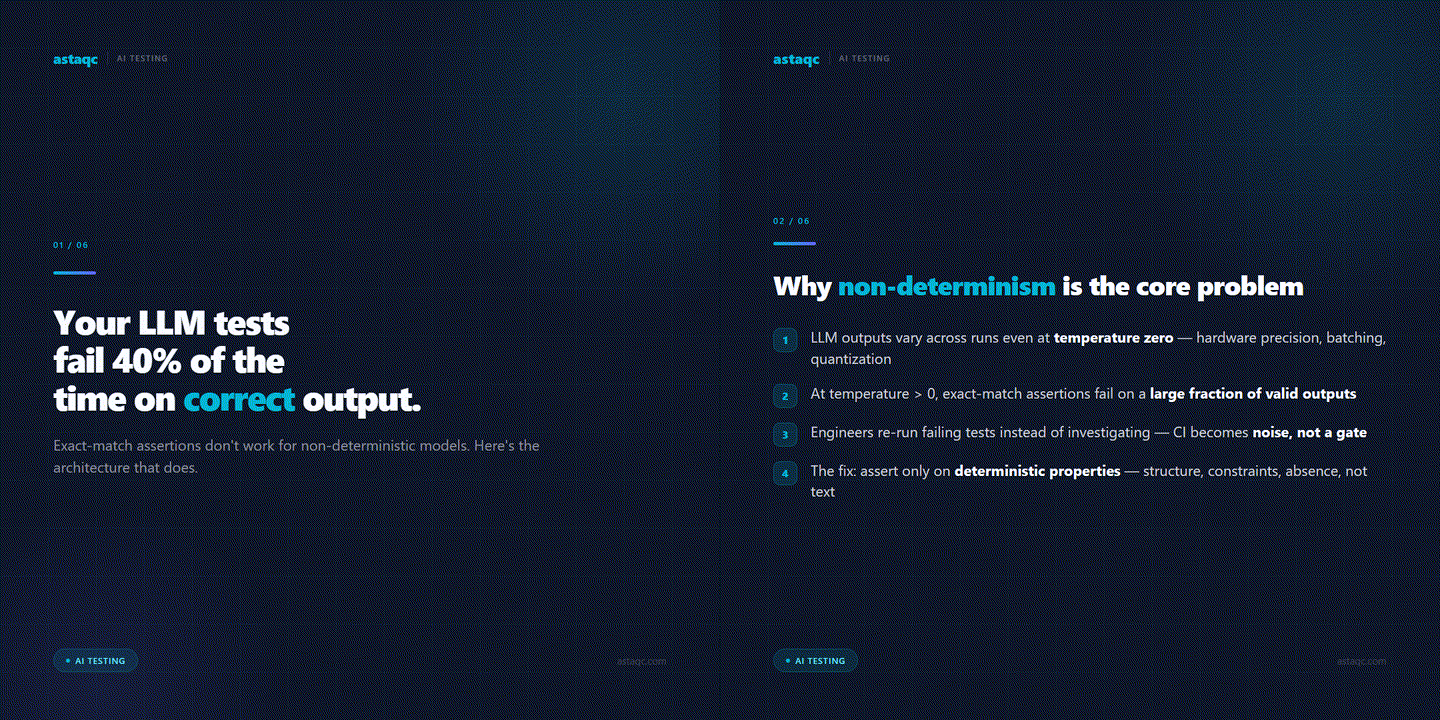
LLM outputs vary across calls even at temperature zero. Minor variations in floating-point arithmetic during inference, quantization differences in model weights, batch processing order, and hardware-level numerical precision all contribute to non-identical outputs from otherwise identical inputs. At temperature above zero—the default for most user-facing LLM features—the variation is large enough that exact-match assertions will fail on a substantial proportion of valid outputs. The model is producing correct responses; the test framework is treating them as failures.
This creates a test failure signal that has no consistent relationship with the presence of a real defect. A test that fails 40 percent of the time on valid output is not a quality gate—it is random noise. Engineers learn to re-run failing tests rather than investigate them, and the CI system learns to tolerate intermittent failures as a cost of using LLM features. Both behaviors are rational responses to a broken test design, and neither of them is compatible with a QA practice that is supposed to gate production deployments.
The solution is not to use a different assertion library or to add retries. The solution is to identify which properties of the LLM output are actually deterministic given a fixed input and test configuration, and to assert only on those. Structural properties (schema conformance, field presence, field type) are deterministic when structured output mode is enforced. Constraint properties (string length, regex match, enum membership) are deterministic for any output that passes structural validation. Absence properties (forbidden strings, PII patterns, disallowed domains) are deterministic as long as the forbidden set is explicitly defined. Semantic properties (relevance, coherence, sentiment) are not deterministic, but they can be covered by a judge whose verdict is itself anchored to a deterministic validation step. Astaqc’s software testing services cover this type of layered test design for teams building AI-powered features, and the complete guide to software testing provides broader context on how test layers address different failure classes.
A verdict-first assertion framework separates the verdict—the binary pass or fail decision—from the evidence, which is the actual model output and the intermediate validation results. Rather than asserting that a specific string appears in the output, the framework defines a set of conditions that must hold for the output to be accepted, evaluates each condition independently against the actual output, and produces a pass verdict only when all conditions hold. The model output itself is always logged alongside the verdict, regardless of the outcome, so that a failing test immediately provides the debugging engineer with the actual content that triggered the failure.
This design has three operational advantages over conventional assertion patterns. First, a verdict-first test fails precisely: it identifies which condition failed, not just that something was wrong. A structural validation failure points to a schema violation; a constraint failure points to a specific field; an absence check failure points to the forbidden pattern that appeared. Second, the logged evidence makes debugging tractable—engineers can inspect the actual output without re-running the test in a debugger. Third, the separation of verdict from evidence makes the test framework composable: the same evidence pipeline can feed both an automated verdict in CI and a human review interface for edge cases that fall outside the automated checks.
The conditions in a verdict-first framework for LLM features are ordered by determinism level. Structural validation asks whether the output conforms to the declared schema: for JSON outputs, this means running the response through a JSON schema validator or a Pydantic model; for text outputs with an expected structure, it means regex or parser-based validation. Structured output mode in the API call enforces the schema at the model level, but testing the schema conformance explicitly catches cases where the model is called outside structured output mode or where the enforced schema has drifted from the application’s expectation.
Presence and type checks verify that all required fields are populated and have the expected types. These are straightforward assertions on the parsed output object that run with zero LLM involvement and fail deterministically when the model produces a structurally valid response that is missing required content. Constraint validation tests whether field values satisfy declared constraints: a summary field with a declared maximum length, a URL field validated as syntactically correct, an enum field containing only values from the declared set. Absence checks detect whether forbidden patterns appear in the output—hallucination signatures, PII formats, content policy violations—using regular expressions against the full output text. Finally, a semantic verdict via a frozenset-anchored judge covers semantic properties that the deterministic checks cannot address, using the approach described in the next section.
A frozenset, in the context of LLM testing, is a fixed, immutable set of acceptable values for a verdict label. When an LLM judge evaluates a feature output and returns a verdict, that verdict is validated against the frozenset. If the judge returns a value not in the frozenset—“mostly acceptable,” “borderline,” “probably fine,” “conditionally valid”—the test fails with a malformed verdict error, not a content failure. This is a distinct failure mode from a semantic failure and is logged separately, directing investigation to the judge prompt rather than to the feature under test.
The frozenset approach forces the judge to commit to a declared vocabulary. For a binary verdict system, the frozenset is typically {"pass", "fail"}. For a graded system, it might be {"acceptable", "borderline", "unacceptable"}. The judge is prompted to return only values from the frozenset and to use structured output mode so the verdict label appears in a defined field of the response JSON. The frozenset validation step runs on the judge’s structured output, not on its prose reasoning—the reasoning is evidence, not verdict. This means the judge can produce verbose chain-of-thought reasoning that helps debuggers understand why a verdict was reached, while the test framework evaluates only the single label field against the frozenset.
Typed output contracts serve the same anchoring function at the feature call level. A Pydantic model or TypeScript interface that describes the expected output of an LLM feature is a machine-checkable specification: every field, every type, every constraint, every optional field. When the LLM is called with structured output mode and the output is validated against the contract, every deviation from the contract is a deterministic test failure that identifies exactly which field was malformed or missing. The contract becomes the source of truth for what the feature is supposed to produce, and the test validates conformance to that contract on every run.
The comparison below shows how different LLM test assertion patterns perform across the key dimensions of determinism, coverage, and interpretability:
| Pattern | Determinism | What it catches | Primary limitation |
|---|---|---|---|
| Exact text match | Fails on valid variation | Literal regressions to a specific output | Fails on correct outputs that differ in phrasing |
| JSON schema / typed contract | Fully deterministic | Structural violations, missing fields, type errors | Does not catch semantic errors in structurally valid output |
| Regex / absence assertion | Fully deterministic | Format violations, forbidden patterns, PII leakage | Does not catch relevance, coherence, or topic drift |
| Frozenset-anchored judge call | Effectively deterministic via verdict anchoring | Semantic errors, topic drift, quality regressions | Judge itself may vary on edge cases near decision boundary |
| Human review | Not applicable | Everything a qualified reviewer notices | Not automatable at scale; expensive per evaluation |
The practical architecture for a production LLM test suite layers all four automated patterns in sequence. Structural and contract checks run first because they are fast and cheap. Regex and absence checks run next because they are also deterministic and require no additional API calls. The frozenset-anchored judge runs last, only on outputs that have passed the deterministic checks, because it is the most expensive step and the least deterministic. Human review is reserved for outputs that the judge marks as borderline. For teams building this type of layered QA infrastructure, Astaqc’s manual testing services can provide the human review layer that complements automated evaluation for edge cases.
Evidence-first QA pipelines log the complete input, output, and verdict for every LLM test run. This is different from conventional test logging, which records only the pass/fail result and the assertion error on failure. For LLM features, the output is the primary debugging artifact: a terse “assertion failed” message without the actual model output gives the debugging engineer nothing to work with. Evidence-first pipelines treat every run as a record in a quality audit trail, not just a binary signal.
The pipeline structure for a single LLM feature test proceeds as follows. First, invoke the LLM feature with the test input and log the full request payload, including model, prompt, temperature, and structured output schema. Second, validate the response against the typed contract: if validation fails, log the validation errors alongside the raw response and mark the verdict as a structural failure. Third, run constraint and absence checks against the validated output, log which checks passed and failed, and if any fail, mark the verdict as a constraint failure with the specific check name. Fourth, if a semantic judge is configured, invoke it with the feature output as its input, validate the judge’s response against its own typed contract, and validate the verdict label against the frozenset—if frozenset validation fails, log the raw judge output and mark the test as a judge error rather than pass or fail. Fifth, extract the verdict label from the judge response, log the complete judge output as evidence, and report the verdict as the test result.
This pipeline structure makes the test results interpretable at scale. A CI dashboard that shows structural failures, constraint failures, and judge errors as distinct categories is actionable: structural failures point to a schema change, constraint failures point to a specific output field, and judge errors point to a prompt engineering problem with the evaluation framework itself. A dashboard that shows only a failure count with no further breakdown is not actionable because the same count could represent a breaking change, a configuration error, or random noise from temperature variation.
Multi-step agentic pipelines require the same evidence logging at each step boundary. When an agent calls a tool, the tool input and output are logged. When the agent produces an intermediate reasoning step, the step content and any structured output are logged. When the agent produces a final response, the full conversation history and the final output are logged together. Each step’s output can be validated independently against a typed contract, producing a verdict that covers both the step and the cumulative pipeline behavior. The guide to outsourcing QA covers how teams can delegate LLM evaluation pipeline construction to external QA specialists when internal capacity is limited, and the AI in software testing guide provides broader context on how evidence-first evaluation fits into a mature AI quality practice.
The minimum viable test is a structural validation check: invoke the feature with a fixed input, enforce structured output mode, and validate the response against the declared schema. This catches the most common class of LLM feature regression—schema drift between what the model produces and what the application expects to receive—and is fully deterministic. It does not catch semantic quality regressions, but it provides a reliable quality gate that can be set up in an afternoon and will not produce noise failures. Adding constraint and absence checks is the next step once the structural test is stable.
Test at the same temperature the feature uses in production. Testing at temperature zero while production runs at 0.7 produces a test environment that does not reflect production behavior—the structural and constraint checks will pass at temperature zero, but a realistic output distribution at higher temperature may produce different rates of constraint violations or semantic failures. The exception is the judge call, which should always run at temperature zero regardless of the feature temperature, to minimize variation in the verdict.
For text-output features without structured output enforcement, the verdict-first approach still applies but the structural validation layer is replaced by a text-format assertion: regex matching, section header detection, or length constraint checking. The absence and constraint checks remain deterministic. The semantic judge becomes more important because the output has no schema to validate against. In practice, most LLM features intended to produce structured data should enforce structured output mode; teams that cannot do so because of API version constraints or framework limitations should treat this as a technical debt item that reduces test reliability.
Tool-calling features require mocking or sandboxing the external tool responses so that the feature test is isolated from external dependencies. The test provides fixed tool responses for each tool call the model is expected to make, validates the tool call inputs against declared schemas using the same typed contract approach, and validates the model’s final response after receiving the tool outputs. This approach covers the model’s tool selection logic and output formatting without requiring live access to external systems in CI. End-to-end tests with real tool calls can run in a separate suite against a staging environment, keeping CI fast and deterministic. Astaqc’s test automation services can help teams design tool-call mocking strategies that are representative of real production behavior without introducing environment dependencies into CI.
A judge that consistently marks correct outputs as failures or incorrect outputs as passing is a quality problem in the evaluation framework. The signal comes from the mismatch rate between judge verdicts and human review decisions when both are run on the same set of outputs. Build a calibration set: a fixed collection of outputs that a domain expert has labeled as pass or fail. Run the judge against the calibration set on each change to the judge prompt or model version, and measure the false positive rate and false negative rate. A judge with a false positive rate above five percent produces enough noise to undermine CI reliability. The calibration set becomes a regression test for the judge itself, applying the same evidence-first logic to the evaluation layer as to the feature layer. The software testing cost guide addresses how to budget for the ongoing maintenance of evaluation infrastructure at this level of maturity.
A test that fails on valid model output is noise. A test that passes on invalid model output is a gap. Deterministic LLM testing means writing assertions that fire on neither—grounded in typed contracts, frozenset verdicts, and logged evidence, not on the text the model happened to generate this run.
September 1, 2026


Sign up to receive and connect to our newsletter

We founded ASTAQC as a tight-knit group of professional Software Testers and software developers.
Subscribe to our Newsletter


