August 13, 2026

Component testing validates individual application components in isolation from the full application stack, providing broader coverage than unit tests without the setup cost and execution time of end-to-end tests. A component test for a checkout form verifies that the form handles invalid input, disabled states, loading states, and error responses from its mocked API calls — coverage that a unit test of the underlying logic misses and an E2E test covers but only for one happy-path scenario among many. In 2026, as front-end applications grow more complex and E2E test suites grow slower, the component layer is where teams with mature testing practices are investing to reduce feedback time without reducing coverage.
For teams determining how to structure their testing investment across layers, the question is not whether component testing is worth doing — it is which components to cover first and how to scope each test. This guide covers what component tests validate, how they compare to unit and E2E tests across key dimensions, which frameworks to use in 2026, and how to integrate them into a CI/CD pipeline without adding meaningful overhead. For broader context on how different testing approaches fit together, the complete guide to software testing covers how testing layers relate to overall quality strategy.
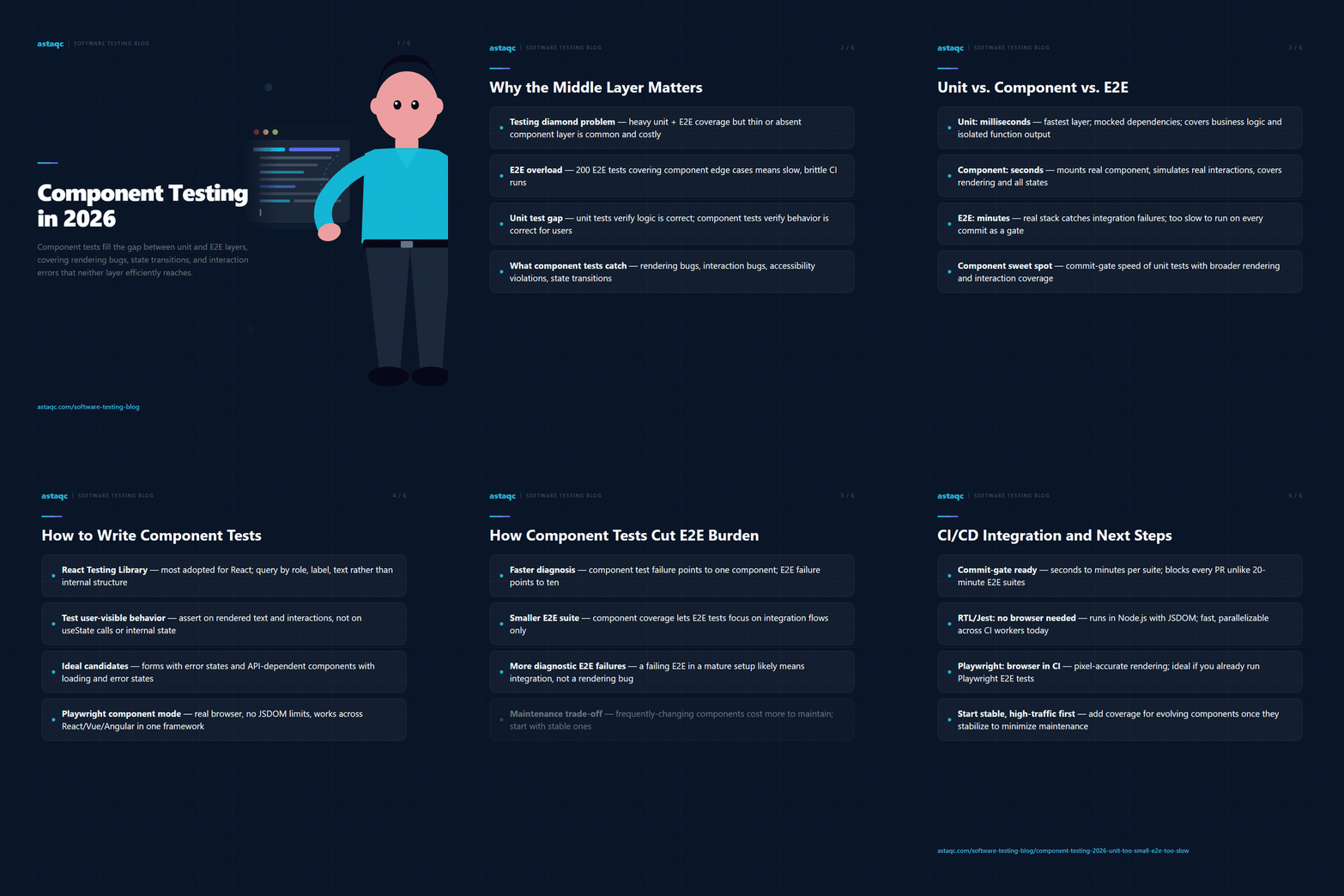
The testing pyramid assumes three layers: unit tests at the bottom (fast, cheap, narrow), E2E tests at the top (slow, expensive, broad), and integration or component tests in the middle. In practice, many teams operate a testing diamond — heavy unit coverage, heavy E2E coverage, and a thin or absent middle layer — because the component layer requires deliberate investment in tooling and test design that is easier to skip when a team is moving fast.
The cost of a missing middle layer is visible in two places. First, E2E test suites that carry the burden of validating UI component behavior at scale become slow. A team with 200 E2E tests covering component-level edge cases — empty states, error states, boundary conditions, disabled inputs — would reduce that set significantly if component tests covered those cases directly. E2E tests could then focus on integrated user flows that only an E2E test can verify. Second, unit tests that cover business logic in isolation do not validate that the component renders the right output for a given input or handles user interactions correctly. The gap between the logic is correct and the component behaves correctly is exactly what component tests cover.
A component test renders a component in a controlled environment, provides specific inputs or props, simulates user interactions, and asserts on the rendered output — not on internal state or implementation details, but on what the user sees and can do. This approach catches rendering bugs, interaction bugs, accessibility violations, and state transition bugs that unit tests do not reach and that E2E tests cover too slowly to include in every CI run. For teams evaluating how to structure their testing investment, the Astaqc software testing services team can help scope which coverage belongs in each layer based on the application architecture and delivery velocity.
| Dimension | Unit Tests | Component Tests | E2E Tests |
|---|---|---|---|
| What is tested | Individual functions, methods, or modules | Single UI component including rendering and interaction | Full application stack across integrated services |
| Dependencies | All dependencies mocked or stubbed | API calls mocked; child components may be real or mocked | Real backend, real services, real browser |
| Execution speed | Very fast — milliseconds per test | Fast — seconds per test | Slow — minutes per suite |
| Coverage scope | Business logic, edge cases in isolated functions | Rendering, state transitions, interaction, accessibility | End-to-end user flows, cross-service integration |
| What it misses | Rendering bugs, interaction bugs, component composition | Cross-component integration, backend state, network behavior | Component-level edge cases, multiple error states, boundary conditions |
| Maintenance burden | Low — stable when logic is stable | Medium — changes when component API or rendering logic changes | High — sensitive to UI changes and environment stability |
| Run frequency | Every commit (CI gate) | Every commit or per PR (CI gate) | Pre-release, per PR for critical paths |
The dominant component testing frameworks in 2026 are React Testing Library for React applications, Vue Test Utils for Vue, Angular Testing Library for Angular, and Playwright's component testing mode, which supports all major frameworks with a shared API. Each takes a similar approach: mount the component in isolation, simulate user interactions, and assert on the rendered DOM rather than on internal state.
The key principle in component testing is to test behavior visible to the user, not implementation details. An assertion that checks the rendered text "Your cart is empty" when no items are present tests user-visible behavior. An assertion that checks that useState was called with an empty array tests implementation detail. Tests that assert on implementation details break when the implementation changes even if the behavior stays the same — the primary cause of high component test maintenance burdens. Testing Library's query API (getByRole, getByLabelText, getByText) enforces this principle by making it easy to query elements the way a user would identify them and hard to query by internal component structure.
For scope decisions, the practical rule is: write a component test whenever you need to verify rendering or interaction behavior that a unit test cannot reach. Forms with conditional rendering, error states, loading states, and disabled inputs are prime candidates. Components that receive data from an API call — the component fetches data, handles the loading state, renders the data, and handles the error state — are candidates for component tests with mocked API responses, which cover all four states efficiently without requiring a live backend. For teams building component test coverage from scratch, the Astaqc test automation services team can define a component testing strategy that fits the application framework and CI pipeline.
Teams often observe counterintuitively that adding a component test layer reduces their total test maintenance burden rather than increasing it. The mechanism is defect-level specificity: when a rendering bug is caught by a component test rather than an E2E test, the failure output points directly to the component and interaction that failed, rather than to a user flow that passed through ten components before failing. Diagnosing a failing E2E test typically requires reproducing the failure locally, identifying which step failed, and then determining which of the components involved in that step is responsible for the failure. A failing component test identifies the component, the interaction, and often the specific assertion immediately.
The second maintenance reduction is in E2E test count. E2E tests that cover the same component behavior multiple times — because each E2E test that uses a component incidentally exercises its edge cases — produce a large test suite that is slow and brittle. When component tests cover the component-level edge cases directly, E2E tests can be scoped to integration flows only: verifying that the checkout component, the payment component, and the confirmation component work together correctly, rather than verifying all three components' individual behaviors through the E2E layer. This reduces E2E test count and makes E2E failures more diagnostic — a failing E2E test in a mature component-test setup most likely indicates an integration problem rather than a component-level rendering bug.
The trade-off is the ongoing maintenance cost of keeping component tests aligned with the component's rendered output as the application evolves. Components that change frequently — design system components undergoing visual iteration, components in active feature development — require more test maintenance than stable components. Teams that write component tests for stable, high-traffic components first and add coverage for evolving components once they stabilize get the maintenance benefit without incurring it prematurely. For teams with limited QA bandwidth assessing where to invest test coverage, the software testing cost guide covers how to weigh coverage investment across testing layers by risk and return. The Astaqc hire-a-QA-team service can provide component testing expertise for teams that do not have it in-house.
Component tests integrate into CI/CD pipelines at the same stage as unit tests: run on every commit, required to pass before merge, used as a gate on pull requests. Their execution time — typically seconds to low minutes per suite — makes this practical in a way that E2E tests are not. An E2E suite that takes 20 minutes to run cannot block every commit without unacceptably slowing delivery. A component test suite that runs in 60 seconds can.
The practical setup for CI integration depends on the framework. For React Testing Library and Jest, no browser is required — tests run in a Node.js environment with JSDOM simulating DOM APIs. This makes them fast and suitable for parallel execution across multiple CI workers. For Playwright component mode, a real browser is used, which requires browser installation in the CI environment but enables pixel-accurate rendering validation and native browser event simulation. For teams already using Playwright for E2E tests, adding Playwright component tests uses the same infrastructure and avoids adding a second testing framework.
Test parallelization across CI workers is straightforward for component tests because each test is isolated — no shared state between component tests that would require coordination. Jest's parallel mode distributes test files across workers automatically; Playwright's sharding feature distributes test files across multiple CI runners. For teams running both unit and component tests in the same CI pipeline, running them in parallel jobs rather than sequentially reduces total pipeline duration. The manual vs. automated testing guide covers how different test types slot into CI pipelines based on their execution characteristics. For teams that need CI pipeline setup assistance alongside component test implementation, the Astaqc software testing services team can provide a comprehensive pipeline review alongside component test strategy.
Component testing and unit testing overlap but are not the same. A unit test validates the output of a function or method in isolation, with all external dependencies replaced by mocks. A component test renders a UI component in a test environment, simulates user interactions, and asserts on the rendered output. Component tests may call real child components, use real CSS, and simulate real browser events — behaviors that unit tests with mocked dependencies do not cover. The distinction matters for test design: component tests should test what the user sees and can do, while unit tests should test the logic that produces those outputs.
For React applications, React Testing Library with Jest or Vitest is the most widely adopted choice in 2026. For Vue applications, Vue Test Utils paired with Vitest is the standard. For Angular applications, Angular Testing Library is the established approach. Playwright component mode is a newer option that works across frameworks and uses a real browser for rendering, which makes it suitable for teams that want to avoid JSDOM limitations — CSS rendering, intersection observers, browser-specific event behavior — and are already using Playwright for E2E tests.
Component tests cannot replace E2E tests because they test components in isolation with mocked API responses. They cannot verify that the full application stack works correctly — that the correct API request is made, that the backend processes it correctly, and that the response produces the expected UI state. E2E tests are required for integration verification. The practical result of a mature component test suite is a smaller E2E suite that focuses on integration flows rather than component-level behavior — not the elimination of E2E tests, but a reduction in how many E2E tests are required. For teams scoping this balance, the AI in software testing guide covers how AI-assisted testing tools are changing how teams allocate effort across testing layers.
Components that consume React context, Redux store, or Pinia store require those dependencies to be wrapped around the component in the test environment. Testing Library provides a render wrapper that accepts custom wrappers for providers, allowing tests to render a component inside the specific context state required for each test scenario. For components with complex provider dependencies, a shared test utility that provides a configured wrapper with sensible defaults reduces the boilerplate of setting up context in each test. Testing in isolation from real store state — providing specific state values rather than the real store — makes the test more predictable and easier to debug when it fails.
Component tests should be granular enough to cover distinct user-visible behaviors: each distinct state the component can render, each interaction that triggers a state transition, each error condition the component can display. For a form component, this typically means tests for successful submission, validation errors, server-side errors, loading state during submission, and disabled state when preconditions are not met. Beyond that level of granularity, tests often start asserting on implementation detail rather than user-visible behavior, which increases maintenance without improving defect detection. The guideline is one test per distinct user-visible behavior, not one test per line of component code.
Component tests and unit tests can run in the same CI job and use the same test framework — Jest, Vitest, or similar — but organizing them into distinct file directories makes it easier to run each layer independently when debugging or profiling. Combined in CI, both layers run quickly enough that a single job is practical. Separating them into distinct CI jobs is worthwhile only when the combined execution time exceeds what is acceptable as a commit gate. For teams establishing this practice from scratch, the QA outsourcing guide covers how to incorporate component testing into a managed QA engagement when in-house expertise is limited.
Component testing is not a replacement for unit tests or E2E tests — it fills the gap between them. Unit tests verify that the logic is correct; E2E tests verify that the application works end to end; component tests verify that each component behaves correctly for the user, covering the states and interactions that neither of the other layers can efficiently reach.
August 13, 2026


Sign up to receive and connect to our newsletter

We founded ASTAQC as a tight-knit group of professional Software Testers and software developers.
Subscribe to our Newsletter