October 21, 2026

A test harness that cannot lie is one where each detection layer checks something the other layers do not, so no single failure mode can cause all layers to agree simultaneously — passing when the application is broken, or failing when it is not. Building this requires deliberate choices about which checks cover which gaps, how those checks are wired into CI, and what the CI output must contain for the results to be auditable. In 2026, the teams that build honest test harnesses are not necessarily running more tests than those whose suites give false confidence; they are running checks that are structurally independent, placed at the seams where real failures originate, and connected to CI pipelines that preserve the evidence chain. Astaqc's software testing services page covers how detection layer design affects overall test suite reliability.
A single-layer test suite is one where all checks use the same detection mechanism: all unit tests using the same assertion library, all integration tests calling the same mock layer, or all E2E tests interacting through the same selector strategy. When the detection mechanism has a blind spot, all checks in the layer share that blind spot. The suite can report 100% pass on every run while leaving that blind spot uncovered.
The canonical example is a suite that mocks the database. Every test in the suite passes because the mock returns the expected responses. When the application ships to production and encounters the real database — with different query timing, different transaction semantics, or a schema migration that was not reflected in the mock — failures appear that the entire test suite was structurally incapable of catching. The tests were not poorly written; they were written for a detection mechanism that agreed with the bug before the bug existed.
The same pattern appears at higher levels. A suite of E2E tests that all use CSS class selectors shares the blind spot created by a redesign that changes class names without changing functionality. A suite of API integration tests that all validate JSON structure shares the blind spot created by a field that changes type without changing name. A suite of accessibility tests that only run at the component level shares the blind spot created by accessibility violations that only appear in the composed page context.
The pattern is not about adding more tests; it is about adding tests that use different detection mechanisms, so the blind spots do not overlap. Astaqc's complete software testing guide covers how independent detection layers are designed across different application types and testing contexts.
The defining property of a multi-layer detection design is that each layer checks something the other layers cannot. This is not the same as having checks at multiple levels (unit, integration, E2E) — a test pyramid is a multi-level structure, but all three levels can share a blind spot if they use the same underlying assumption. A multi-layer detection design requires that the detection mechanisms be structurally independent.
In practice, independence comes from combining checks that differ along at least one of these dimensions:
Designing for independence means asking, for each new check: what assumption does this check make that could be wrong, and do any existing checks catch the case where that assumption fails? If the answer is no, either add a complementary check or accept the gap knowingly. Most teams do not ask this question explicitly, which is why their detection layers accumulate without becoming independent.
The target is not zero overlap — some overlap is acceptable and even desirable as a safety net. The target is zero shared blind spots: no failure mode should be able to pass all layers simultaneously. Astaqc's test automation services page covers how structurally independent detection layers are designed in client automation engagements.
The principle that the bug lives at the seam, not in the logic, captures a pattern that most experienced QA engineers have observed directly: the logic in each component works correctly in isolation, but the integration between components — the seam — is where failures accumulate. A component that correctly serializes data and a component that correctly deserializes data can still produce a bug at the seam where one was serializing with a timezone offset the other did not expect. The individual unit tests for each component pass. The failure only appears at the seam, and only a check placed at that seam can catch it.
Seam-based scenario coverage means writing checks at the integration points between components, not at the centers of each component. The seams that most commonly produce failures in modern applications are:
| Seam Type | Most Common Failure | Check That Catches It |
|---|---|---|
| API contract | Schema change without coordination between producer and consumer | Contract test run by both producer and consumer |
| Database transaction | Constraint violation rolls back write silently | Post-write database state assertion |
| External service | Unexpected success response with error payload | Response body assertion beyond status code |
| State transition | Event not fired after state write | Post-transition state assertion, not action assertion |
Astaqc's manual testing page covers how exploratory testing at integration seams complements automated seam-based checks, since exploratory testing is well-suited for discovering unexpected seam behaviors that were not anticipated in the automated scenario design.
An audit-proof CI pipeline is one where a reviewer can answer three questions for any test run: what ran, what it checked, and what evidence it produced. A CI pipeline where tests pass or fail without producing readable output beyond a green or red icon is not audit-proof, even if the tests themselves are correctly designed. The evidence chain breaks when the output becomes opaque.
Making CI outputs audit-proof requires decisions at the pipeline configuration level. The key properties are:
Named check results: Every check in the CI run should produce a named result that appears in the run summary. A test suite that reports 42 tests passed is not named; a test suite that reports API contract tests: 8 passed, checkout flow: 12 passed, visual regression: 4 passed is. Named results allow reviewers to see exactly which detection layers ran and whether any layer had results missing — an absent layer can indicate a configuration failure that went undetected.
Artifact preservation: CI runs should preserve the outputs that make failures diagnosable: test reports, screenshots, network traces, and coverage reports. These should be available for at least the retention window of the release cycle. When a production incident is traced back to a release, the CI artifacts for that release must be retrievable to establish whether the failure mode was covered by a check that passed, a check that failed and was overridden, or a check that was absent.
Override audit trails: When a CI check is bypassed — a failing test skipped for a release, a threshold temporarily lowered, or a check disabled for a branch — that override must be logged with the person who made it and the reason. An override that is not logged is invisible to retrospective analysis. Teams that track overrides systematically can identify patterns: if the same check is overridden repeatedly, the check may be too brittle, or the override may be masking a genuine systemic failure.
Coverage delta reporting: CI runs should report whether the coverage of each detection layer changed from the previous run. A coverage delta that shows a layer losing coverage without a corresponding code deletion is a signal that a check was silently broken or removed. Automated detection of coverage regressions prevents detection layers from degrading over time without the team noticing. Astaqc's outsource QA guide covers how audit-proof CI pipeline design is used in external QA engagements. Astaqc's performance testing page covers how performance CI fits into this same audit-proof pipeline model.
A team that does not currently have a multi-layer detection harness should not attempt to build one completely before shipping. The practical path is to identify the five most valuable checks to add first — the five that cover the most critical seams and are most likely to catch a production failure — then add coverage incrementally, one layer at a time.
The five checks that most commonly provide the highest detection return for teams starting from a single-layer baseline are:
With these five checks in place, the team has five independent detection layers that cover five structurally different failure modes. From this baseline, adding coverage means asking for each new feature: which seam does this feature introduce, and which of the five existing check types covers that seam? If none do, add a new layer. If one does, extend the existing layer. This discipline prevents the accumulation of redundant checks in the same layer and ensures that coverage growth translates to detection breadth, not just depth. Astaqc's dedicated QA team page covers how Astaqc structures incremental harness development in QA engagements that start from a minimal coverage baseline. Astaqc's software testing cost guide covers how incremental harness investment is justified against the cost of production incidents that a lying test suite would not catch.
A test suite is a collection of tests. A test harness is the infrastructure that executes those tests and produces results: the test runner, the fixture management system, the stub or mock layer, the CI integration, and the reporting pipeline. A well-designed test suite running on a poorly designed harness produces unreliable results because the harness introduces the false confidence — tests that pass because the mock always returns success, or tests that fail because the CI environment is not isolated. Harness design precedes test design; fixing a lying harness is more impactful than writing more tests for an existing one.
The most reliable signal is a production incident that was not caught by any CI check. If the application shipped with the test suite passing and then failed in production, examine whether the failure mode was covered by any check in the suite. If the failure mode was covered (a check should have caught it but passed), the harness is producing false positives. If the failure mode was not covered (no check was designed to catch it), the harness has a blind spot. Both are forms of lying. Tracking what production failures were or were not covered by CI checks is the most direct way to measure harness honesty over time.
Mutation testing is useful for evaluating the assertion depth of existing checks, not for discovering missing detection layers. It works by introducing artificial bugs into the codebase and verifying that at least one test fails on each mutation. This is valuable for identifying under-asserted checks, but it only applies to the detection mechanisms already in the suite. A suite with no database state assertions will not be improved by mutation testing because mutation testing only evaluates assertions that exist. Use mutation testing to audit assertion quality within a layer, and use seam analysis to design coverage across layers.
Fast-release teams often face pressure to override failing CI checks to meet release deadlines. The discipline is to require that every override creates a follow-up item in the backlog before the release proceeds, with the exact failing check and the reason it was overridden. The follow-up item is created by the person making the override, not by a process or tooling that generates it automatically — automated follow-up items accumulate without being addressed. Making the human cost of an override explicit (you must create and assign the follow-up) reduces the rate of override without preventing it when the release timing genuinely requires it.
The minimum viable harness for a startup is three checks that cover three structurally independent failure modes. The three highest-value choices are: one API integration test that calls the production-equivalent backend with real database connections (covers the backend logic and database seam), one E2E smoke test that covers the critical user path against a production-equivalent deployment (covers the frontend-to-backend integration seam), and one scheduled synthetic test in production that runs the same critical path against the live environment (covers the deployment and configuration seam that only appears in production). These three checks are structurally independent and cover the three seams most likely to produce a production incident. Astaqc's AI in software testing guide covers how AI-assisted tools can reduce the effort of implementing and maintaining these foundational checks.
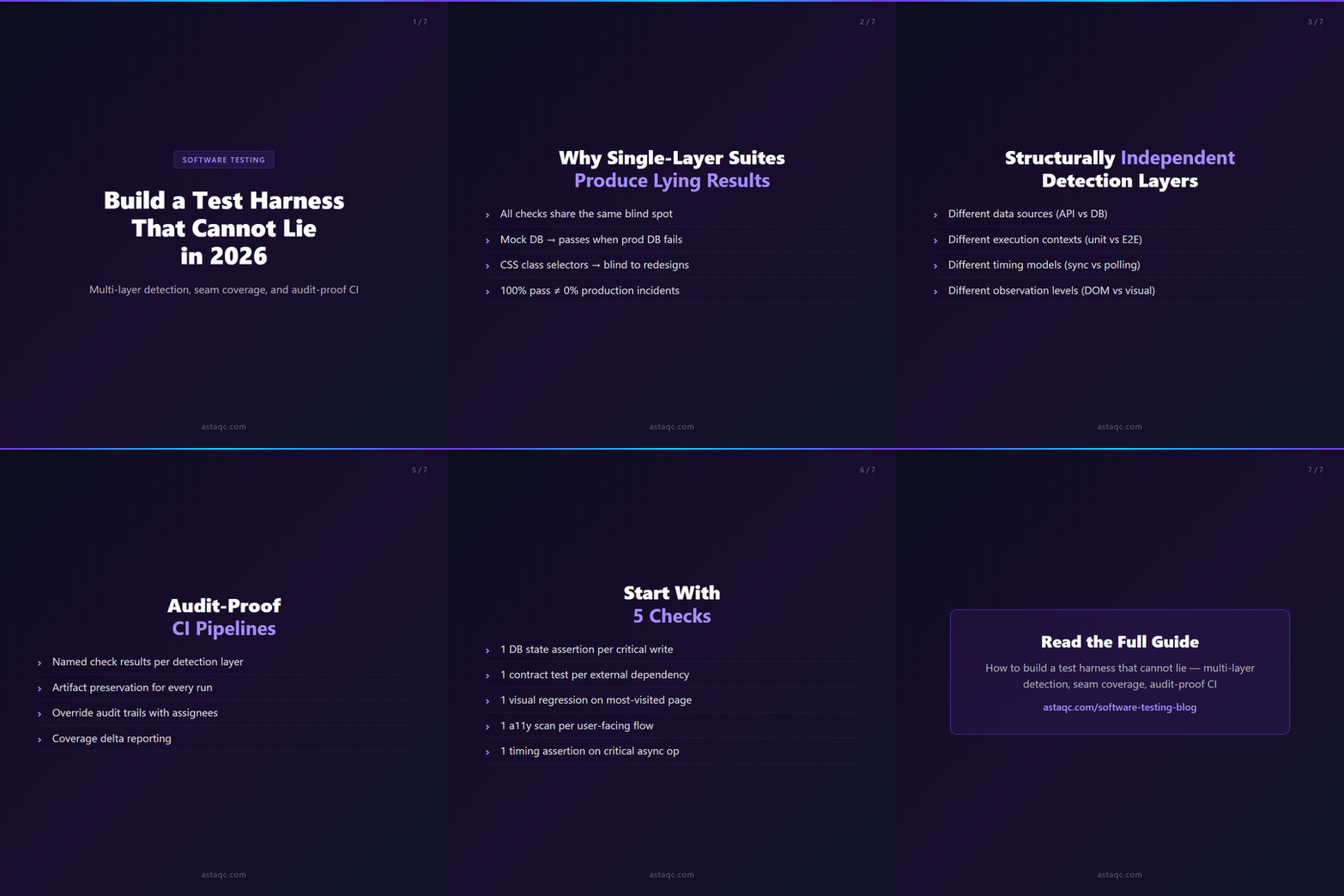
A single detection layer can agree with the bug it is meant to find. Multiple independent detection layers that check different things cannot all agree with the same bug at the same time. This is the core principle of a test harness that cannot lie.
October 21, 2026


Sign up to receive and connect to our newsletter

We founded ASTAQC as a tight-knit group of professional Software Testers and software developers.
Subscribe to our Newsletter