November 2, 2026

API rate limit testing validates that an application correctly handles throttling responses from APIs it depends on. When an external API enforces rate limits — typically returning HTTP 429 Too Many Requests with a Retry-After header — the application needs to respond correctly: pause, retry with appropriate backoff, surface a user-facing message if needed, and avoid cascading the failure into unrelated parts of the system. Rate limit testing verifies that this behavior is implemented correctly, not that the API itself can handle a given request volume. That is load testing, and it is a different discipline.
Rate limits are a standard feature of every significant API category in 2026: payment processors, AI inference providers, social media platforms, CRM systems, search APIs, geolocation services, and communication platforms all enforce them. The limits vary in structure: some are per-second, some per-minute, some per day, and some are per-endpoint rather than global. Some APIs return a Retry-After header with the number of seconds to wait; others return X-RateLimit-Remaining and X-RateLimit-Reset headers that allow the client to pre-emptively reduce its request rate. Some have burst allowances that permit short bursts above the sustained rate. Testing all of these behaviors requires specific, controlled test scenarios that cannot be replicated by waiting for rate limits to occur naturally in production.
The most common failures in rate limit handling:
Rate limit testing in 2026 matters more than it did two years ago because AI inference APIs — OpenAI, Anthropic, Google Gemini, Cohere — are now central to production applications and have some of the most aggressive rate limits in the API ecosystem. An application that calls an AI inference API for every user request will hit rate limits in normal production operation, not just under unusual load. QA teams that have not built rate limit test coverage for AI API dependencies are running blind.
For context on how rate limit testing fits within a broader API test automation strategy, the distinction between rate limit testing and load testing is important to keep clear throughout the test planning process.
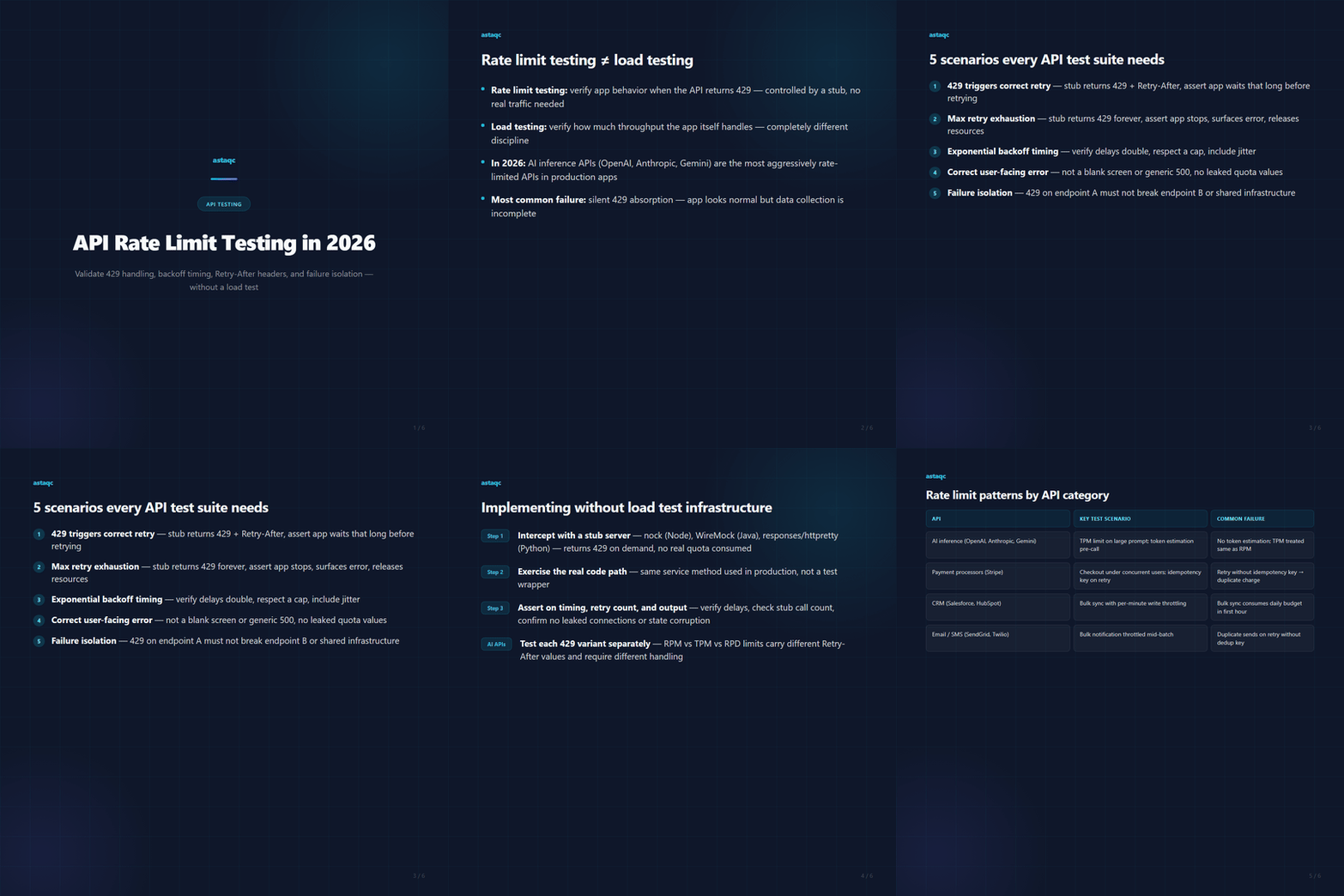
The following test scenarios cover the behaviors that most commonly break in rate-limited environments. Each scenario has a specific assertion target and can be implemented with standard HTTP testing tools without requiring a load test setup.
Stub the API dependency to return HTTP 429 with a Retry-After header. Assert that:
Stub the API to return 429 for all requests regardless of retry count. Assert that:
Stub the API to return 429 for three consecutive calls. Assert that:
Stub the API to return sustained 429s. Assert that:
Stub one specific API endpoint to return 429. Assert that:
These five scenarios can be implemented in any HTTP testing framework. The key is the API stub: rather than waiting for real rate limits to occur, the test controls exactly when the 429 is returned, how many times, and with what headers. Tools that support HTTP request interception — WireMock, MSW (Mock Service Worker), nock, or httpretty — are standard choices for this stubbing. Software testing services typically implement these scenarios as part of an API test suite build, alongside positive-path and error-response tests.
The most common misconception about rate limit testing is that it requires generating enough real traffic to trigger actual rate limits. It does not. Rate limit testing is a functional test that verifies application behavior in response to a specific HTTP status code. The rate limit does not need to be genuine — the application should behave identically whether the 429 comes from a real API hitting its limit or from a stub server returning 429 on the first request.
The implementation pattern for rate limit tests at the integration layer:
Use a proxy or mock server that intercepts HTTP calls from the application to the external API. In a Node.js environment, nock intercepts calls to specific hosts and returns configured responses. In a Java environment, WireMock serves as the stub server. In a Python environment, responses or httpretty patches the requests library. The choice depends on the application stack, not the API being tested.
Example (conceptual, nock):
nock('https://api.example.com')
  .get('/resource')
  .times(3)
  .reply(429, { error: 'rate_limit_exceeded' }, { 'Retry-After': '2' })
  .get('/resource')
.reply(200, { data: 'success' });Trigger the application code path that calls the stubbed API. This should be the same code path used in production, not a test-only wrapper. If the application has a service layer that wraps the API call, call the service method. If the application makes direct HTTP calls, exercise the endpoint that triggers the call.
After the test, assert on:
AI inference APIs (OpenAI, Anthropic, Google Gemini) return 429 with a specific body structure that includes the type of rate limit hit (requests per minute, tokens per minute, requests per day). Applications that integrate AI APIs should test that they handle each type of 429 correctly, since the Retry-After value for a tokens-per-minute limit is different from one for a requests-per-day limit. The body parsing logic that extracts the limit type and retry delay should be explicitly tested, not just the retry behavior itself.
For teams using manual testing approaches alongside automated tests, rate limit scenarios are particularly well-suited for automation because the timing and retry count assertions are difficult to verify manually. Manual testers can verify the user-facing error messages and UI behavior, while automated tests cover the retry logic, backoff timing, and isolation behavior.
| API Category | Common Rate Limit Structure | Key Test Scenario | Common Failure Mode |
|---|---|---|---|
| AI inference (OpenAI, Anthropic, Gemini) | RPM + TPM + RPD; 429 with limit type in body | TPM limit on large prompt; retry timing; token estimation pre-call | No pre-call token estimation; TPM 429 treated same as RPM 429 |
| Payment processors (Stripe, Braintree) | Per-second burst; 429 with rate_limit error code | Checkout flow under concurrent users; idempotency key preservation on retry | Retry without idempotency key causes duplicate charge |
| Social media (Twitter/X API, LinkedIn) | 15-minute windows; X-RateLimit-Reset header | Queue drain behavior at window reset; partial sync recovery | Window reset not honored; sync job re-runs from beginning instead of resuming |
| Search (Google Custom Search, Bing) | Daily query quota; 429 at quota exhaustion | Graceful degradation when daily quota exhausted; cached fallback behavior | No fallback; search feature broken for rest of day after quota hit |
| CRM (Salesforce, HubSpot) | Daily API call limit; per-minute write limit | Bulk sync with per-minute write throttling; daily limit monitoring and alerting | Bulk sync consumes daily budget in first hour; no alerting until failure |
| Email / SMS (SendGrid, Twilio) | Per-second send rate; 429 with retry guidance | Bulk notification send throttled mid-batch; message ordering preserved on retry | Duplicate sends on retry without deduplication key |
| Geolocation (Google Maps, Mapbox) | QPS limit; 429 with billing/quota context | Address validation throttled during bulk import; fallback to cached coordinates | No cached fallback; import fails entirely on quota exhaustion |
Rate limit tests run in the same CI pipeline as other integration tests. The stub server (WireMock, nock, MSW) runs as part of the test environment, not as a separate service that must be maintained. Each test configures the stub for its specific scenario, runs the application code, asserts the result, and tears down the stub.
The test execution time for rate limit tests that include backoff timing is longer than typical integration tests because the application waits for the configured backoff delay. Keeping base backoff intervals at their minimum in the test environment (1 second rather than the production value of 5 or 10 seconds) reduces this without invalidating the test. The test is verifying backoff behavior, not a specific duration.
Recommended CI placement: rate limit tests belong in the integration test suite, not the unit test suite. They require the application to make actual HTTP calls to the stub server, which means they need the application and the stub server to be running. They do not require an external network connection.
For teams running performance testing pipelines in addition to functional tests, rate limit tests should run before the performance suite to verify that the application can handle throttling gracefully before evaluating its performance under load.
Rate limit testing is a functional test that verifies application behavior when an API dependency returns HTTP 429. The test controls the 429 via a stub and does not require generating real traffic volume. Load testing verifies how the application itself performs under high request volume. These are different disciplines with different tools and objectives. Rate limit testing is appropriate for every API integration. Load testing is appropriate when understanding the application's own throughput characteristics is the objective. For context on how these fit together, the complete software testing guide covers the full taxonomy of test types.
Use a local stub server (WireMock, nock, MSW, httpretty) that intercepts calls to the API host. The stub returns 429 on demand without requiring any interaction with the real API. The application under test cannot distinguish between a 429 from the real API and a 429 from the stub — the HTTP response format is identical. This approach also avoids consuming API quota during test runs, which matters for pay-per-request APIs.
Some APIs return 429 without a Retry-After header. The standard approach is to use an exponential backoff with jitter, starting from a short base interval (1–2 seconds) and doubling with each retry up to a maximum cap (30–60 seconds). This should be the default behavior even when Retry-After is present, treating the Retry-After value as a minimum rather than an exact wait time. The test for this scenario should stub a 429 with no Retry-After header and assert that the application uses its configured backoff strategy.
For POST, PUT, or PATCH calls that mutate state on the API server, retrying a 429 without an idempotency key can cause duplicate side effects (duplicate charges, duplicate sends, duplicate records). The test for this scenario stubs a 429 followed by a 200, then asserts that the retry included the original idempotency key in the request headers. This requires reading the stub server's request log to verify the headers sent on each attempt, not just that the final response was 200.
A daily quota exhaustion (common with Google APIs, some search APIs, and AI APIs on lower-tier plans) requires a different handling strategy than a per-second rate limit. The application cannot retry after a short wait because the quota will not reset until the next day. The test should verify that: the application detects the quota exhaustion (often signaled by a specific 429 body or 403 response), falls back to a cached or degraded behavior if available, surfaces a monitoring alert or admin notification, and does not queue retried requests that will also fail. The test stub should return the quota-exhaustion flavor of 429 and assert each of these behaviors separately.
Circuit breakers open when an external dependency fails repeatedly, temporarily stopping calls to that dependency to prevent cascading failure. To test circuit breaker behavior under rate limiting, stub the API to return 429 for enough consecutive requests to open the circuit, then assert that: the circuit breaker is in the open state, subsequent calls fail fast without reaching the stub, a monitoring event is emitted, and the circuit transitions to half-open after the configured recovery interval and resumes requests when the stub returns 200. This requires access to the circuit breaker's state, either through the application's health endpoint or through a test-only inspection interface.
Teams evaluating their API test coverage can review their current suite against these scenarios with support from outsourced QA teams who specialize in API testing. Astaqc’s AI in software testing guide covers how AI-assisted test generation is changing coverage for complex API behaviors like rate limit handling.
Rate limit testing is not load testing. The goal is not to push an API to failure — it is to verify that the application behaves correctly when the API says “slow down.”
November 2, 2026


Marcus Chen is a software testing engineer specializing in API testing, performance engineering, and security QA. He has led QA programs for enterprise SaaS, fintech, and healthcare technology companies across three continents.

Sign up to receive and connect to our newsletter

We founded ASTAQC as a tight-knit group of professional Software Testers and software developers.
Subscribe to our Newsletter