August 15, 2026
A test suite that reports 100% passing is not evidence that the application works correctly in production; it is evidence that the application satisfies the test suite's assertions, which may not cover the same set of behaviors that production traffic exercises. AI-generated code makes this distinction more consequential because the code is often syntactically correct, passes linting, and satisfies unit test assertions while implementing logic that misunderstands the requirement, handles edge cases incorrectly, or depends on assumptions that are not true in production. In 2026, as AI code generation tools produce larger volumes of plausible code faster than test coverage can keep pace, the gap between tested behavior and correct behavior has become a practical concern for engineering teams managing production quality.
This guide covers what the correctness gap is, how AI generation expands it, which categories of failures pass automated tests routinely, and what testing approaches reduce it without requiring a complete rethink of existing coverage. For teams that want a structured view of how testing fits into application quality as a whole, the complete guide to software testing provides a useful framing. Teams dealing with production failures despite passing CI pipelines can work with Astaqc's test automation services to identify which coverage gaps are contributing to the failure pattern.
The correctness gap is the difference between behaviors that tests verify and behaviors that the application must produce to work correctly for real users in production. Every test suite has a correctness gap: no suite verifies everything. The question is whether the untested behaviors represent high-risk edge cases that production traffic routinely hits, or low-probability paths that fail rarely enough to be acceptable risk. When the gap is small and covers low-probability paths, most engineering teams accept it. When the gap is large and covers high-probability paths that production traffic exercises differently than the test environment, passing tests coexist with production failures.
The gap exists for several reasons that are not unique to AI-generated code. Tests are written by engineers who model the application's behavior from a developer perspective, not from the distribution of real user interactions. Test environments have different infrastructure characteristics than production — different latency, different database load, different service dependency availability. Test data is controlled and does not represent the edge cases that accumulate in production data over time. These structural differences between the test environment and production mean that test passage is a necessary but not sufficient condition for production correctness.
In 2026, two factors have made the correctness gap more visible in engineering teams that were not previously aware of it as a distinct problem. First, AI code generation tools produce code quickly enough that the ratio of code added per day to test coverage added per day has increased in teams that use generation heavily. Second, AI-generated code exhibits specific patterns of logical correctness failure — it looks right, passes syntactic and type checks, and satisfies the assertions in nearby test files, but implements the wrong logic for the use case it was supposed to address. This combination of high velocity and plausible-but-wrong code produces a failure mode that standard testing infrastructure does not detect until production.
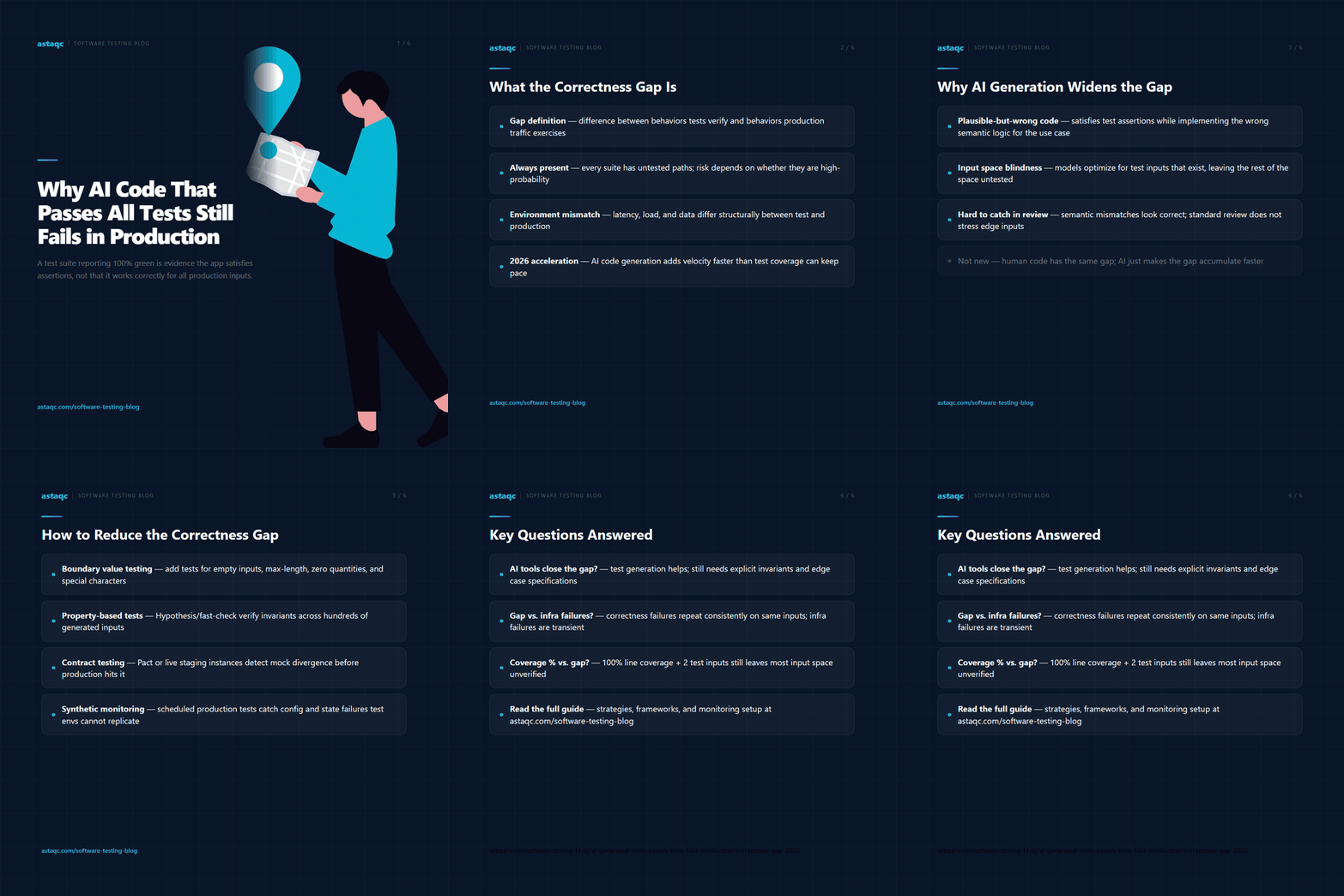
AI code generation tools produce code by predicting token sequences that are plausible continuations of the surrounding context. When the context is a prompt describing a function and the adjacent code includes tests, the generation model produces code that satisfies those tests. But satisfying tests and correctly implementing the specified behavior are not the same thing when the tests do not fully specify the behavior. A function that returns the correct output for the test input values may return incorrect output for the input values that production traffic actually sends. If those production input values are not represented in the test suite, the function passes tests and fails in production.
This is not a new problem — human-written code has always had the same exposure. What changes with AI generation is the scale and the character of the errors. Human engineers who write incorrect logic typically understand what the code is supposed to do and make logical errors while implementing it. AI generation errors often involve misunderstanding the semantic requirements of the use case: the model produces code that is internally consistent and syntactically correct but addresses a slightly different problem than the one specified. These semantic mismatches are harder to detect in code review because the code looks reasonable, and harder to detect in testing because standard tests verify behavior for a small set of representative inputs rather than verifying semantic correctness across the full input space.
The practical effect is that teams using AI generation heavily can accumulate semantic mismatches faster than their test coverage identifies them. A team generating several hundred lines of production code per day via AI tools and writing tests that pass in CI is not accumulating verified-correct code; it is accumulating code that passes its test assertions, which is a weaker guarantee. The difference only becomes visible when production traffic exercises the input space outside the test suite's coverage, which happens continuously in running applications. Understanding this dynamic is a precondition for making useful decisions about how to adapt test strategy to AI-generated codebases. The manual vs. automated testing guide covers how to balance test types in a way that improves semantic coverage beyond what unit tests alone provide. For teams that want an external assessment of their test coverage depth relative to production risk, Astaqc's software testing services include coverage gap analysis calibrated to specific application risk profiles.
| Failure Category | Why Tests Miss It | How to Surface It |
|---|---|---|
| Semantic logic errors | Tests verify correct outputs for the inputs they use; semantic errors appear at inputs outside test coverage | Property-based testing; contract review against specification |
| Race conditions under load | Test environments run at lower concurrency than production; timing-dependent bugs do not manifest at single-threaded test scale | Load testing; concurrency stress testing |
| Dependency API changes | Tests mock external dependencies; mock behavior diverges from current API behavior over time | Contract testing against live dependencies; synthetic monitoring |
| Edge case input handling | Tests use representative inputs; production users send inputs outside the tested range (empty strings, unicode, null values, max-length fields) | Fuzzing; boundary value analysis; production log analysis for input distribution |
| State accumulation over time | Test environments reset between runs; production data accumulates over months creating slow queries, constraint violations, or cache poisoning | Testing against production-scale database snapshots; longevity tests |
| Configuration environment differences | Environment variables, feature flags, and infrastructure settings differ between test and production in ways tests do not account for | Smoke tests in production; environment parity checks in deployment pipeline |
| Security boundary violations | Functional tests do not verify that access control is correctly enforced across all endpoints; authorization logic misses edge cases | DAST in CI pipeline; authorization boundary testing; penetration testing |
Each of these categories is present in codebases written entirely by human engineers. AI generation increases the frequency of semantic logic errors because the generation model does not have access to the full set of constraints and edge cases that an engineer with domain knowledge holds implicitly. The other categories remain at roughly the same frequency, but they become more consequential when semantic logic errors have already introduced correctness problems that go undetected through standard CI pipelines.
Teams that want to reduce failure rates across all these categories can layer their testing approach. For teams evaluating where to invest, the Astaqc performance testing services team covers load and concurrency test design, and the testing documentation services team can help structure test plans that explicitly target each failure category.
The most effective first step is shifting from testing representative happy-path inputs to testing boundary values and failure modes explicitly. For each AI-generated function or module, identify the input cases where semantic errors are most likely to appear: empty inputs, maximum-length inputs, inputs that cross business rule boundaries (a quantity of zero, a date in the past, a string containing special characters). Adding tests for these cases does not require rewriting existing tests; it requires extending coverage for the input space that AI generation errors most commonly affect.
Property-based testing is a higher-leverage approach for codebases where the input space is large. Rather than specifying fixed input-output pairs, property tests specify invariants that must hold for any valid input: sorting a list produces an output with the same length as the input; applying a discount calculation never produces a total below zero; parsing and re-serializing a value produces the original value. Frameworks like Hypothesis (Python), fast-check (JavaScript/TypeScript), and QuickCheck (Haskell/Erlang) generate hundreds of random inputs per test run and report which inputs violate the property. Property tests catch semantic mismatches that example-based tests designed around representative inputs consistently miss.
Contract testing against real dependencies — rather than mocking everything in unit tests — surfaces a different class of production failure. When external API behavior changes and tests still mock the old behavior, the mock-based test suite continues to pass while production requests fail with unexpected responses. Running a subset of integration tests against real staging instances of dependencies, or using contract test tools like Pact to define and verify behavioral contracts against live services, closes the mock divergence gap without requiring full end-to-end test runs on every CI build. The QA outsourcing guide covers how external QA teams can introduce contract testing into existing pipelines as a distinct engagement.
Synthetic monitoring in production is the closest available proxy to testing the actual user experience against real production conditions. Scheduled tests that run against production endpoints at regular intervals, verify that critical flows complete successfully, and alert when they do not, catch the configuration environment and state accumulation failures that test environments cannot replicate. Production smoke tests also catch semantic errors that only become visible when production traffic exercises the specific input combinations that AI generation got wrong. For teams that want to implement synthetic monitoring without building the infrastructure from scratch, Astaqc's QA team provides ongoing monitoring setup and alerting configuration as a managed service.
The evidence from teams in production in 2026 is mixed. AI generation increases development velocity significantly, which means more code is deployed per unit of time. Whether the failure rate per deployed unit of code increases depends on whether the team has adapted its testing strategy to address the specific correctness gap patterns that AI generation introduces. Teams that continue using the same test strategy they used before AI generation and deploy at higher velocity tend to see more production incidents. Teams that add boundary value tests, property tests, and production smoke tests to their AI generation workflow tend to maintain or improve defect rates despite higher deployment velocity.
AI-assisted test generation, including tools like TestInspector that generate test steps from plain-language descriptions, reduces the effort required to extend test coverage into boundary cases and failure modes. However, an AI test generation tool does not know which boundary cases the AI code generation got wrong without some specification of what correct behavior looks like. Effective use of AI for testing requires explicit input about what invariants must hold, which edge cases are high-risk, and what the correct behavior is for specific input classes — the same domain knowledge that closes the correctness gap when applied to human-written tests.
Failures caused by the correctness gap typically reproduce consistently with specific inputs — the same user action or API call fails every time because the code computes the wrong result for those inputs. Infrastructure failures are typically transient: the same action succeeds when retried moments later because the infrastructure condition resolved. Structured production log analysis that tags failures by input characteristics, comparing failure rates across different input value ranges, is the most direct method for identifying correctness gap failures in a running application.
The correctness gap exists in all codebases: every test suite has behaviors it does not verify. AI generation makes the problem more visible because the gap can grow faster than teams notice, and because the character of AI generation errors — semantically plausible but behaviorally wrong — makes the gap harder to detect in code review than typical human implementation errors. The mitigation strategies described above apply equally well to human-written codebases; they become more important in AI-generated codebases because the generation velocity makes the gap accumulate faster.
Line and branch coverage metrics measure whether the test suite executes code paths, not whether it verifies that those paths compute correct results for the relevant input space. A function with 100% line coverage might be tested with only two or three input combinations, leaving most of the input space unverified. High coverage percentage and a large correctness gap coexist routinely in codebases where tests are written to maximize coverage metrics rather than to verify behavioral correctness across the input distributions that production traffic exercises. For a structured approach to coverage that accounts for input distribution, the AI in software testing guide covers how to design coverage strategies that align with production risk rather than coverage percentage targets.
A test that passes does not confirm that the code is correct. It confirms that the code satisfies the test's assertions for the test's inputs. When AI generation produces code that is semantically wrong — addresses a slightly different problem than the one intended — a passing test suite reports green while production failures accumulate in the input space the tests do not cover.
August 15, 2026


Sign up to receive and connect to our newsletter

We founded ASTAQC as a tight-knit group of professional Software Testers and software developers.
Subscribe to our Newsletter