August 27, 2026
Reqnroll is the maintained successor to SpecFlow, the dominant BDD framework for .NET teams. Both tools use Gherkin syntax to express test scenarios in Given/When/Then form, generate step definition stubs in C#, and execute scenarios through xUnit, NUnit, or MSTest. TestInspector takes a different architectural position: it generates structured test steps from natural-language instructions delivered through an AI chat interface, with no step definition layer and no Gherkin syntax required. Understanding when each approach is appropriate requires separating the technical difference from the organizational context that determines which tool actually fits.
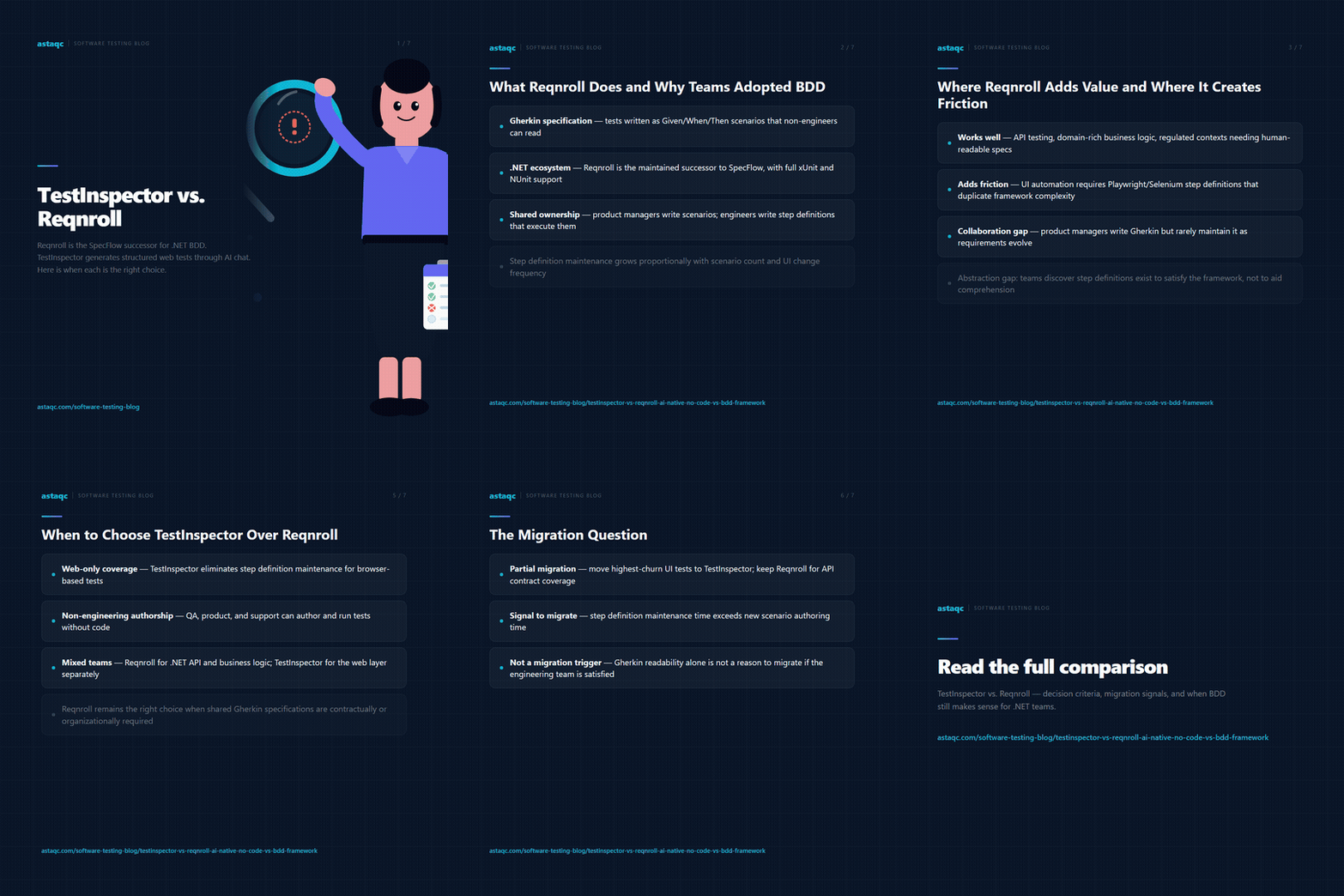
Reqnroll, like SpecFlow before it, implements the BDD testing pattern developed by Dan North in the mid-2000s. The core premise is that test scenarios written in natural language serve as executable specifications that both product managers and engineers can read and maintain. A Reqnroll scenario describes the precondition (Given), the action (When), and the expected outcome (Then) in a form that reads as English prose. The Gherkin syntax parser maps each scenario step to a step definition method in C# that contains the actual automation code.
Teams adopted SpecFlow and BDD primarily for two reasons: shared ownership of test specifications and documentation as a byproduct of testing. When a product manager can write or modify a Gherkin scenario directly, the test suite gains a stakeholder who is invested in keeping it accurate. When a regulatory or compliance context requires human-readable documentation of test coverage, Gherkin feature files serve that purpose more directly than code-based test frameworks do. The .NET ecosystem adopted BDD earlier and more thoroughly than other ecosystems in part because SpecFlow provided tooling that was mature enough for production use, and because enterprise .NET development environments frequently require documentation artifacts alongside test results. For teams evaluating the SpecFlow to Reqnroll migration, Astaqc test automation services can audit existing step definitions and advise on migration scope. The complete software testing guide situates BDD testing within a broader test strategy.
TestInspector generates test steps through an AI chat interface. A tester describes the scenario in natural language — navigate to the login page, enter a username from a variable, submit the form, and assert that the dashboard heading is visible — and TestInspector generates the corresponding structured test steps without requiring the tester to write Gherkin, step definitions, or any automation code. Each step is a discrete action with a type and parameters: click, type, navigate, assert text, assert visible, HTTP request, or accessibility assertion. The test runner executes these steps via Selenium on the configured browser.
The self-healing layer addresses the primary maintenance cost of web automation: element selectors becoming stale when the application’s markup changes. When a step’s selector fails to locate an element, TestInspector’s AI analyzes the surrounding DOM context and suggests alternative selectors. The tester selects the correct suggestion, the step updates, and the test continues without requiring manual inspection of markup or a replacement locator written from scratch.
Variable interpolation supports dynamic test data without hardcoded values. TestInspector supports {{VAR}} for named variables, {{TIMESTAMP}} for time-based uniqueness, {{ALPHANUMERIC}} for random strings, and {{TOTP:secret}} for time-based one-time passwords, with variables scoped at the test, suite, or organization level and encrypted storage for secrets. This makes it practical to run tests across multiple environments using environment-specific variable sets and to automate authentication flows that require 2FA without embedding secrets in test files.
TestInspector also supports HTTP request steps with status code, body, and header assertions; accessibility assertions via axe-core with severity level filtering; visual regression via SSIM screenshot comparison with baseline approval and exclusion selectors; and CI/CD integration via a trigger API with live WebSocket run streaming. Tests can be scheduled on cron, interval, or one-time triggers, and MCP tokens allow AI coding tools like Claude Code and Cursor to generate and run tests directly. For a detailed view of TestInspector’s capabilities, visit the TestInspector product page. Teams working with Astaqc software testing services can integrate TestInspector into an existing QA operation with support for onboarding and test design.
| Dimension | TestInspector | Reqnroll |
|---|---|---|
| Test creation method | AI chat generates structured steps; no coding required | Gherkin feature files + C# step definition classes |
| Language requirement | None; natural language input, structured step output | C# for step definitions; Gherkin for feature files |
| Business stakeholder readable | Structured steps are reviewable but not Gherkin syntax | Feature files are human-readable Gherkin specifications |
| Selector maintenance | AI self-healing suggests replacements when selectors break | Manual update of step definition code or Page Object selectors |
| Variable and test data | {{VAR}}, {{TOTP:secret}}, {{TIMESTAMP}}, encrypted storage, suite/org hierarchy | Scenario Outline + Examples tables; external data via C# helper methods |
| Visual regression | SSIM screenshot comparison, baseline approval, exclusion selectors | Requires third-party integration (e.g., Applitools, Percy) |
| Accessibility testing | axe-core assertions with severity levels built into test steps | Possible via axe-core NuGet package in step definitions |
| Scheduling | Cron, interval, and one-time scheduling built in | Scheduling via CI platform (GitHub Actions schedule, Azure DevOps) |
| CI/CD integration | HTTP trigger API; live WebSocket run streaming | MSTest, NUnit, or xUnit runner; dotnet test in CI pipeline |
| Export formats | Playwright TypeScript, Selenium IDE (.side), Gherkin | Gherkin native; no export to code-based frameworks |
| Skill requirement | Manual testers can create and maintain tests without scripting | .NET development experience required for step definitions |
| Deployment model | Cloud SaaS; no local infrastructure required | Open source; runs in team CI infrastructure or locally |
The most consequential difference is the relationship between test authoring and .NET development skill. Reqnroll tests require a developer or engineer with C# experience to write and maintain step definition code. When the team has this skill and the BDD collaboration model is actively used — when product owners review feature files as acceptance criteria — Reqnroll’s overhead is justified by the specification quality it produces. When the Gherkin layer exists for format compliance rather than genuine stakeholder communication, the step definition maintenance overhead adds cost without the corresponding benefit. For teams assessing whether their Reqnroll investment is delivering the collaboration value BDD frameworks are designed to provide, Astaqc hire QA team can evaluate the current test authoring and review workflow. The outsourcing QA guide covers how to structure test automation engagements that match tool complexity to team capability.
TestInspector is the appropriate choice when the application under test is web-based, the team needs non-engineer QA members to own test creation and maintenance, and the priority is reducing automation overhead rather than generating Gherkin specifications for business stakeholder review. Teams that adopted a BDD framework because it was recommended practice but find that product owners and business analysts do not actively read or review feature files are the most common candidates for migration — the Gherkin layer is adding maintenance cost without the stakeholder alignment benefit it is designed to provide.
Specific scenarios where TestInspector’s architecture provides measurable advantage: authentication flows requiring TOTP (TestInspector’s {{TOTP:secret}} variable handles time-based OTP generation natively without a helper library in step definitions); visual regression testing where teams need to approve intended appearance changes and track regression from a baseline; and CI/CD pipelines where live step-level test run visibility during execution matters. For teams considering migrating web tests from Reqnroll to TestInspector, Astaqc manual testing services can support the transition by mapping existing step definition coverage to structured test steps before migration. The AI in software testing guide covers how AI-native tools like TestInspector fit within a broader quality engineering strategy in 2026.
Reqnroll is the appropriate choice when Gherkin-based specification is a genuine working practice — when product owners or business analysts write or actively review feature files as part of sprint acceptance criteria, and when the living documentation that Gherkin produces serves teams beyond the QA function. In this context, Reqnroll’s specification layer creates a shared artifact that business, development, and testing teams maintain together, serving as an executable form of the product’s behavioral requirements.
Reqnroll is also appropriate for teams with existing .NET test infrastructure where step definition code is tightly integrated with application-specific helpers, factories, and database seeding logic. Migrating away from Reqnroll in this context requires either rewriting the infrastructure support code in TestInspector’s HTTP request step model or accepting reduced coverage of the scenarios that depend on that infrastructure. For teams with large Reqnroll test suites and active BDD collaboration workflows, the migration cost is likely to exceed the maintenance savings unless the team is simultaneously restructuring how tests are authored. For teams evaluating the total cost of maintaining a Reqnroll-based automation portfolio, Astaqc performance testing services can assess automation portfolio health. The software testing cost guide provides a framework for calculating automation ROI across different tool categories.
Yes. If the Gherkin layer in the current test suite exists because BDD was adopted as a recommended practice but business stakeholders do not actively read or review feature files, removing the Gherkin and step definition layer eliminates maintenance overhead without reducing the collaboration benefit that the framework is supposed to provide. TestInspector’s structured steps are readable and reviewable by QA engineers and developers without .NET expertise. For teams in this situation, the migration removes the step definition binding maintenance cost while preserving web test coverage.
TestInspector supports parameterized variation through its variable interpolation system. Variables at test, suite, or organization scope allow the same test to run against different input values by changing the variable set. For high-volume parameterization across a large table of input rows — the use case that Reqnroll’s Scenario Outline with Examples tables handles well — TestInspector’s current model requires creating test variants or using the trigger API to initiate runs with different parameter configurations. Teams with Reqnroll suites that rely heavily on Scenario Outline for bulk data variation should evaluate this pattern specifically before committing to migration.
Reqnroll step definitions are shared across all feature files by default: a Given step binding defined in one class is available to any feature file that uses the same step text. TestInspector handles reuse at the suite level — tests within a suite share variable scope, and common setup steps can be structured as independent tests that other tests reference or run in sequence. For teams with large Reqnroll suites that share step definitions extensively across feature files, mapping the shared step pattern to TestInspector’s organizational model requires planning before migration to ensure reused steps are represented accurately.
Reqnroll’s living documentation value — the ability to generate a browsable specification report from feature files that shows which scenarios pass and which fail — is lost in migration to TestInspector, which does not produce Gherkin-format documentation. If living documentation is actively used by the team, migration requires either maintaining a parallel Gherkin specification layer or accepting that this artifact will no longer exist. TestInspector’s run history and test reports serve a similar function for QA and engineering audiences, but they are not in a business-readable Gherkin format.
TestInspector integrates with CI pipelines via an HTTP trigger API, not a .NET test runner. Instead of running dotnet test to invoke Reqnroll scenarios, the pipeline sends an HTTP request to TestInspector’s trigger endpoint, which initiates a test run and returns a run ID. The pipeline can then poll or subscribe via WebSocket to monitor the run’s status and retrieve results. This model works with any CI platform that can make HTTP requests — GitHub Actions, Azure DevOps, Jenkins, GitLab CI — but the integration pattern differs from the dotnet test runner pattern that Reqnroll uses, which may require pipeline reconfiguration as part of migration.
Reqnroll is a .NET framework. If the application under test is not built on .NET, or if the QA team does not have .NET development experience, Reqnroll is not a practical choice. Step definition code must be written in C#, the project must be a .NET project, and the test runner must be MSTest, NUnit, or xUnit. Teams without a .NET background who want a BDD-style framework typically use Cucumber (for Java, Ruby, or JavaScript) or pytest-bdd (for Python). Teams who want BDD-style specification output can export Gherkin format from TestInspector and use those files as specification artifacts without maintaining step definition binding code.
TestInspector removes the Gherkin feature file and step definition binding layer that Reqnroll requires, making it the appropriate choice for teams whose primary need is web test automation without framework overhead. Reqnroll remains the appropriate choice for teams whose process depends on Gherkin as a shared specification language between business and engineering.
August 27, 2026


Sign up to receive and connect to our newsletter

We founded ASTAQC as a tight-knit group of professional Software Testers and software developers.
Subscribe to our Newsletter