September 24, 2026
QA teams modernizing their automation practices in 2026 face a specific tradeoff: script-heavy frameworks like Selenium and Playwright provide precise control but require continuous engineering investment for authorship, selector maintenance, and framework upgrades. AI-native testing platforms like TestInspector reduce that investment by generating test steps from natural language, automatically recovering from selector failures, and running tests on schedule without requiring teams to maintain framework-specific code. This guide covers what AI-native testing changes in practice, how TestInspector compares to scripted frameworks at each stage of the QA workflow, and how teams can structure a modernization transition without dropping coverage.
For context on where automation strategy fits in broader quality practice, see Astaqc’s complete software testing guide and test automation services. Teams evaluating a transition can also engage Astaqc’s software testing services to structure the modernization alongside existing suite coverage.
Script-heavy test automation frameworks require engineers to write, review, and update test code as a primary activity. When an application changes a button label, a route, or a DOM structure, a Playwright or Selenium test breaks and must be repaired manually: the selector is updated, the test is re-run, and the fix is reviewed. For teams running several hundred tests, selector drift—the accumulated breakage of previously stable locators as the application evolves—becomes a maintenance cost that competes directly with new test authorship. QA teams that Astaqc works with through its test automation services typically report that 20–40% of automation engineering time in mature Selenium or Playwright suites goes to test repair rather than new coverage.
Beyond selector maintenance, scripted test frameworks require engineers who can write reliable test code in a specific language and framework. This creates a knowledge bottleneck: a manual QA engineer who understands the application deeply but does not write Playwright tests cannot independently create automated tests for the features they test manually. The gap between knowing what to test and knowing how to write the test code means that test authorship depends on development engineering time, which is a constrained resource. In fast-moving development cycles, this bottleneck means automated coverage lags behind the application’s feature surface, leaving recently delivered features undertested.
Two additional overhead sources compound the maintenance problem: environment setup and CI wiring. A Selenium or Playwright suite requires a configured test environment—Node.js version, browser binaries, driver compatibility, network access to the application under test—before a single test can run. In teams without a dedicated DevOps function, environment setup is often the engineering work that blocks QA from running automation independently. TestInspector removes this dependency: tests run via TestInspector’s managed Selenium infrastructure on Chrome, Firefox, Edge, and Safari without any local or CI-level browser configuration, so QA engineers can create and run tests without waiting for infrastructure setup to be completed. For more on where AI-native tooling fits in a complete testing strategy, see Astaqc’s AI in software testing guide.
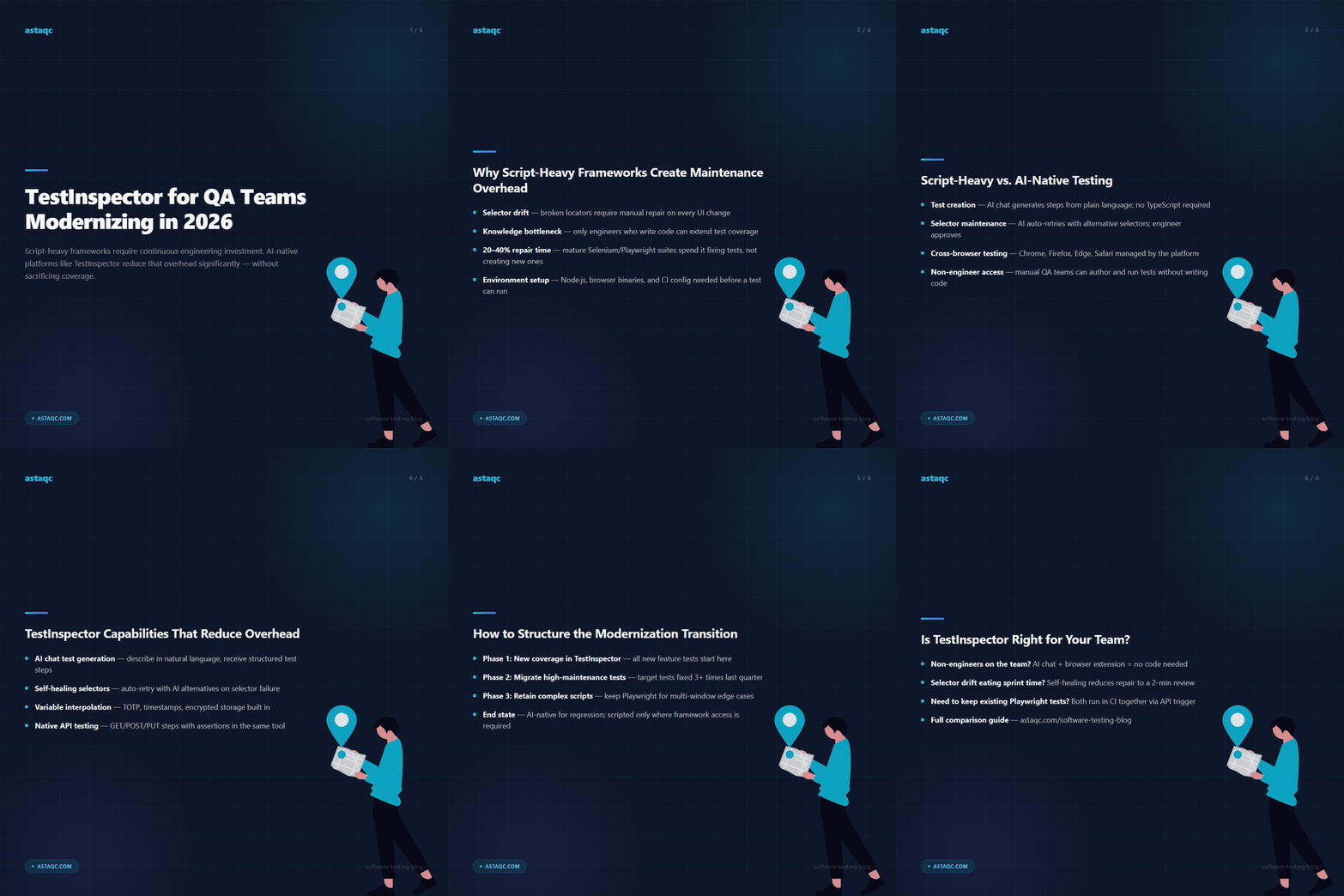
The practical difference between script-heavy and AI-native testing appears across four stages of the QA workflow: test creation, test maintenance, test execution, and failure diagnosis. The table below maps what each approach requires at each stage, using Playwright as a representative scripted framework and TestInspector as the AI-native reference.
| Stage | Playwright (Script-Heavy) | TestInspector (AI-Native) |
|---|---|---|
| Test creation | Write TypeScript test functions; requires selector knowledge and framework APIs | Describe test in natural language; AI chat generates structured step-by-step test without code |
| Selector maintenance | Manual repair required when selectors fail; engineer must identify new stable locator | Self-healing auto-retry generates AI selector suggestions; engineer reviews and approves the fix |
| Test execution | Requires CI pipeline configuration and local Node.js/browser environment | Runs on managed browser infrastructure; scheduling via cron, interval, or one-time trigger |
| Failure diagnosis | Inspect trace files and screenshots manually; requires local environment to reproduce | Live WebSocket streaming during run; step-level run logs visible in the UI without local setup |
| Cross-browser testing | Requires browser matrix configuration in CI; separate runs per browser | Browser selection per test: Chrome, Firefox, Edge, Safari; managed by the platform |
| Access by non-engineers | Not practical without TypeScript fluency and framework knowledge | Manual QA engineers can create, edit, and run tests without writing code |
The table reveals that the primary advantage of scripted frameworks is precision and extensibility at the code level: a Playwright test can do anything a browser can do, without constraints imposed by a no-code platform’s step library. That advantage matters most for complex test scenarios—multi-window flows, low-level browser events, custom WebGL interactions—that require framework-level control. For the majority of application test coverage—form submissions, navigation flows, API response validation, accessibility assertions, visual regression checks—AI-native platforms cover the same territory without the maintenance overhead.
For QA teams that need both, TestInspector’s export capability provides a bridge: tests created through the chat interface can be exported as Playwright TypeScript, Selenium IDE (.side), or Gherkin, giving engineers a starting point for more complex scenarios without starting from a blank file. AI-native test generation can feed a scripted test suite rather than competing with it. For guidance on how this fits into a broader manual vs. automated testing strategy, Astaqc’s testing guide covers the decision criteria in detail.
Several TestInspector capabilities address specific sources of overhead in script-heavy frameworks. Understanding which capabilities map to which overhead sources helps teams identify where AI-native testing provides the most immediate benefit.
AI chat test generation. The chat interface accepts a description of what to test—“log in with test user credentials, navigate to the checkout page, add item X to the cart, and verify the cart total matches the item price”—and generates a structured sequence of test steps: click actions, navigation steps, form fill steps, and assertion steps. Each step is expressed in natural language with the target element and expected value, not in framework code. The QA engineer reviews the generated steps, adjusts any that do not match the application’s actual behavior, and runs the test. This removes the framework knowledge requirement from test authorship without removing the QA engineer’s judgment from test design.
Self-healing with AI selector suggestions. When a test step fails because a selector no longer matches an element in the DOM, TestInspector automatically retries the step with alternative selectors generated by the AI based on the element’s context in the page. If the auto-retry succeeds, the run continues; the engineer is shown the failed selector and the successful alternative in the run log, so they can update the test’s selector with the stable version. Selector drift that would require a manual fix in a scripted framework is handled automatically on first failure, with the engineer reviewing the fix rather than diagnosing and writing it. See Astaqc’s TestInspector product page for more on how the self-healing mechanism works in practice.
Variable interpolation and encrypted storage. Tests that involve dynamic data—login credentials, timestamps, generated identifiers, one-time passwords—require test data management infrastructure in scripted frameworks. TestInspector handles this through variable interpolation with a hierarchy that resolves the most specific value first: test-level, suite-level, organization-level. Variables can be plain text, {{TIMESTAMP}}, {{ALPHANUMERIC}} for random strings, or {{TOTP:secret}} for time-based one-time passwords. Sensitive variables are encrypted at rest. This removes the need for external secret management and CI environment variable configuration for the majority of dynamic test data needs.
HTTP request steps and API assertions. API testing in scripted frameworks requires either a separate test library or using the framework’s network interception layer. TestInspector includes HTTP request steps as native test step types: GET, POST, PUT, PATCH, and DELETE requests with configurable headers, body, and assertions on status code and response body. API tests and UI tests can be authored in the same tool by the same QA engineer using the same variable system. For teams that need manual testing alongside automated API coverage, this unified approach reduces the tool fragmentation that typically accompanies mixed test strategies.
Visual regression via SSIM comparison. Scripted frameworks require external visual testing tools for screenshot-based regression testing. TestInspector includes visual regression assertions natively: baseline screenshots are captured and approved, and subsequent runs compare new screenshots to the baseline using SSIM scoring. Crop selectors and exclusion selectors allow dynamic regions to be excluded from comparison, reducing false positives. The baseline approval workflow is part of the test editing UI, not a separate tool requiring separate authentication. For additional context on testing documentation as part of a comprehensive QA approach, Astaqc’s documentation services cover how to capture capability decisions alongside implementation.
Teams that decide to adopt AI-native testing typically benefit from a phased approach that adds AI-native coverage alongside existing scripted tests rather than replacing them immediately. This preserves coverage continuity while building familiarity with the new platform and identifying which test types benefit most from the transition.
Phase 1: New feature coverage with TestInspector. Rather than migrating existing scripted tests, start by writing all new feature coverage in TestInspector. This applies immediately to features being delivered in the current sprint and gives QA engineers a practical environment to learn the platform against real application behavior. New feature tests in TestInspector run on the same schedule and CI trigger as existing scripted tests via the CI/CD trigger API, establishing the habit of running both suites together before the existing scripted suite is touched. Teams using Astaqc’s QA team services during modernization typically follow this phasing to avoid coverage regression during the transition period.
Phase 2: Migrate high-maintenance scripted tests. Identify scripted tests with the highest repair frequency over the last quarter—tests that have been manually fixed three or more times due to selector drift or application changes. Rebuild each high-maintenance test in TestInspector using the AI chat interface: describe the test scenario, review the generated steps, run the test against the application, and verify parity with the scripted version before retiring it. These tests are the best candidates for migration because the maintenance cost of keeping them as scripted tests is already high, and the self-healing mechanism directly reduces that cost.
Phase 3: Evaluate retention of scripted tests for edge cases. After Phase 2, assess which scripted tests remain: typically tests that require framework-level control (multi-window flows, file uploads with custom handlers) or tests that are stable and low-maintenance. For stable, low-maintenance scripted tests, the migration cost exceeds the benefit—leave them in the scripted framework. For complex edge case tests, consider keeping them as scripted tests and using TestInspector’s export feature to generate Playwright TypeScript stubs for new edge case scenarios rather than authoring them from scratch.
The end state for most teams is a distribution of test types across tools: AI-native tests for the majority of regression and acceptance coverage, scripted tests for complex edge cases, and API tests in TestInspector’s HTTP request steps for service-level validation. For teams building out this hybrid approach, Astaqc’s test automation services include modernization planning, tool selection, and coverage mapping as part of the engagement scope. For guidance on the cost implications of transitioning test tooling, see Astaqc’s software testing cost guide.
Tests that require direct framework-level browser control—manipulating browser security settings, accessing non-standard browser APIs, testing WebGL rendering, or simulating complex multi-finger touch gestures—are not well-suited to no-code AI-native platforms. Performance load testing (simulating concurrent users, measuring throughput under load) also requires tools like k6 or JMeter rather than a functional test automation platform. TestInspector covers functional UI testing, API testing, visual regression, and accessibility checks; edge cases requiring framework-level access are better served by Playwright or Selenium scripts, which TestInspector can export to for teams that need both.
Playwright’s auto-retry retries a test or a specific assertion if it fails, up to a configured count. It does not change the selector; it retries with the same selector and either passes (if the element appeared in time) or fails after exhausting retries. TestInspector’s self-healing is different: on a selector failure, the system generates alternative selectors based on the element’s context in the DOM and retries with each alternative before surfacing the failure. If an alternative succeeds, the run continues and the engineer is shown the successful alternative for approval. This addresses selector drift—a changed locator—rather than the timing problem that Playwright’s auto-retry addresses.
Yes. The AI chat interface requires a description of the test scenario in plain language, and the browser extension can record a sequence of interactions and convert them into test steps without writing code. Manual QA engineers who understand the application can create tests, run them, review failures from the run log, and update step definitions without framework knowledge. The main dependency for non-engineers is access to a test environment and familiarity with the application being tested—the same prerequisite they have for manual testing.
No. TestInspector runs independently of existing scripted test suites. Both can be triggered in the same CI pipeline: existing Playwright or Selenium tests run as before, and TestInspector tests are triggered via the CI/CD API or on a separate schedule. Teams adopt a phased approach—new coverage in TestInspector, existing scripted tests maintained in place—until the cost-benefit calculation favors migration for a specific test type. Retaining scripted tests for complex edge cases while using TestInspector for regression and acceptance coverage is a stable end state, not an intermediate one.
CI environment variables are single-valued per run and require pipeline configuration to change. TestInspector’s variable hierarchy—test-level, suite-level, organization-level—resolves the most specific value first, so a test can use a different base URL in staging than in production without pipeline reconfiguration. Dynamic variables ({{TIMESTAMP}}, {{ALPHANUMERIC}}, {{TOTP:secret}}) generate new values at runtime, removing the need to seed the CI environment with time-sensitive test data. Sensitive variables are encrypted at rest and never exposed in run logs.
TestInspector exports tests to Playwright TypeScript, Selenium IDE (.side), and Gherkin. A migration starts with exporting the current tests as Playwright TypeScript files, then using those files as the starting point for the scripted suite. The exported tests provide working test logic that engineers can refine rather than rewriting from scratch. In practice, teams that adopt TestInspector do not reverse the migration, because the maintenance reduction is the primary driver of adoption; a team that finds TestInspector insufficient would typically migrate to a different no-code platform before reverting to a script-heavy framework.
The maintenance overhead of script-heavy test automation is not a framework problem—it is a resource allocation problem. Teams that move selector recovery and test generation to AI tooling free engineering capacity for the coverage decisions that automation cannot make on its own.
September 24, 2026


Sign up to receive and connect to our newsletter

We founded ASTAQC as a tight-knit group of professional Software Testers and software developers.
Subscribe to our Newsletter