August 25, 2026
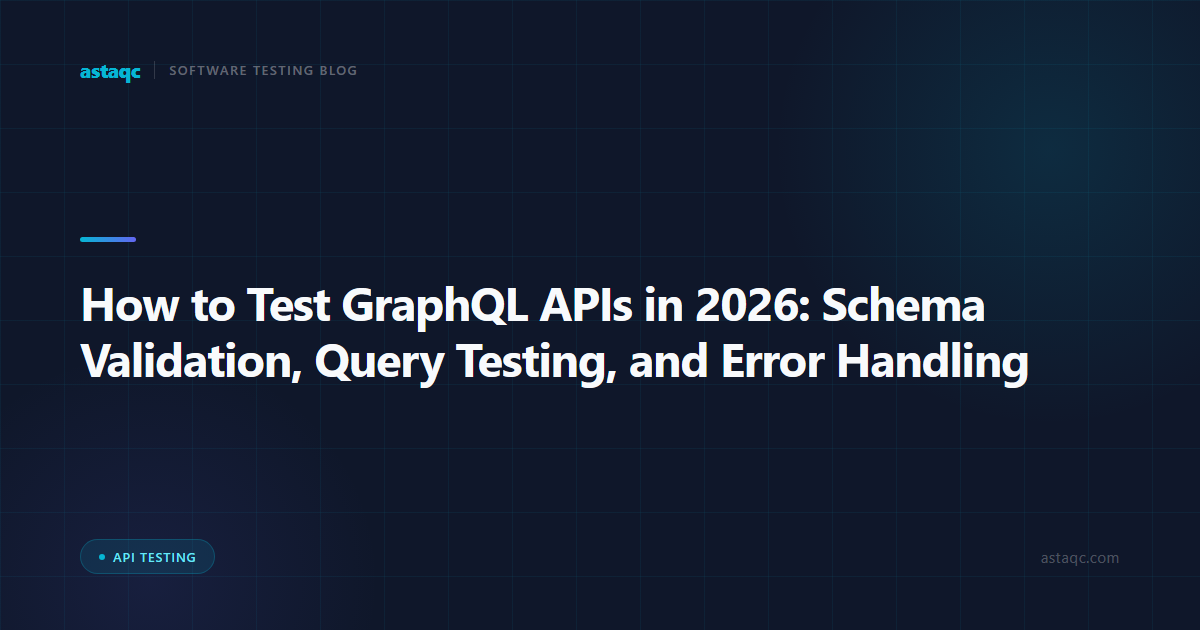
GraphQL API testing in 2026 requires a different approach than REST API testing because GraphQL’s single endpoint, client-driven query structure, and schema-based type system create testing challenges that REST-focused strategies do not address. Schema validation, query complexity limits, resolver error propagation, and subscription testing each require specific test patterns that differ from REST endpoint coverage. Teams that apply REST testing strategies to GraphQL APIs consistently miss the failure modes that GraphQL’s flexibility makes possible: malformed queries that return partial data with errors rather than HTTP failures, resolver errors that surface in the response body rather than the HTTP status code, and schema changes that break existing client queries without triggering observable errors at the transport layer.
REST API testing works by mapping test coverage to HTTP methods and endpoint paths. A POST to /orders is a distinct operation from a GET to /orders, and the test suite covers each endpoint and method combination with assertions against the response structure and HTTP status code. This mapping breaks with GraphQL because all queries and mutations go to a single endpoint via HTTP POST, and the operation type and the fields requested are in the request body rather than in the URL or method.
This structural difference has three practical consequences for test coverage. First, HTTP status codes are not a reliable signal of operation success in GraphQL. A resolver that encounters a partial error may return HTTP 200 with a mix of data and errors in the response body, rather than an HTTP 4xx or 5xx that a REST test would catch with a status assertion. Testing only for HTTP 200 on a GraphQL response is insufficient — the test must also inspect the errors array. Second, the field selection in the query determines what the response contains, which means the same operation returns different response structures depending on what the client requests. Third, GraphQL’s schema is the API contract, and schema changes can break client queries without producing HTTP errors, which means schema-level testing is a distinct requirement from query-level testing that REST API testing does not have an equivalent for.
For teams building API test coverage for GraphQL backends, Astaqc test automation services can design a GraphQL-specific testing strategy that covers schema, query, and error dimensions. The complete software testing guide situates GraphQL API testing within a broader test architecture.
GraphQL schema testing validates that the API’s published contract matches the implementation and that changes to the schema do not silently break clients. The schema is the authoritative type definition for every query, mutation, and subscription the API supports, and it is accessible at runtime via introspection queries. Schema-level tests use introspection to verify that expected types, fields, and directives exist, that required fields are non-null as specified, and that field types match the documented contract.
The primary tooling for GraphQL schema testing in 2026 is graphql-inspector, which compares two schema versions — typically the current schema and the schema from the previous release — and classifies the differences as non-breaking (adding fields, adding types), potentially breaking (adding required arguments, making nullable fields non-null), or breaking (removing fields, removing types, changing field types). Running graphql-inspector in CI catches breaking schema changes before they reach an environment where clients depend on the schema.
Schema validation in CI follows this pattern: capture the schema in SDL (Schema Definition Language) format during the build, store it as an artifact, and compare it against the previously stored schema on each pull request. Breaking changes fail the build; potentially breaking changes generate a warning that requires manual review. This catches field removal, type changes, and argument changes before they reach clients. The practical gap in most teams’ GraphQL schema testing is that they validate the schema against itself but do not validate that client queries are compatible with the schema — schema validation only catches changes, it does not verify that existing client queries are valid against the current schema.
Query validation testing fills this gap by parsing client queries against the schema to check for syntax errors, missing fields, type mismatches, and deprecated field usage. Tools like graphql-codegen and persisted query systems can generate query validation checks as part of the build, ensuring that client query files are syntactically and structurally valid before they are deployed. For teams managing GraphQL clients across multiple repositories, Astaqc software testing services can establish centralized schema validation tooling that covers both schema changes and client query compatibility. The manual vs automated testing guide covers when manual API testing should supplement schema and query validation automation.
Query testing validates that a specific GraphQL operation returns the correct data for the requested fields given a specific application state. Mutation testing validates that a mutation produces the correct state change and returns the correct response. Both follow the same structure: arrange application state, execute the operation, assert the response, and (for mutations) verify the resulting state.
| Test Type | What to Assert | Common Gap |
|---|---|---|
| Happy-path query | data contains expected fields and values; errors is absent or empty | Not testing that errors is absent — HTTP 200 with errors still passes a status-only assertion |
| Null field handling | Nullable fields return null correctly when the underlying data is absent | Only testing with data present; null fields cause client rendering errors in production |
| Mutation side effects | State change persisted correctly; a subsequent query returns the mutated state | Asserting only the mutation response, not the persisted state after the mutation |
| Authorization filtering | Authenticated and unauthenticated queries return different data subsets as expected | Testing only the authenticated case; unauthenticated access returns data that should be restricted |
| Query complexity | Queries that exceed complexity limits return the expected error before execution | No complexity limit testing — deeply nested queries cause resolver timeout or N+1 issues in production |
| Pagination | Cursor-based pagination returns correct pages; pageInfo.hasNextPage is correct on all pages | Testing only the first page; cursor boundary conditions only surface at the end of the result set |
Query complexity testing deserves specific attention in 2026 because GraphQL’s schema flexibility allows clients to construct arbitrarily nested queries that can overwhelm resolvers and downstream databases. Testing the complexity limit requires constructing a query that exceeds the configured limit and asserting that the server rejects it with an appropriate error before execution, not just that execution fails with a timeout.
For teams using no-code testing tools to cover GraphQL queries, HTTP request steps with POST body containing the GraphQL query string and variables, combined with body assertions against the response JSON, can cover happy-path and error scenarios. For teams building comprehensive GraphQL query test coverage, Astaqc hire QA team can provide engineers with GraphQL testing experience. The outsourcing QA guide covers how to structure testing engagements for API-first products.
GraphQL errors do not always produce non-200 HTTP responses, which is the most common gap in GraphQL test coverage. When a resolver encounters an error, GraphQL’s specification allows the response to include both a partial data object (for resolvers that succeeded) and an errors array (for resolvers that failed), with HTTP 200 as the status code. A test that asserts HTTP 200 and a non-empty data field passes for a response that contains resolver errors. Teams that check only HTTP status and the presence of a data field will not detect resolver error conditions in automated tests.
The three error response patterns that require explicit test coverage are: authentication errors (an unauthenticated request should produce an appropriate message in the errors array, not an empty or null data field without explanation); authorization errors (a request from an authenticated user who lacks permission for a field should produce a permission error in errors, and the data field for that resolver should be null rather than returning restricted data); and resolver errors (a resolver that depends on an unavailable service or encounters an unexpected condition should produce a meaningful error rather than crashing the request or returning null without an error entry).
GraphQL errors also propagate differently depending on whether the field that errored is nullable or non-null. When a non-null field’s resolver returns an error, GraphQL propagates the null upward to the nearest nullable parent field or to the root data object, which can cause a larger portion of the response to be null than expected. Testing this propagation behavior requires constructing scenarios where a non-null field resolver fails and asserting that the response data structure reflects the propagation. For teams assessing whether their GraphQL error test coverage is complete, Astaqc test automation services can review existing test suites against the error patterns that GraphQL’s execution model makes possible. The AI in software testing guide covers how AI-assisted test generation tools are applied to API error scenario coverage in 2026.
GraphQL subscriptions expose a real-time data channel over WebSocket or Server-Sent Events. Testing subscriptions requires establishing the WebSocket connection, sending the subscription start message, triggering the event that should produce a subscription update, receiving the update, and asserting its content. This differs from query and mutation testing because the assertion is asynchronous — the test must wait for the subscription update to arrive after the triggering event, with a timeout if it does not arrive within the expected window.
Subscription tests should cover: the subscription connection itself (the subscription starts without error and the initial response confirms the subscription is active); event delivery (a mutation that triggers the subscription produces the correct subscription event with the correct field values); authorization (a subscription to events the client is not authorized to receive does not deliver events from unauthorized sources); and connection failure recovery (when the WebSocket connection drops, the client’s reconnection behavior correctly restores the subscription and does not miss events during the disconnection window). For teams testing WebSocket-based GraphQL subscriptions, Astaqc performance testing services can assess subscription behavior under concurrent subscriber load. The software testing cost guide provides context for how to budget real-time API testing within a broader test automation investment.
The most common gap is not asserting the absence of errors in responses. Because GraphQL returns HTTP 200 for partial errors, a test suite that asserts only HTTP 200 and non-empty data fields will pass for responses that contain resolver errors. The fix is to add an explicit assertion that the errors field is absent or empty on every happy-path test case, and to add separate test cases that trigger known error conditions and assert the specific error content rather than just HTTP status.
Yes. GraphQL operations are standard HTTP POST requests with a JSON body containing the query string and optionally a variables object. Any tool that supports HTTP POST requests with JSON bodies can send and assert GraphQL queries and mutations. What these tools do not provide natively is GraphQL-specific schema validation or subscription testing. Schema validation requires a dedicated tool like graphql-inspector running against the SDL, and subscription testing requires a WebSocket client. For the query and mutation coverage that represents the majority of GraphQL API tests, general HTTP testing tools are sufficient.
The standard approach is to store the schema SDL as a versioned artifact in CI, compare the new schema against the stored schema on every pull request using graphql-inspector or a similar tool, and block merges that introduce breaking changes without explicit approval. Potentially breaking changes — adding required arguments, marking fields as deprecated — generate warnings that require review. Non-breaking changes — adding new fields or types — pass automatically. Teams that operate a GraphQL schema registry (Apollo Studio, Cosmo Router, The Guild’s Hive) get this workflow built in; teams without a registry can implement it with a CI script and a stored SDL artifact.
N+1 queries occur when a resolver fetches related data one item at a time rather than in a batched request: a query that returns a list of 50 orders and requests each order’s customer will trigger 50 individual customer lookups if the resolver is not using a DataLoader or equivalent batching mechanism. Detecting N+1 issues in tests requires instrumenting the resolver layer or the database query layer to count queries, then asserting that a query returning N parent items triggers at most a constant number of additional queries, not N additional queries. Tools like graphql-query-complexity and DataLoader usage validation can catch N+1 patterns at the code review stage.
GraphQL Federation testing covers three levels: individual subgraph testing (each subgraph’s schema and resolvers are tested independently), composition testing (the supergraph schema composed from all subgraphs is validated for composition errors and breaking changes using rover or the Apollo Federation toolchain), and gateway integration testing (end-to-end queries that span multiple subgraphs are executed against the gateway and the response is asserted against the expected federated data shape). The gateway integration test is the most expensive because it requires all subgraphs to be running, but it is the only test level that catches cross-subgraph resolver failures and entity resolution errors. For teams building federation test infrastructure, Astaqc software testing services can design a multi-level federation test strategy appropriate to the team’s architecture.
GraphQL performance testing must account for query complexity variability that REST performance testing does not face. A single GraphQL endpoint can receive queries ranging from a simple field lookup to a deeply nested multi-type query, and the server’s performance characteristics differ significantly between these cases. Performance tests for GraphQL should test representative query shapes from actual client traffic rather than synthetic simple queries, should include the most complex queries clients are known to send, and should validate that complexity limiting middleware correctly rejects queries that would produce unacceptable load before they reach resolvers. For teams without production query analytics, sampling client query patterns from API logs is the practical starting point. Astaqc performance testing services covers load and complexity testing for GraphQL APIs.
GraphQL API testing requires inspecting the errors array in every response, validating the schema for breaking changes on every release, and testing resolver behavior under partial failure conditions — not just asserting HTTP 200 and a non-empty data field.
August 25, 2026


Sign up to receive and connect to our newsletter

We founded ASTAQC as a tight-knit group of professional Software Testers and software developers.
Subscribe to our Newsletter