August 10, 2026
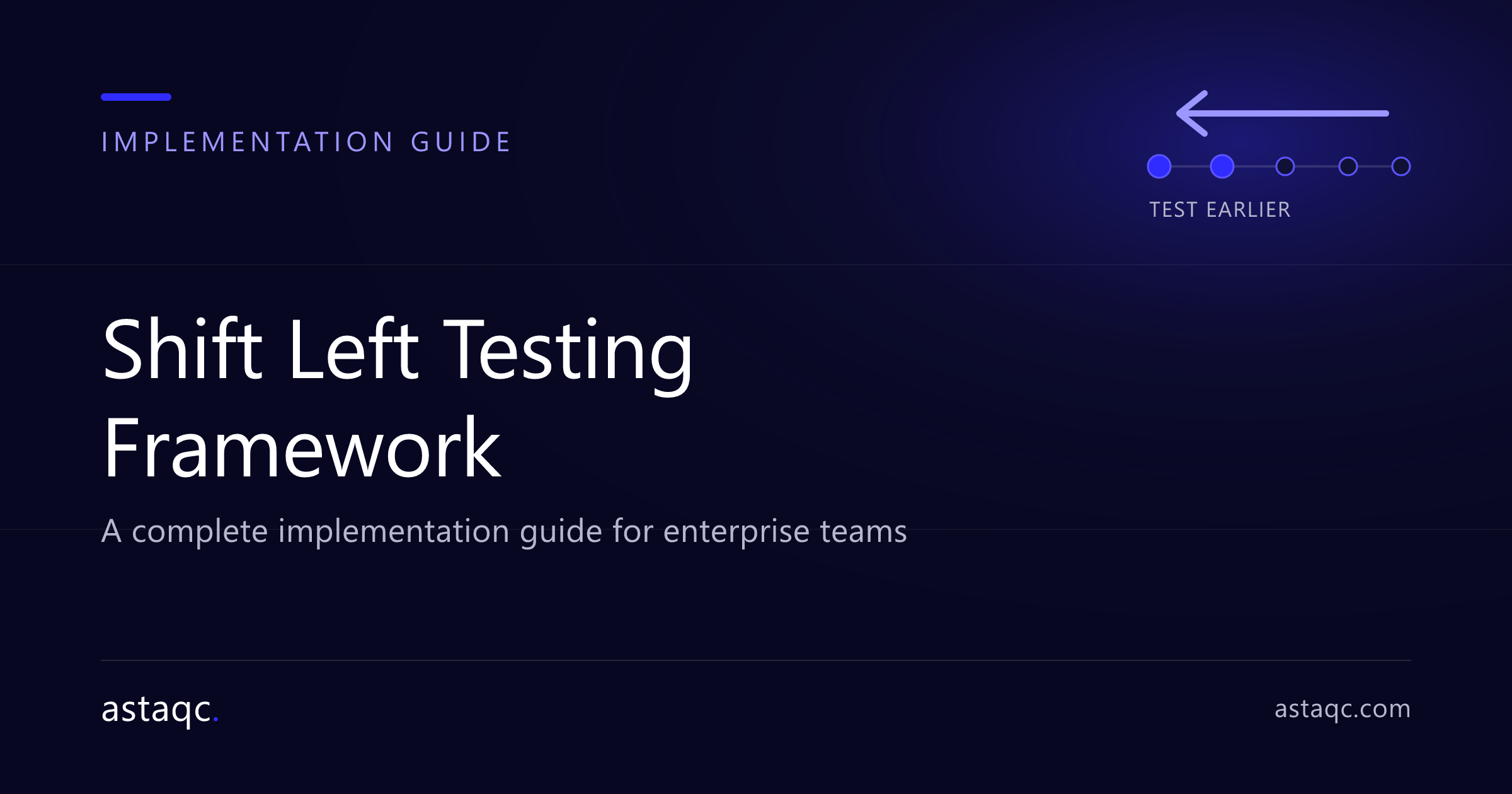
A shift left testing framework is a structured approach to moving quality activities earlier in the software development lifecycle. Instead of testing only after development is complete, enterprise teams build quality into requirements, design, and coding, so defects are found when they are cheapest to fix.
Shift left is a principle; a framework turns that principle into repeatable practice. It defines when testing activities happen, who owns them, and how they connect to the delivery pipeline. For enterprise teams, a framework is what makes shift left scalable across many teams and services rather than a one-off developer habit.
New to the concept? Start with our primer, then use this guide to operationalise it: What is Shift Left Testing? Definition, Benefits, and How to Implement It.
| Pillar | What It Means |
|---|---|
| Early involvement | QA joins at requirements and design, not just at the end. |
| Test automation | Unit, API, and integration tests run automatically as code is written. |
| CI/CD integration | Tests execute on every commit as pipeline quality gates. |
| Shared ownership | Developers and QA own quality together, not in silos. |
| Continuous feedback | Fast, visible results drive rapid correction. |
What is a shift left testing framework?
It is a structured approach that defines how, when, and by whom testing happens early in the lifecycle, so quality is built in from requirements through delivery rather than checked at the end.
How is shift left different from agile testing?
Agile is a delivery methodology; shift left is a quality principle that fits inside it. Shift left specifically pushes testing activities as early as possible in each cycle.
How long does it take to implement shift left?
A phased rollout typically spans one or two quarters: planning and automation foundations first, then CI/CD gating and security, then continuous measurement and expansion.
What is the biggest challenge?
Culture. Shift left requires developers and QA to share ownership of quality, which is a mindset change as much as a tooling change.
Astaqc Consulting helps enterprise teams design and roll out shift left frameworks — from early QA involvement to CI/CD-integrated automation. Talk to our team or hire a dedicated QA team.
August 10, 2026


Sign up to receive and connect to our newsletter

We founded ASTAQC as a tight-knit group of professional Software Testers and software developers.
Subscribe to our Newsletter