October 2, 2026
How TestInspector Validates Environment-Specific Behavior: Configuration Testing, Feature Flag Assertions, and Environment Parity Checks Without Code
TestInspector’s HTTP request steps and environment-scoped variable interpolation let QA teams write configuration validation tests that run against staging and production using the same test structure, swapping only the target URL and expected values through org, suite, and test-level variable hierarchies. The result is a set of scheduled assertions that verify each environment returns the correct configuration — catching parity failures before users encounter them. Teams without automated configuration validation typically rely on pre-release manual checklists, which are slow, error-prone, and impossible to run continuously.
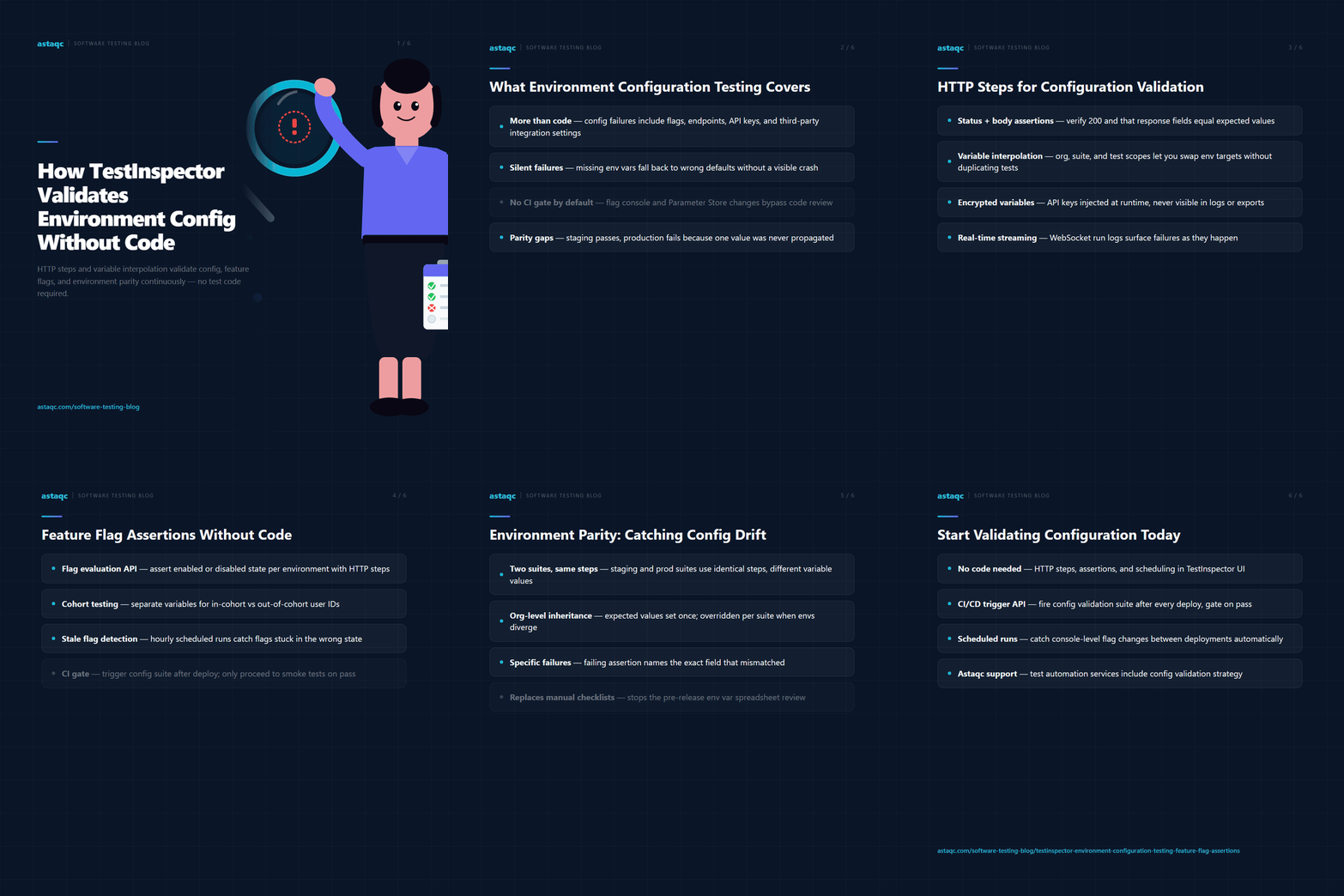
Environment configuration testing covers a broader surface than most QA teams actively test. Configuration-dependent behavior includes feature flags (which features are active per environment), API endpoint availability, authentication provider settings, third-party integrations (payment gateways, analytics, email providers), rate limiting rules, and any application behavior that differs between development, staging, and production. These settings live in environment variables, configuration services, or remote flag providers, and they change independently of code deployments. A configuration change that disables a feature in production, points an integration at the wrong endpoint, or activates a flag before its supporting code is deployed can cause application failures that no amount of code-level testing would catch.
Teams looking for foundational context on testing strategy can review Astaqc’s test automation services and the complete software testing guide. This article covers how TestInspector handles configuration validation, feature flag assertions, and environment parity testing without requiring test code to be written.
Environment configuration testing verifies that each environment is correctly configured for its role: that staging mirrors production’s external service endpoints, that feature flags are in their intended states, and that environment-specific values (API keys, rate limits, logging levels) are correctly set. The failure mode this testing prevents is the environment parity gap: staging tests pass because staging is configured correctly, but the same code fails in production because a configuration value was not propagated, a feature flag was left in the wrong state, or an integration points to a test endpoint rather than the live one.
The most common configuration testing failures are silent ones: an environment variable is missing and the application falls back to a default value that causes subtly wrong behavior rather than an immediate error. A payment integration reads from the wrong API key and processes to a test account. A feature flag evaluates to false in production because it was disabled during a previous incident and never re-enabled. A third-party analytics endpoint has a staging URL that was never updated for production. These failures do not cause visible application crashes — they cause incorrect behavior that persists until someone investigates a downstream symptom.
Configuration testing is also necessary when environment configuration is managed outside the deployment pipeline: in environment variable stores, in remote configuration services like AWS Parameter Store or HashiCorp Vault, or in feature flag platforms. Changes to these systems do not trigger CI/CD runs and do not have code review gates. An automated configuration validation test that runs on a schedule or is triggered after infrastructure changes provides the same confidence for configuration that CI/CD provides for code.
TestInspector’s HTTP request step type supports GET, POST, PUT, PATCH, and DELETE requests with configurable headers, request bodies, and assertions on status codes, response headers, and response body fields. For configuration validation, GET requests with JSON body assertions are the most common pattern: the test sends a request to a health check endpoint, a configuration endpoint, or a feature flag evaluation endpoint, and asserts that the response contains the expected values for the current environment.
Variable interpolation makes this pattern environment-portable. TestInspector supports variables at three scopes: org-level variables apply to all tests in the organization, suite-level variables apply to all tests in a suite, and test-level variables are scoped to individual tests. A configuration validation suite that runs against both staging and production uses a suite-level variable for the base URL and org-level variables for environment-specific expected values. The test step references {{BASE_URL}} and {{EXPECTED_API_VERSION}}; the values are swapped by updating the suite variable, not by duplicating tests.
Encrypted storage protects sensitive configuration values that must be included in tests. TestInspector stores variables marked as encrypted at the org, suite, or test level and prevents their values from appearing in run logs or exports. An API key used to authenticate against a configuration service can be stored as an encrypted org-level variable and referenced as {{CONFIG_SERVICE_KEY}} in the HTTP request Authorization header. The value is injected at runtime without appearing in the test definition or run output, which means the same test can be shared across team members without exposing credentials.
Status code assertions are the most straightforward configuration check: a healthy configuration endpoint returns 200, an unavailable or misconfigured endpoint returns 500 or 503. Body assertions are more specific: for a feature flag evaluation endpoint that returns {"flag": "new_checkout", "enabled": true}, the assertion verifies that the enabled field equals true. If the flag is disabled in production when it should be active, the assertion fails and the run reports which field failed and what value was returned. TestInspector’s live WebSocket run streaming means the failure is visible in real time, not only after the full run completes.
For teams using the TestInspector platform, these HTTP validation steps require no custom test code: the step is configured through the UI, variables are set in the platform’s variable manager, and assertions are added as field-by-field comparisons. The test can be triggered manually, scheduled, or invoked through the CI/CD trigger API before or after a deployment. Detailed context on test automation strategy is available on Astaqc’s test automation services page.
Feature flags are configuration — they are values stored outside the application code that control which execution paths are active. Testing feature flags follows the same pattern as testing any other configuration: assert that the flag evaluation endpoint returns the expected value for each environment, user segment, and test context. The challenge is that feature flags introduce combinatorial complexity: a flag with targeting rules based on user properties, percentage rollout, and environment creates multiple evaluation paths that each need assertions.
TestInspector handles this through parameterized HTTP steps. A feature flag evaluation test sends a request to the flag provider’s evaluation API — or to the application’s own configuration endpoint if flags are evaluated server-side — and asserts on the response. For a flag with percentage-based targeting, the test uses multiple user identifiers (stored as test-level variables) to verify that users in the target cohort receive the flagged experience and users outside it do not. The variable {{TEST_USER_IN_COHORT}} is a user ID known to fall in the flagged percentage; {{TEST_USER_OUT_COHORT}} is a user ID outside it. Both assertions run in the same test suite.
The most common feature flag failure mode is a stale flag: a flag is enabled in staging for development purposes and never disabled when the environment is reset, or a flag is supposed to be activated in production for a release but the activation was applied to the wrong environment. TestInspector’s scheduling capability turns flag state validation from a manual pre-release check into a continuous assertion: a test suite that verifies all production flag states runs every hour and reports immediately when any flag is in an unexpected state. This is particularly valuable for flags changed by product managers or operations teams without a code deployment — there is no CI/CD run to catch the change, so the scheduled test is the only automated gate.
Teams integrating TestInspector into their release process can trigger flag validation tests through the CI/CD trigger API immediately after a deployment completes. The sequence is: deploy the new code, trigger the configuration validation suite, wait for the run to complete, and proceed to smoke tests only if configuration assertions pass. This gates the smoke test phase on confirmed correct configuration, preventing false negatives where smoke tests pass because the flag is in the wrong state rather than because the feature works correctly.
Environment parity testing verifies that two environments are configured identically for the properties that must match: external service endpoints, authentication provider settings, feature flag states for shared flags, and application configuration values that must be consistent across environments. Parity gaps are a persistent source of release-day failures: an application that behaves correctly in staging fails in production because a configuration value was updated in one environment and not the other.
TestInspector’s variable interpolation and multi-suite organization make environment parity tests practical at scale. The test structure uses two suites with identical test steps and assertions but different base URL and expected value variables: one suite targets staging, the other targets production. When both suites pass, the environments are in parity. When one suite fails, the specific assertion that failed identifies which configuration value is mismatched. This is faster and more specific than manual comparison of environment variable stores, which requires reading through long lists of variables without any indication of which ones affect application behavior.
The TestInspector test hierarchy supports parity testing across multiple environments through org-level variable inheritance. A parity test suite can define expected values as org-level variables and override them per suite for environment-specific assertions. An org-level variable {{EXPECTED_API_VERSION}} with value “2.4” applies to all suites unless a suite overrides it. If staging is on version 2.5 during a staged migration, the staging suite overrides the expected version; the production suite inherits the org-level value. The difference is explicit and tracked in the variable hierarchy rather than hidden in duplicated test steps.
| Validation Approach | Catches Config Drift | Runs in CI | Runs Continuously | Requires Code |
|---|---|---|---|---|
| Manual pre-release checklist | Sometimes (human error) | No | No | No |
| Custom config validation scripts | Yes (if maintained) | Yes | With scheduler | Yes |
| TestInspector HTTP steps + scheduling | Yes | Yes (trigger API) | Yes (built-in) | No |
| Infrastructure monitoring (synthetics) | Partially (behavior, not config values) | No | Yes | No |
Astaqc provides configuration testing strategy support as part of its software testing services. Teams building environment parity validation programs can reference the AI in software testing guide for context on how configuration testing fits into broader automated quality strategies in 2026.
Functional testing validates that the application’s code behaves correctly for given inputs. Configuration testing validates that the environment settings the code reads at runtime — API keys, feature flags, service endpoints, rate limits — are correct for that environment. A functional test can pass completely while configuration testing fails, because functional tests run against whatever configuration is present without verifying that the configuration itself is correct. Configuration testing is a prerequisite for trusting functional test results: if the environment is misconfigured, passing functional tests do not guarantee correct production behavior.
TestInspector’s variable hierarchy solves this directly. Org-level variables provide defaults; suite-level variables override them for a specific environment suite; test-level variables override them for individual steps. A configuration test that asserts on an API version, a flag state, or a service endpoint URL uses a variable reference in the assertion value. The same test step runs correctly against staging and production by updating the suite’s variable values, not by duplicating the test. Environment-specific expected values are explicit, managed in the platform’s variable manager, and reviewable without reading test code.
Yes. Tests scheduled on a cron or interval trigger run continuously and report failures through the platform’s run history. A configuration assertion that runs every hour and verifies that a specific feature flag is enabled in production will fail immediately when the flag is accidentally disabled — even if no code deployment triggered a CI run. Teams configure a suite covering all critical configuration assertions and schedule it at the cadence appropriate for their change frequency. Live WebSocket streaming means failures are visible in real time rather than only at run completion.
At minimum: the application’s health check endpoint (verifies the service is running and can reach its dependencies), any feature flag evaluation endpoint exposed by the application or the flag provider, authentication provider connectivity (a request that validates the auth service returns the expected issuer or public key), and any external integration endpoint the application calls at startup (payment providers, analytics, email services). These cover the configuration failures most likely to cause application-wide behavior changes without a code deployment. Teams with more complex configuration should add assertions for every environment variable that controls behavior, not just infrastructure availability.
TestInspector’s CI/CD trigger API accepts authenticated requests that start a specific test suite run. In a CI/CD pipeline, a deployment job calls the trigger API after the deployment completes, passing the suite ID and environment variables for the target environment. The pipeline waits for the suite run to complete, checks the run result, and either proceeds to smoke tests or fails the pipeline on a configuration assertion failure. This places configuration validation as an explicit gate between deployment and smoke testing, ensuring smoke tests run against a correctly configured environment. Full details are on the TestInspector product page.
Astaqc’s test automation services include test strategy and implementation for environment validation, CI/CD integration, and configuration coverage planning. The software testing guide provides foundational context on where configuration testing fits within a broader quality strategy. For teams with established QA practices looking to add configuration validation, Astaqc provides both assessment and implementation support.
Environment parity failures account for a significant fraction of release-day incidents in teams without automated configuration validation. TestInspector’s HTTP steps and environment-scoped variables convert manual pre-release configuration checks into scheduled assertions that run continuously against every environment.
October 2, 2026


Sign up to receive and connect to our newsletter

We founded ASTAQC as a tight-knit group of professional Software Testers and software developers.
Subscribe to our Newsletter