August 17, 2026
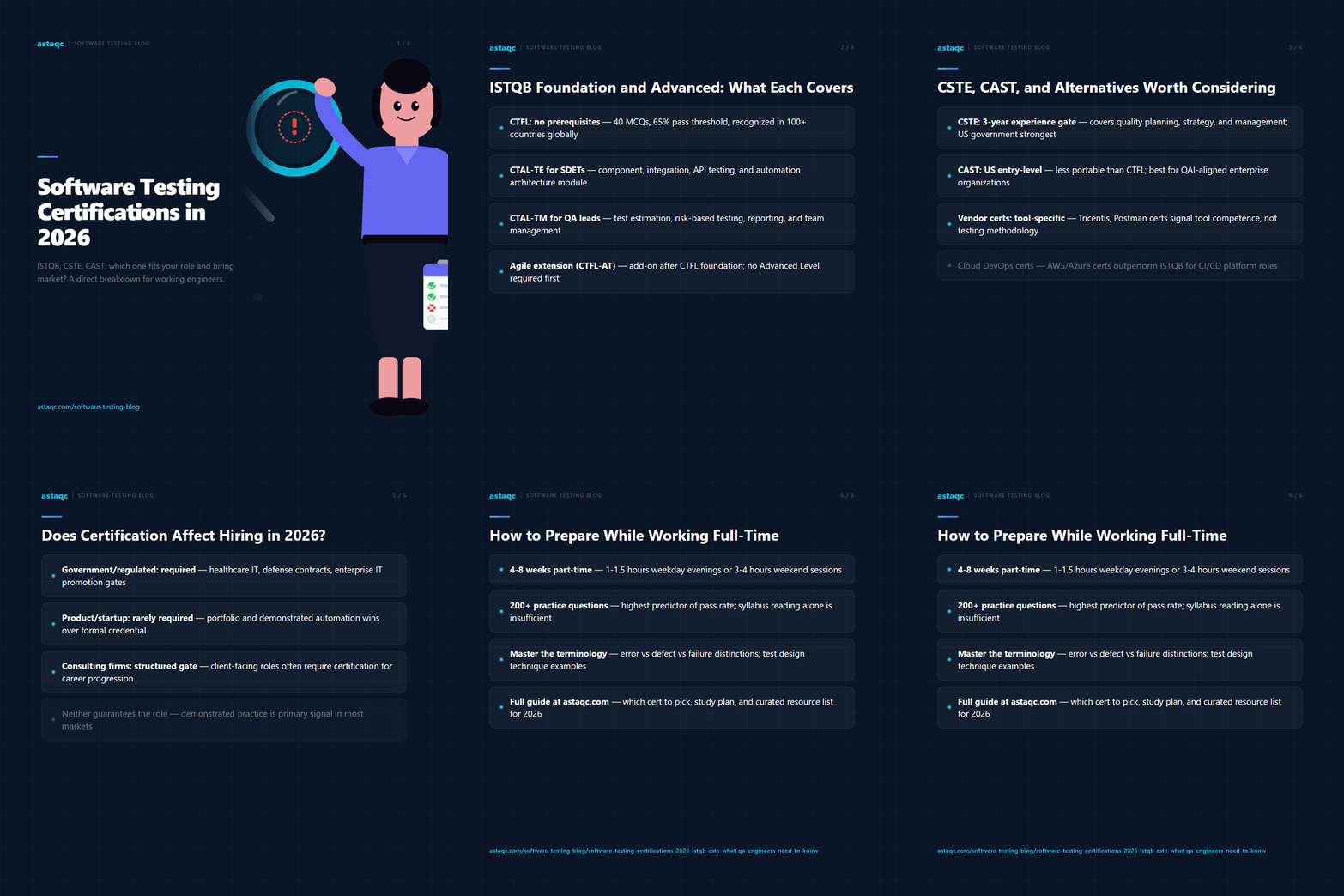
ISTQB Foundation Level (CTFL) and CSTE are the two most widely recognized software testing certifications in 2026, but they test different knowledge, are administered by different bodies, and are valued differently depending on the role, the employer, and the geography. ISTQB CTFL covers testing fundamentals and terminology standardized across over 100 national boards; CSTE covers a broader business quality and process scope and is more common in senior, management, and consulting roles. For a QA engineer evaluating certification options today, the practical question is not which credential is more prestigious but which one matches the specific role and hiring market they are targeting.
This guide covers what each certification tests, which career situations each fits, how to compare the time and cost commitment, and how to prepare while working full-time. For the wider context of how QA skills are valued in modern engineering organizations, the complete software testing guide covers how foundational testing knowledge maps to practical team roles. QA engineers who want to build hands-on experience alongside a certification program can use Astaqc’s software testing services team or consider joining a structured QA team engagement to apply concepts in live production contexts.
The International Software Testing Qualifications Board (ISTQB) is the largest testing certification body in the world, with over 1 million certifications issued across more than 100 countries. The CTFL (Certified Tester Foundation Level) is the entry-level credential and is the most widely referenced testing certification in job postings across Europe, Southeast Asia, India, and enterprise sectors in the US. It covers testing fundamentals: the testing lifecycle, test techniques (equivalence partitioning, boundary value analysis, decision table testing, state transition testing), defect management, test planning, and test tools categories. The exam is 40 multiple-choice questions, taken at an accredited center or online, with a 65% passing threshold. Study materials are standardized from the ISTQB syllabus, and the Foundation Level has no prerequisite.
The Advanced Level divides into three distinct credentials: CTAL-TA (Test Analyst), CTAL-TM (Test Manager), and CTAL-TE (Technical Engineer). Each requires a CTFL prerequisite and targets a specific specialization. CTAL-TA covers test design, test techniques, and defect classification in depth, and is relevant for QA engineers whose primary role is designing and executing test cases. CTAL-TM covers test estimation, risk-based testing, test reporting, and team leadership, and is the most relevant credential for QA leads and managers. CTAL-TE covers testing at the technical layer — component testing, integration testing, web-based testing, API testing, and test automation strategy — and is the most useful credential for SDETs and automation engineers. CTFL-AT (Agile Tester) is an extension module for teams working in Agile environments and does not require Advanced Level completion. ISTQB also offers specialist modules in areas including performance, security, AI testing, and model-based testing at the expert level. For QA engineers building skills in AI-specific testing approaches, the AI in software testing guide covers practical skills that complement what the ISTQB AI specialist module covers conceptually.
The Certified Software Test Engineer (CSTE) and the Certified Associate in Software Testing (CAST) are administered by the Quality Assurance Institute (QAI) and the ASTQB (American Software Testing Qualifications Board). CSTE is a senior-level credential that covers software quality planning, business process quality, test strategy, and test management. Candidates must have a minimum of three years of experience and two years specifically in QA before sitting the CSTE exam. The credential is more common in the US than ISTQB and is referenced frequently in government contracting, defense, and enterprise IT management job descriptions. For QA engineers aiming for management or consulting roles in the US market, CSTE is a more targeted credential than CTFL.
CAST is the entry-level QAI credential, covering software testing fundamentals similar to what ISTQB CTFL covers but with a US-centric perspective and a business quality orientation. CAST does not carry the same global recognition as CTFL and is less commonly required in international hiring. For US-based QA engineers early in their careers who are already working in an organization that values QAI credentials, CAST is a viable starting point. For those without an existing organizational context for QAI certifications, CTFL is more portable across employers and geographies.
Several vendor-specific certifications are worth considering depending on the tool stack. Tricentis offers certifications for Tosca; Micro Focus (now OpenText) offers certifications for UFT; Postman offers a certification for API testing fundamentals. These vendor certifications demonstrate competence with a specific tool and are relevant when applying to roles that list that tool as a requirement, but they do not carry the cross-employer recognition of ISTQB or CSTE. AWS, Azure, and Google Cloud each offer DevOps and cloud certifications that include testing concepts in the context of CI/CD pipeline design, which are useful for SDETs and platform engineers who work at the intersection of testing and infrastructure. Teams evaluating how test automation skills map to specific tool certifications can read the test automation services overview and the manual vs. automated testing guide for practical skill context.
| Certification | Body | Level | Prerequisites | Best For | Global Recognition |
|---|---|---|---|---|---|
| ISTQB CTFL | ISTQB | Foundation | None | QA engineers new to certification; international hiring | High — 100+ countries |
| ISTQB CTAL-TA | ISTQB | Advanced | CTFL + 18 months experience | Senior QA engineers focused on test design and analysis | High |
| ISTQB CTAL-TM | ISTQB | Advanced | CTFL + 18 months experience | QA leads and managers; test governance roles | High |
| ISTQB CTAL-TE | ISTQB | Advanced | CTFL + 18 months experience | SDETs and automation engineers | High |
| ISTQB CTFL-AT (Agile) | ISTQB | Foundation Extension | CTFL | QA in Agile/Scrum teams | Medium-High |
| CSTE | QAI / ASTQB | Senior | 3 years experience, 2 years QA | Management-track QA; US government and enterprise | Medium — strongest in US |
| CAST | QAI / ASTQB | Associate | None specified | Entry-level US market; QAI-aligned organizations | Low-Medium — mostly US |
| ISTQB AI Testing Specialist | ISTQB | Specialist | CTFL | QA engineers on AI product teams; ML pipeline testing | Medium (growing) |
The most important factor in the comparison is geography and hiring market. If the role target is in Europe, Asia-Pacific, or international enterprise, ISTQB CTFL is the clear starting point. If the role is in US government contracting, defense, or large US enterprise IT management, CSTE is the most recognized credential at the senior level. If the role is in AI product development or test automation, CTAL-TE or the AI Testing Specialist module is more relevant than CTFL alone.
Certification requirements in job postings vary significantly by employer type. Government contracting and regulated industry positions (healthcare IT, financial services, defense) frequently list ISTQB or CSTE as requirements or preferred qualifications, and in some cases certification affects contract eligibility directly. Large enterprise IT departments with formal QA maturity programs often require or reward certification for promotion decisions. In these contexts, certification is not optional signaling — it is a structural credential that affects compensation and role eligibility.
In product companies and startups, certification is rarely required and less commonly listed as preferred. Hiring decisions in these organizations are more heavily weighted toward demonstrated hands-on experience: portfolio evidence of test automation, contributions to open-source test frameworks, or measurable quality outcomes from previous roles. An ISTQB CTFL on a resume does not hurt and signals foundational knowledge, but it does not substitute for demonstrated practice in the way it might in a consulting or enterprise IT context.
Consulting and QA services firms occupy a middle position. Firms that sell QA capacity to enterprise clients frequently require certification as a client-facing credential signal and include certification requirements in staffing contracts. For QA engineers who work at or aspire to work at consulting firms, certification completion is often an explicit condition of role progression. For the testing skills that matter most in the consulting context — test strategy, documentation, stakeholder reporting, and structured testing approaches — the testing documentation services overview and the QA outsourcing guide describe the professional practices that certifications are designed to codify. For QA engineers building their practice profile, working with an established firm like Astaqc through a QA team engagement provides both certification-applicable experience and client-facing project exposure.
The ISTQB CTFL syllabus is publicly available from the ISTQB website and is the primary study material. The document is approximately 75 pages and covers all exam topics with standardized definitions. Most candidates who prepare well pass CTFL in 4 to 8 weeks of part-time study, typically 1 to 1.5 hours per evening or 3 to 4 hours on weekends. The exam fee ranges from $150 to $250 USD depending on the national board, and online proctored options are available in most regions.
Effective study for CTFL focuses on three areas that are frequently misunderstood by candidates who study only by reading the syllabus. First, the ISTQB has specific definitions for common terms — “error,” “defect,” and “failure” have precise meanings in the ISTQB framework that differ from colloquial usage. Exam questions test whether candidates can apply the correct term in context. Second, the test design techniques require practice with worked examples, not just reading. Equivalence partitioning, boundary value analysis, and decision table construction are best studied by working through 15 to 20 examples per technique until the derivation is mechanical. Third, the exam includes questions on the test manager role and metrics that QA engineers who focus on execution rarely encounter in daily work — these sections require deliberate study rather than relying on existing experience.
Recommended study resources for CTFL in 2026: the official ISTQB syllabus; published practice question banks (100 to 200 questions per session); Rex Black's book “Managing the Testing Process” for the test management sections; and the ISTQB glossary for terminology. Online courses from ISTQB-accredited providers are useful for candidates who learn through structured video content and are available on Udemy, LinkedIn Learning, and national board sites. CSTE preparation requires more structured experience documentation — candidates must demonstrate three years of experience in addition to passing the exam — so the preparation timeline includes assembling the experience portfolio alongside the study material. Teams at Astaqc can also provide structured project environments where candidates apply the testing techniques covered in the CTFL syllabus in real client contexts, which accelerates the gap between conceptual understanding and applied competency.
For experienced QA engineers, CTFL provides the most value in contexts where it is a specific role requirement or where international job portability is a goal. Engineers with extensive experience who work in product companies where certification is not required often find that their practical track record carries more weight with hiring managers than the credential. The decision is primarily market-driven: if the target employers list ISTQB as a requirement or preference, pursue it; if they do not, experienced candidates often see better return from demonstrating portfolio evidence than from certification alone. Advanced Level modules (CTAL-TA, CTAL-TM, CTAL-TE) are more differentiated credentials for experienced engineers.
ISTQB CTFL certification does not expire. Once passed, the credential is permanent unless the certification body introduces a renewal requirement, which ISTQB has not done as of 2026. Advanced Level and specialist module certifications are also permanent once earned. The syllabus was updated significantly in 2023, and some employers may note which version a candidate holds. The 2023 syllabus is the current standard for new candidates.
ISTQB CTAL-TE (Technical Engineer) is the most relevant credential for manual-to-automation transitions. It covers component testing, integration testing strategies, web-based and API testing, and test automation architecture — the knowledge base that automation engineering roles require. Pairing CTFL with CTAL-TE provides a credential signal of both foundational and technical depth that supports role transition applications. Practical experience with automation tools alongside the credential is still the primary hiring signal, but the credential adds context for candidates changing specialization. The test automation services team at Astaqc can also provide a practical automation environment for candidates who want project experience alongside their certification study.
ISTQB and cloud provider certifications cover complementary knowledge domains. ISTQB CTFL covers testing methodology, process, and test design; cloud certifications cover infrastructure, deployment pipelines, and service configuration. For QA engineers moving into DevOps or platform engineering roles that include responsibility for CI/CD quality gates, a cloud certification (AWS Certified DevOps Engineer, Azure DevOps Engineer Expert) carries more direct hiring signal than additional ISTQB modules. For roles that remain in testing but within cloud-native systems, ISTQB CTAL-TE combined with practical experience in cloud testing environments is more relevant.
Individual study with practice question banks is effective for most CTFL candidates who are self-directed learners. Study groups add value when members challenge each other's understanding of terms and techniques — the ISTQB framework has specific terminology that benefits from discussion when definitions are ambiguous in context. Online study communities organized by ISTQB national boards and on Reddit's r/softwaretesting provide question-answering communities for candidates who want peer review without a formal study group. The single most effective preparation activity regardless of study format is working through large sets of practice questions — candidates who complete 200 or more practice questions under timed conditions before the exam have significantly higher pass rates than candidates who study the syllabus without practice exams.
ISTQB CTFL exams are administered by national boards and accredited training providers. The fee ranges from $150 to $250 USD depending on the national board and delivery method. Online proctored exams are available in most countries and allow candidates to sit the exam from home with a webcam and stable internet connection. The exam is 40 multiple-choice questions with a 65-minute time limit. A score of 65% or above (26 of 40 questions correct) is required to pass. Most national boards publish practice exams with answer explanations on their websites at no cost, which are the most representative preview of the actual exam question format.
ISTQB Foundation Level is the most broadly recognized testing credential in 2026 — useful as a baseline signal in enterprise hiring across Europe and Asia and increasingly in the US. CSTE remains more relevant for senior and management-track QA roles. For most engineers starting the certification path, CTFL is the right first credential, with Advanced Level specializations adding measurable value once the foundation is in place.
August 17, 2026


Sign up to receive and connect to our newsletter

We founded ASTAQC as a tight-knit group of professional Software Testers and software developers.
Subscribe to our Newsletter